
A grey couch living room idea only works if you match the undertone first, warm with warm and cool with cool, or every pillow and wall color you buy will fight the sofa. Most people skip this test and end up with a room that reads as muddy or flat without knowing why. Hold a white sheet against your couch in daylight: if the grey turns bluish or greenish, you have a cool undertone; if it reads brown or taupe, it is warm. That thirty-second check determines whether mustard and terracotta will settle in or turn sour, and it saves roughly $40 in returned throw pillows.
1. Contrast with lighter or darker colors

A gray couch sits at some point on the value scale, and the contrast that wakes it up comes from one direction, not both. Push lighter or darker, but match the undertone. A warm gray with a yellow or red base turns muddy against cool contrast partners; a cool gray with blue or green underneath goes flat beside warm ones.
For warm grays, mustard and terracotta do the heavy lifting. They read as intentional rather than accidental because they share the same underlying warmth. Cool grays want blue or green in the walls, the rug, or a solid block of throw pillows. Jute and rattan belong with warm grays; they read as dirty against cool ones.
The mistake is treating gray as neutral enough to take anything. Test your contrast fabric against the couch in daylight before you buy. If the two samples seem to vibrate slightly at the edge where they meet, the undertones are fighting. Pick the other temperature and the room settles.
2. Layer textures with pillows and throws

Velvet reads expensive but costs little secondhand, and it catches light against gray in a way flat cotton never will. Linen wrinkles on purpose, boucle nubs catch your sleeve, and a chunky knit thrown over the arm gives you somewhere to land on a cold night. Beige, ivory, and cream build the calm base; gold, terracotta, and burnt orange are where the warmth comes from. The mistake is stopping here. Most weekend projects do: the pillows look good in the cart, good on the couch, and the brain marks the room done. What reads as styled in a photograph reads as flat when you live in it, because texture without variation in height and finish still photographs as one plane. You need the low linen square against the tall velvet lumbar, the smooth weave against the looped fiber, or you have replaced a problem with a neater version of the same problem. The throws matter as much as the pillows. A gray couch in a gray room with gray-toned textiles is a mood board, not a room you sit in. The terracotta against cream is what keeps it human.
3. Ground the seating area with a rug

A rug under your grey couch does two jobs at once: it marks where the living area ends and it gives your feet something softer than the floor. Charcoal and dark grey rugs play well with grey sofas, deepening the tone without fighting it, while white or beige keep things quiet if the rest of the room already has enough going on. Bold patterns, like a geometric in a strong color, can turn the rug into the focal point the room needs. Soft textures do the opposite, pulling the seating together into something that reads as one calm spot.
No one in the sources pinned down exact rug sizes, so measure from couch edge to wall and aim for one of two setups. Front legs on the rug works for tighter rooms; all legs on needs roughly eighteen to twenty-four inches of rug showing beyond each side of the sofa. Too small and the rug floats; too large and you are buying floor coverage you already have.
4. Add artwork and accessories for character

A single oversized painting above your grey couch does more visual work than most gallery walls. The neutrality of grey means the artwork carries the personality without competing for attention, and one strong piece anchors the room instead of scattering your eye across a dozen small frames. A sculptural floor lamp beside the sofa extends that same logic into three dimensions, giving you function and form in the same footprint.
If you prefer the collected look, keep the arrangement tight. A small gallery set works when the frames share a finish or the mats align at the same height, but the grey couch itself is already quiet enough that you do not need a wall full of proof that you have taste. One standout artwork wins for a weekend timeline and a real budget.
For the surfaces around the couch, stack books and set out candles or a ceramic vase you actually use. These are the objects that make a room feel inhabited rather than staged, and grey’s restraint lets a slightly irregular collection of things look intentional rather than cluttered. A round mirror above the sofa is another move worth considering, especially if the wall faces a window; it throws light back into the room and doubles the sense of space without adding another color decision to make.
Change the accessories with the seasons if you want the room to shift. Gold, yellow, or blush ceramics in autumn warm the grey without repainting a wall or reupholstering a cushion. The couch stays, the mood moves.
5. Pair with neutral or warm wall colors
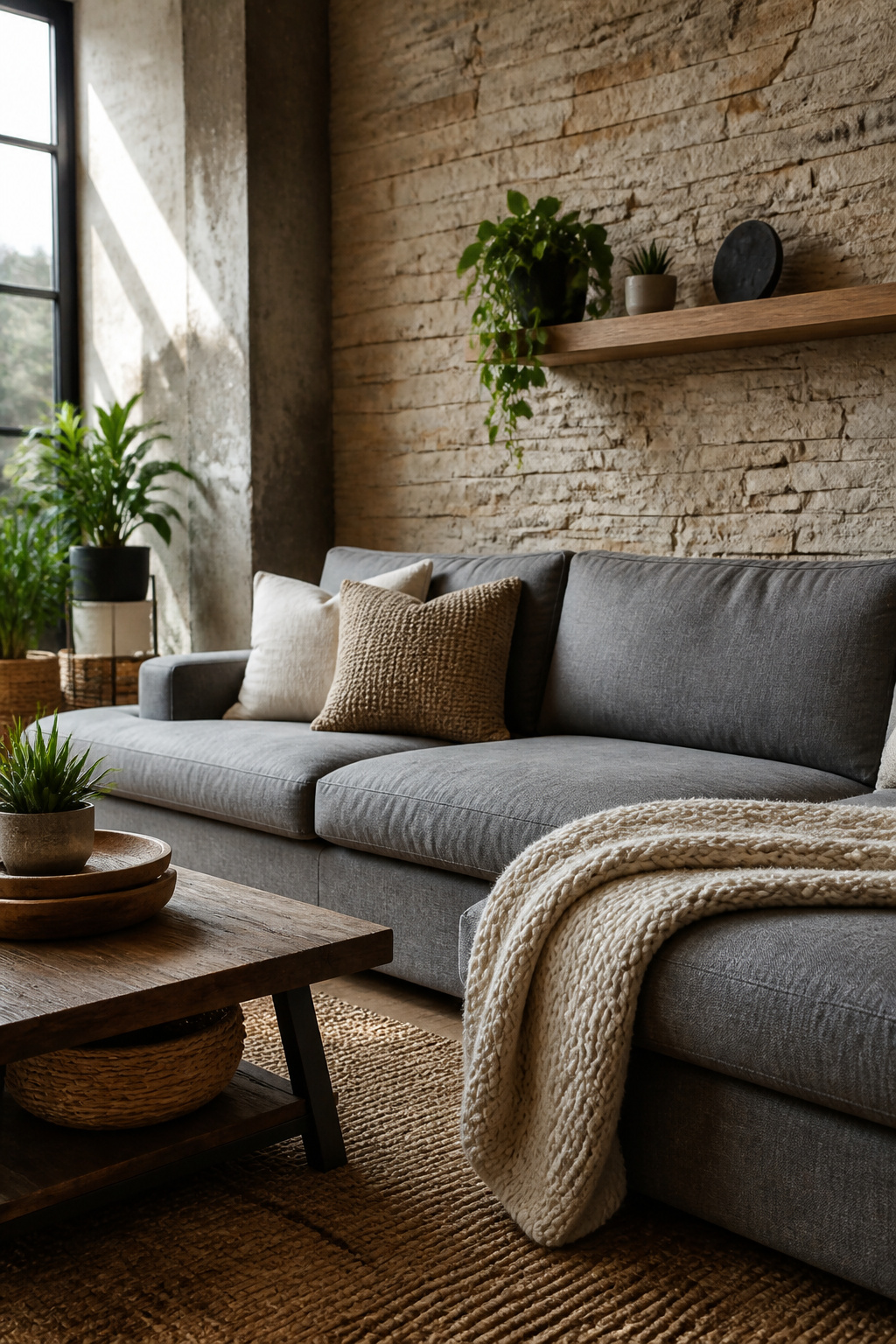
The wall color is usually the first thing people lock in, and that order is backward. The undertone of your gray couch has to come first, or the room reads as off in a way you will not be able to name.
If your gray leans warm, pair it with warm white walls and keep the palette consistent through jute, rattan, or other organic accents. A cool gray needs the same discipline in reverse: stick to cooler neutrals or it will look muddy against anything yellow-based. Beige walls with a light gray sectional only works when both share the same temperature; otherwise the sofa looks dirty against the paint.
For finish, a flat wall will read flatter still against gray upholstery. A limewash or other textural finish adds depth that keeps the pairing from feeling like a showroom floor. If you want to keep it simple, layer the wall itself: a textured stone accent behind the sofa gives the neutral scheme natural contrast without introducing a color that fights the couch.
The safe move is to test a large swatch in the actual light and view it against the sofa fabric at three times of day. Gray shifts more than most colors, and the wall will shift with it.
6. Mix furniture styles around the couch

A grey couch living room idea that actually earns its keep is mixing furniture styles you already own instead of buying a matched set. Grey acts as a visual referee between pieces that would otherwise fight each other. A mid-century sofa with clean lines and tapered legs can sit across from a chunky farmhouse coffee table without the room feeling like a furniture store display gone wrong.
The same principle opens the door for color. A charcoal or light grey sofa will absorb a bright accent chair, a mustard wingback or a teal barrel chair, in a way that a brown or navy couch never could. The grey cools the clash without killing the energy. If you are working with hand-me-downs or slowly replacing old pieces, start with the sofa in grey and let everything else argue around it; the room holds together because that one piece refuses to take sides.
7. Rotate decor for the season

A gray couch does the heavy lifting so your small accents can shift with the calendar. Swap pillow covers and a throw, and the same piece reads fresh four times a year.
In spring, try sage green and blush against medium gray; it reads like open windows without the pollen. Summer calls for navy and white, crisp enough that the room still feels cool when the AC struggles. Come fall, rust and olive turn the space inward in a good way, the kind of warmth that makes you want to stay on the couch past dark. Winter goes cream and charcoal, layered quiet so the room feels held together when the light leaves by five.
The full rotation costs about $200 if you buy covers, not inserts, and shop end-of-season. That is the smallest spend for the biggest change in this whole list. Store the off-season set in a bin under the couch or on a closet shelf; flat folds keep the covers ready.
The trick is staying in the same temperature family. A warm gray fights a cool navy, and a blue-gray turns muddy against rust. Hold a cover up to your couch in daylight before you commit.
8. Bring in plants for living texture

A grey couch can read as cold until something living sits next to it. Plants are the fastest way to break that urban edge, but choose the plant after you measure the light, not before. Walk over to where the couch sits and notice what the window actually delivers for a few hours in the afternoon. Pothos, snake plant, and ZZ plant all tolerate the low light that lands behind most sofas, which is why they survive where others go pale and leggy.
The weekend timeline is simple: buy on Saturday morning, repot into something with drainage that matches your room, and place by Sunday afternoon. Skip the decorative pot with no hole; root rot from sitting water is the silent killer in low-light spots because the soil stays damp longer. If you forget to water for two weeks, these three will not hold it against you.
What gray works with and why

Yellow, blush, navy, and emerald all read against gray better than most people expect, but the pairing only holds if you match the temperature. A warm gray couch turns yellow sour and blush muddy, while a cool gray drains the life out of navy and emerald. The undertone rule is this: warm gray with warm colors, cool gray with cool colors. That is the whole trick, and it is the reason so many throw pillows end up returned.
Neutral against neutral trips people up too. Gray and beige can work, but only when the undertones line up. Warm gray beside warm beige reads intentional. Cool gray beside warm beige looks like two pieces that met by accident. Before you buy a single pillow, hold a white sheet beside your couch in daylight. If the gray looks bluish or greenish against it, you have a cool tone. If it looks taupe or brownish, you have a warm one. Shop from that information, not from the store lighting.
Pillow colors that fail and why

Orange-red against a blue-gray couch is the clash you notice from across the room. The warm pigment in the pillow fights the cool base of the upholstery, and neither wins. Lavender against green-gray fails the same way: the purple reads muddy where the gray pulls olive, and the whole pairing looks like a mistake you are stuck with because the tags are gone.
Hold the pillow against the couch in daylight before you cut anything. Morning light through a window shows the undertone honestly; store fluorescents lie. If the two surfaces seem to vibrate at the edges, they will not settle in after a week. Warm gray with navy or green, cool gray with yellow or pink: the match has to run the same direction, and your eye will tell you in ten seconds whether it does.
A weekend project order that works

- Identify the undertone. Hold a white sheet of paper against your grey couch in daylight. If the grey looks bluish, you have a cool undertone. If it reads brown or green, it is warm. This single check determines every color that follows.
- Test wall color next. Paint two-foot squares of your top candidates and live with them for a full day. Beige walls with a light grey sofa give a calm, sunlit base; stone or textured accents add depth if the room feels flat.
- Buy the rug before the pillows. A grey sofa pairs with tone-on-tone textural rugs or with patterns that introduce color, but the rug sets the scale and warmth of the whole seating area. The common mistake is starting with pillows: you will end up returning $300 in mismatched sizes and textures.
- Layer pillows and throws. Mix linen, boucle, and velvet in varied sizes. Cool grey sofas take navy or geometric blue patterns well; charcoal pieces need the contrast of a black-and-white blanket to avoid reading as a black hole.
- Hang art at seated eye level, roughly 57–60 inches to the center of the frame. The grey couch is neutral enough that the art carries the room’s personality.
- Add plants for living texture. One tall floor plant and one smaller piece on a side table is enough; the green reads against grey without competing.
- Seasonally rotate. Swap pillow covers and the throw blanket twice a year. It costs less than replacing furniture and keeps the grey couch from feeling static.
Budget breakdown for a gray couch refresh

Most grey couch refreshes land between $400 and $800 if you spread them across one weekend. That range sounds wide until you start assigning dollars.
A rug pad is not optional. Skip it and your $200 rug creeps, bunches, and wears out in two years instead of seven. Budget $30–$40 for a decent one, then spend the rest on the rug itself. Pillow covers over new inserts save roughly half: buy 18-inch inserts once, swap covers seasonally for $15–$25 each instead of replacing whole pillows. Art and frames run $50–$120 depending on whether you print at home or order poster-size. Live plants with basic ceramic pots total $40–$80; faux works if you travel, but real ones shift the room’s feel in a way plastic does not.
| Item | Low | High | Where to cut | Where to spend |
|---|---|---|---|---|
| Rug | $150 | $300 | Synthetic over wool | The pad beneath it |
| Pillows + throw | $80 | $150 | Covers only, keep inserts | Insert quality (density holds shape) |
| Art / frames | $50 | $120 | DIY prints, thrift frames | Glass over acrylic for glare |
| Plants + pots | $40 | $80 | Grocery store nursery plants | Drainage holes, always |
| Seasonal swap | $50 | $100 | Off-season clearance | One piece that reads as intentional |
The $50–$100 seasonal line covers a second throw, a ceramic swap, or holiday textiles. It is also the first line to freeze if your total creeps past $800.
How to read your gray’s undertone
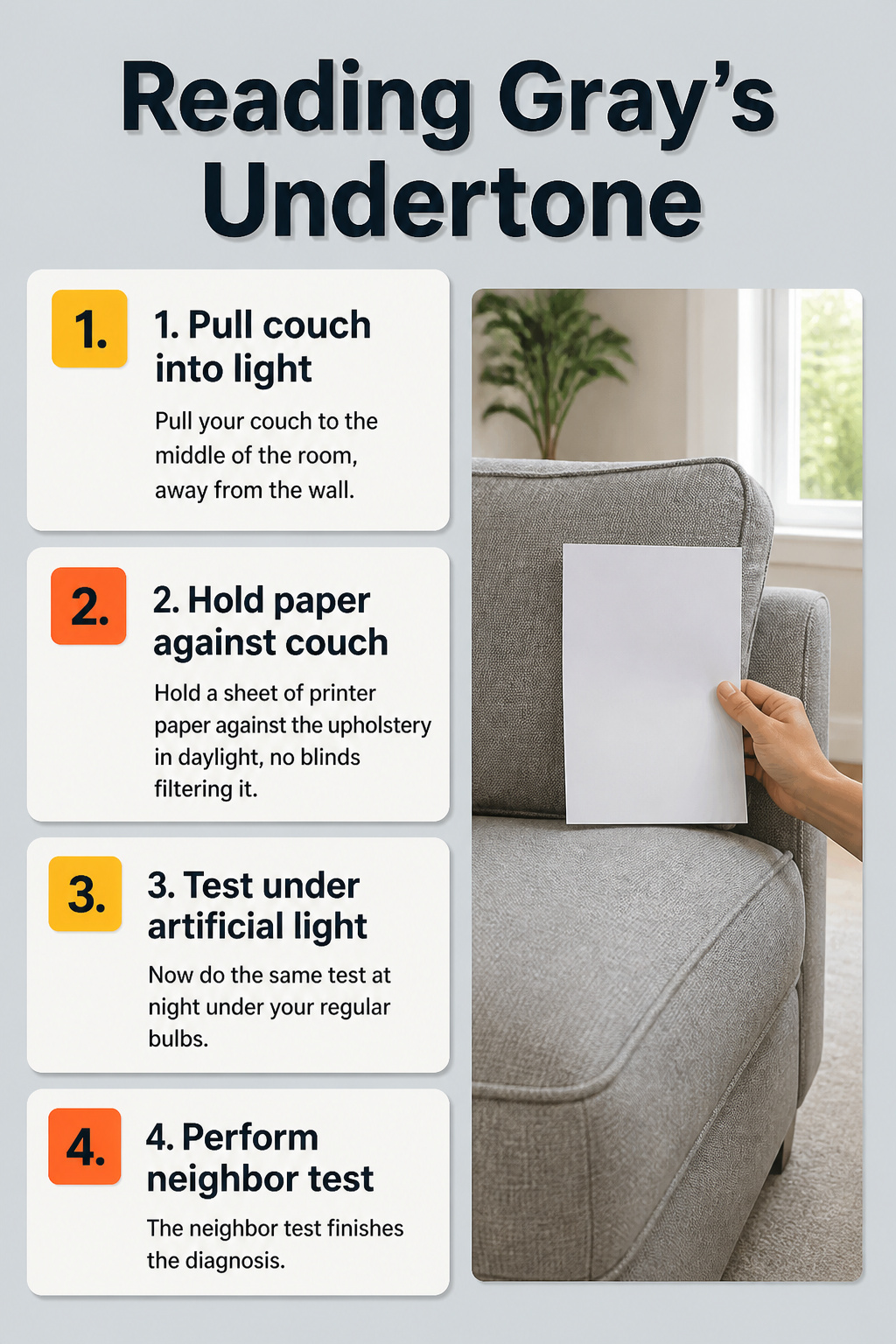
Pull your couch to the middle of the room, away from the wall. Hold a sheet of printer paper against the upholstery in daylight, no blinds filtering it. If the gray suddenly looks green, blue, or violet against that white, you have a cool undertone. If it reads beige, tan, or brown, it is warm. This takes thirty seconds and saves you a $40 pillow that clashes.
Now do the same test at night under your regular bulbs. Daylight exaggerates cool tones; warm bulbs can bury them. A gray that looked neutral in morning sun may turn muddy under 2700K light. If you live with lamps on after five, trust the lamp test over the window test.
The neighbor test finishes the diagnosis. Set a true white, a cream, and a blue item on the seat, one at a time. Warm gray flattens next to blue and brightens against cream. Cool gray sharpens against white and turns sickly next to cream. Once you know which reaction you are seeing, every paint strip and textile choice after this falls into place.
Frequently Asked Questions
What colors go with a gray couch?
Yellow, blush, navy, and emerald all read well against gray, but only if you match the temperature. Warm gray belongs with warm colors like terracotta and mustard; cool gray needs cool partners like navy or emerald. Hold any pillow or fabric against your couch in daylight before buying, because the undertone match is what makes the pairing work.
How do I style a living room with a gray sofa?
Start with the undertone of your gray, then build outward through contrast, texture, and layers. Push lighter or darker on the value scale, ground the seating with a rug, and add living texture through plants. Mix furniture styles freely; gray acts as a visual referee that lets unlike pieces sit together without fighting.
What color pillows go with a gray couch?
Beige, ivory, and cream build a calm base, while gold, terracotta, and burnt orange bring in warmth. Mix textures like velvet, linen, and boucle in varied sizes so the arrangement reads dimensional rather than flat. The key is matching the pillow temperature to your gray’s undertone: warm with warm, cool with cool.
What color rug should you pair with a gray sofa?
Charcoal and dark gray rugs deepen the tone without fighting it, while white or beige keep things quiet if the rest of the room already has enough going on. Bold geometric patterns can turn the rug into a focal point, while soft textures pull the seating into one calm spot. Measure carefully: too small and the rug floats; too large and you are buying floor coverage you already have.