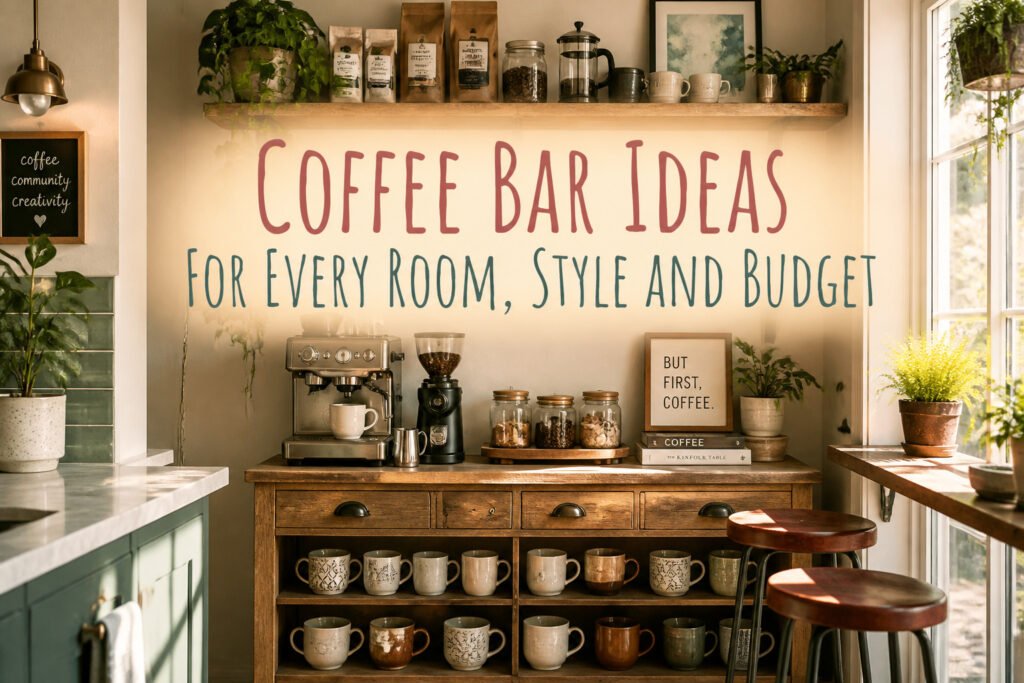
A coffee bar that works in 2026 depends on one calculation: how much square footage you can give it and whether that space is permanent or stolen from another routine. The French bistro cabinet that signals Parisian cafe starts at $150 from IKEA, but only reads as lived-in once the glass shows actual morning clutter, not staged canisters.
1. French Bistro Glass and Brass
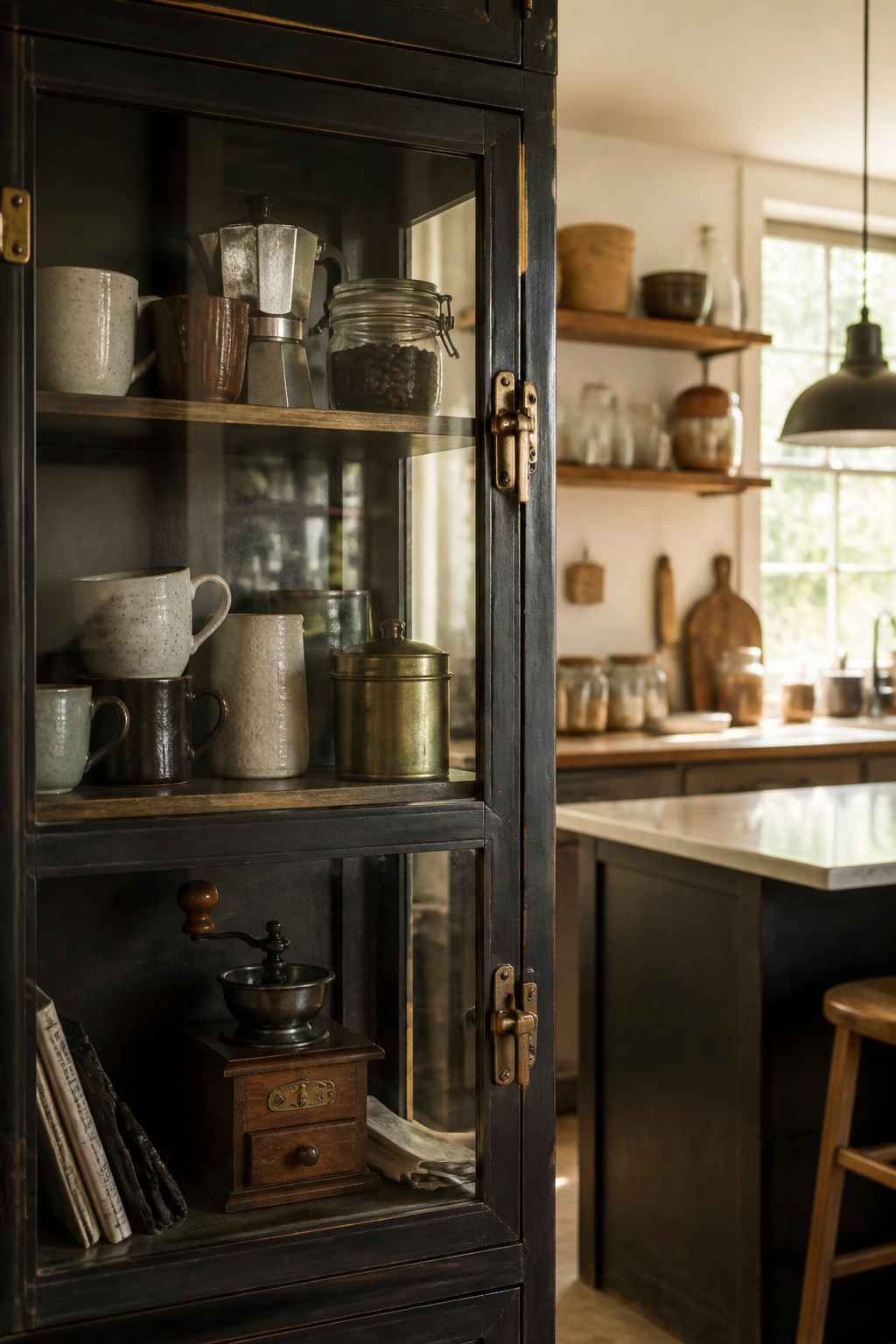
A glass-front cabinet with brass hardware is the fastest way to signal Parisian cafe without gutting a kitchen. The IKEA Milsbo runs $150–$300 depending on width, and its steel frame takes spray paint or replacement pulls well if the standard black does not suit you. Other retailers carry similar pharmacy cabinets in that same band, so the idea survives even if your local stock is thin.
The mistake that turns this into a stage set, not a morning routine, is treating the glass as pure display. A cabinet packed with matching canisters and untouched cups reads like a prop department. You need the clutter of actual use: the mug with the chipped rim you reach for first, the sugar jar that never quite closes, the morning paper wedged behind the grinder. The brass helps here, but only if you choose the finish carefully. Lacquered bright brass catches light like costume jewelry; unlacquered or lightly antiqued brass dulls to something that looks handled, which is the point. If the pulls arrive too shiny, a night in vinegar and salt takes them down a step.
Sources: sincerelytori.com (budget strategies), procoffeegear.com (French bistro concept), marissacalhome.com (bistro shelving commentary)
2. Narrow Niche Station
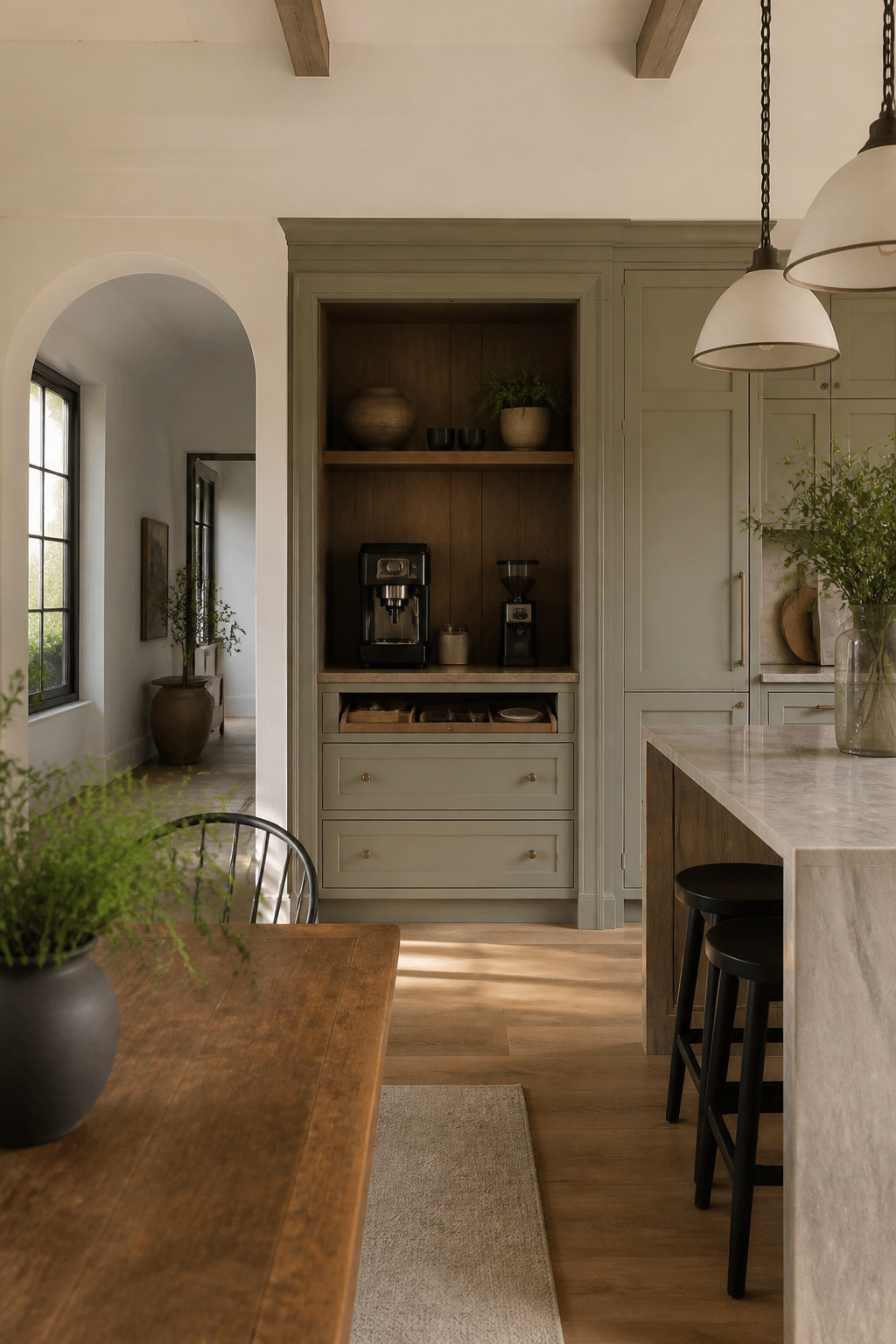
A recessed wall niche or the slim gap between cabinets can hold a real coffee station if you respect two numbers. The counter height you are building to is 36 inches, the standard that lets you work without hunching. When the niche is taller, add a false floor: a shelf or platform at that height so your machine sits where your hands expect it to be, with storage dead space above or below.
Depth matters more than width. Plan for 15 inches front to back at minimum, measured from the wall to the front edge. Anything less and you will pull a mug toward yourself only to knock the grinder off the back ledge. That 12- to 18-inch width you are working with is tight but workable; the depth is what keeps the station from feeling like a balancing act.
Designer Marnie Oursler treated a hallway niche with weathered wood paneling and a waterfall counter to give the narrow space some dimension.
"We like to include a wall treatment behind the bar for dimension, plus a waterfall counter can add a touch of elegance to the space."
For your own build, that wall treatment is worth the effort: a narrow niche reads as an afterthought when everything is flat, and a back panel in beadboard, tile, or even painted plywood gives the eye a reason to stop. The waterfall counter Oursler used is a luxury move; a simple shelf with a finished front edge gets you the same workable depth on a weekend budget.
3. Terracotta Backdrop
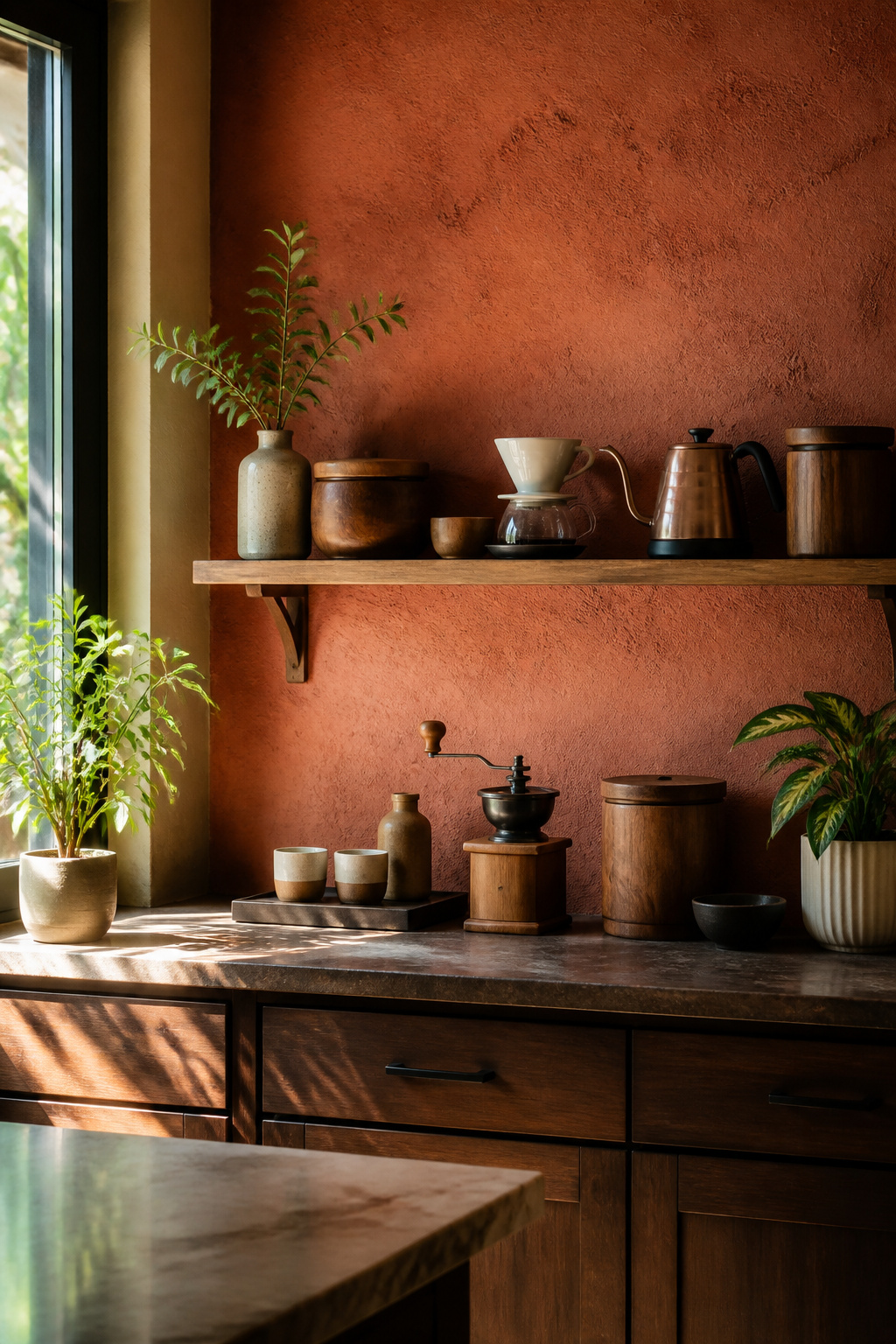
A terracotta wall behind your coffee station does the practical work of hiding splatter while warming up the whole corner. Matte finish beats eggshell here; the flatter surface knocks back glare from morning light and forgives the uneven texture most rental walls already have. Sherwin-Williams Cavern Clay SW 7701 sits in the right range, warm without sliding toward pumpkin, and runs $45–60 per gallon. One coat often covers over a light existing color, though a deep previous paint or fresh drywall needs primer underneath.
The shade plays especially well against wood tones, whether your shelves are oak, walnut, or the cheap pine board you stained yourself, and it holds its own against white cabinets without looking muddy. Tile gives you the same color with more wipe-down durability; a simple 4×4 matte terracotta tile on a mesh backing installs over a weekend and handles the steam from an espresso machine better than paint in a tight corner. Either way, skip the accent wall logic that demands balance across the room. This is a working station, not a feature for the sofa to face; let it be the one spot that goes darker and more saturated than the rest of the kitchen.
4. Double-Duty Coffee and Wine Bar
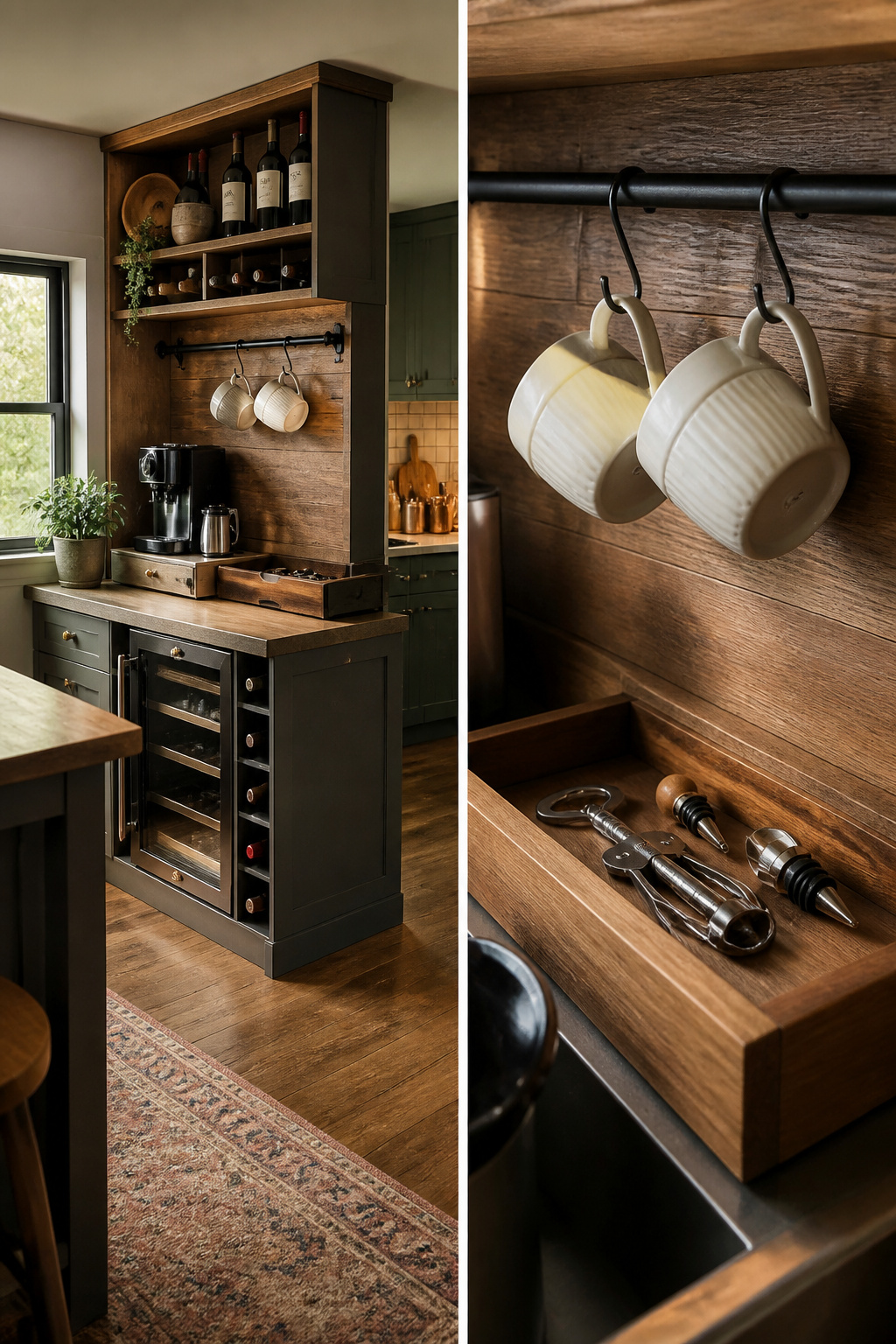
A single station for coffee and wine only works if you can hide half of its identity at any given hour. The morning crowd does not need to see last night’s corks, and evening guests do not need your chipped mug collection in their faces.
Hang your coffee cups from a rail-and-S-hook system mounted on the underside of the upper cabinet or shelf. The mugs stay accessible for the 6 a.m. rush, but lifting them off the hooks and stashing them in a cabinet above takes ninety seconds before anyone arrives for dinner. The rail itself disappears into ordinary kitchen hardware once the mugs are gone.
Below the counter, a shallow drawer between three and four inches deep holds corkscrews, wine stoppers, and the foil cutter. Anything deeper wastes space and lets items slide into a pile you have to dig through. The drawer sits directly under the rail, so the same square footage serves both routines without either one colonizing the whole station.
The judgment call is which identity faces outward by default. If you drink coffee daily and wine twice a month, keep the mugs on display and the wine tools in the drawer. Reverse it only if you entertain weekly and brew coffee alone.
5. Home Gym Coffee Bar
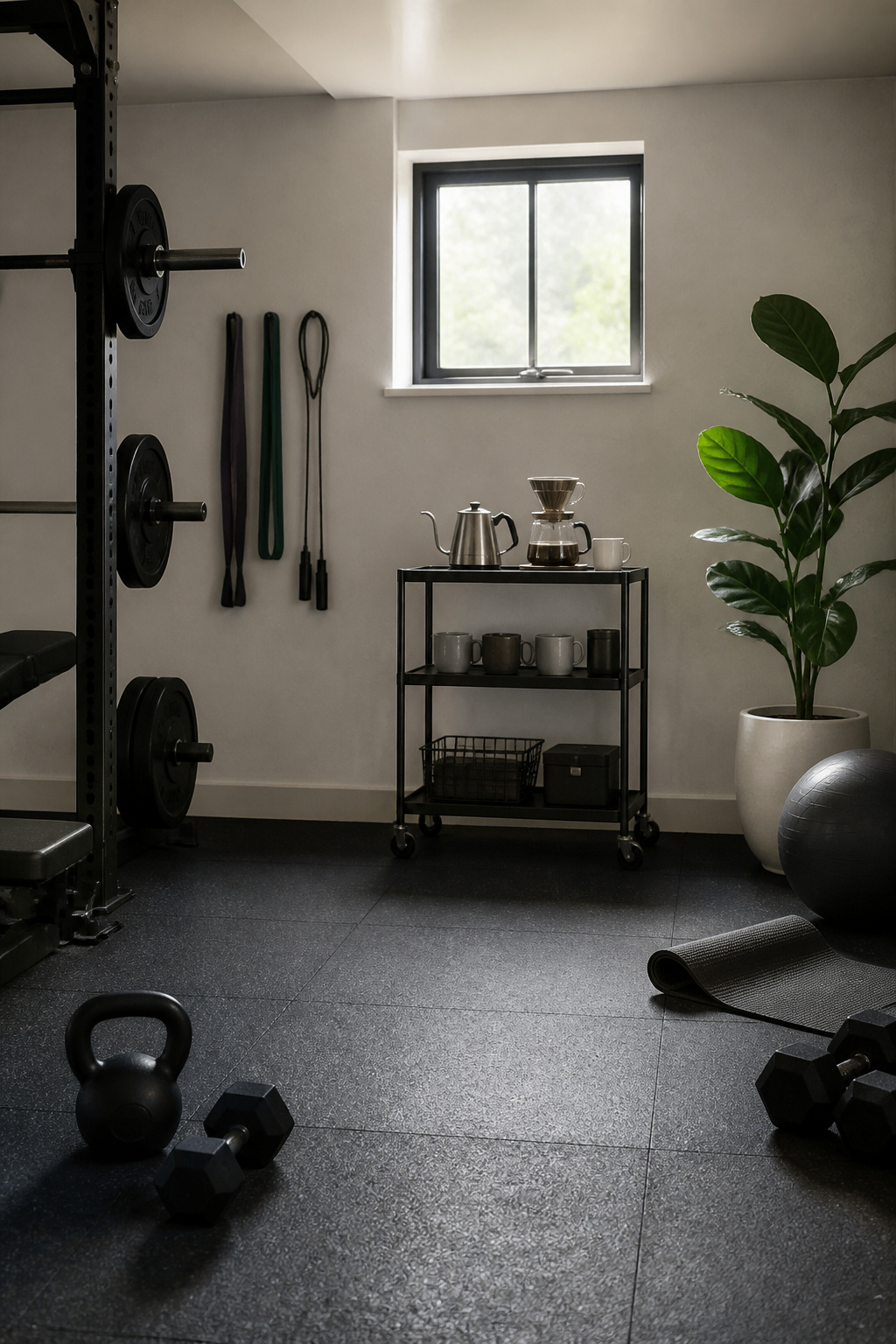
A rolling cart between your weights and your stretching mat keeps coffee within reach without dedicating permanent floor space. The humidity you generate during a workout, especially in a garage gym or basement, will eventually corrode the heating element in an electric drip machine or gum up the seals on an espresso maker. A simple pour-over setup, a kettle, and a manual grinder have no electronics to fail, and you can wipe them dry in ten seconds.
Plan $80 to $150 for the cart itself, and prioritize two details: a top surface wide enough for your kettle base and at least two locking casters. Rubber gym flooring is softer than it looks, and a cart that drifts while you are loading plates becomes a hazard fast. The wheels that grip best on rubber tend to have a slightly harder urethane tread rather than the soft rubber ones meant for hardwood. Test the lock mechanism with some weight on it before you trust it near a squat rack.
6. Coffee and Wine Bookends
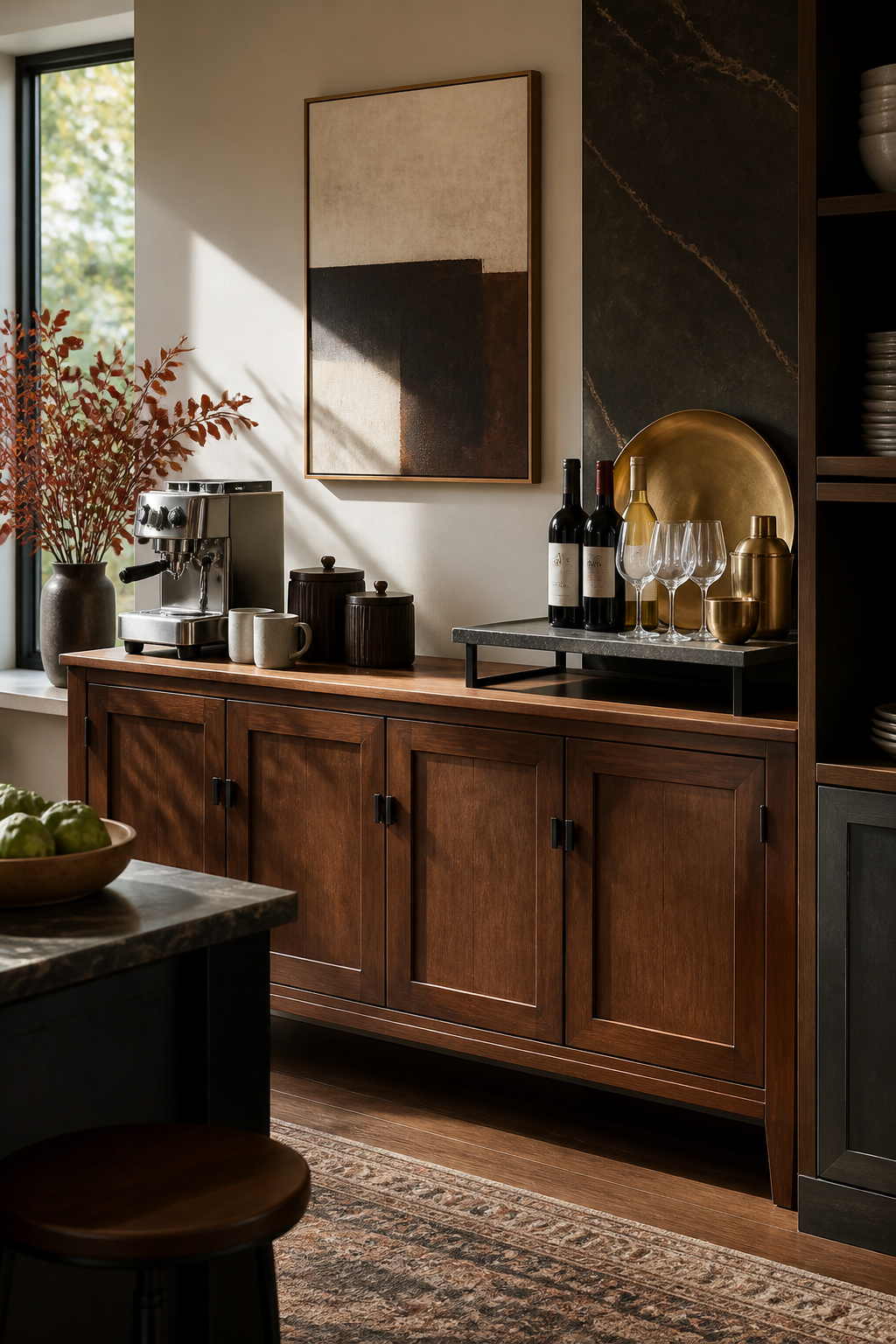
A long counter or sideboard can hold both morning coffee and evening wine without the two stations bleeding into each other. Give each end at least 24 inches of width to work comfortably; anything tighter and you are stacking cups on top of corkscrews.
The middle ground matters. A small sink is ideal if the plumbing allows it, but a cutting board works as a shared landing zone for opening bottles or rinsing a French press. The visual separation comes from height, not color. Keep the coffee zone low with the machine, grinder, and canisters sitting flat; raise the wine side on a tray or a shallow riser so bottles and glasses read as their own layer. Layering with trays and cutting boards keeps each zone deliberate rather than scattered.
Do not try to blend the aesthetics. Warm wood and black metal on one end, brass and glass on the other, will fight for attention across six feet of counter. Pick one finish for the whole piece, then let the contents do the distinguishing. Coffee supplies tend toward matte ceramics and opaque canisters; wine gear brings in clear glass and reflective surfaces. That contrast is enough.
7. Awkward Corner Drawer
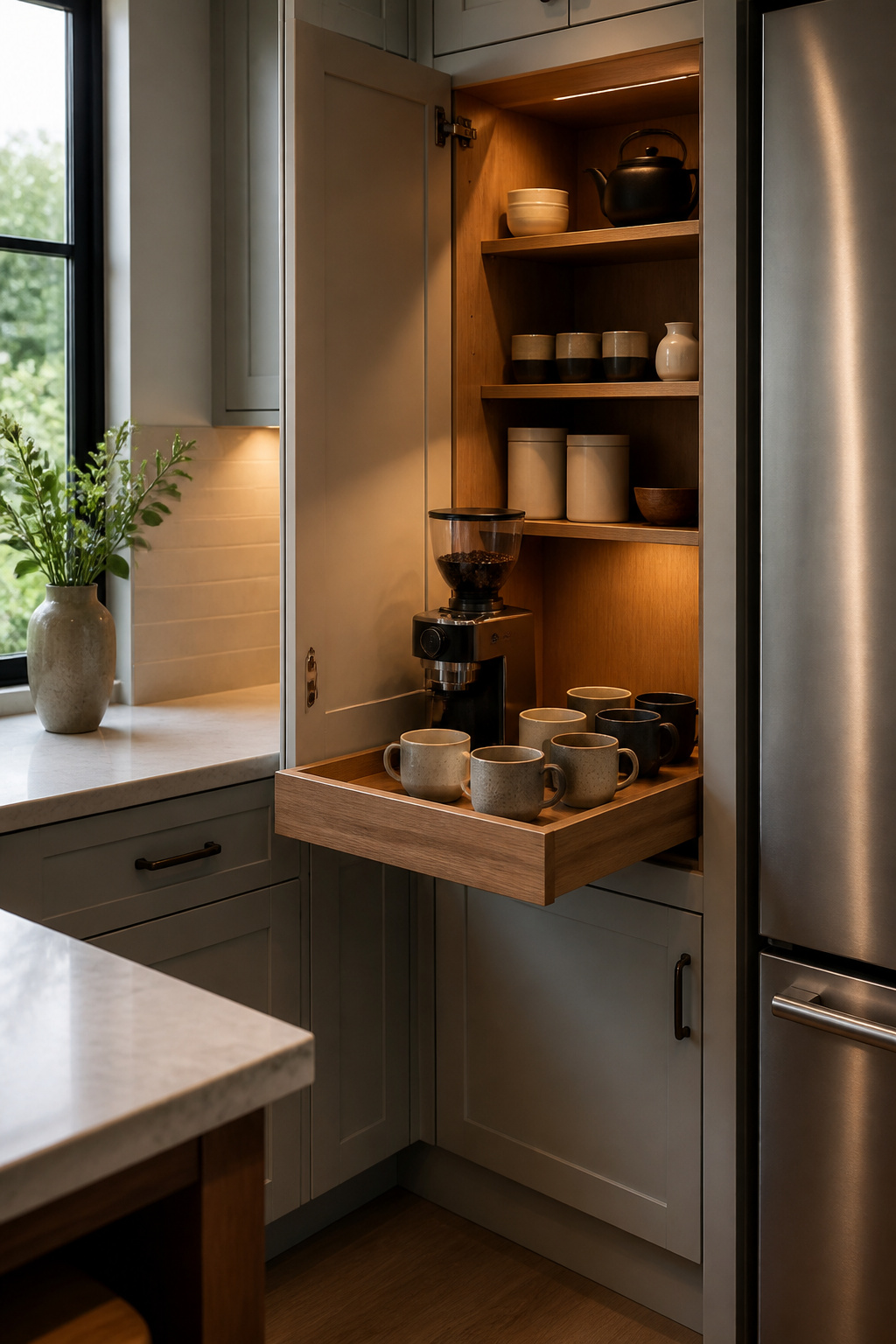
Most kitchens have a corner cabinet or deep drawer that swallows mugs whole and forces you to kneel with a flashlight. That dead space is salvageable. A pull-out coffee station fits inside the existing box, no carpentry beyond the drawer itself.
The hardware that matters is a 22-inch full-extension drawer slide. Anything shorter leaves the back row of mugs in shadow; anything less than full extension means you still reach. Mount the slide to a plywood platform cut to your cabinet floor, then build your drawer on top.
Power is the part people botch. A cord running across the counter to the cabinet looks like an afterthought and catches on everything. A power strip mounted inside the cabinet, with the cord exiting through a drilled hole to the receptacle below, keeps the counter clear and the station self-contained. Use an in-wall-rated cord if your local code asks for it; most inspectors do not care inside a cabinet, but the fire-resistant jacket costs almost nothing extra.
The full hardware run, slides plus plywood and a basic front, lands between $40 and $80 if you already own a drill. Custom pull-out units from kitchen organizers start at $300 and climb fast. The trade is a Saturday of measuring twice and one trip back to the hardware store when you realize the rear bracket hits your cabinet hinge.
8. Work From Home Setup
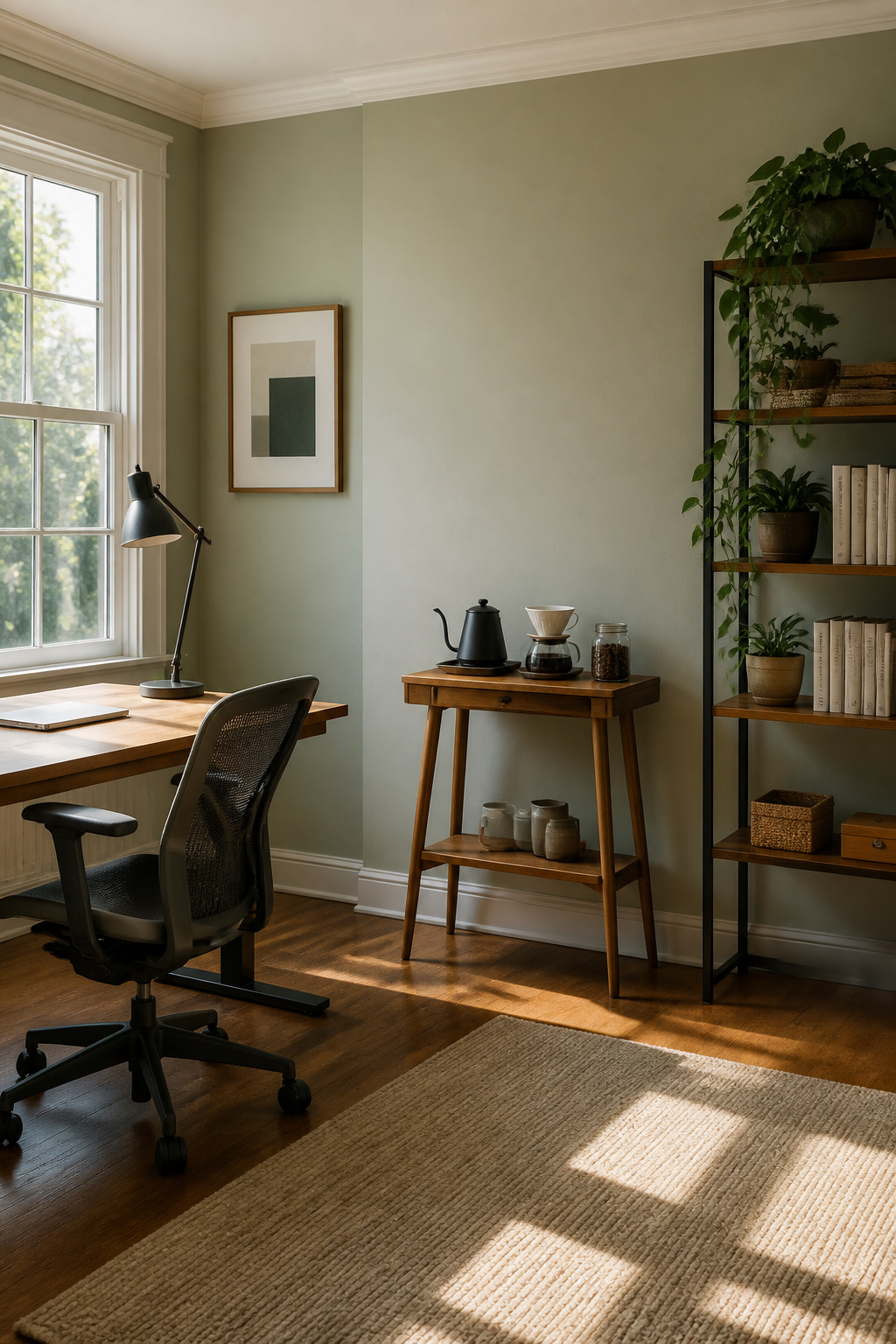
A coffee station in your home office lives or dies on placement. Keep the machine about six feet from your desk, close enough that the walk does not break your focus, far enough that the grinder does not. At that distance you still hear the burrs, but they fade into the same background hum as a desk fan.
The real problem is the morning grind. Blade grinders scream; conical burr grinders are quieter but still loud enough to interrupt a call. If you share walls or take video meetings, pre-grind your beans the night before and store them in an airtight jar. The trade is freshness for peace, and most people choose wrong the first time.
For brewing itself, thermal carafe drip machines and manual pour-over setups run nearly silent after the initial water heat. Avoid anything with a pump, including single-serve pod systems, unless your office door closes solidly. A small electric kettle heats water with less noise than most machines and pairs with a simple ceramic dripper that makes no sound at all.
9. Rail System Storage
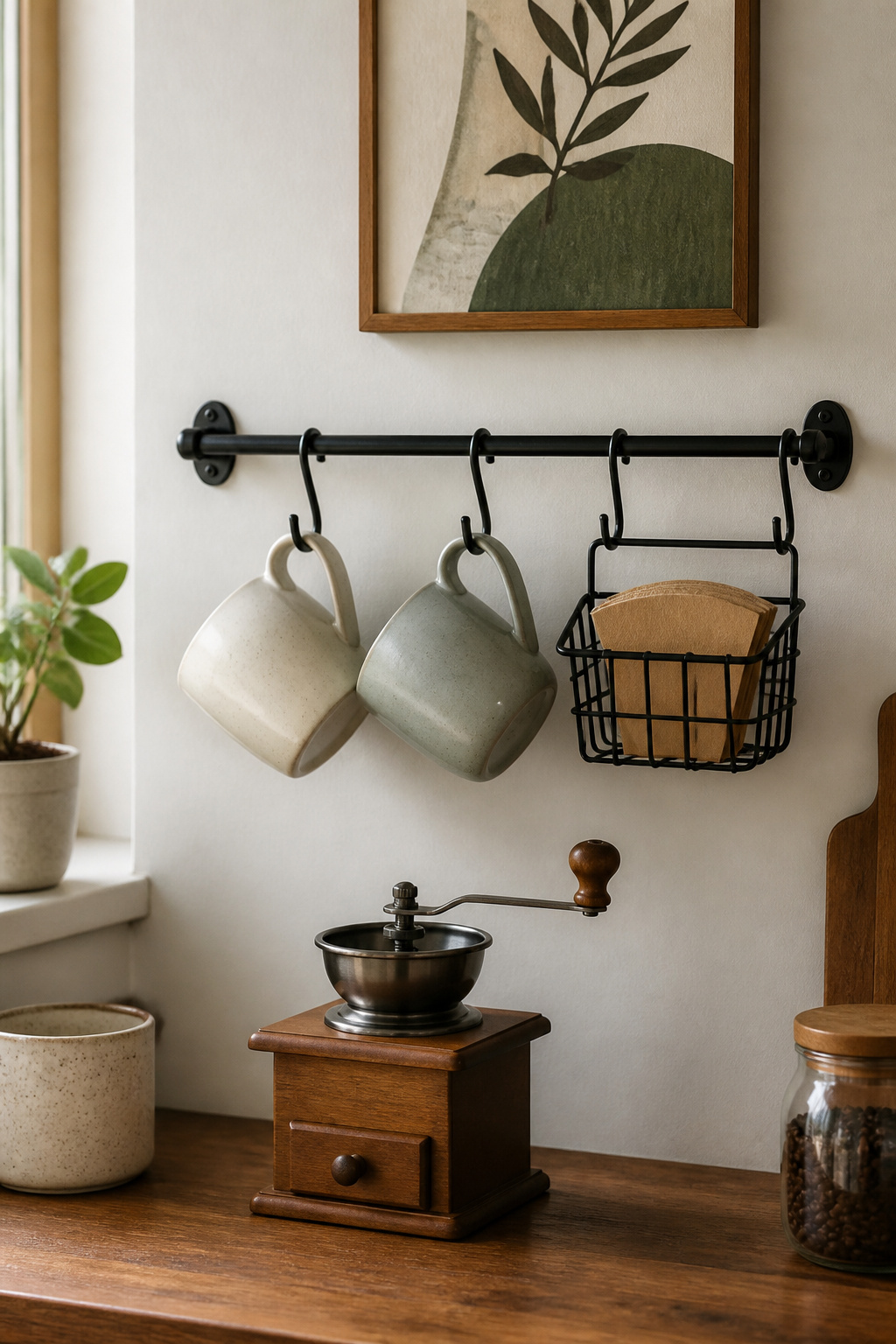
A 12-inch rail is enough to anchor a small coffee station without eating your whole wall. Mount it at eye level above your machine, add two or three S-hooks, and hang the two mugs you actually use plus a small basket for filters or a scoop. IKEA and Amazon Basics versions run $15–$40, which leaves room for matching containers if you want a uniform look. The system works best on drywall where you can find a stud or use a toggle anchor. Tile backsplashes are where this idea falls apart for renters. Drilling through ceramic or glass tile requires a special bit, steady pressure, and a real chance of cracking the surface. Lose a chunk of landlord-installed tile and you are explaining yourself at move-out. If your kitchen is tiled floor to counter, skip the rail and look for a tension-mounted shelf or a cart instead.
10. Cabinet Skirt
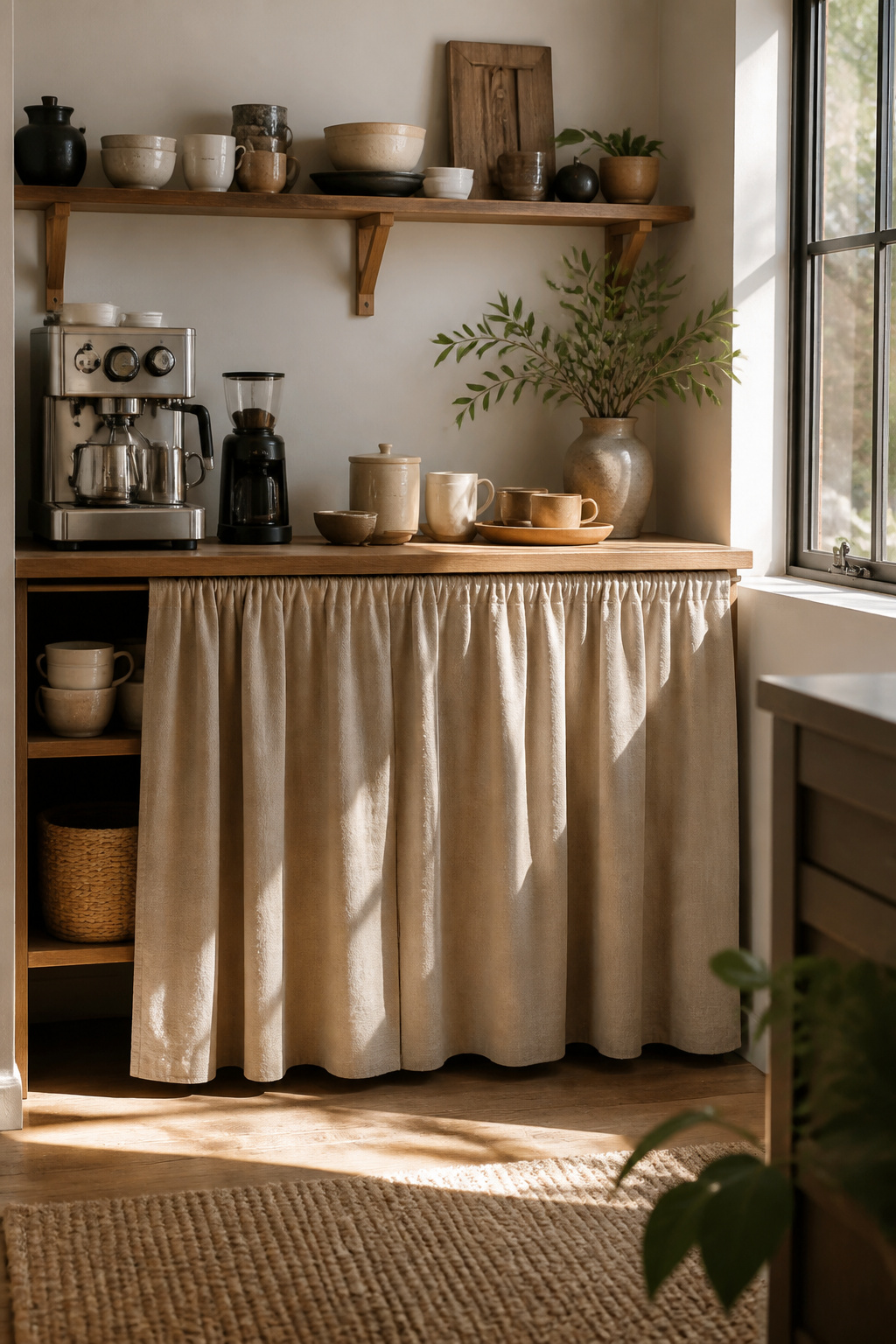
A fabric skirt hung on a tension rod turns open shelving into clean visual space for about $12 to $25 in canvas or linen. Two yards covers most standard cabinet widths, and the project takes roughly half an hour if you sew a simple hem. No machine? Hem tape and an iron handle the edge just as well.
The real payoff is what disappears behind it. Backup filters, the extra mugs you keep for guests, that bag of decaf you bought for your mother-in-law: all of it stays accessible but out of sight. Open coffee shelves read as clutter because the items are small, numerous, and rarely color-coordinated. A skirt breaks that visual noise into one soft plane.
Velcro strips work if you want to lift the panel straight off for cleaning. Tension rods are faster to install and easier to adjust if you change the shelf height later. Either way, this is one of the few coffee bar upgrades that actually looks better in a rental kitchen than in a styled photograph, because the mess it hides is the real one you live with.
11. Stocked Bar Cart
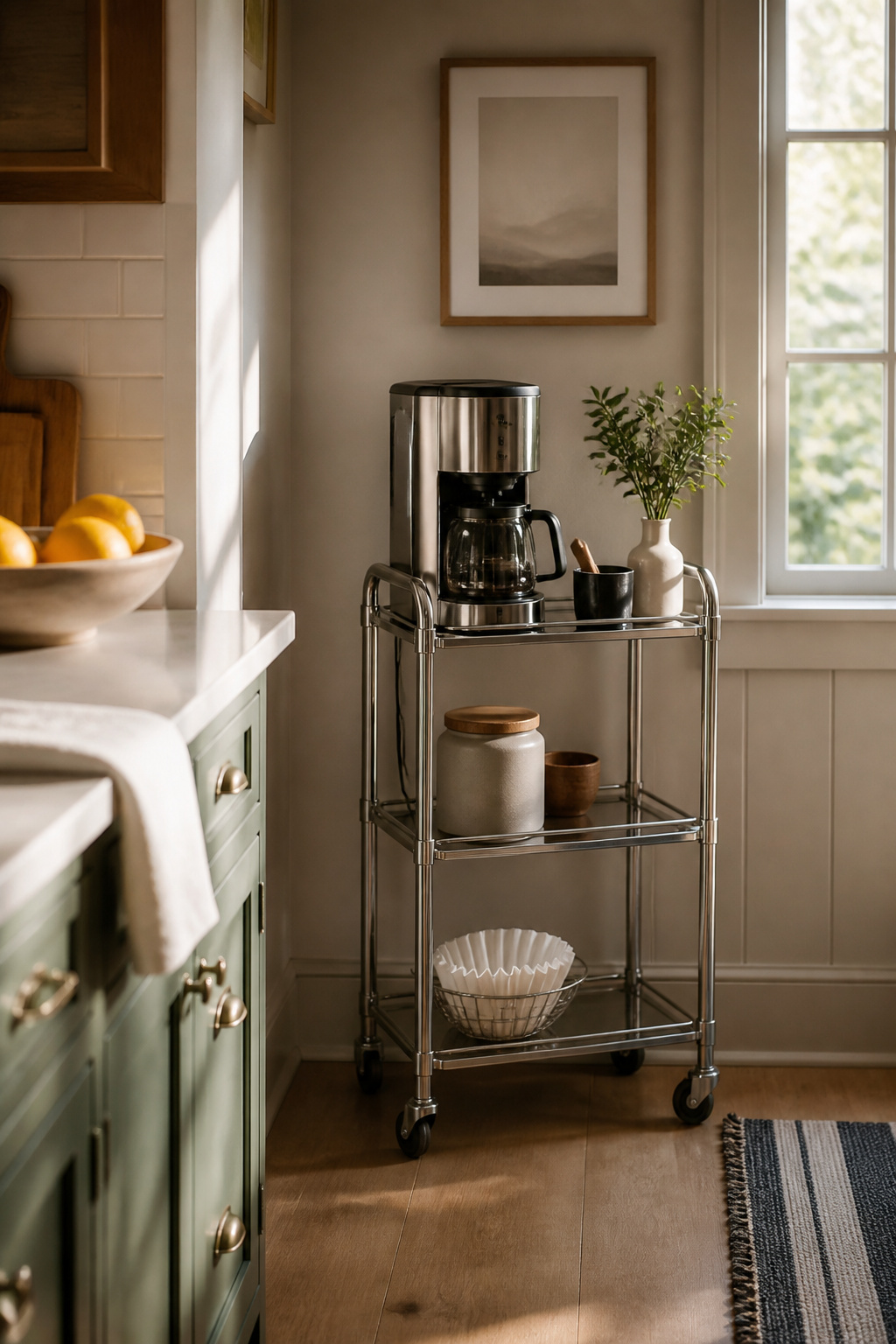
A rolling bar cart solves the problem most renters know too well: the only free counter is where you also prep dinner. If you can spare 18 inches of width, you have enough room for a machine, a small grinder, and a canister of beans without stacking hazards. The three-tier layout practically arranges itself: machine on top where steam vents freely, daily supplies in the middle at hand height, mugs and backup filters on the bottom where weight keeps the cart stable. You will find usable carts starting around $60, usually powder-coated steel with plastic casters that work fine on hardwood but rattle on tile. The shift to $150–200 buys you a sturdier frame, rubber wheels that actually lock, and the peace of mind that a full carafe will not tip the thing when you roll it from kitchen to living room. For holiday mornings or guests who rise early, the same cart wheels into a hallway or guest room and becomes a self-serve station without the 6 a.m. kitchen traffic. The tradeoff is storage: no closed cabinet means everything shows, so if you cannot stand the sight of syrups and sweeteners, add a basket on the middle tier or accept that this setup is for the disciplined.
12. Office Coffee Corner

An office coffee corner only works if it stays off camera. Set it on a surface separate from your desk, even by a foot or two, so the machine and its steam do not drift into your webcam frame during calls. One to two feet of counter space is enough for a permanent station that does not feel like clutter.
The mini fridge question splits on how you drink your coffee. If you reach for milk or creamer every morning, a small refrigerator keeps you from walking to the kitchen and losing focus. It also stores alternate beverages or medications close by. At roughly $120 and the size of a dorm unit, it eats desk space you might need for files or a second monitor. Skip it if you drink black coffee or use shelf-stable oat milk; buy it if cold dairy is non-negotiable and you have the square footage.
Cable management is what separates a station from a mess. Run the espresso machine cord, any grinder line, and the fridge plug through a single channel behind the desk leg, not across the floor where they tangle and show. A power strip mounted to the underside of the table, faced away from the camera, gathers everything out of sight. Test your framing on a video call before the first Monday you rely on it; the angle that looks clean at 9am may expose a nest of wires by 2pm when the sun shifts.
13. Converted Closet

A reach-in closet that is at least 24 inches deep and 36 inches wide has just enough room for a slim counter at standard bar height, 42 inches, with a small under-counter fridge or open storage below and a wall-mounted mug rack above. You will need to address power. Running a new outlet to code inside the closet costs $150–400 if the panel is nearby; otherwise, plan on concealing a heavy-duty extension cord through a cord channel painted to match the wall, which runs about $25. Budget $200–600 total, with painted shelves and a curtain instead of the door keeping costs at the lower end and butcher block or stone pushing them up.
Steam needs somewhere to go. A closet with no airflow will mildew the walls behind your machine in a season. If the closet backs to an exterior wall, a small through-wall vent fan, around $30, solves it; otherwise, leave the curtain open during morning use or add a louvered door panel rather than sealing it shut. Remove the door entirely for a cleaner look, or hang a heavy linen curtain on a tension rod if you want to close it off when guests come through. Either way, the frame stays, which saves you from patching trim.
14. Modern Meets Vintage
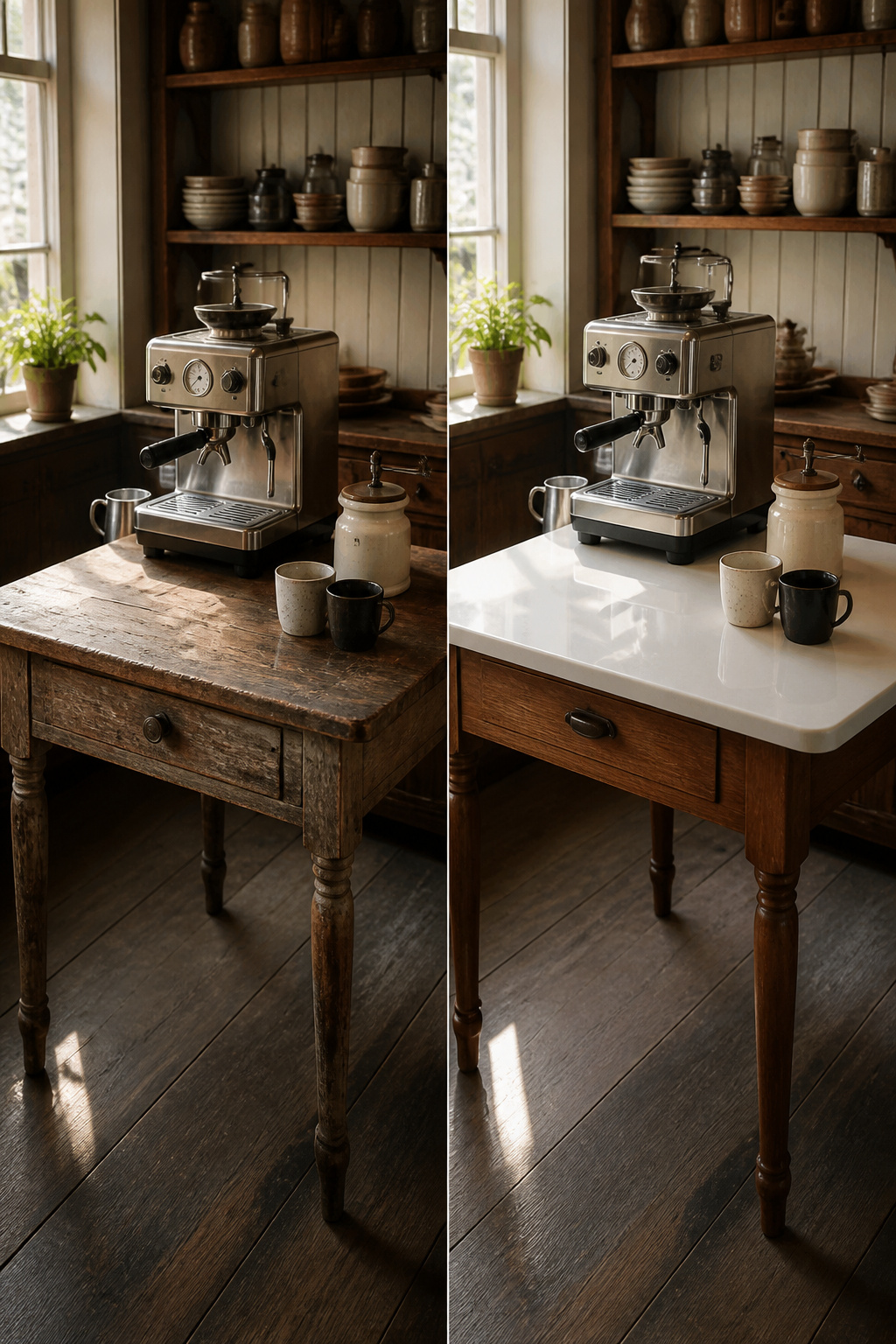
A new espresso machine sitting on a 1950s enamel-top table hits a note that all-matching sets never quite reach. The enamel survives heat and wipes clean, and the chrome legs barely register the weight. Mid-century credenzas with solid wood tops work the same way; the structure was built for daily use and the drawers swallow filters, scales, and the backup mugs you keep meaning to purge.
The pieces that crack under daily use are the ones that looked promising in the store. Veneer over particle board swells at the first spilled shot; the surface dimples, the edge tape peels, and within a season you are propping one corner on a shim. Skip anything that sounds hollow when you knock.
The typical thrift spend runs $40 to $150. At the low end you are cleaning and possibly swapping hardware; at the high end you are buying a piece that already has good bones and maybe a refinished top. Pair either direction, new machine on old base or vintage grinder beside a plain cabinet. The contrast does the work.
15. DIY Built-In
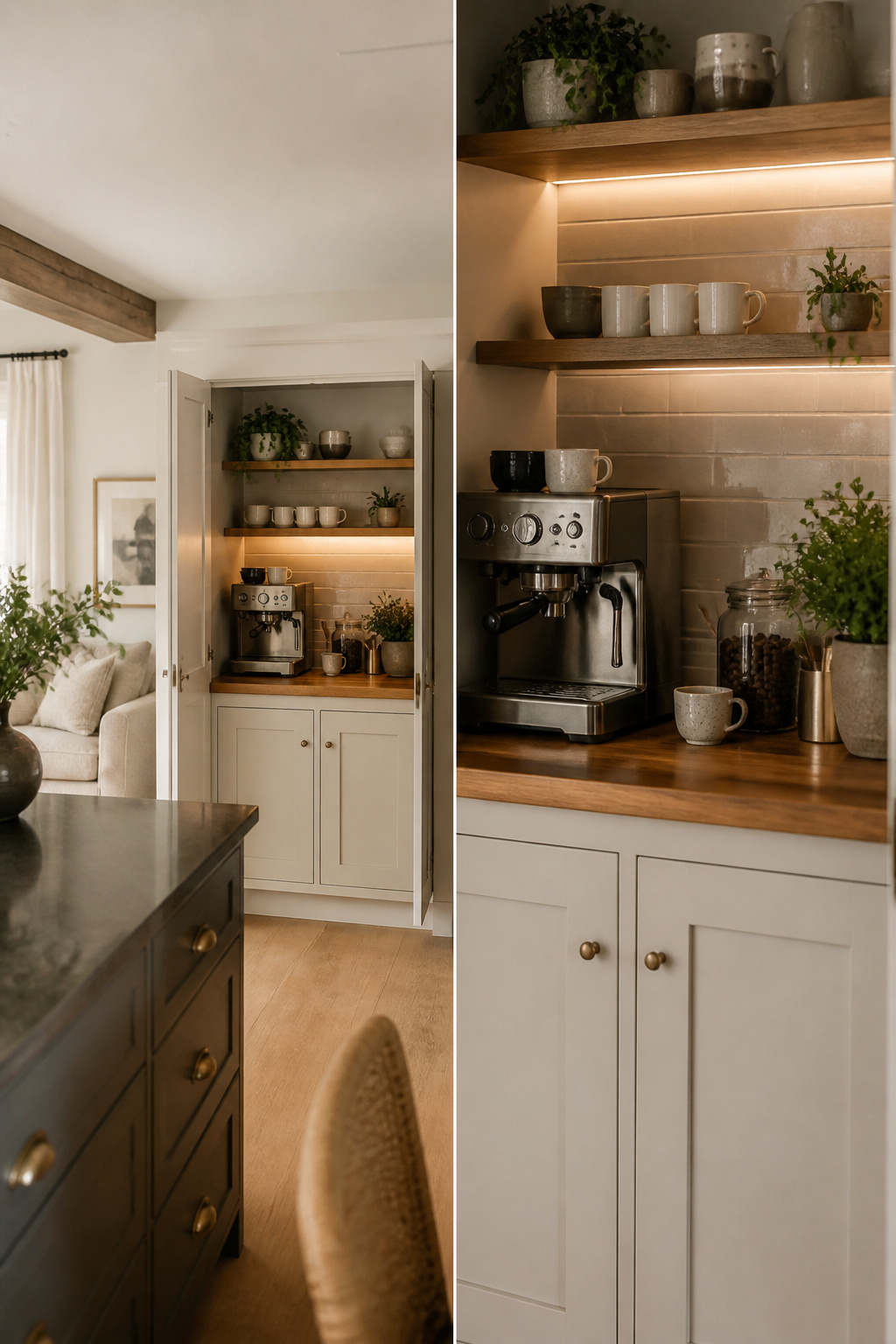
A DIY built-in coffee station starts with two stock base cabinets and a length of butcher block or plywood countertop, screwed together and anchored to the wall. The 36-inch counter height is the standard you want to hit, measured from the finished floor to the top of the surface, not the cabinet box itself. Base cabinets run 21 inches deep, which leaves enough room for a coffee maker and grinder without the machine crowding your face when you lean in.
The place this goes wrong is the backsplash. Tile, even thin subway tile, eats up a quarter to half an inch of your depth if you forget to set the cabinets out from the wall to account for it. You end up with the counter edge proud of the cabinet face, or the whole unit sitting too tight to plug anything in. Shim the cabinets forward before you secure them, or plan the backsplash to end at the counter edge instead of running behind it. Materials for a 4-foot station run about $150 if you paint existing cabinets and use a basic wood top, closer to $400 if you buy new cabinets and a finished hardwood surface. Either way, it is a two-day build: one for assembly and install, one for paint and sealing the counter.
16. Mini Countertop Station
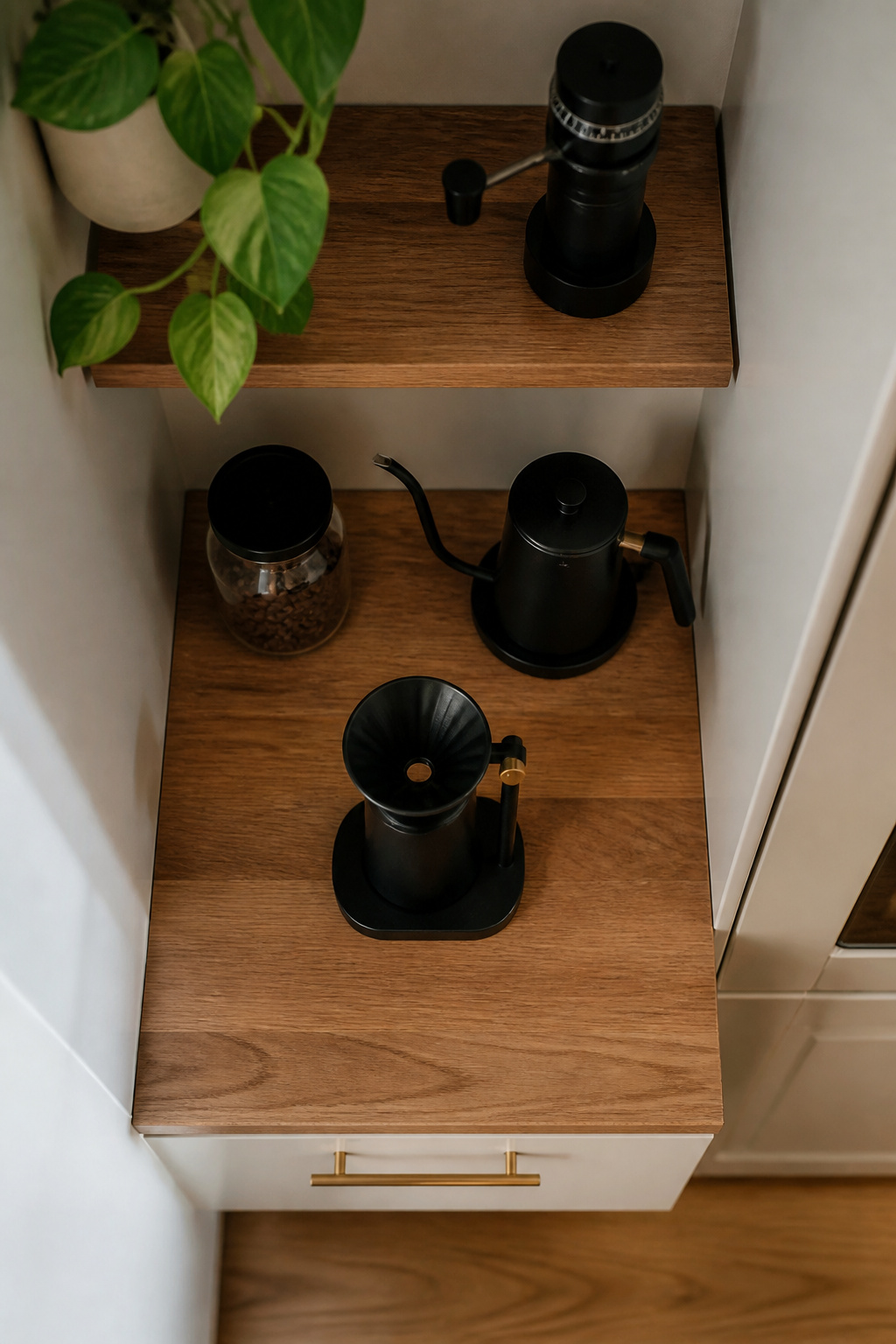
The smallest viable coffee bar needs 1 to 2 feet of counter space, with everything else stacked upward. A 24-inch by 24-inch surface handles a daily setup without crowding the rest of your kitchen.
That vertical storage is what makes the math work. A grinder that doubles as bean storage saves you one container and one motion every morning. A collapsible pour-over stand folds flat against the wall or tucks into a drawer when you are done. These are the pieces that earn their footprint, because in a mini station every item that does only one job is an item you will eventually shove into a cabinet.
Galley kitchens are where this wall-mounted approach wins outright over a cart. A cart needs floor space and a traffic lane around it, which a narrow kitchen does not have to give. The counter-edge setup stays out of the corridor, and under-cabinet lighting above the station gives you enough visibility to brew without turning on the overheads. A rolling cart with a fold-down surface sounds flexible, but in practice it spends most of its life either expanded and in the way, or collapsed and unused.
17. Cottagecore Style
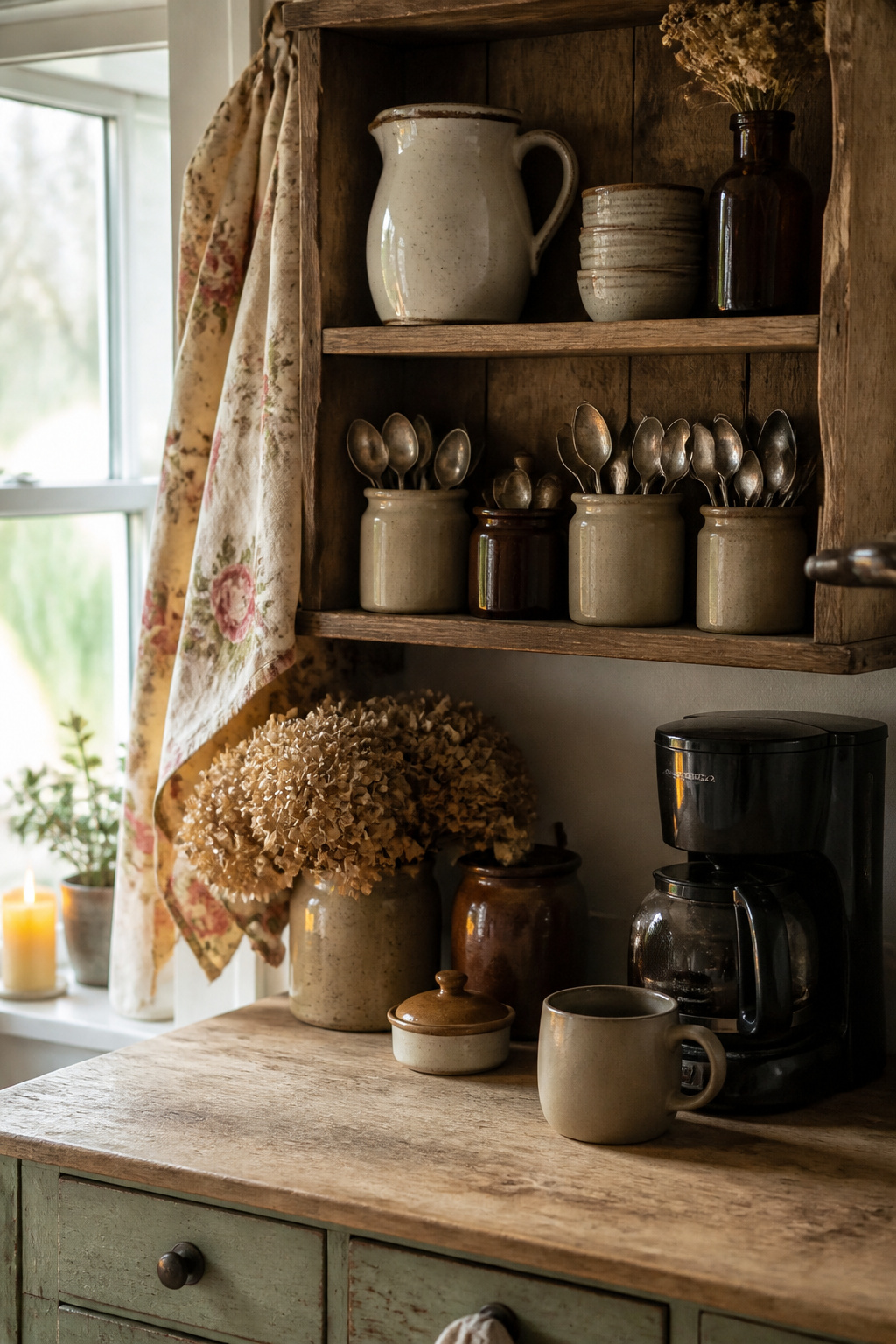
A cottagecore coffee bar lives or dies on the line between collected and cluttered. What saves it is the three-color rule: white or cream as the anchor, plus two muted tones drawn from a floral curtain or a crock you found at an estate sale. Without that anchor, three vintage baskets and a wildflower print read as chaos instead of intention.
Wood tones should vary. A pine shelf above an oak cabinet is fine; matching sets look like a furniture showroom. Visible storage is the point, so lean into crocks for spoons, wire baskets for filters, and a ceramic pitcher that holds nothing but looks right.
The real pieces come from estate sales and Facebook Marketplace, where most of what you need runs $30–80. A chipped pitcher is fine. A faded floral tray is better than new. The hunt is slow, which is the whole idea: this look is built over months, not a single Saturday.
18. Barista’s Dream Setup
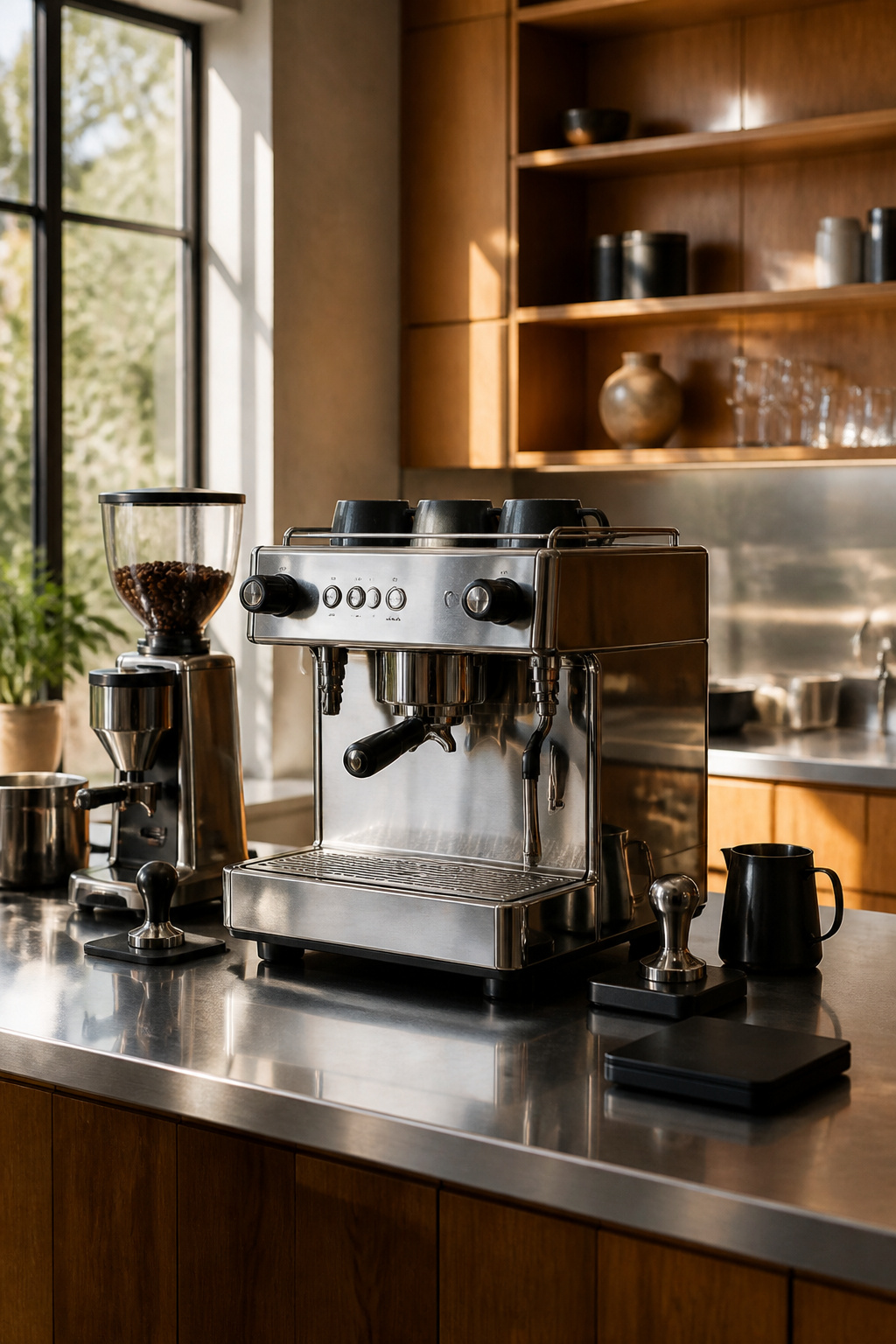
A real espresso setup starts with 24 inches of width for the machine alone, and that is before you account for a dedicated grinder, a scale, and the kettle you will want for pre-heating cups or rinsing the group head. Plan on 800 to 2,500 dollars for the core equipment if you are buying new, with PID-controlled machines sitting at the higher end of that range and paying back in temperature stability you can actually taste.
Most people who go this route end up keeping it in the kitchen, not a corner of the living room or a converted closet. The machines need a water line, or at least a reservoir you are refilling every few shots, and the weight of the thing means you are not moving it to entertain. A built-in looks clean, but a couple thousand dollars for a wall-mounted unit is still waiting-room dreaming for most budgets. A slim pump machine on the counter, grinder beside it, keeps the workflow tight and the plumbing simple.
19. Vintage Appliance Focus
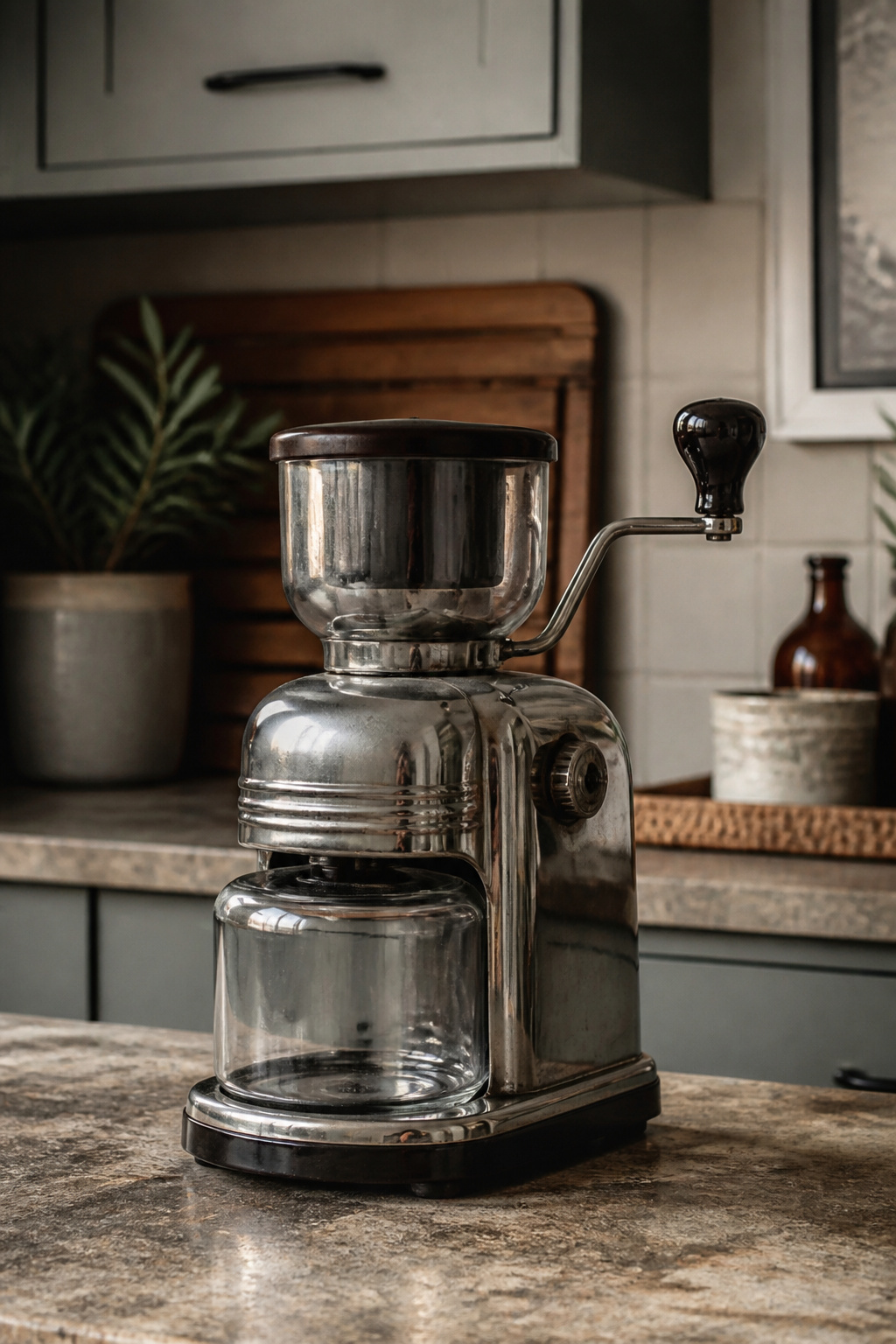
A 1930s percolator or 1950s hand-crank grinder sitting on your counter carries more visual weight than any shelf styling you could arrange around it. The chrome curves and Bakelite handles from those decades were designed to look good left out, which is exactly what a coffee bar asks for.
The catch is the wiring. Most vintage electrics need rewiring to be safe for daily use, and that runs $40–100 at a small-appliance repair shop. The alternative is buying a reproduction with modern internals and vintage shell, which costs more upfront but plugs in without the trip to a specialist. Hand-crank grinders sidestep the issue entirely, though they take longer each morning than an electric burr grinder.
If you do restore, the 1930s–1950s period is where the design peaks. Earlier and you get more primitive shapes; later and safety regulations started smoothing out the details that read as character now. A rewired percolator brews slower than a drip machine and needs watching to avoid over-extraction. That slowness is either the ritual you wanted or ten minutes you do not have.
20. Coastal Palette
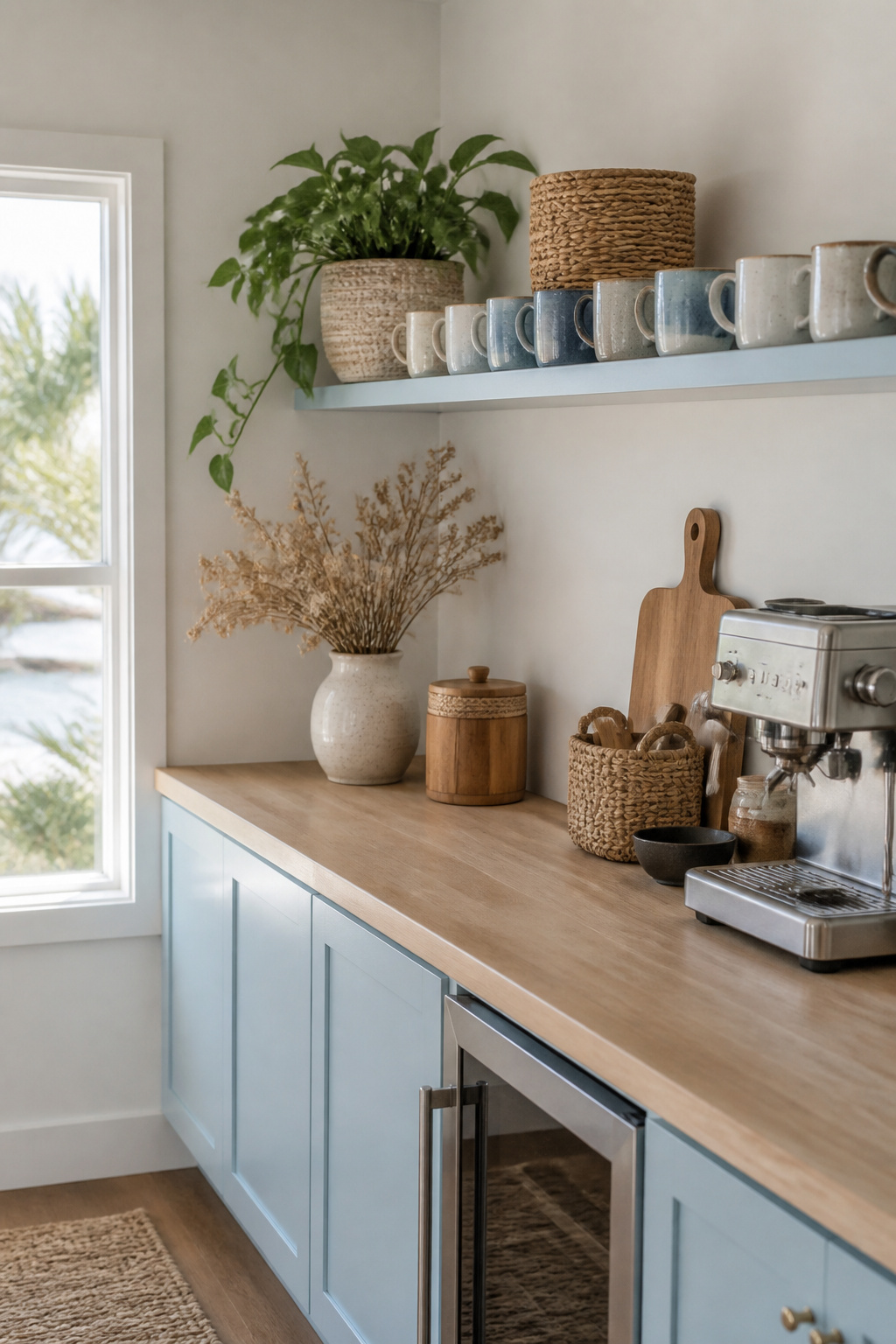
White Dove OC-17 by Benjamin Moore runs about $50–70 per gallon and hits the right note for a coastal coffee bar: warm enough to feel like sun-bleached siding, not the stark white of a rental kitchen you are trying to forget. Pair it with pale blue on a single shelf back or the inside of a cabinet you open every morning. Natural wood tones come from the grain you leave visible, not stain you add; a light sanding and a matte seal on pine or oak keeps the beach-house feeling honest.
Rattan or seagrass baskets hide filters, backup mugs, and the odd packet of tea you swear you will finish. They cost $15–30 at most home stores and do the texture work that painted wood cannot. This palette shows every coffee stain the moment it lands, especially on that White Dove wall or a pale countertop. You will wipe the steam wand splash or the drip from the carafe within the hour, or you will see it from across the room for weeks. Darker coastal schemes exist, but they read nautical, not shore-house relaxed; skip them if the breezy mood is what you wanted.
21. Dedicated Coffee Cart
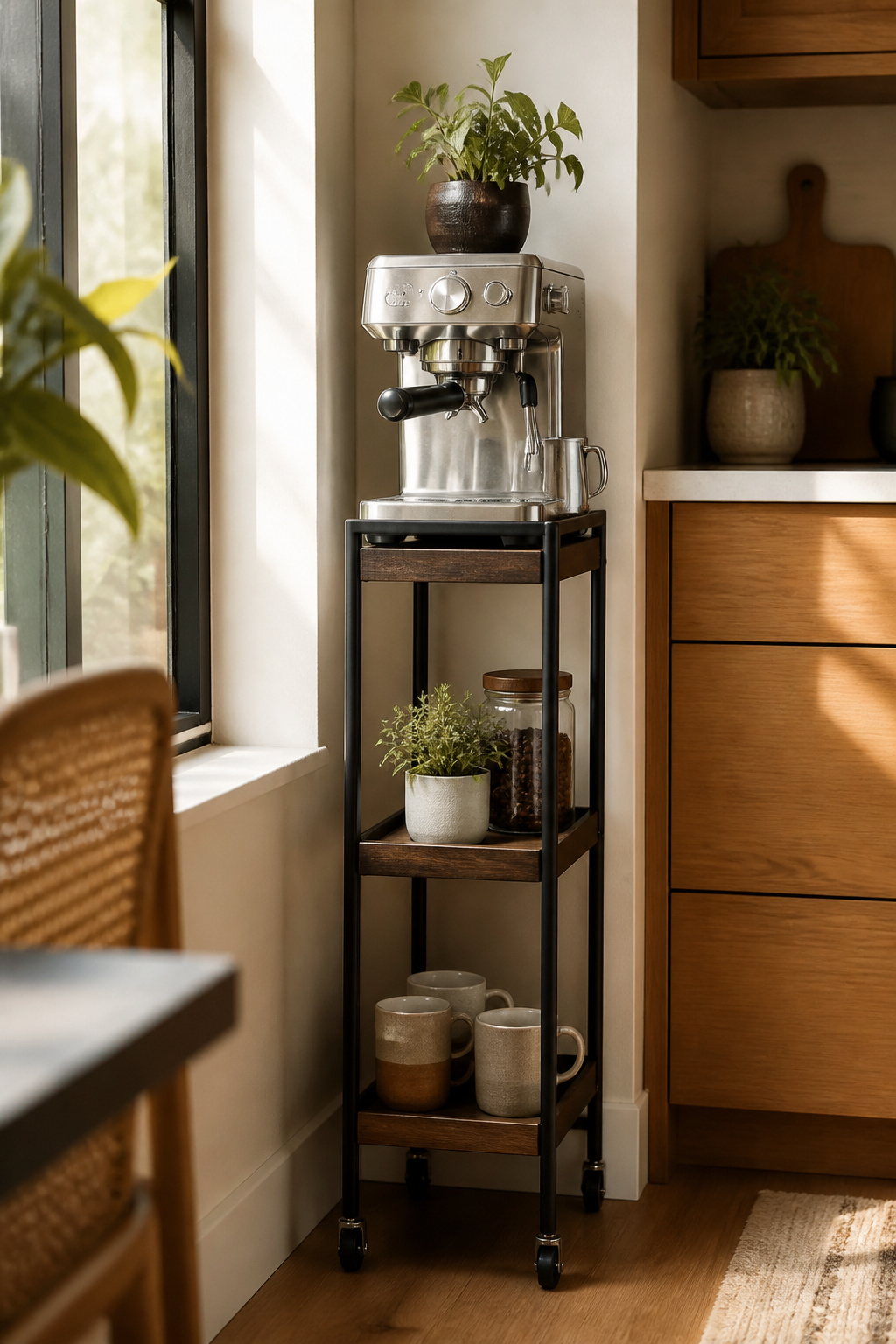
A dedicated coffee cart earns its keep by doing one job well. Unlike the multi-purpose bar cart that holds bottles one weekend and mail the next, this stays put as a coffee station, and that focus lets it shrink down to spaces a standard cart won’t touch.
The 16-inch width models slide beside a refrigerator or in the gap between cabinets, turning dead space into a morning workflow. Most run $40 to $120, with the lower end getting you a basic metal frame and the upper tier adding the mug rack and a small shelf for filters or a scale. The mug rack matters more than it looks; hanging cups frees the top surface for the actual making, and it keeps drips from pooling where you set the machine.
Locking wheels are non-negotiable here in a way they aren’t on a bar cart. A wine cart sits against a wall for parties and rolls out twice a year. Your coffee cart moves every morning: pull it forward to access the outlet, roll it back when the pot’s hot. If a wheel drifts on a wood floor while you’re pouring, you learn fast why the brake matters.
22. Hidden Behind Doors
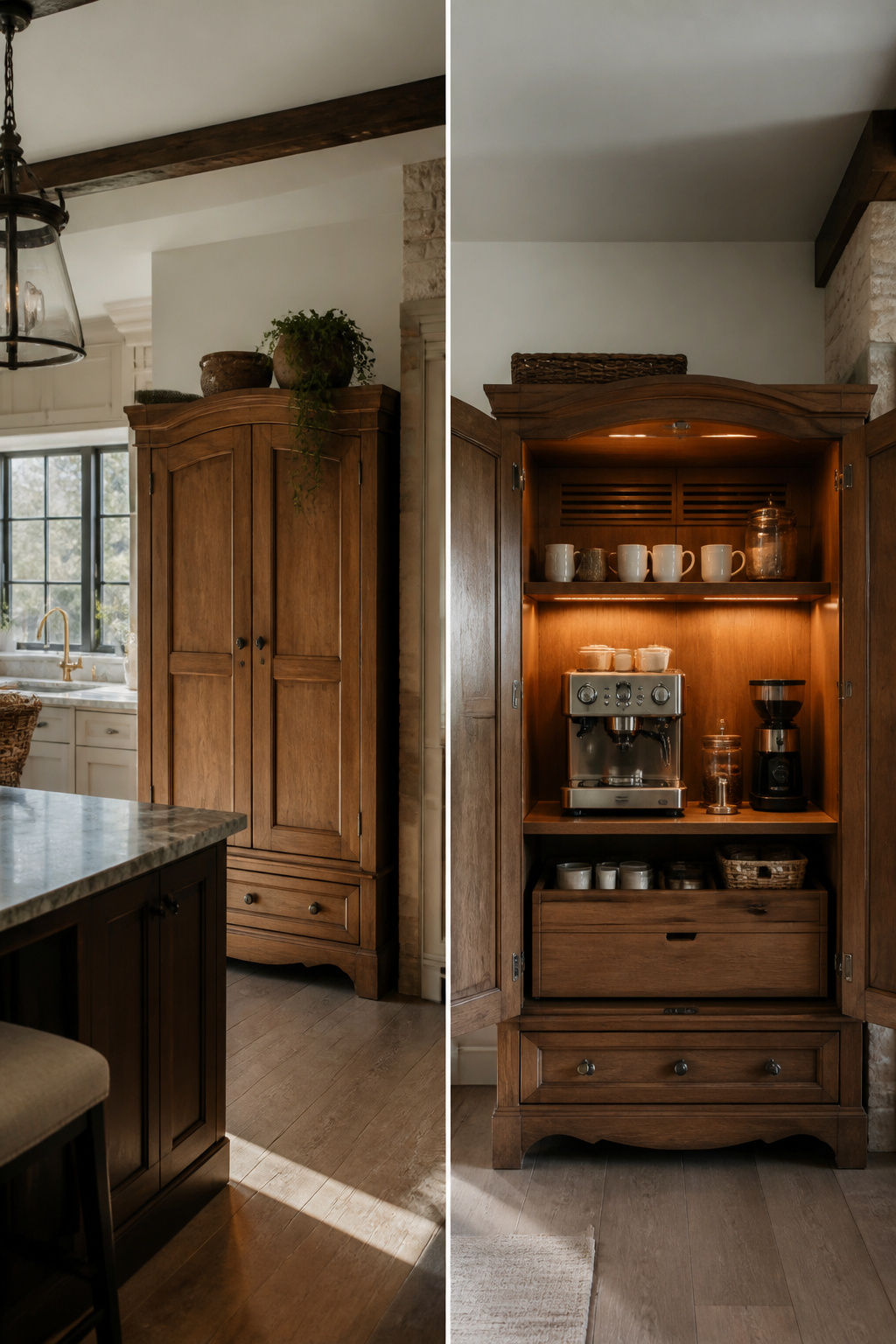
A used armoire with solid doors costs $150 to $400 and hides the morning mess completely. The catch is steam: running a machine inside an enclosed cabinet warps wood over time, so leave a two-inch gap at the back or fit a small vent before you drill the cord hole. A standard espresso machine needs 30 inches of interior width to sit and breathe, and many older hutches fall short by four or five inches. Measure inside the frame, not the outer trim. Purpose-built appliance garages run $600 or more and solve the ventilation problem with built-in gaps, but the used armoire wins on budget if you modify it yourself. Sliding barn doors on a kitchen cabinet work the same way and save floor space in a galley kitchen, though they never seal the steam in quite as tight.
23. Upcycled Furniture Base
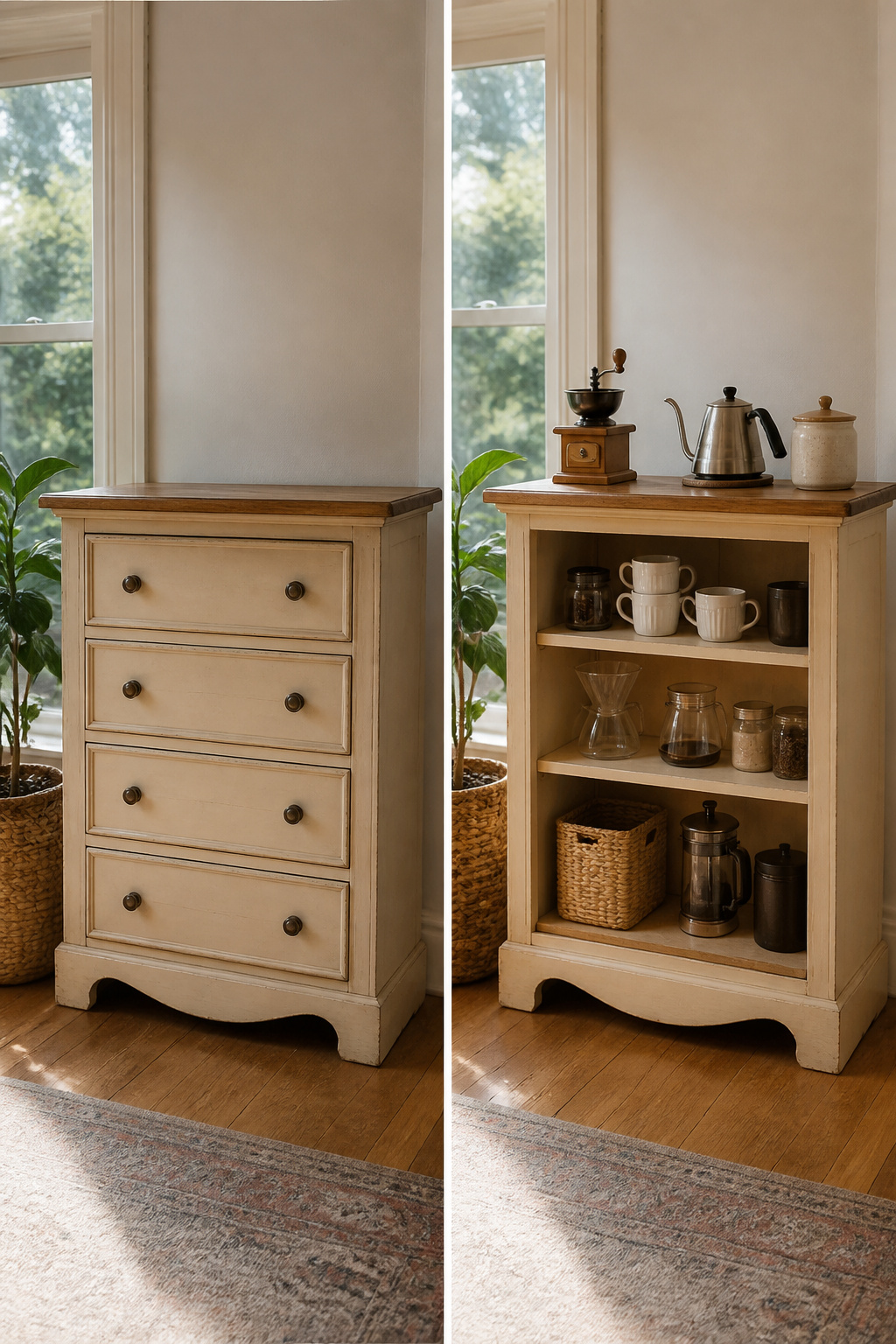
A dresser with the drawers pulled out and fitted with plywood bottoms becomes storage for mugs and filters, while the top holds your machine and grinder. Nightstands work for tighter corners, and old media consoles already have the width for a full setup. The catch is height: a coffee bar needs to sit at least 30 inches off the floor to be comfortable for daily use, and most dressers fall short. You will need to add legs or a platform base, which changes your math.
Check the bones before you commit. Sagging drawer bottoms or joints that shift when you push on the corners mean the piece will wobble under the weight of a grinder and water reservoir. Most of these run $0 if you already own them, or under $75 at a thrift store or garage sale. Sand, paint, or strip the finish, swap the hardware, and remove doors if the piece has them. The result reads intentional, not improvised, and it costs a fraction of buying new.
24. Seasonal Rotation
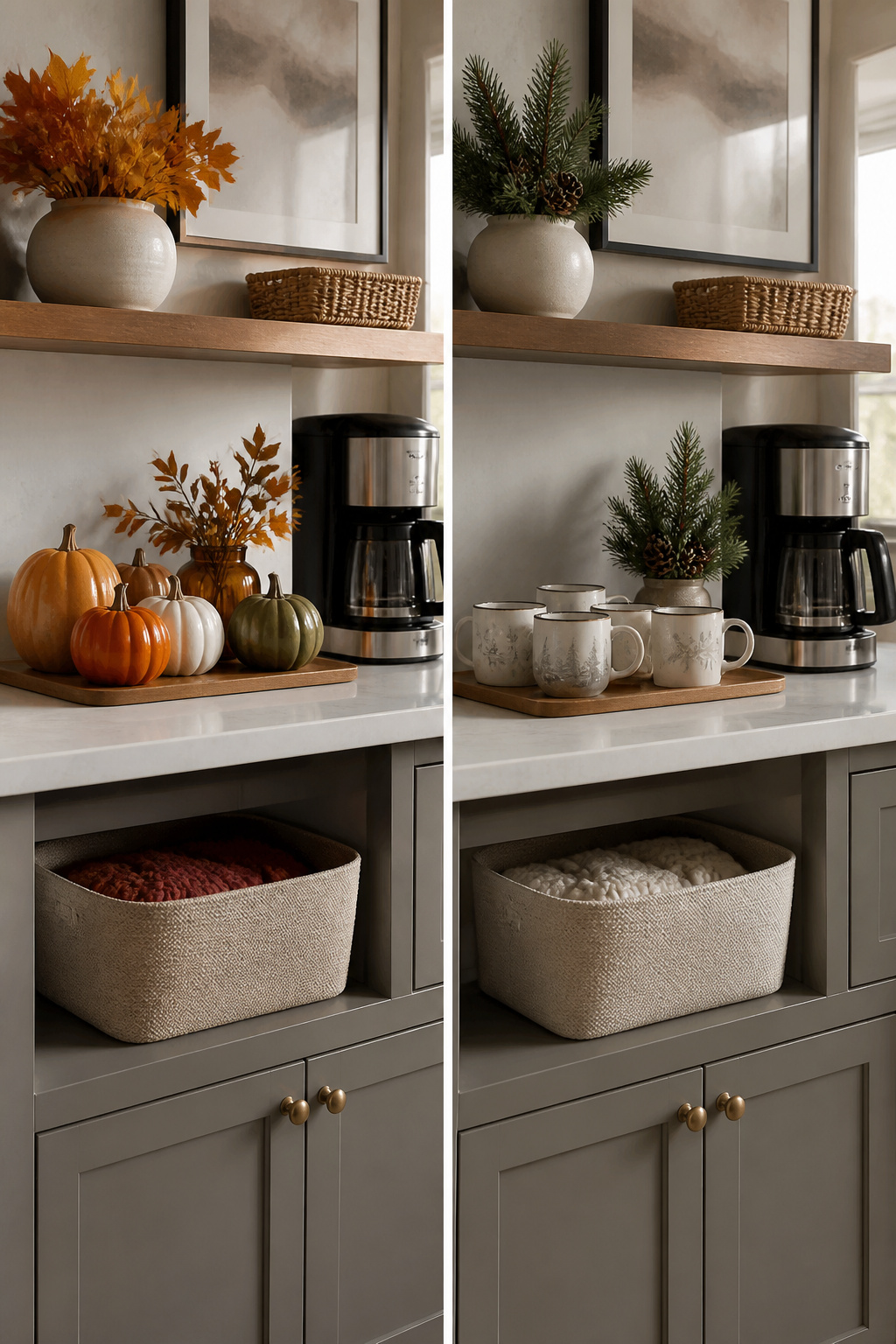
A seasonal coffee bar only works if you have a single bin for off-season items and a place to keep it. Most people skip the storage plan, which means November’s peppermint tins end up scattered in junk drawers until July.
The $20–50 annual spend breaks down to one or two small swaps: a ceramic pumpkin or two in October, a red enamel tray after Thanksgiving, maybe a set of green mugs you find on clearance in January. The mistake is buying anything that does not change how you actually make coffee. A themed sign behind the machine is visual clutter you stop noticing by week two. Swapping your everyday syrup bottle for a seasonal one, though, changes what you reach for each morning.
Store the bin wherever you already keep holiday decorations. Label it "coffee bar" so you are not hunting through four boxes of garlands next October. If you do not have that storage, skip the rotation entirely and buy one neutral set of accessories that works year-round.
25. Minimalist Counter
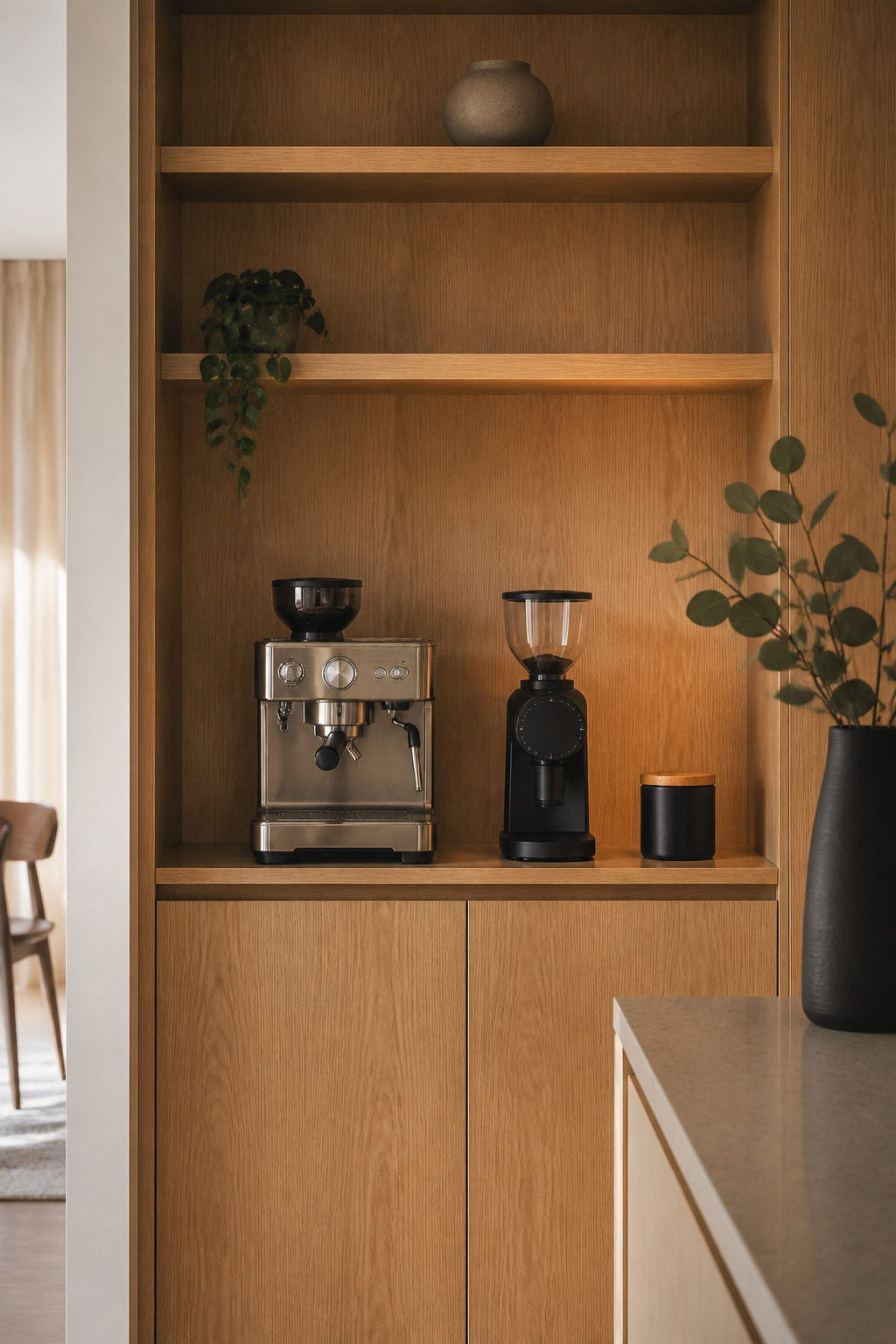
A minimalist counter lives or dies by the three-item rule: machine, grinder, one storage vessel. Anything else is a guest that overstays.
The machine and grinder are your $300–800 investment, and at that price each piece has to earn its visual presence. A quality espresso machine anchors the space, with a capable grinder beside it to keep the workflow tight. Skip the espresso machine if you batch brew; a dependable drip maker and grinder still land in that same range.
The storage vessel holds only what you will use this week. Beans stay fresher, and the counter stays clean.
This is the style that requires the most discipline to maintain. One mug left to dry, one extra canister for tea you forgot you owned, and the whole thing collapses into clutter. The line between intentional and empty is thin, and you are the one who walks it every morning.
26. Rustic Wood and Metal
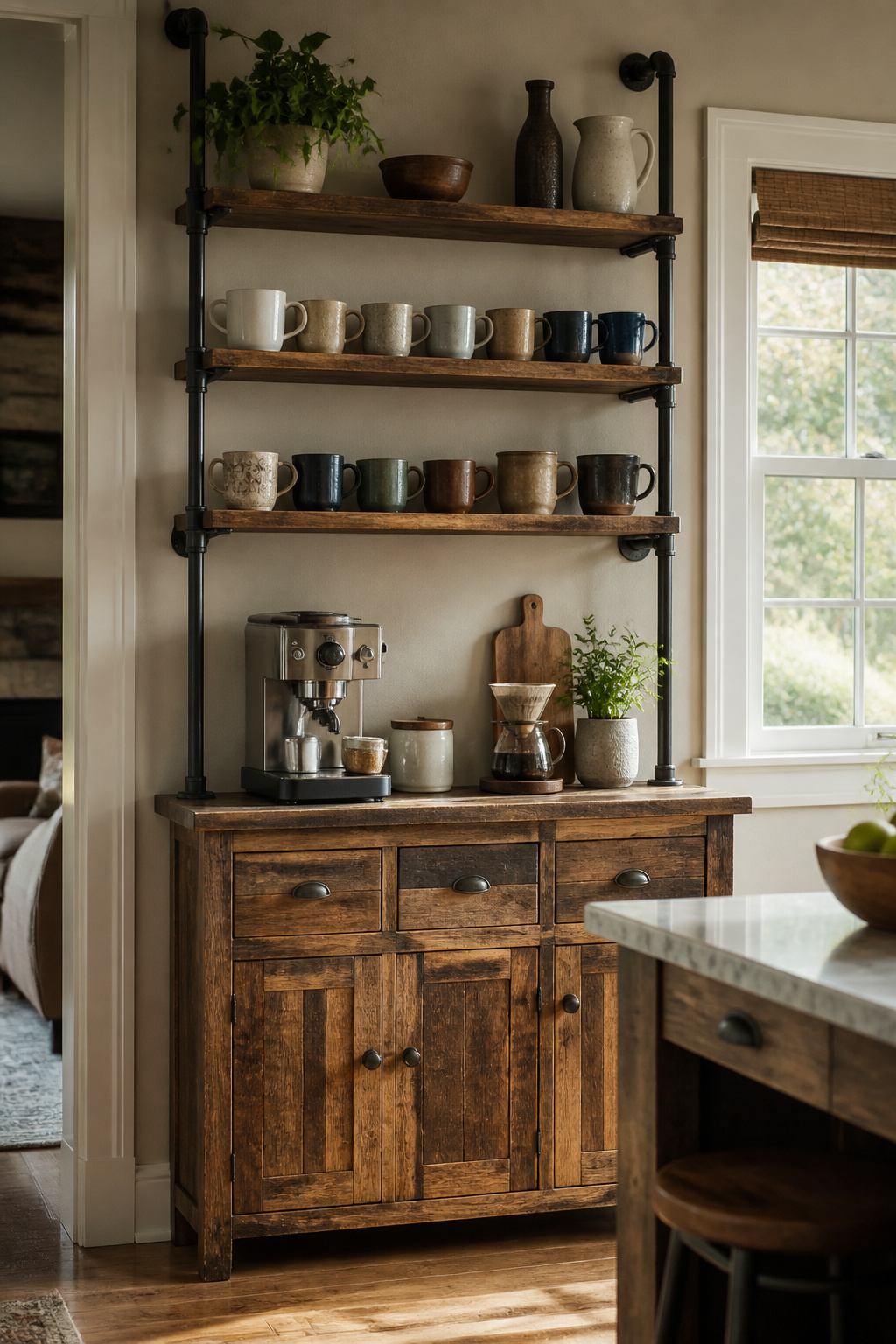
Reclaimed wood brings immediate warmth to a coffee bar, but the romance fades fast when you pull a splinter from your palm while reaching for a mug. Sand every surface to at least 220 grit and seal it with a food-safe finish if mugs will touch it directly; most reclaimed lumber carries old nail holes, uneven grain, and enough grit to ruin a morning.
Black iron pipe shelving runs about $80–200 for a simple two-shelf unit, depending on whether you buy flanges and pipe cut to length or assemble from hardware store stock. The exposed hardware looks intentional rather than unfinished, which saves you from hiding brackets or matching finishes.
This style pairs better with mismatched mugs than a matching set. A dozen identical cups read as a display; a collected assortment of thrifted stoneware and chipped enamel feels like it belongs against raw wood and iron. The irregularity of the materials hides the irregularity of the mugs, and vice versa.
27. Classy Neutral Station
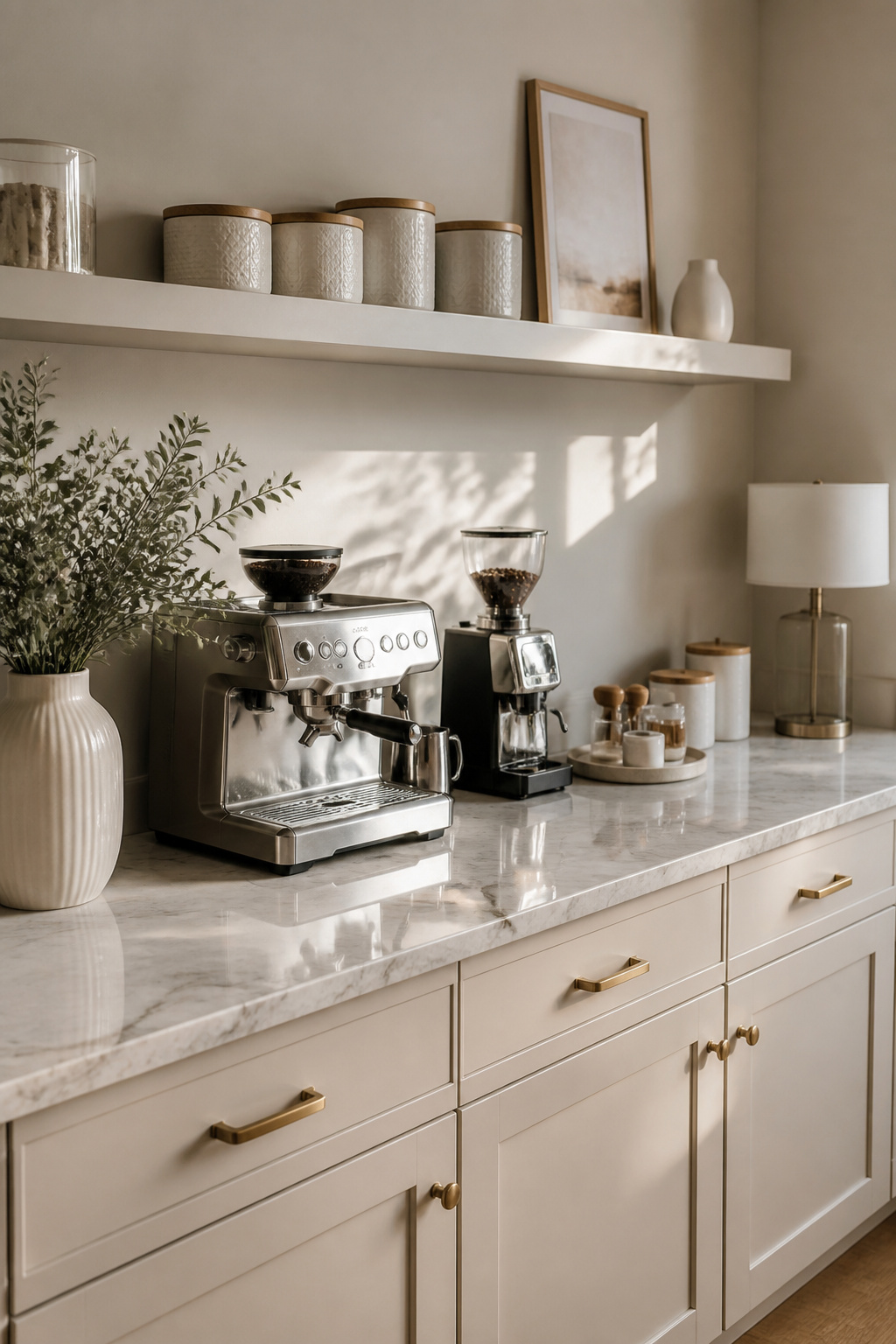
A marble countertop reads expensive until you price it out: $100 to $250 per linear foot for the real thing, which puts a coffee station out of reach for most weekend budgets. Laminate printed with a marble pattern runs $30 to $60 per linear foot and, from a few feet away, the illusion holds. The savings let you put money into metal instead. Brass or chrome on the faucet, the rail for hanging cups, or the feet of a small shelf ties the look together without matching every piece to death.
Ceramic canisters in white or soft gray finish the palette. Sets run $15 to $40, and the glaze catches light the way pricier stone vessels do. The trick is keeping the shapes simple; too much detailing reads kitchen-kitsch instead of quiet luxury.
Light surfaces with coffee demand a rhythm you actually follow. Wipe the laminate weekly before oils set, and once a month pull everything off for a real cleaning. Skip the sealed stone maintenance entirely, but do not pretend the pale top hides a Monday morning spill. A darker grout line on the backsplash behind the machine buys you a little forgiveness where splatter actually lands.
28. Living Plant Backdrop
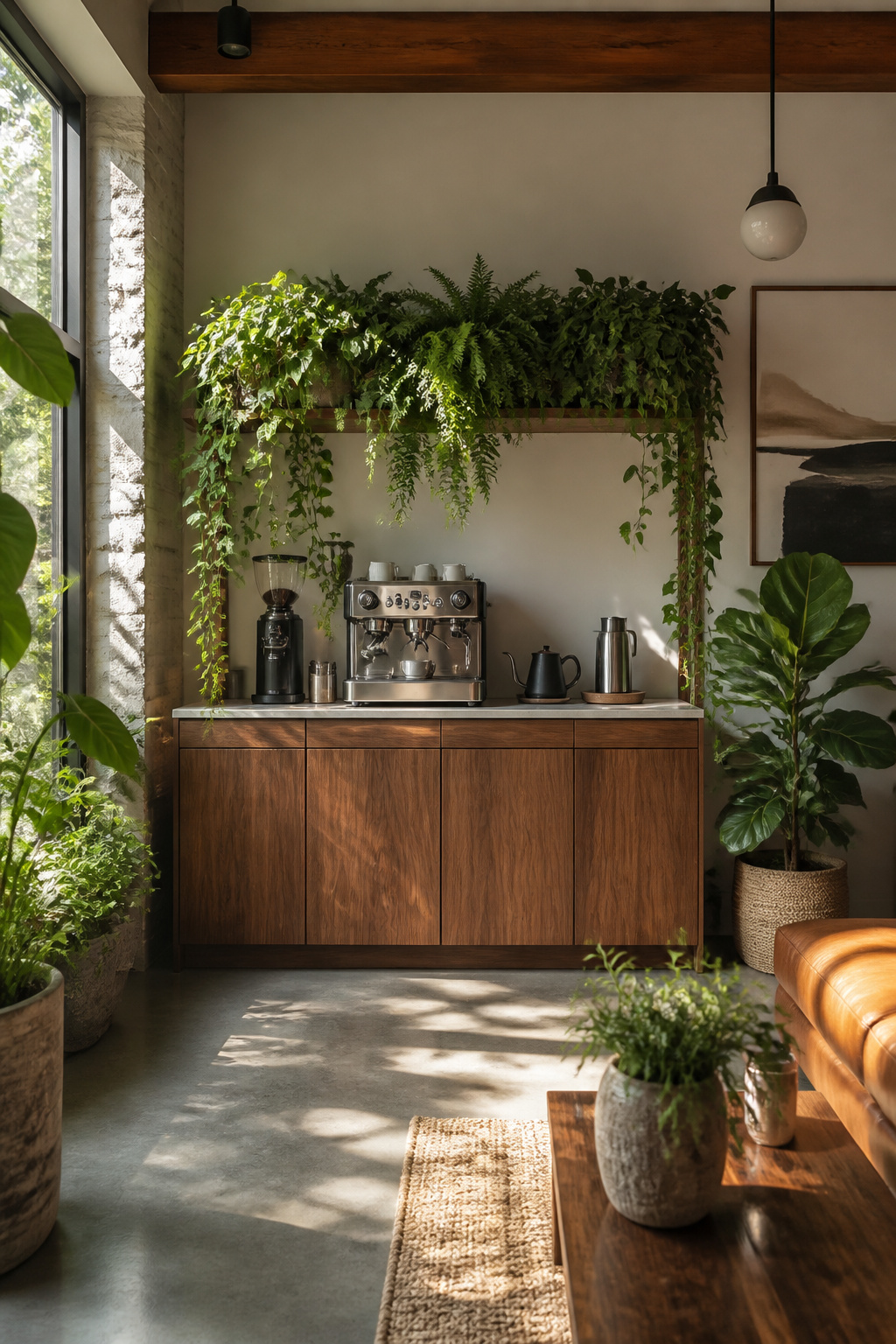
A coffee station puts out more humidity and heat than you think, and plants right against the machine cook. Pothos, ferns, and philodendrons handle it fine. Succulents and cacti do not; their leaves burn and they rot in the damp.
Leave 12 inches of clearance between the top of your machine and any shelf with greenery. Closer than that, the steam scorches leaves within a few weeks of daily brewing.
Expect to spend $25 to $75 a year on replacements. Some plants thrive for years in that microclimate, others decline no matter what you do. Buy them small at the grocery store or hardware store and do not get attached. The look is worth the small casualty rate, but only if you pick the right species and give them that buffer of space.
29. Artwork as Focus
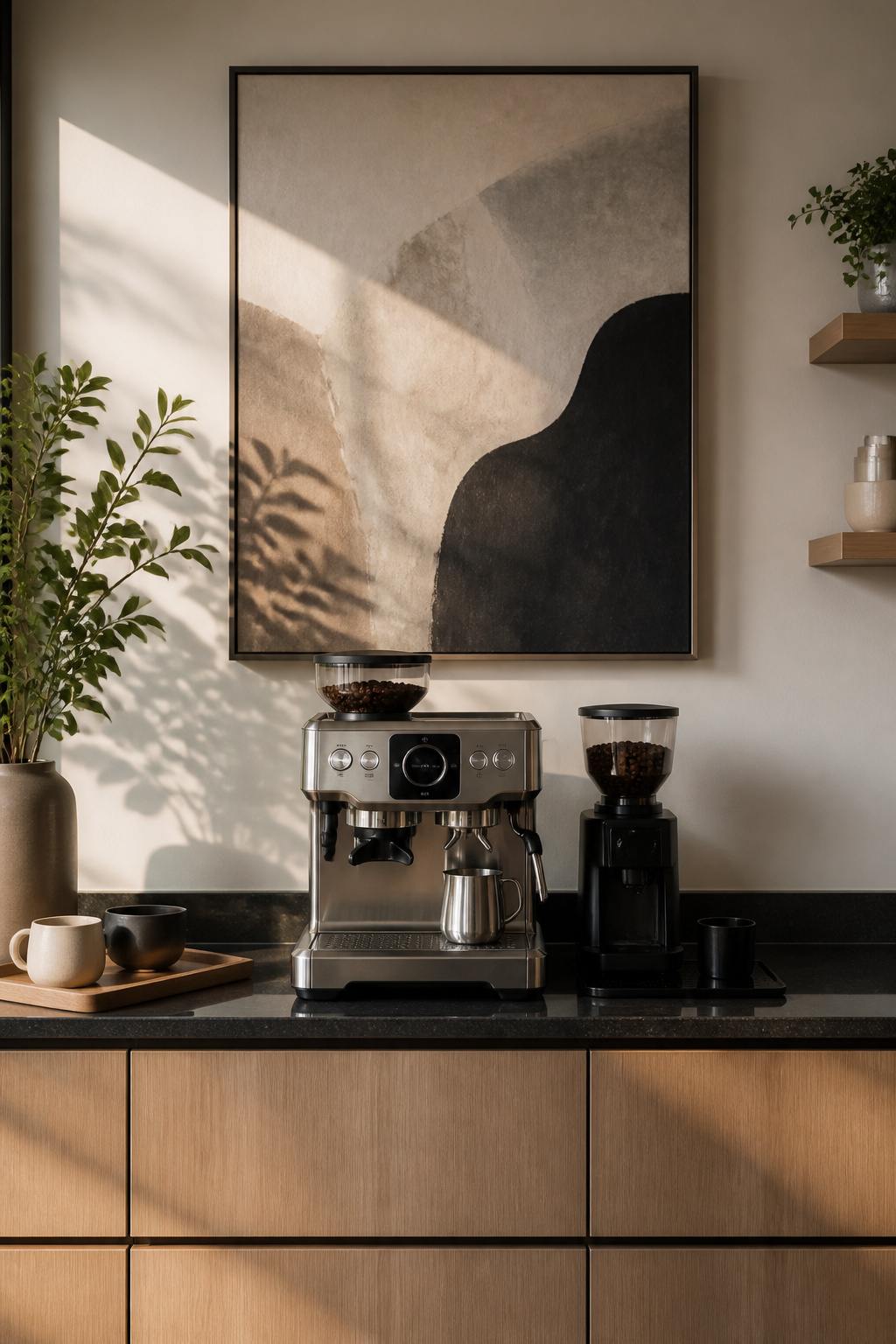
A single print or a tight cluster of three can pull a coffee station together faster than any appliance upgrade. The mistake most people make is hanging too high, which leaves the art floating above the action instead of anchoring it. Keep the center of the frame at 57 inches from the floor, a height galleries use because it sits at average eye level and keeps the composition connected to whatever sits below it.
Most renters and first-home owners do well spending $30 to $200 on prints in standard frames from places like Society6, Framebridge, or even Target’s Project 62 line. Above that, you are paying for rarity or scale, neither of which a compact coffee station needs.
Where people trip up is choosing art that competes with the station itself. A busy abstract with splattered color and aggressive brushwork fights the visual clutter of mugs, syrup bottles, and grinder cords. A simple graphic, a vintage botanical line drawing, or a single block color holds the wall without shouting over the countertop. Think of the art as the period at the end of the sentence, not another clause.
30. Open Shelving Display
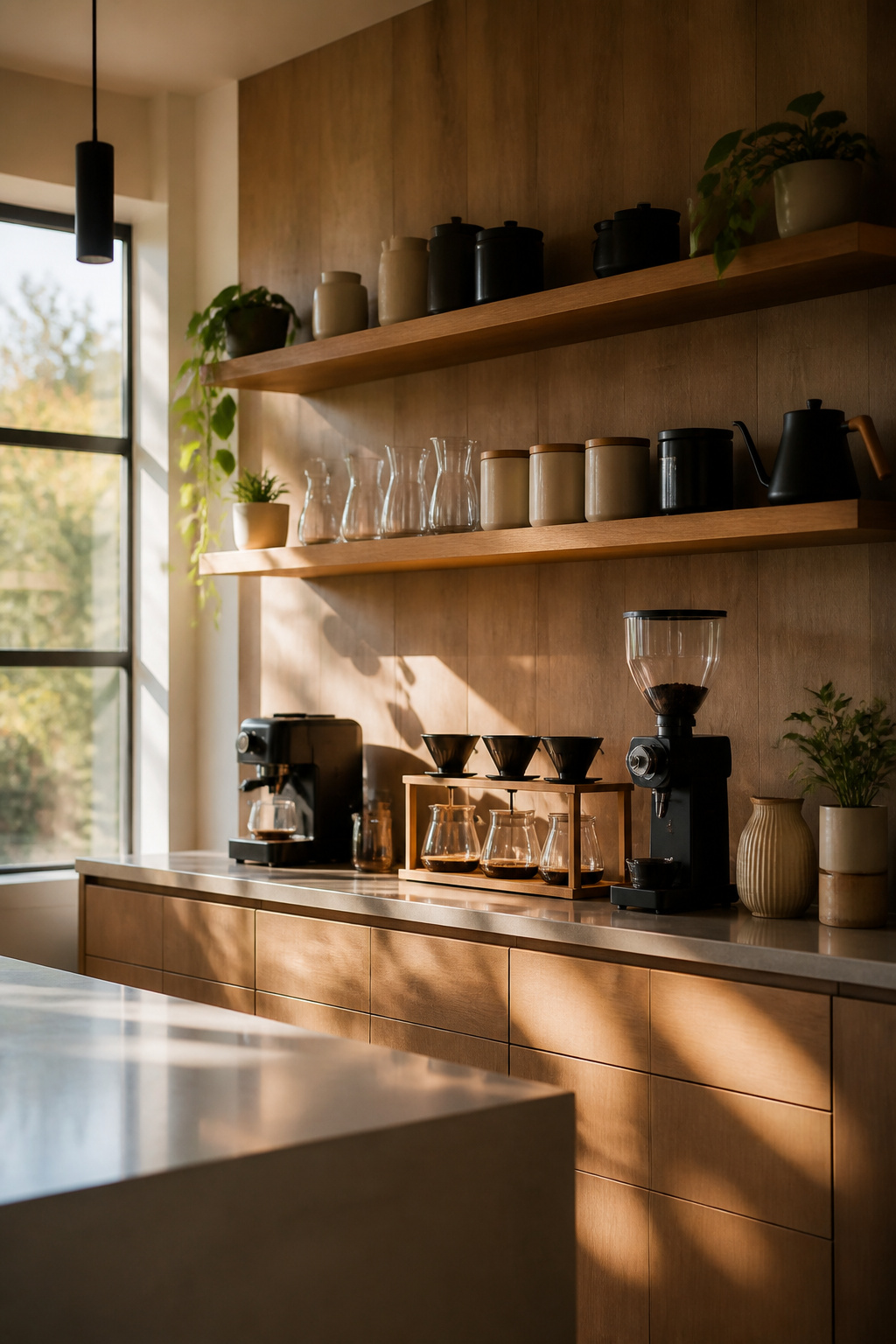
Open shelving turns your coffee setup into something you actually want to look at, not just use. A 12-inch shelf depth fits most canisters, pour-over stands, and small grinders without wasted space, while 10-inch boards shave off a couple inches where every fraction counts but leave taller items hanging off the front edge. A basic two-shelf bracket system runs about $20–60 in lumber and hardware if you cut the boards yourself and use simple L-brackets from any hardware store. The trade is dust. Everything sits out in the open, which means you’re wiping jars, scales, and the shelves themselves weekly if you want to keep it looking intentional rather than neglected. If you’re already sweeping the kitchen on Saturdays, add five minutes and it’s handled. Skip it if you know you’ll let it go three weeks and hate the film that settles on dark surfaces.
Essential Appliances
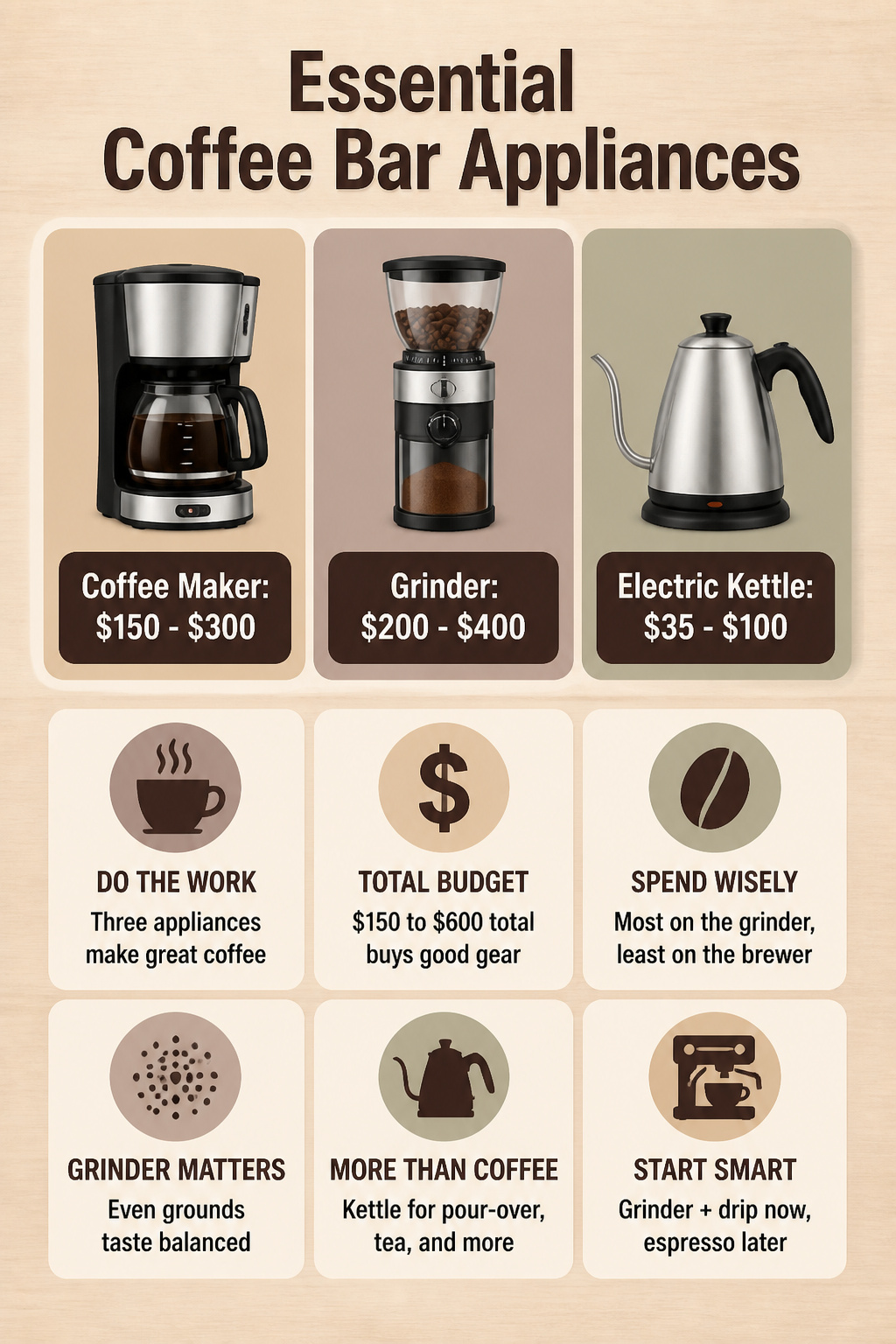
Three appliances do the actual work in any coffee bar: the coffee maker or espresso machine, the grinder, and an electric kettle. Plan your counter space and outlet placement around them before you think about canisters or display shelves.
For all three, $150 to $600 total buys competent entry-level gear that will last. That range is wide because the split matters more than the total. Spend the smallest slice on the brewer and the largest on the grinder. Cheap grinders produce uneven grounds, which means some particles over-extract and taste bitter while others under-extract and taste sour, no matter how fresh your beans are or how carefully you measure water. If your morning cup is muddy or unpredictable and you cannot blame the beans, the grinder is the culprit.
A gooseneck kettle sits beside them for pour-over, tea, or anyone in the house who skips coffee. You do not need everything new on day one. Start with a solid burr grinder and a reliable drip machine, then add the espresso later if milk drinks become a regular habit rather than an occasional treat.
Organization Systems
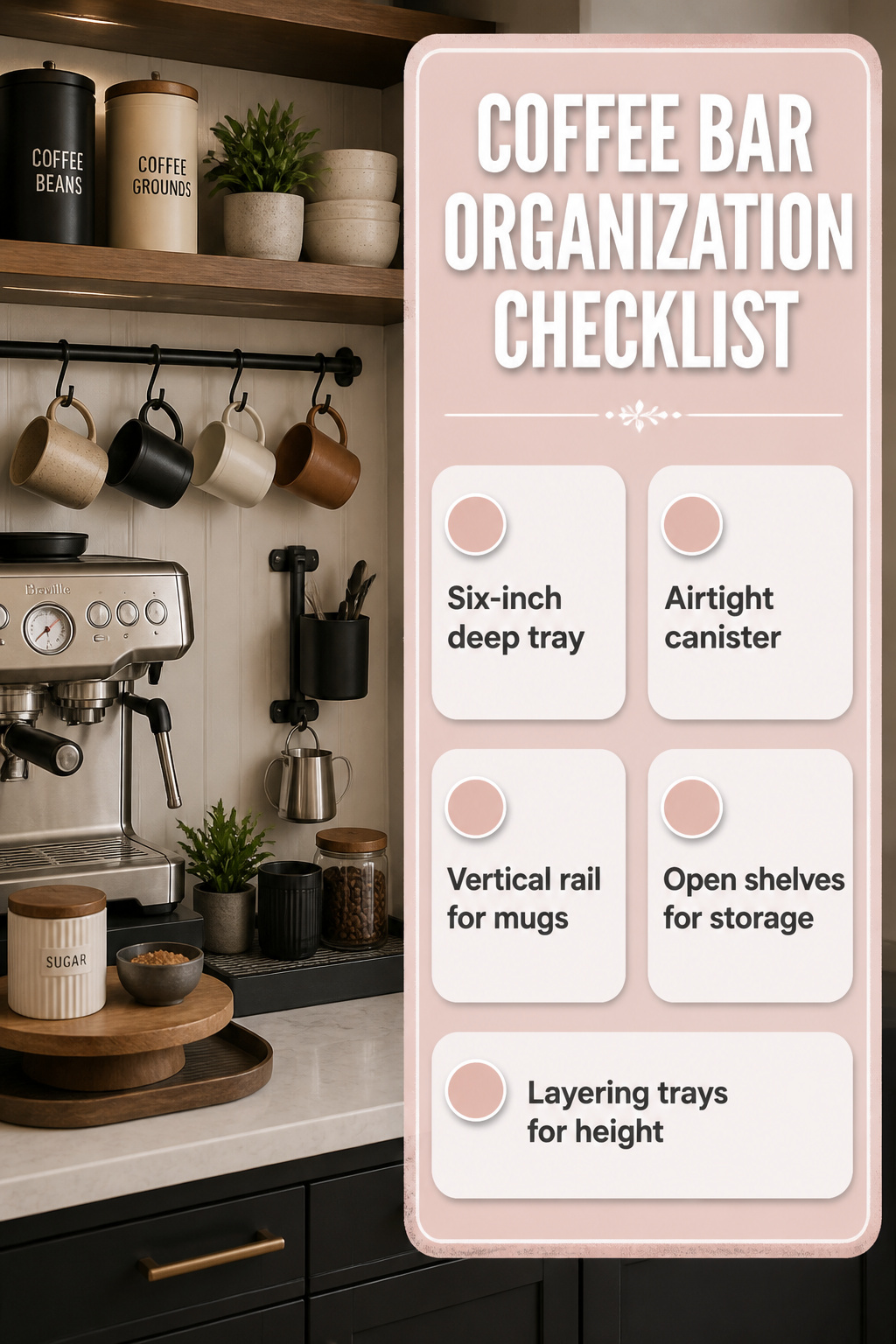
A six-inch deep tray sits at the back of your coffee bar and catches drips before they hit the counter without stealing workspace you cannot spare. Beans keep better in an airtight canister with a one-way valve that lets CO2 escape while oxygen stays out; grounds only need a plain seal since they have already degassed. If your counter is tight, think vertically: a rail mounted under the cabinet above holds mugs on hooks, and a wall-mounted rail beside the machine keeps tools off the surface entirely. Open shelves above the station let you store canisters and bowls at eye level rather than spreading them across the counter. Layering with trays, cake stands, or cutting boards builds height and keeps the daily-use items in front, the backups behind. Vertical storage wins on any counter under two feet wide, but it only works if you reach for the top shelf without a step stool, so keep the everyday mug on the hook, not the display set.
Styling Without Clutter
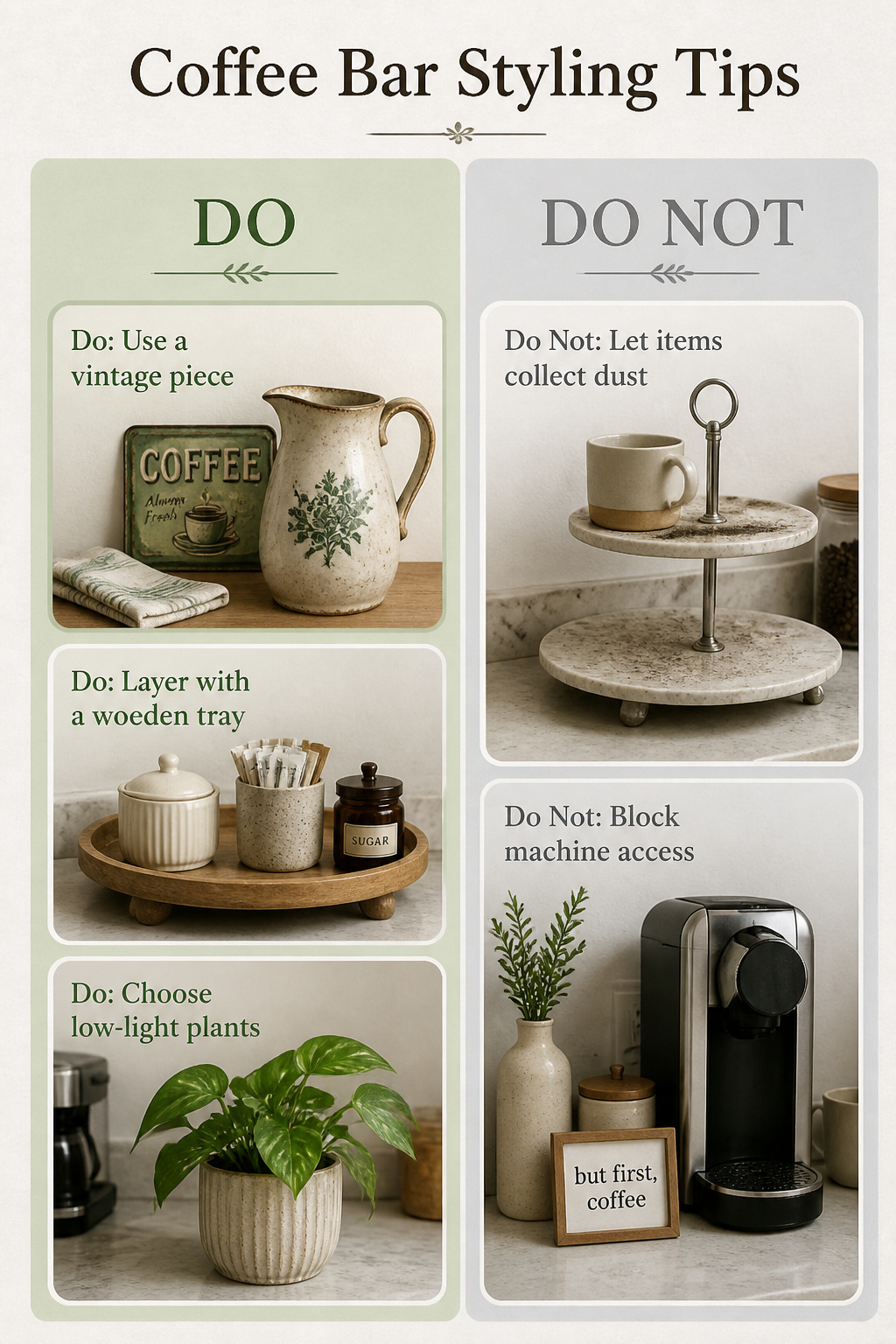
The line between a coffee bar that feels lived-in and one that collects dust sits at about 80 percent functional, 20 percent decorative. Cross it, and your morning routine starts around a tray of objects you wipe down twice a year.
A single vintage piece earns its place: one ceramic pitcher, one tin sign, one item with actual history rather than manufactured nostalgia. Pair it with one plant, something that tolerates the steam and low light most coffee corners get. A pothos or a ZZ plant usually survives where a fiddle-leaf fig browns and drops leaves into your grinder. Layer those on a footed wooden tray, which keeps daily items like sugar packets and a spare pod corralled and lifts them off the counter so the surface stays wipeable.
Small trays also catch the clutter that accumulates naturally: the spare key, the receipt, the packet of vitamins you meant to take. Without a tray, those become three separate messes. With one, they read as a single still life.
The moment styling becomes an obstacle is when you reach around something to plug in the machine, or when a cake stand meant for pastries holds nothing but a film of grease. If you have not used the decorative item in a week, it is not decorating your coffee bar. It is colonizing it.
Small Space Solutions
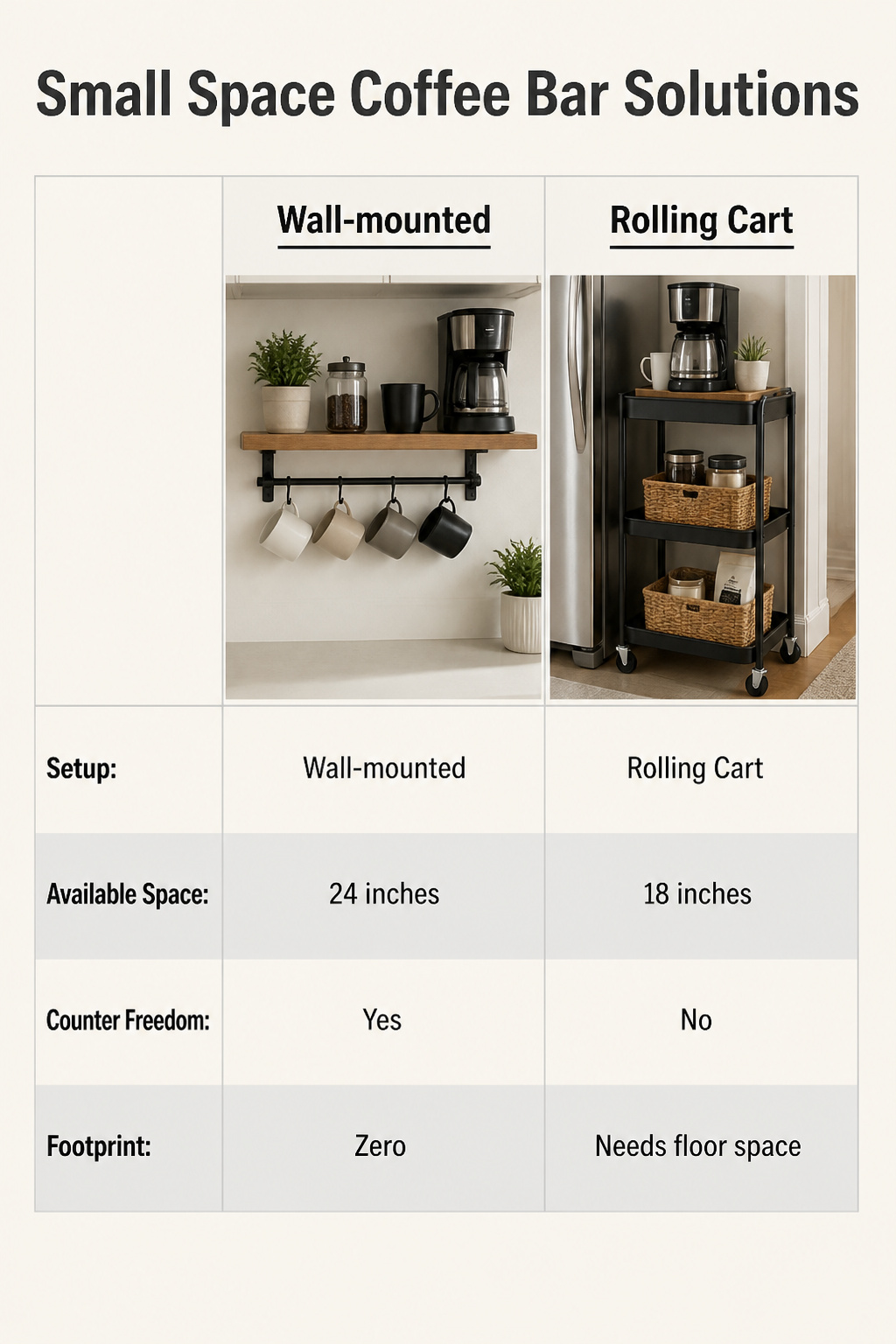
A kitchen under 100 square feet teaches you fast what counts as essential. Coffee gear rarely makes that cut on the counter, so the first question is whether you have 24 inches of available floor space. That is the line between a rolling cart that actually works and one that blocks your dishwasher every morning.
Wall-mounted options free the counter entirely. A floating shelf paired with a rail-and-hook system under an upper cabinet gives you storage without footprint. You keep mugs vertical, the machine at eye level, and the only floor space sacrificed is what your feet already occupy.
The rolling cart is the fallback when walls are full or rented. Sources describe these at about 18 inches wide, narrow enough to park beside a fridge or in the gap between counter and doorway. Baskets and trays keep the small surface functional; without them, a cart becomes a clutter pile on wheels.
A cabinet conversion, roughly 24 by 24 inches, is the other workable option if you can spare the storage. One source runs two setups at that size: seasonal on a butcher block, permanent behind a door. Either way, the measurement holds. Two feet is enough if you edit your gear to match.
Frequently Asked Questions
What should be included in a coffee station?
A coffee station needs the machine you actually use, a grinder if you brew from beans, mugs, and the small items that make the routine work: filters, a scoop, sweeteners, and something to catch drips. Keep only what you reach for daily on the counter; backup supplies and occasional-use items belong in a drawer or basket below. The article also suggests a rail-and-hook system for mugs if wall space allows, and a tray or riser to contain the clutter.
How do I set up a coffee bar in a small kitchen?
You need one to two feet of counter space, with everything else stacked upward. A wall-mounted rail with S-hooks, under-cabinet storage, or a narrow niche with a false floor at 36 inches can all work. The article warns against rolling carts in galley kitchens; they need floor space and a traffic lane that narrow kitchens do not have to give.
What appliances do you recommend for creating a coffee bar?
The right appliance depends on your space and noise tolerance. Thermal carafe drip machines and manual pour-over setups run nearly silent after heating water, which matters in a home office. For a garage or basement gym, skip electric machines entirely; humidity corrodes heating elements, so a pour-over setup with a manual grinder has nothing to fail.