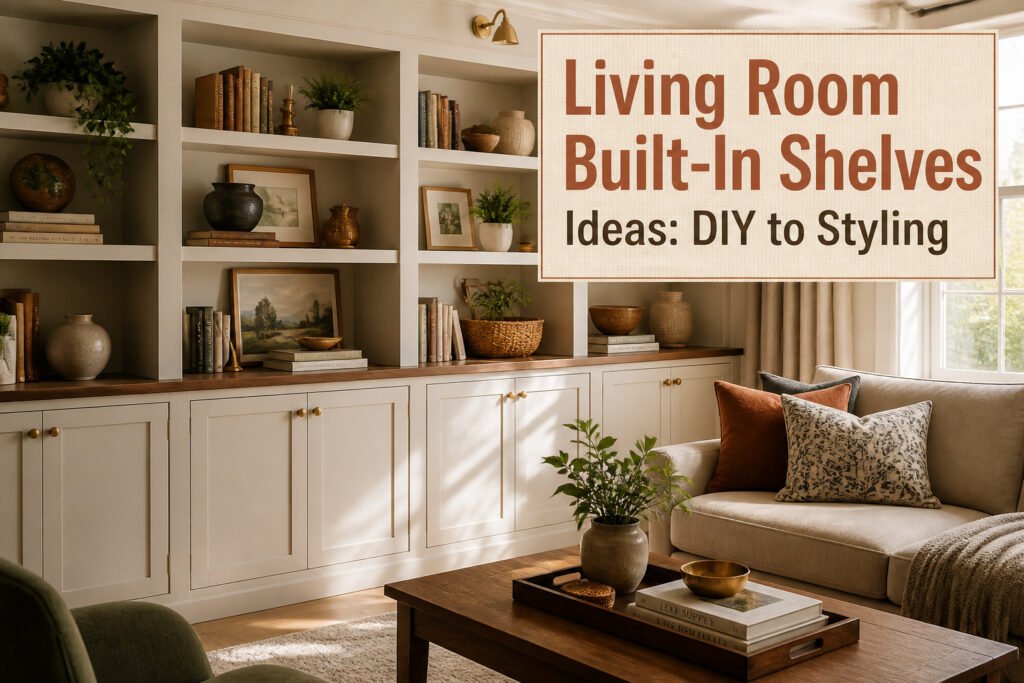
Built-in shelves living room projects range from a $200 IKEA hack to full custom millwork, and the deciding factor is whether you need closed storage below or open display above. The catch is that stock cabinets rarely fit walls straight out of the box: older houses need scribe strips, and the trim to hide gaps runs 30–40 percent above the cabinet price. Paint the cases and filler the same color, though, and that mismatched Billy bookcase run reads as intentional architecture.
1. DIY Built-In Shelves

The cheapest way to get built-in shelves living room projects finished in a weekend is to start with stock cabinets or prefab bookcases and make them look like they were always there. Home Depot, Lowe’s, IKEA, Costco, Menards, and Amazon all carry units that work for this, and Habitat Rebuild stores sometimes have pre-owned cabinets you can refinish for even less.
The basic approach stays the same across sources: set your cabinets or bookcases in place, then bridge the gaps with trim and molding so the separate pieces read as one continuous wall. Fill seams with caulk, paint everything the same color, and suddenly that $200 Billy bookcase run looks intentional. For surfaces that take wear, a $100 quartz remnant pulled from a local stone yard works as a hearth top or counter, giving you durability at laminate prices.
Local kitchen stores can also tweak stock sizing if the big-box dimensions do not quite fit your wall, which still runs cheaper than fully custom work. The key limit is your ceiling height and wall irregularities: older houses especially will need scribe strips or filler pieces, so buy an extra length of matching trim when you pick up the cabinets.
2. Decorating Tips for Built-In Shelves

Most built-in shelves start out tidy and end up as dumping grounds for whatever fits. The difference between cluttered and curated comes down to a few deliberate choices.
Vary the heights and shapes so your eye moves across the whole unit. Stack some books horizontally and stand others upright. Use one tall vase or frame to anchor a shelf, then set a shorter object slightly in front of it. Layering this way adds depth without crowding. If your shelves are adjustable, change the spacing between them to break up the grid.
Group similar items in odd numbers, usually three or five. Our eyes naturally seek these groupings, and they read as intentional rather than random. Mix textures too: smooth ceramic beside rough woven baskets, glossy photo frames against matte pottery.
Pull colors and shapes from the furniture and decor already in the room. A navy throw pillow across the sofa can echo in a small dish or book spine on the shelf. This ties the built-ins into the rest of the space instead of letting them float on their own.
Leave open space. A shelf packed edge to edge feels heavy. Start with fewer pieces than you think you need, live with it for a week, then add one item at a time until it feels balanced. Large single pieces, a big vase or a sculptural object, do more work than clusters of small knick-knacks.
Books do not have to carry the whole load. Turn a few spines inward for neutral blocks of color, or use them as risers to lift smaller objects. The goal is a shelf that looks lived-in, not staged for a photograph.
3. Built-In Shelf Design Ideas

Built-in shelves living room projects work best when the unit reads as part of the wall itself, not furniture parked in front of it. Painting shelves and walls the same color erases the visual break between them, and Fairview Taupe by Benjamin Moore is the shade that keeps coming up for this trick. It is warm enough to feel intentional, quiet enough to let your books and objects take focus.
Material choice should match the architecture you already live with. A rustic room wants thick hardwood and leather or metal straps that hold books in place. A modern space leans toward walnut with minimal frames, or wood veneer with lacquer and thin gaps between shelves to keep the line clean. Hardwood plywood and engineered wood cost less than solid stock and still hold up if the finish is right.
Adjustable shelf heights are not a luxury, they are the feature that keeps the unit useful past the first arrangement. Standard peg holes let you move from tall vases to stacked paperbacks without rebuilding. Plan for that range before you cut anything.
4. Functional Uses of Built-In Shelves

Built-in shelves earn their keep when they handle the clutter you already own while giving your eye somewhere to rest. The practical half is straightforward: closed lower cabinetry hides the router, board games, and that stack of manuals you will need someday. The open upper shelves carry what you actually want to look at. This dual role is what separates built-ins from a freestanding bookcase you could shove against any wall.
Danielle Perdue, an interior designer in Westport, Connecticut, used this exact pairing in a waterfront house: crisp white built-ins with closed storage below and open shelves above, styled in muted blues and natural textures for a quiet coastal feel. She noted that the closed lower cabinetry creates a practical storage solution while the open shelves lend the room a more serene feel.
"Built-in bookshelves add functionality but they also increase the property value of a home. High-quality custom built-ins are seen as an upgrade and can increase the resale value of a home."
For a renter or first-time owner, this means you are not just building storage; you are building equity. Even a modest run of shelves around a fireplace can frame the room like architecture rather than furniture. The trick is to let the shelves hold both the useful and the beautiful: the drink tray you actually use when people come over, the inherited knick-knack you would never buy but cannot part with, a few books you have read more than once. Let the objects do the decorating, and the built-in becomes a feature, not a filler.
5. Color and Material Choices

Solid wood sits at the top for built in shelves living room projects, though hardwood plywood or engineered wood will carry the load for hundreds less. The trade is straightforward: solid hardwood takes dents and refinishing across decades, while plywood edges need covering and engineered boards swell if moisture gets past the paint. For a renter planning two years or an owner stretching a $600 weekend budget, the affordable options win. Paint them in a tone pulled from the wall or a piece you already own so the unit reads as architecture, not furniture wedged in place. Walnut or oak left natural suits built-ins meant to stand out; lacquered medium-tone wood veneer stays quiet in modern rooms where the books themselves supply color. LED strips tucked behind the face frame cost extra but repay it in evenings when the shelves become the lamp.
IKEA and Prefab Hacks

You can get a built-in look without starting from raw lumber. Billy bookcases are the usual starting point, and with good reason: they are narrow enough to flank a fireplace without stealing floor space, and the adjustable shelves let you hide uneven ceiling heights by trimming the top gap with crown molding.
The steps run like this:
- Remove the baseboards where the units will sit, or scribe the bookcase bases to fit over them so the whole assembly sits flush to the wall.
- Anchor the cases to studs; the back panels are thin and the cases will rack if you skip this.
- Fill the seams between units with wood filler or thin lattice strips, then prime and paint everything, cases and filler together, so the grain does not telegraph through.
- Add a face frame of 1×2 poplar around the front edges, nailed and glued, to hide the seam where the adjustable peg holes run. This one step is what separates a hack from a built-in.
For lower storage, Sektion cabinet boxes work the same way but need a deeper clearance. The advantage is drawer hardware that is already installed; the tradeoff is a taller toe-kick that reads more kitchen than library. Build a 4-inch plinth from MDF and wrap it with baseboard to bring the line down.
Either route, order the filler panels and end caps at the same time. They are cheaper in the initial shipment than as later singles, and the color match is exact.
Seasonal Shelf Styling

The first rule of seasonal shelf styling is taking everything off. Every single time. Clearing the shelves lets you see what you actually own instead of falling into the same pairings, and it forces you to dust while you’re at it. What sits in storage half the year should be your neutral backbone: plain vases, solid books, simple frames. These stay. What swaps are the thin, cheap accents that read as one season only. Think woven textures for summer, something with weight for winter. You do not need a new collection each time. The challenge is pairing stored pieces differently, which is half the point of restyling. If you buy anything new, make it something you absolutely love enough to keep year-round or rotate back in. Otherwise you are just hoarding holiday filler. Keep one bin per season under a bed or in a closet, labeled, and the swap takes an afternoon, not a weekend. The open space you leave between items matters more than any single piece you add.
What Stock Cabinets Cost

Stock cabinets run about $60–$200 per linear foot depending on depth and finish, while prefab bookcases from big-box stores usually land between $150 and $400 each. A $100 quartz remnant for a countertop between two units is a real number that shows where the material savings come in: you are not buying a full slab, and you are doing the cutting and fitting yourself.
| Option | Price Range | Depth | Best For |
|---|---|---|---|
| Base stock cabinets | $60–$150/ft | 24 in. | Window seats with storage |
| Wall stock cabinets | $80–$200/ft | 12–15 in. | Flanking a fireplace |
| Prefab bookcases | $150–$400 each | 11–16 in. | Quick filler on a flat wall |
| Open shelf units | $100–$250 each | 10–12 in. | Display-only runs |
What pushes the total up is not the boxes. It is the trim, the filler strips, and the paint or stain to make mismatched pieces read as one built-in. Plan on adding 30–40 percent above the cabinet price for those finishing materials. If you are working around existing baseboard or uneven floors, stock cabinets will need shimming and scribing, which eats time but not cash. Prefab units skip that labor, but you lose the custom fit and the hidden storage.
Mistakes That Waste a Weekend

Built-in shelves look simple until you are two hours from Sunday night with a unit that wobbles and paint that will not dry. These are the missteps that turn a weekend project into a two-weekend recovery.
- Measuring once, not twice. A quarter inch off on width means your unit either gaps at the wall or bows outward. Measure the span at top, middle, and bottom; walls are rarely flat.
- Skipping the stud finder. A built-in that leans on drywall anchors alone will sag once you load books. Find studs, or use toggle bolts rated for the real weight, not the weight you think you will load.
- Painting after assembly. You will miss the interior corners and nick the face frames with your brush. Paint boards flat on sawhorses, let them cure, then build.
- Buying decor before the shelves exist. That oversized vase you loved fits nowhere once the actual shelf depth and height are fixed. Cardboard templates, cut to your planned dimensions, save the return trip.
- Overcrowding to "finish" the look. Sources show styled shelves, but your eye needs empty space to rest. Leave one shelf per unit nearly bare, or the room reads as cluttered storage, not built-in architecture.
Frequently Asked Questions
How do I style built-in shelves?
Vary heights and shapes so your eye moves across the whole unit, group objects in odd numbers, mix textures like smooth ceramic beside rough woven baskets, and pull colors from existing furniture. Leave open space rather than packing shelves edge to edge, and start with fewer pieces than you think you need.
What materials are best for built-in shelves?
Solid wood sits at the top for durability and refinishing potential, though hardwood plywood or engineered wood will carry the load for hundreds less. Paint affordable options in a tone pulled from your wall so the unit reads as architecture, or choose walnut or oak left natural if you want the shelves to stand out.
Can I create built-in shelves with stock cabinets?
Yes, and it is the cheapest way to finish a project in a weekend. Set cabinets or prefab bookcases in place, bridge gaps with trim and molding, fill seams with caulk, and paint everything the same color so separate pieces read as one continuous wall.