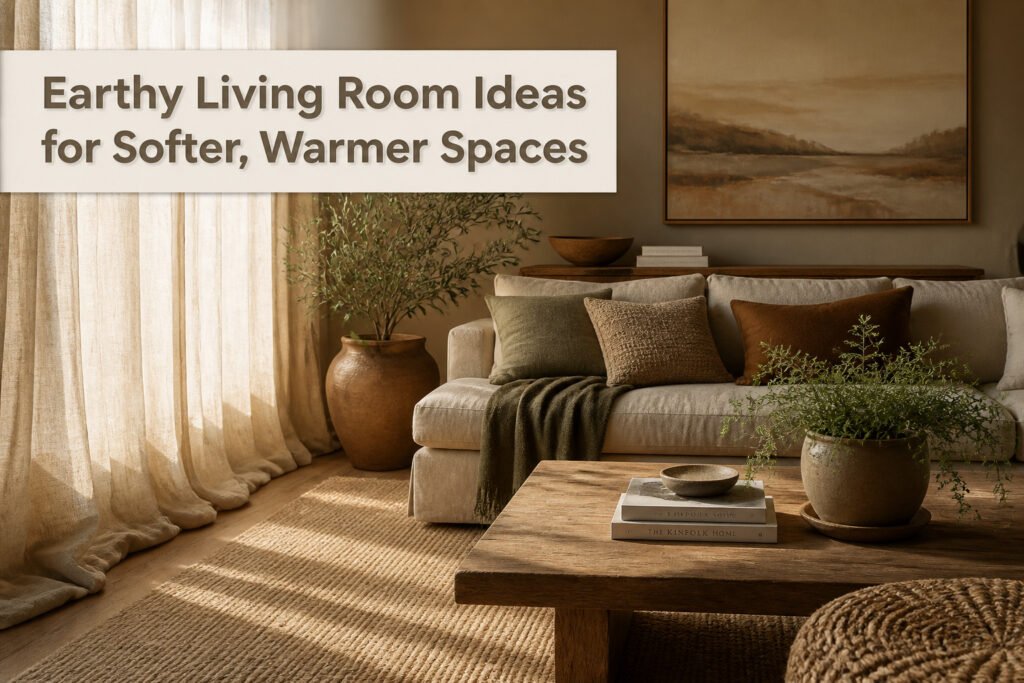
Earthy living rooms range from polished minimal to layered maximal, and the difference comes down to how much control you want over aging. Raw pine darkens in sun whether you planned for it or not; sealed oak stays put but never earns the patina. The article starts with linen curtains pooling on the floor to hide baseboards you did not choose, because renters build around what they cannot change.
1. Soft Traditional Layers

Linen curtains hung high and wide do more than soften the window. They catch morning light and spread it through the room like a thin wash of color, and when they pool an inch or two on the floor, they hide baseboards you did not choose. A worn Persian-style rug with the pile beaten low anchors everything without demanding center stage; the pattern is busy enough to forgive coffee drips and the odd scuff from a moving box.
A tufted sofa in camel or ochre gives you the shape of something formal without the posture. The buttoning reads traditional, but the color keeps it from feeling like a showroom. Stack two or three throw pillows in mismatched patterns that share a single tone, maybe rust or faded sage, and the whole thing looks collected over time rather than bought in an afternoon.
This setup travels well for renters. The sofa and rug come with you, and the textiles, the curtains and pillows, are the cheap pieces you replace when they finally give out. They also age faster than the furniture in a way that helps; a little wear on the rug or a fade line on the linen just adds to the story you are building.
2. Sunlit Desert Calm

Pale terracotta walls change everything in a room that gets hammered by afternoon sun. Instead of fighting the light, the desert palette absorbs and softens it, so the space stays warm rather than washed out.
Unsealed pine is the right choice here, but only if you accept what happens next. Where the sun hits, the wood darkens to a honeyed amber over months, and that uneven patina becomes part of the texture. Bleached finishes or sealed surfaces would fight this; raw pine lets the room age with you.
For textiles, skip anything bright white. Unbleached muslin curtains filter glare without bouncing it back at you, and a flatweave rug in sand and rust ties the floor to the walls without competing. The rust tones specifically keep the palette from going flat; without them, you end up with a beige room that the sun finishes off entirely.
The whole approach asks you to let the room change. That is not the instinct with a rental or a first project, where you want control. But in strong light, control is expensive and temporary. This way, the sun does some of the work.
3. Stone Hearth Soul

A room built around a fireplace does not need a working chimney or even a working anything. The hearth is an idea more than a fixture: a heavy center that pulls seating inward and away from the wall where the television usually goes.
In a rental without a flue, you can fake the anchor with a low console faced in stacked stone tile from the hardware store. It sits against the wall like a built-in, weighs enough to feel planted, and leaves when you do. A thick wooden mantel shelf on iron brackets does the same work higher up, giving you a ledge for candles and the eye a horizontal line to rest on. For something lighter still, a deep windowsill layered with river rocks and a few fat candles reads as hearth enough in a small space.
The shift that matters is the seating. Once the "fireplace" wall becomes the focal point, the sofa faces inward and the chairs turn to meet it, not the screen. The conversation becomes the activity. You will watch less television without deciding to, and the room will feel warmer for it.
4. Warm Boho Ease

The warm boho look starts with a strict neutral base: cream, sand, camel, or terracotta on every large surface. Against that, you can layer patterned textiles without the room turning chaotic. Every pattern you bring in must share at least one color already present in the room; this is what keeps a mix of ikat, block print, and geometric stripes from fighting each other.
Rattan furniture anchors the material story. A peacock chair or a simple woven coffee table adds instant texture, and it ages better than the synthetic versions that crack after a season near a window. Macrame or woven wall hangings fill vertical space without the weight of framed art, which matters in rooms with lower ceilings.
What sells the look is a genuinely old piece: a faded kilim, a dented brass tray, a stool with water rings. New everything reads as a set, and this style collapses into catalog staging the moment it feels staged. The old item does not need to be expensive. Flea markets and estate sales are full of woven pieces with the patina that factory distressing never quite copies.
5. Rustic Elegance

Live-edge wood tables look effortless, but the ones that last are cut with precision and sealed so the natural edge won’t splinter or cup. Iron hardware carries weight; cheap castings feel hollow and rattle in their mounts, while solid forgings settle into place with a quiet thunk. Linen with visible slubs works the same way: the irregularity is intentional, the weave is not. The tension is between raw material and exact construction, and that gap is where the style lives.
This is where your budget hurts most if it is thin. Distressed reproductions read as costume because the wear is applied evenly, the proportions are slightly off, the materials are something else painted to look like something else. One well-made piece, even small, outperforms a room full of them. A single live-edge side table with hand-forged legs and a linen cushion you can see the slub in gives the whole room permission to be simple. The rest can be plain, rented, secondhand. The honest piece does the work.
6. Minimal Earth Tones
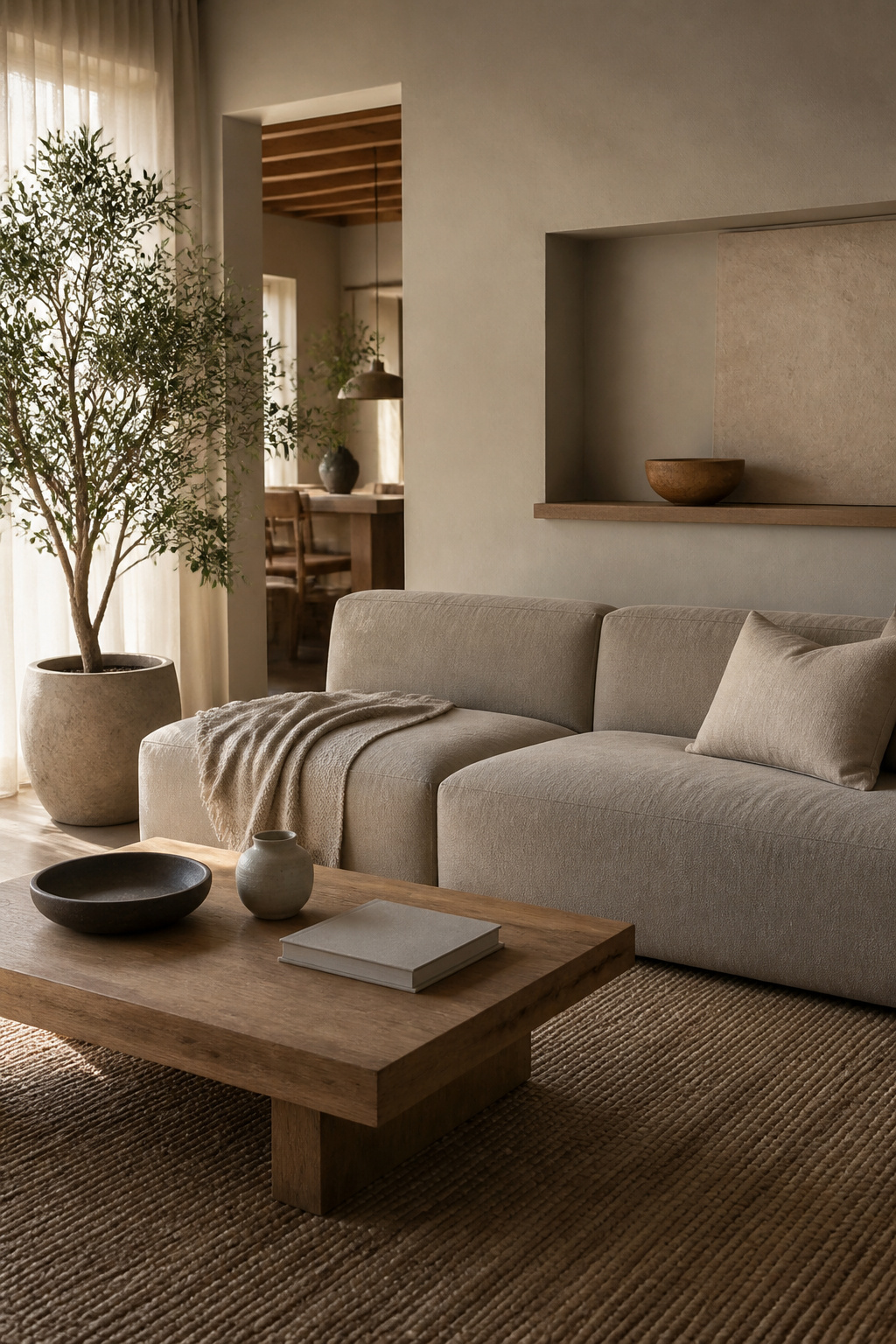
Minimal earth tones work because the palette itself supplies the warmth that sparse rooms usually lack. You start with one sofa in warm gray linen, one wooden bowl on a bare table, and a single large plant. Each piece has to carry its own weight, which means spending your budget on fewer, better things rather than filling the room fast.
The discipline is real. A low-profile seat and a simple wood table earn their place through material and proportion, not through clutter around them. Off-whites, taupes, and warm grays offset with wood accents give the relaxed feeling without the coldness people associate with stripped-down spaces. Washable covers matter here, because this style shows every mark. One lived-on sofa in a restrained room reads as peaceful; the same sofa with a stain reads as unfinished.
7. Old World Comfort
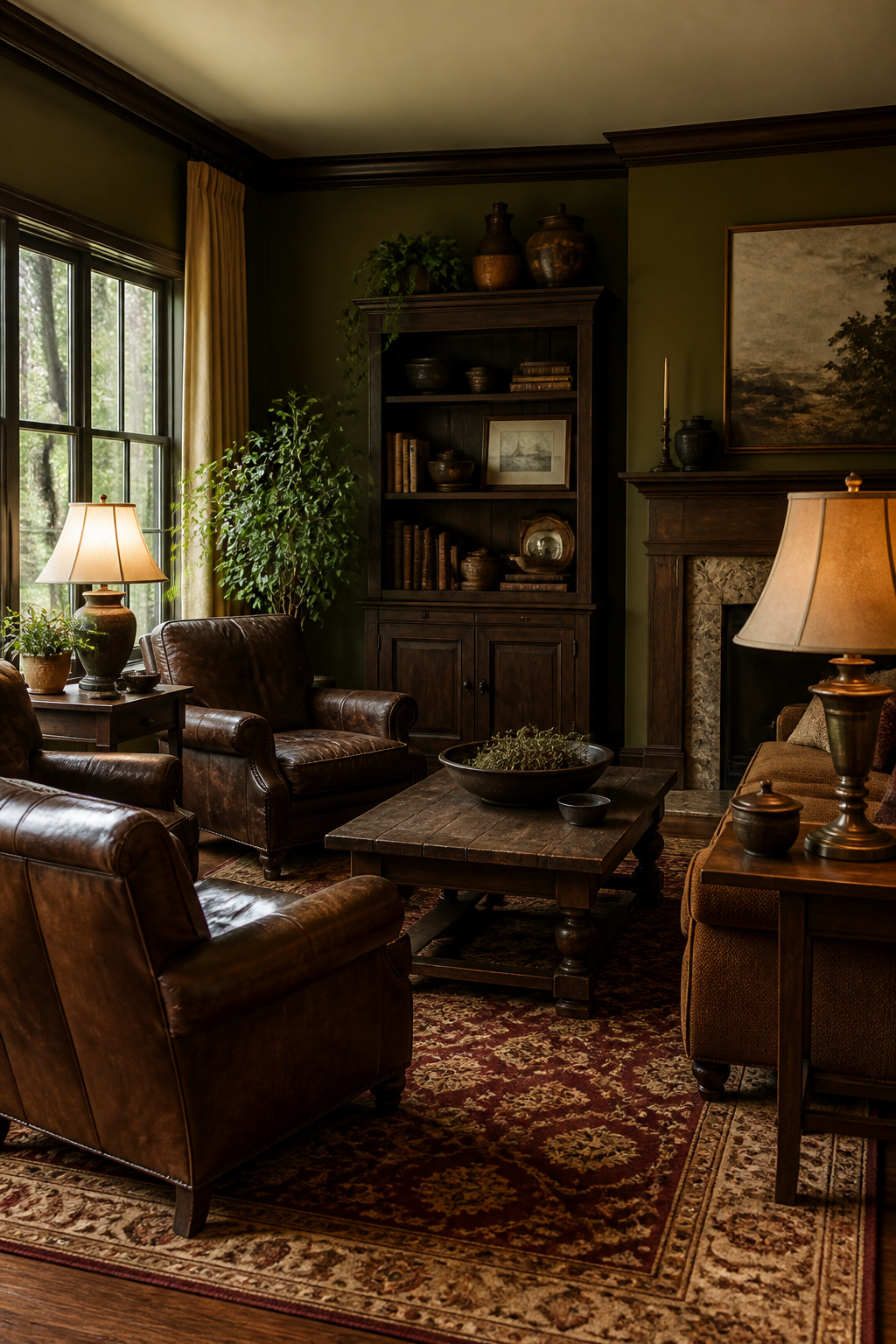
Dark wood and worn leather carry a warmth you cannot fake with stain or distressing paint, but you do not need a grandfather’s estate to get there. A single overhead fixture kills this look every time, so plan for at least three lamp sources before you buy a single chair. Library-style reading chairs in used condition give you the slouched, broken-in silhouette that new leather takes years to earn. Pair them with brass fixtures that already carry patina; the dull glow matters more than polish here. Walls in deep olive or warm umber close the room in without turning it cave-like, though this palette is the least forgiving of bad lighting. Without those three lamps casting yellow light downward, the olive goes flat and the leather reads as orange. A $25 thrifted floor lamp with a linen shade and two matching table sources at chair height will do more than any paint color to sell the illusion of age.
8. Nature-Inspired Calm

The most grounded rooms start with a place you have actually stood in. A photograph you took on the Olympic Peninsula, say, or a coast you walked during a gray October afternoon. You are not decorating around a theme. You are building a room from three colors and two textures you can name because you saw them.
Work from one image, not a Pinterest board of twelve. Pull the moss green where the forest meets the salt water, the wet bark brown, the fogged silver of the sky. For textures, choose what you can source honestly: raw cedar that still smells, linen with the slub left in. The reference keeps you honest when a catalog offers something cleaner.
Literal nature prints usually read as hotel art. A blown-up fern or waterfall photograph fights the room instead of grounding it. Abstraction works better: a canvas in those same three colors, a ceramic vessel with the same surface irregularity as the driftwood you picked up. The viewer feels the place without being told where it is.
If you rent, the textures matter more than the colors. Paint goes back; a wool throw or a chunk of unsealed stone on the coffee table travels with you. The goal is not to recreate the forest. It is to make the room feel like the moment before you took the photograph, when you stopped moving and the air was still.
9. Warm Modern Grounding

Clean lines only feel cold when the material underneath is cold. A walnut console with visible grain and softly rounded corners warms a room faster than any paint color can, while the same shape in white lacquer reads as showroom furniture. Grain and roundness matter more than tone when you are judging whether a modern piece will soften or harden your space.
Wool upholstery beats polyester every time, not just for texture but because it ages visibly and well. Terracotta planters or a single ceramic lamp base do the same work that concrete attempts without the industrial chill. These swaps do not add visual weight; they add visual life.
This approach suits small rooms better than most earthy styles because the spare silhouettes leave actual open space. A low walnut sofa with thin arms, one rounded ceramic side table, and a single wool throw gives you breathing room that layered traditional pieces would swallow. The warmth comes from what the shapes are made of, not from how many of them you fit in.
10. Vintage Earthy Layers

A room built from different decades still reads as intentional when every piece carries the same warm wear. Estate sales beat thrift stores for wood furniture; you are looking for solid frames with surface patina, not laminate pretending to be old. Five disparate items look planned together if they share either tone or texture: three honeyed oaks and two beaten leathers will settle in, but one glossy black piece breaks the truce.
Budget $200–400 per seat to re-cover vintage upholstery, labor and fabric together, because the bones are usually worth saving even when the fabric is not. Simple slipcovers in washed linen or cotton duck cost a fraction if you sew, and they let you wash out the cat hair or the coffee instead of living with it. The risk is buying a vintage sofa that sags structurally; press down on the front rail and feel for movement before you commit.
11. Earthy Elegance

Hand-plastered walls catch the light in a way flat paint never will, but the crew who knows how to do it right charges accordingly. One craft piece per room is the workable compromise: a single hand-loomed throw, a ceramic lamp base with a thumbprint still visible, a side table with the slight wobble of the human hand. Buy the rest well-made and machine-produced, and let that one object carry the story.
This style photographs almost too well. The risk is a living room that looks staged for a shoot rather than lived in by actual people. The fix is deliberate disorder. Drape that hand-loomed textile over the back of the sofa instead of folding it. Let the ceramic lamp sit slightly off-center. The irregularity you paid for only reads as elegance when it has company: a stack of mail, a cup with coffee rings, the normal mess of a Saturday afternoon. Without that friction, the room feels like a showroom, and the craft becomes decoration rather than character.
12. Modern Organic Flow

Curved furniture changes how a room breathes. A kidney-shaped coffee table softens the center of a seating group and lets people move around it without the shin-level corners of a rectangle. Arched floor lamps repeat that curve upward, and sofas with continuous arms, no hard break between back and arm, keep the line going at sitting height.
The flow matters for traffic more than most people expect. Curves guide movement; they suggest a path instead of creating the abrupt stops that angular pieces force. A rounded corner invites you to keep walking, so the room feels larger even when the footprint stays the same.
You need more floor space for this to work. A curved sofa sits deeper front-to-back than a boxy one, and a kidney table needs clearance on all sides to avoid looking like an obstacle. In a narrow room, one curved piece, a lamp or a single chair, reads as intentional. Packed with curves, the same space turns into a furniture store display. Measure your walking paths before you commit; if the main route through the room is under three feet wide at any point, keep the curves to accents and stay angular on the big pieces.
13. Classic Farmhouse Warmth

Farmhouse style turns generic the moment you walk into a room full of distressed signs that say "Gather." The workable version keeps the bones and loses the costume.
Use shiplap on one wall only, painted in a warm white or very soft sage, and let the other three surfaces stay simple drywall or plaster. That single accent gives you the horizontal line and shadow without the barn effect. Carry the same idea through smaller pieces: side tables with apron-front proportions, the same squared shape you see on a farmhouse sink, read as familiar without being literal. Black metal hardware on drawers, doors, and even lamp bases ties the room together for about the cost of a few pulls from the hardware store.
The real risk is everything looking too new and too coordinated. The fix is one genuinely old agricultural piece. A grain bin flipped to a side table, an egg crate mounted on the wall for mail and keys, a wooden seedling flat under glass as a coffee table. One item with real use history stops the room from reading as a showroom set. Everything else can be new; that single piece does the convincing.
14. Statement Wood Moment

One large wooden element does more for an earthy living room than a dozen small ones scattered around. A single slab table, a wall of vertical cedar, or a reclaimed beam ceiling gives the room its center of gravity and lets everything else settle around it.
The piece you choose needs space to breathe. Keep pattern and strong color away from it. A live-edge table against a busy rug fights for attention and loses both battles. Let the wood be the event; pair it with quiet upholstery and walls that step back.
Installation has its realities. A slab table is heavy enough to dent standard flooring, so plan for protection underneath before it arrives. A feature wall of vertical boards needs to land on studs, and finding every one of them matters more with cedar than with lightweight paneling; the boards will warp or pull if anything is loose. Ceiling beams look dramatic, but check whether your joists can take the load or whether you are bolting into decorative housing that only reads solid.
Start with the wood, build the rest of the room in lower keys, and the earthy warmth you want will already be there without chasing it through accessories.
15. Warm Everyday Cozy

The lived-in side of earthy style is where a deep sofa with a washable cover earns its keep. You can let the dog up, spill coffee, and still have the thing looking decent by Sunday night. An ottoman that stores blankets keeps the room from swallowing your whole linen closet, and a side table level with the sofa arm means you never fumble for where to set a mug.
But function only looks good with editing. Cozy slides into cluttered fast. Nothing sits on the floor except furniture, a plant, or one basket. That one-foot rule is what separates a room you want to sink into from a room you have to wade through. Everything else needs a drawer, a shelf, or a reason to leave.
16. Soft Mediterranean Calm
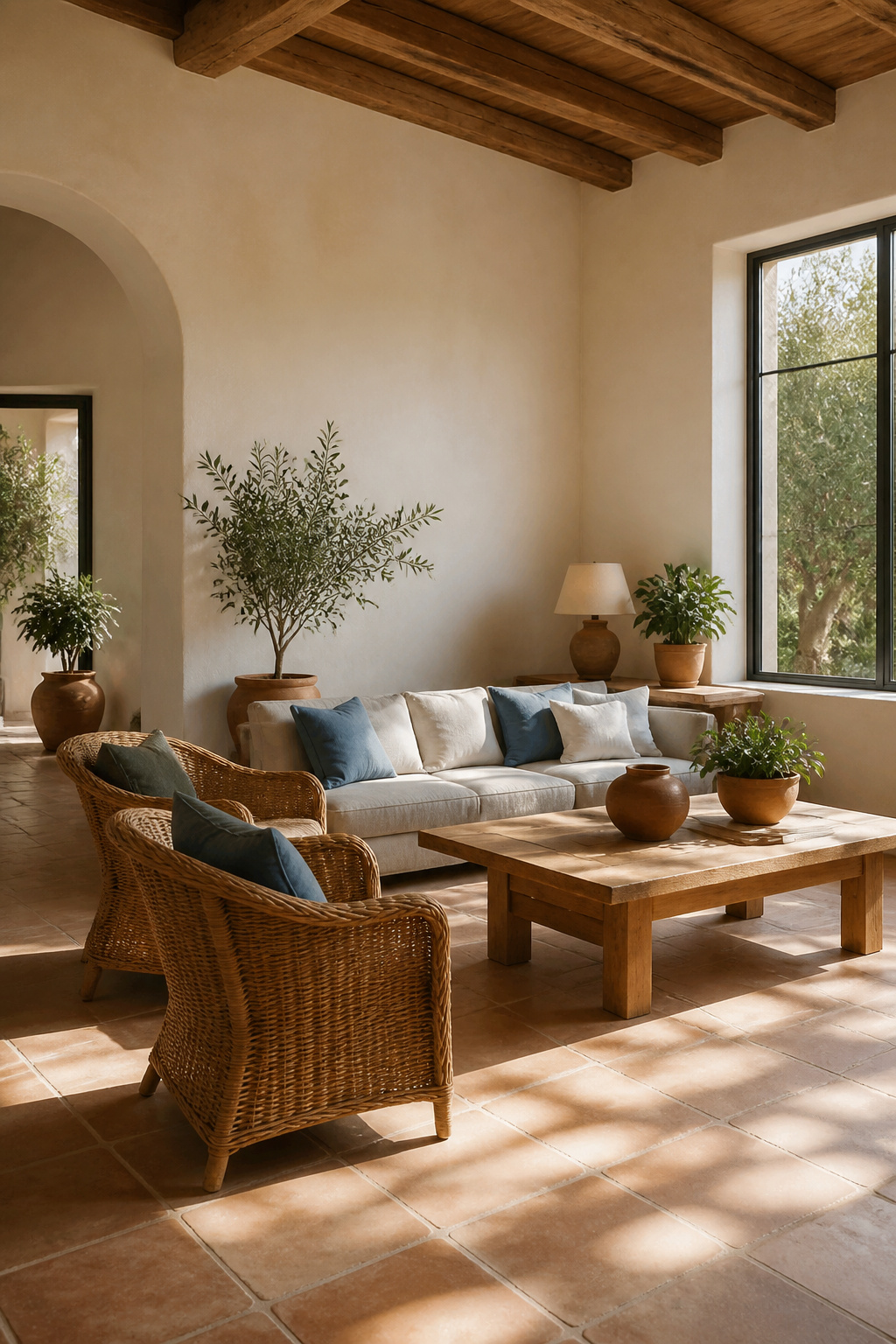
Whitewash reads warmer when it sits over a terracotta or ochre base instead of starting from gray. Lime plaster in warm white, not stark, carries that glow. Dusty blues soften the walls without competing for attention.
Woven rush seats on oak frames, ceramic tiles with slight color drift from batch to batch, and ironwork with simple scrolls rather than ornate twists give the room its regional bones. These materials need natural light to stay alive. In a north-facing room, shift to warmer whites and add more wood so the space does not flatten into coolness. A honey-toned oak coffee table or exposed ceiling beams can carry the warmth the walls cannot generate alone.
17. Collected Cottage Layers

A collected cottage look reads as decades of slow accumulation, but you can build it in a year if you work with intention. Start with two matching pieces, a pair of nightstands or twin lamps, to give the room a spine. From there, add one item at a time with a single rule: each new piece must relate to two you already own, through color, material, or era. A brass frame links to your brass lamp and to the warm wood of the first nightstand. A faded textile picks up the blue in the frame and the worn finish of an old bench. This is how the room begins to talk to itself.
Cottage style collapses when every object competes at the same small scale. One large piece, even something plain like a simple linen sofa or a single oversized basket, gives the eye a place to rest. Without that anchor, the room feels like a shop display rather than a lived-in space. Let the big piece be quiet and the small pieces carry the story.
18. Grounded Modern Retreat
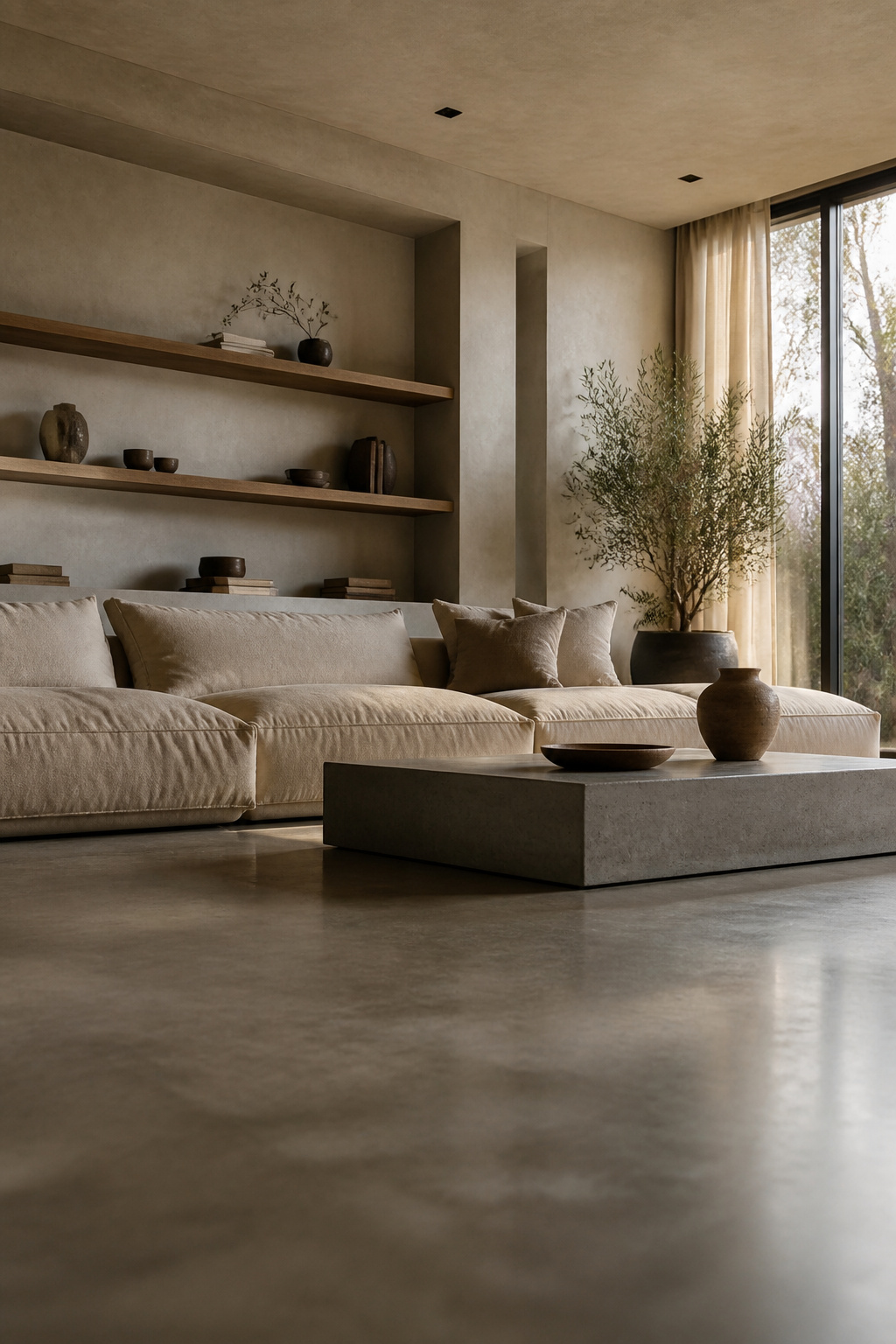
Low furniture changes how a room breathes. Seat your sofa and chairs at 14–16 inches high instead of the standard 18, and the ceiling suddenly feels taller, the floor more present. The proportion shifts from sitting on the room to sitting inside it.
This works best with earth-toned concrete or microcement floors that carry the same visual weight wall to wall. Heavy textiles, linen or thick cotton, should pool slightly where they meet the floor. That soft break between fabric and hard surface keeps the space from feeling staged.
The trade is storage. Horizontal surfaces disappear when everything stays low, so you need to plan upward. Wall-mounted shelves at eye level carry what side tables and credenzas otherwise would. Keep them shallow; deep shelving fights the openness you just bought yourself.
19. Cozy Layers Done Right

Layering textures is where most earthy living rooms fall apart. The eye needs variety to read the room as intentional rather than cluttered, and that variety comes down to scale and count more than anything else. Use three textures minimum, five maximum. Below three the space reads flat; above five you have started a junk shop.
The common mistake is choosing all medium-scale patterns. A medium woven stripe, a medium floral, a medium cable knit. They fight for the same visual territory and the eye tires fast. What works is one large statement texture, a chunky boucle or an oversized ribbed throw, paired with two that read smaller. A fine-gauge linen and a tight herringbone, say. That hierarchy lets each piece register without shouting.
Vary the weave size, not just the material. Two knits in different fibers still read as one texture if the stitch size is similar. Mix looped, flat, and piled surfaces instead.
The squint test catches what planning misses. Step back, blur your eyes, and check whether shapes still read as distinct. If everything melts into one brown lump, your scale variation failed or your palette went muddy. Earthy tones drift toward mud fast; keep one texture significantly lighter or darker than the others to preserve separation.
20. Earthy Modern with a Polished Edge

Earthy modern does not have to mean raw or unfinished. The sharper version keeps the same oak, linen, and stone but gives them a controlled edge: matte lacquer on oak instead of oil, linen with seams pressed flat rather than slouching, stone honed to a satin smoothness rather than left pit-rough. These finishes read as intentional, and they shift the room closer to contemporary without losing warmth.
The catch is upkeep. Polished and honed surfaces show scratches, water rings, and the dull patina of handled use faster than rougher ones. A honed stone coffee table in a high-traffic spot will need regular sealing, maybe yearly, and you will notice every glass set down without a coaster. Matte lacquer on a dining table resists some staining but marks more visibly than oiled wood, where a dent just joins the grain.
Spend the money on precision where hands meet material daily. A lacquered oak sideboard you open twice a week can carry the rougher cut; the honed stone top of a coffee table you touch every evening deserves the investment and the maintenance schedule. Vertical pieces and display surfaces, the ones you look at more than handle, can stay raw or lightly finished. That split, polished against rough, is what keeps the look grounded rather than sterile.
21. Everyday Earthy Comfort

Most people land on earthy living room ideas by painting one wall warm terracotta or olive and swapping cool gray pillows for ochre and rust. That alone shifts the room from cold to grounded. Add one natural material you did not have before, maybe a woven jute basket or a raw wood bowl, and you have the entry point done in a weekend with paint and textiles.
The danger is stopping there. A single natural material reads as an accent you forgot to build around. The difference between a room that looks intentional and one that looks like a Pinterest phase is the second layer. Add another material, raw linen curtains or a cork side table, or bring in one plant with real scale, something that hits at least knee height rather than another three-inch succulent. That second move makes the first one look like it was planned, not stumbled on.
22. Soft Earthy Layers

The muted end of the earthy palette lives in the space between color and neutral: putty, greige, warm taupe, dusty rose, and sage at its grayest. These are the tones that end arguments in shared spaces, where one person wants color and the other resists it. Neither side wins outright, which is exactly the point.
Matte paint finishes are essential here; any sheen reads as cold. Eggshell or satin will undo the softness you’re after, turning walls into something distant and office-like. Flat or matte absorbs light instead of bouncing it back.
The risk with this palette is flatness. Without texture, the room can feel like a rental blank-slate rather than an intentional choice. Layer in woven accents, soft fabrics, and natural wood tones to give the eye somewhere to land. A greige wall with a nubby linen sofa and a warm taupe throw reads as considered; the same wall with smooth leather and glass surfaces reads as unfinished.
Dusty rose works best in small doses here, as upholstery or a single textile, not as a wall color. Sage at its grayest can carry a whole room if the light is right, but test it at the hour you actually use the space, morning and evening both. These colors shift dramatically with daylight, and the gray base that keeps them gentle can turn dim in a north-facing room.
23. Textured Neutral Haven

Stripped-back color puts every material decision on display. Raw silk catches light differently than slubbed linen, hand-thrown ceramics carry the slight irregularity that factory glaze erases, and unglazed terracotta holds warmth that sealed surfaces bounce away. Rough oak completes the palette, its grain doing the visual work that paint would otherwise cover.
This is the most expensive look to execute well. Without color or pattern to distract, a cheap fabric reads cheap immediately, and a mismeasured curtain becomes the whole wall’s story.
The budget path is selective investment. Buy one extraordinary textile, a throw or a single curtain panel, and let it anchor the room. Everything else stays simple and clean: plain cotton duck, basic oak frames, ceramics from a local pottery class rather than a gallery. The restraint is the point. One imperfect, costly thing surrounded by quiet companions reads as intention; the same piece fighting pattern and color everywhere else reads as accident.
24. Rustic Softness with Soul

A table with water marks, a chair with repaired joinery, a rug with faded patches where the sun hit it year after year: these are the marks that make a room feel lived in rather than staged. The fastest way to this feeling is buying one genuinely old piece and letting it teach the room. Everything else can be new, but that single object with real history sets the temperature for what surrounds it.
Factory distressing tries to skip to the end of this story, but the eye catches the uniformity. The sanding is too even, the "wear" too symmetrical. Soul comes from actual use: the cup ring from a morning ten years ago, the glue line where someone chose repair over replacement, the dye that faded because that corner faced a window. You do not need to fill a room with antiques. One piece carries enough weight to make the others relax around it. Let it be the thing that is slightly wrong, and the room becomes forgiving in response.
25. Warm Modern Energy

Warm modern energy lives in the tension between clean lines and grounded color. Start with black metal frames against warm wood: a slim steel console behind a walnut sofa table, or matte iron shelf brackets on honey-toned floating shelves. The black reads as structure, not darkness, because the wood underneath keeps it from going cold.
Deep olive against cream builds the same relationship on your walls. Paint Zero’s olive shade carries a subtle golden undertone that reads as sunlit forest rather than military drab. Pair it with a cream sofa and the room has weight and air at once.
For pattern, look to geometric rugs in natural fibers. A flatweave with bold shapes in undyed wool or jute adds movement without introducing synthetic brightness. The indoor-outdoor versions hold up to pets and kids and still read as intentional design, not utility.
The energy here comes from contrast, not from bright color. If pure minimalism feels sterile to you but you still want its clarity, this is your middle ground. The shapes stay sharp, the palette stays rooted in earth, and the room feels awake without shouting.
26. Thoughtful, Relaxed Styling

Arrangement works best as a practice, not a finished picture. The rooms that feel lived-in without sliding into clutter are the ones where someone moves things on purpose, regularly.
Nothing stays where it lands forever. Set a reminder to shift one surface each weekend: move a bowl from the coffee table to the shelf, swap the stack of books by the chair, turn the ceramic vase so its crack faces the wall this time and the light next month. Small, repeated adjustments train your eye and keep the space from going stale.
Rotate objects with the seasons, not all at once. Store half your books and pieces elsewhere, bring them out when the light changes. That woven basket reads warmer in October than it did in July, and you will actually notice it if it has been gone since spring.
Photograph the room once a month. After three or four shots, you will spot patterns: the same corner always looks heavy, one shelf never changes because you forgot it existed. The camera sees what walking past every day hides.
Deliberate movement is what separates relaxed from messy. The habit itself is the earthy living room idea, not any single perfect placement.
27. Subtle Earth Tones, Big Comfort

Oversized furniture reads entirely different in muted earth tones than it does in saturated color. The same deep sofa that feels like a bold statement in cobalt or mustard settles into the background in oatmeal, warm taupe, or faded sage, letting the room breathe around it. A single oversized piece in a quiet neutral gives you the comfort without the visual weight. The proportions that make this work are simple: seat depth past 24 inches, back height low enough that the horizontal line dominates, and arms wide enough to set a coffee cup on. Those measurements push the piece toward lounge territory rather than formal seating.
You need either the square footage to let these pieces float with walking space on all sides, or the restraint to buy fewer of them. In a small room, one oversized armchair with a matching ottoman outperforms a compact two-seat sofa every time. The chair fills the same footprint as a love seat but gives you a place to stretch out fully, and the ottoman tucks under or shifts aside when you need floor space. Skip the matching set entirely; one generous piece plus a simple side table reads as intentional, while a scaled-down sofa and loveseat pair just looks like you could not afford the larger version.
28. Earthy Elegance With Character

Earthy style matures when you stop editing out the odd parts and start placing them on purpose. One piece in the room should carry a visible repair: a ceramic lamp with a kintsugi crack, a wooden stool with a butterfly joint holding a split together, a textile with a small, well-mended tear. The repair signals that the object lasted, that someone kept it.
Pick one color that sits slightly off from your scheme. If the room runs warm ochre and olive, add one muted plum cushion or a single dusty blue vessel. The discord keeps the eye moving and prevents the palette from flattening into a catalog spread.
Then place one object you cannot fully explain: a stone picked up on a trip, a carved figure from a relative whose story you half-remember. You do not need the full history. The gap is what makes it interesting to live with.
This only works if you understand the rule you are breaking. A room full of random objects reads as indecision, not character. Build your base with intention: consistent scale, a coherent material range, a floor plan that actually functions. Once that structure holds, the single odd element becomes a choice rather than a mistake. Confidence is knowing which rule you are ignoring and why.
Natural Materials That Actually Work

Natural materials only look effortless if they survive daily life. Some woods dent when you drop a remote; others scratch when a dog runs through. Maple and birch take impact without marring easily, but their surfaces show claw marks fast. Oak sits in the middle, gaining character without falling apart.
Stone follows the same split. Marble and limestone drink up red wine and oil within minutes of contact. Granite and soapstone resist staining but need different care: granite wants a sealer at installation and again every year or two, soapstone asks for regular oiling to keep its color even.
Fibers and clay finish the room. Jute and sisal vacuum clean with the beater bar turned off; the bar shreds the strands. Wool rugs hide soil but need spot treatment fast. Unglazed terracotta planters and coasters absorb water rings unless you seal them, same as stone.
| Material | Best For | Weakness | Care |
|---|---|---|---|
| Maple, birch | High-traffic shelves, tables | Surface scratches | Wipe spills; paste wax optional |
| Oak | Flooring, coffee tables | Slow to dent, marks over time | Sweep grit promptly |
| Marble, limestone | Display, low-use surfaces | Staining | Seal at install; reseal yearly |
| Granite, soapstone | Kitchen-adjacent pieces | Soapstone darkens unevenly without oil | Seal granite; oil soapstone monthly |
| Jute, sisal | Layered rugs, texture | Shreds under agitation | Vacuum suction-only |
| Wool | Main living area rugs | Holds odor if wet | Blot spills; dry fully |
| Terracotta | Warm accents, planters | Porosity | Seal interior and base |
Start with one or two pieces in the hardest-use spots and build from what holds up.
Color Palette Starting Points

Picking three colors is where most earthy palettes fall apart. You need a dominant tone for roughly 60 percent of the room, usually walls and large upholstery, a secondary for 30 percent in rugs or curtains, and an accent for the last 10 percent in small objects or a single piece. Get the proportions backward and the room feels either washed out or pinned down by one heavy shade.
These five combinations have held up in real rooms with standard builder-grade light and rental beige carpet:
| Palette | Dominant (60%) | Secondary (30%) | Accent (10%) | Best for |
|---|---|---|---|---|
| Warm neutral base | Behr Almond Wisp PPU5-12 | Behr Terracotta Clay S190-5 | Behr Sage Wisdom PPU11-16 | North-facing rooms that need warming |
| Deep olive | Farrow & Ball Green Smoke 47 | Benjamin Moore White Dove OC-17 | Behr Moroccan Spice S190-6 | Rooms with strong afternoon sun |
| Greige | Sherwin-Williams Agreeable Gray SW 7029 | Benjamin Moore Kendall Charcoal HC-166 | Farrow & Ball India Yellow 66 | Open plans that flow into kitchens |
| Warm white | Benjamin Moore Swiss Coffee OC-45 | Behr Sand Dune PPU8-17 | Farrow & Ball Sulking Room Pink 295 | Small rooms you want to expand |
| Charcoal | Benjamin Moore Kendall Charcoal HC-166 | Behr Camel Tan N280-4 | Farrow & Ball Bancha 298 | Large rooms that feel too hollow |
The warm neutral base with terracotta and sage is the safest starting point if you are renting and repainting only once. The charcoal palette works best when you own the furniture and can commit to a camel sofa or a major vintage rug. If you have one bold piece, like a rust-colored leather chair, build outward from the deep olive or greige columns rather than forcing it into warm white.
Plants That Survive Real Rooms

Most plant deaths in living rooms come from overwatering, not neglect. The test that saves them: stick your finger two inches into the soil. If it feels damp, wait.
- Snake plant and ZZ plant tolerate the low light beside a sofa or in a north-facing room and forgive skipped waterings for weeks. Keep snake plants in scale with the furniture; a three-foot specimen anchors a corner, while tabletop sizes work on shelves.
- Pothos adds trailing height without floor space. Run it along a mantel or let it spill from a high shelf. It handles the same low light as snake plants and shows you it needs water with slightly drooping leaves, which recover quickly.
- Fiddle leaf fig belongs only where you have bright, stable light and a consistent routine near a south or west window. It does not tolerate drafts, moves, or uneven watering. Skip it unless your room already supports one without effort.
Size to the room’s proportions. A single large plant reads calmer than six small ones clustered together.
Furniture Grouping That Feels Right

The right furniture grouping makes an earthy living room feel settled rather than staged. Start with the sofa-to-chair distance: about eight feet between seats lets people talk without leaning forward or raising their voice. Coffee tables sit most naturally at 14–18 inches tall, low enough that you can set down a mug without reaching up from the sofa. Keep 3.5 feet clear for walkways; anything narrower and people cut through the conversation zone instead of around it.
When the fireplace and television fight for attention, pick one to anchor the grouping. In rooms under 12 by 16 feet, face the main seating toward the fireplace and angle a secondary chair toward the television corner. Larger rooms can split the difference with two facing sofas, the fireplace on one wall and the screen on another, so neither seat has its back to both. If you are renting and cannot mount the television, a low console beneath the fireplace mantel often works better than the reverse; the fire draws the eye upward, the screen downward, and they compete less when stacked vertically than when side by side.
Seasonal Shifts Without New Furniture

- Strip the room back in late spring. Fold the heavy wool throws into a zippered bin and slide it under the bed, then pull out the summer linen. The shift from a closed, warm space to something that breathes changes the whole mood without touching the sofa.
- Keep a second pillow set in that same bin. Earthy rooms live or die by textile weight; a slubby linen cover in June reads as intentional, while the same tone in boiled wool in January reads as shelter. Two complete sets, rotated twice a year, is enough to track the seasons without a closet overhaul.
- Add back the weight in October. The winter bin comes out, the summer one goes under. This is also when you move the candles forward, onto surfaces that felt bare all summer. A room that holds its warmth after dark needs the light source closer to where you sit, not up on a mantel.
- One throw per season, not three. Extra layers look like clutter by February, and you will stop using them. The discipline is in choosing the single right weight and accepting that bare arms on a couch in July are the point.
Frequently Asked Questions
What is an earth tone?
Earth tones take inspiration from nature and the outdoors. Think warm browns, muted grays, sandy shades, and natural greens or rust. The palette avoids vivid, inorganic brights in favor of colors with depth and warmth that originate in the natural world.
How can I make my living room feel more inviting?
Start with natural materials and warm colors rather than chasing a theme. A worn Persian-style rug, linen curtains that pool on the floor, and a tufted sofa in camel or ochre give a room the softness that makes people want to stay. Layer in mismatched throw pillows that share a single tone so the whole thing looks collected over time.
What furniture works best for an earthy living room?
Low-profile pieces in warm materials anchor the space without crowding it. A walnut console with visible grain, a curved sofa with continuous arms, or a live-edge wood table paired with quiet upholstery lets the material do the work. Keep upholstery in muted colors and washable fabrics so the room stays livable.