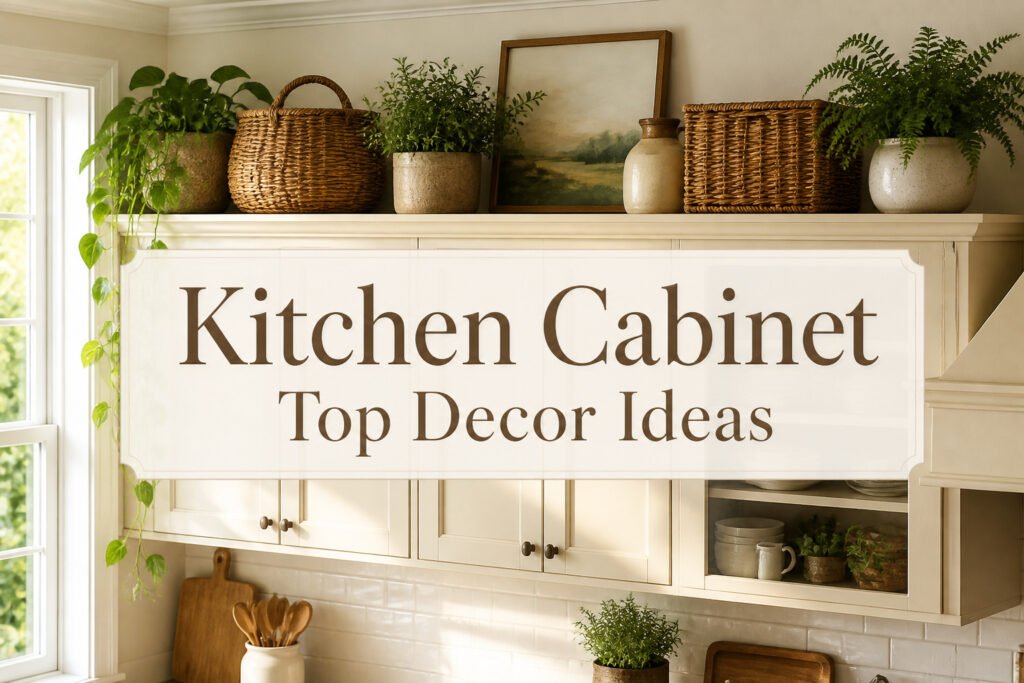
The best top of kitchen cabinet decor ideas run from zero effort to a weekend project, and the deciding factor is the gap your builder left behind. Most kitchens give you about 13 inches of clearance up there, enough for a trailing vine or a compact planter but not much else. That measurement determines whether you lean a single board, fill the run with baskets, or leave the space empty entirely.
1. Greenery for Life and Texture

Plants above cabinets soften the hard line where cabinetry meets the wall, and they do it without demanding a big budget. Most kitchens leave you about 13 inches of clearance up there, which is enough for a trailing vine or a compact planter but not much else. Pothos and eucalyptus work well because they read as vertical, not bulky, and trailing varieties draw the eye upward in rooms with standard-height ceilings.
Real plants need light you probably do not have that high up, and they need reaching. Faux greenery solves both problems, and the quality has improved enough that you are not stuck with the plastic-looking stems of a decade ago. Either way, choose leaves you can wipe down. This area collects dust and grease from cooking, and intricate textures or fabric-based arrangements trap both. Ceramic, wicker, or metal planters keep the look intentional rather than like you stored something up there and forgot it.
2. Decorative Baskets for Warmth and Storage

Woven baskets turn that awkward horizontal run above your cabinets into something that reads intentional instead of leftover. You get warmth from the texture, and you get storage for the serveware you pull out twice a year.
Group them in threes or fives, not pairs. Odd numbers force the eye to move across the space instead of locking into a static line. Mix the shapes and sizes, but keep the weave style consistent so it does not read as a yard sale haul.
Open-weave seagrass or rattan traps less grease than tight wicker. The gaps let air move through, which matters more than it sounds when you are standing on a stepladder six months from now wondering how everything got sticky. Lidded baskets go further, hiding the contents entirely and cutting down on the dust film that settles on everything up there. Labels help if you actually plan to retrieve what you stored.
If your cabinets are builder-grade beige laminate, baskets add the warmth the manufacturer left out. Just leave breathing room between each grouping. The space between matters as much as the objects.
3. Artwork and Framed Prints

The gap above your cabinets is tall and narrow, which makes it a natural spot for vertical artwork or a framed print leaned against the backsplash wall. This fills the vertical space without pushing objects out over the cabinet edge where they collect grease and read as clutter. Hang the piece just above the cabinet line or tilt it against the wall if your cabinets sit a few inches out from the back; either way, the frame draws the eye upward and breaks the blank stretch into something intentional.
Size matters more than subject here. Small pieces, or a scattering of them, disappear against the scale of that wall and look like afterthoughts. One large vertical piece, or a horizontal stack that reads as a band across the full cabinet run, extends the height of the whole installation. If your kitchen runs white and you want color, this is the place to add it; the frame and mat give you a contained way to bring in something bold without committing to painted walls or colored appliances. Wood frames also work harder than you’d expect, repeating a tone from your floor or a cutting board and spreading warmth through a room that can otherwise feel like a gallery of hard surfaces.
The downside is dust, same as anything up there, and leaning frames can slip if the ledge is shallow or someone slams a lower cabinet hard. A small dot of museum putty on the baseboard side of the frame fixes that without marking the wall, which matters if you’re renting.
4. Large Vases and Sculptural Pieces

One glazed ceramic vase or a turned-wood sculpture can carry an entire corner from kitchen floor distance. Single substantial objects read better than clusters of small items because your eye picks up one bold silhouette instead of hunting through clutter twelve feet up.
The shape matters more than the finish. Full, bulbous masses extend the cabinet upward and make it read taller, while tall vertical pieces do the same work in kitchens with vaulted ceilings. An oversize sailboat, a heavy urn, a piece of vertical artwork leaned against the wall where depth allows: all of these register as intentional from across the room.
Small pieces fail here. A collection of tiny frames or figurines dissolves into visual noise at that height and distance, and the gap above the cabinets swallows them. If your space above the cabinets measures only around thirteen inches, smaller items can hold their own, but in a standard twelve- to eighteen-inch gap or anything taller, scale up or leave it empty.
5. Natural Wood Elements

Natural Wood Elements
Stacking cutting boards, bread boards, and wooden trays on their sides above your cabinets turns tools you already own into the warmest kind of display. These pieces read as texture rather than clutter, especially against white or gray cabinetry where they keep the space from feeling sterile. Rotate them up when you need them out of the way, swap them back down when a project calls.
A trio of oversize boards leaning against the wall works, or a single antique dough bowl centered between crocks if the all-wood look starts to feel heavy. The trick is treating your kitchen’s own equipment as the decor. You spent money on that walnut bread board; let it earn its keep on two levels.
What stops this from looking like storage is the lean, not the lay. Boards propped vertically catch light across their grain and cast thin shadows behind them. Laid flat they read as forgotten items; stood on edge they become intentional.
6. Seasonal Displays

The space above your cabinets is built for rotation. Keep the same baskets, wire stands, or wooden risers year-round and only swap what sits inside them. That single decision cuts your annual decorating budget to a few fill-ins instead of a full restock.
For fall, tuck small pumpkins or dried stems with copper or amber tones between your permanent pieces. One collector uses her entire set of amber bottles up there, paired with a vintage washboard, to get a warm glow without buying anything new. In winter, trade the pumpkins for fresh greenery, twinkle lights, or a miniature village if you have the depth. Come spring, strip it back: lighter colors, fewer objects, and nothing that reads heavy against longer daylight.
The mistake is treating seasonal as an excuse to add. The space is narrow, sight lines are long, and clutter collects dust where you cannot easily reach. If your kitchen feels busy, you have kept too much. Pull half of it down and see what the room does with breathing room.
7. Decorative Containers for Storage

Lidded canisters, old flour tins, and ceramic crocks belong on top of your cabinets when you need storage that reads as intentional. The container becomes the display; what is inside stays hidden. Group them in threes, mixing heights so the eye moves across the row rather than locking on a single block.
What convinced me, reading through a dozen of these setups, is that the dust up there is sticky and greasy, not the dry kind that brushes off. Emily Henderson lined her cabinet tops with cut linoleum pieces to make wiping easier, and another approach is laying down newspaper and replacing it as it soils. Either way, anything you store up there needs to survive a real cleaning cycle or be something you are willing to sacrifice.
Antique stoneware crocks with hand-painted designs hold bulk items you use often enough to keep nearby, but not so often that daily retrieval becomes a chore. Clear or ceramic containers work best when grouped neatly; the visual rhythm matters more than matching the set exactly. If your cabinets are white, large lidded boxes in the same tone can run the full length and disappear into the architecture, giving you seamless storage without a curated styling project.
8. Lighting to Enhance the Space

LED strip lights or a small plug-in picture light above your cabinets cast an upward glow that expands the room visually. The trick is the color temperature. 2700K reads as intentional light, not institutional. Anything cooler than that starts to feel like a hospital corridor.
In kitchens with high ceilings, this upward wash keeps the space from going dark and heavy above eye level. It also picks out whatever you have sitting up there, whether that is a single ceramic piece or a row of plain canisters. The result is depth without clutter.
Strip lights are the cheaper route and tuck out of sight behind a facing board. A picture light costs more but looks like you planned it from the start. Either way, plug-in models save you from touching the house wiring, which matters if you are renting or just want the project finished by Sunday evening.
9. Minimal Styling
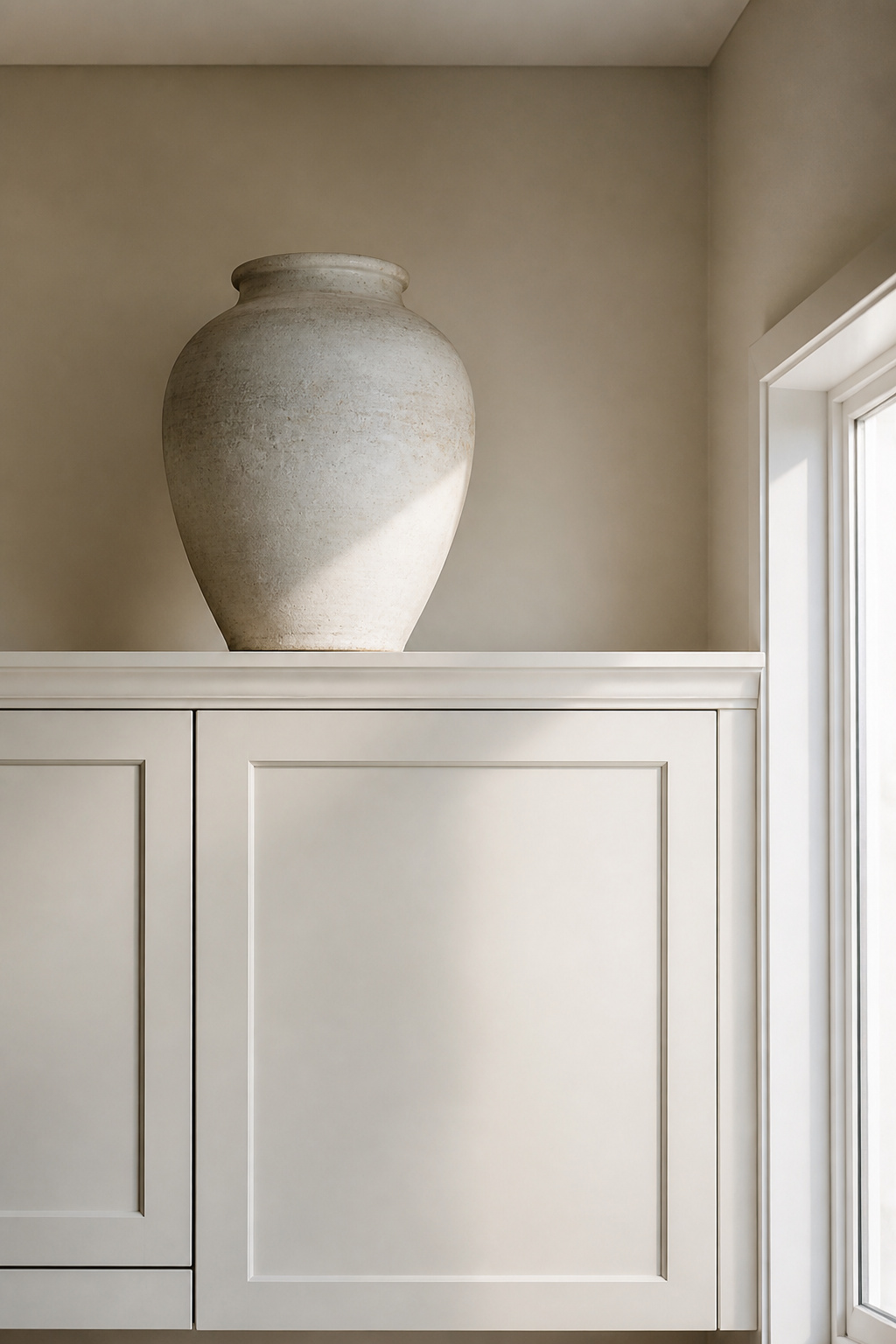
In kitchens where cabinets sit close to the ceiling, the gap above them is already a visual statement. Adding a full row of objects just crowds the line where cabinet meets ceiling. One piece, or two at most, reads as intentional. The negative space does the work.
If your kitchen runs modern or already carries bold countertops or a patterned backsplash, this restraint keeps the room from competing with itself. A single large basket or a bulbous ceramic urn extends the cabinet height upward without demanding attention across the whole run. Grouping in threes or fives works for collections, but here one bold shape beats a lineup. Leave the rest bare.
10. Consistent Color Palette

Pick two or three colors already living in your kitchen and repeat them deliberately across everything you set above the cabinets. Odd-numbered groupings at varied heights still fail if the vase is sage, the basket is terracotta, and the frame is navy. They compete instead of talking to each other.
Neutral pairings with subtle contrast age better and move between modern and traditional kitchens without looking dated. Warm woods, soft metallics, or restrained blues against white cabinetry add depth without shouting. A mass of blue and white ginger jars above a lacquered green cabinet works because the palette holds; scatter in a rust pot or a black lantern and the eye loses the cabinet entirely.
If your kitchen runs warm, stay warm. If it runs cool, stay cool. The cohesion matters more than the individual piece.
When to Leave It Empty

Cabinets sitting within a foot of the ceiling leave no breathing room for decor. The gap reads as trim, not shelf space, and anything you wedge up there fights the architecture instead of working with it. Strongly minimalist kitchens fall into the same camp: a single line of cabinets against a quiet wall is the whole statement, and objects above it break the spell you built.
The same logic applies when another element already owns the room. A statement hood or a gutsy backsplash tile draws the eye on purpose. Add competing shapes above the cabinets and you scatter attention everywhere instead of letting it rest where you planned. In one kitchen that kept its older perimeter cabinets, the designer painted them to blend with the wall precisely so the height would not get noticed. Objects up there would have undercut the trick.
This is the decision most sources skip, but it is usually the one readers stall on. When the room is already doing its job, leave the space empty.
Cleaning and Maintaining What You Put Up There

Grease and dust ride the thermal current above your stove and even your dishwasher, settling into a film that turns ordinary dust into something sticky. Plan to wipe everything down monthly with a degreasing cleaner, or the buildup becomes a project of its own.
Faux plants win over real ones here unless you are committed to hauling them down for a rinse every few weeks. Real pothos or eucalyptus softens the lines, but the grease film clings to leaves the same way it coats cabinet tops, and the maintenance load adds up fast.
Skip anything that cannot handle a damp cloth. Fabric, paper, and intricate weavings will trap that sticky residue; if you want the texture, tuck them inside a lidded basket or a sealed container instead. Wipeable surfaces are the only kind that survive long-term.
Odd Numbers and Varied Heights

Odd numbers pull the eye better than even ones. Group your top-of-kitchen-cabinet decor in threes or fives, then stagger the heights so nothing sits at the same level. The tallest piece should sit slightly off center, not dead middle. That offset keeps the arrangement from looking like a fence post and sends the gaze upward along the cabinet run.
Tall ceilings make this rule matter more. In a kitchen with generous headroom, small pieces spread flat across the top read as clutter you forgot to clear. A tall vase or sculptural piece flanked by shorter companions gives the eye something to climb. Without that vertical step, the whole row goes flat and the ceiling feels emptier than it is.
The same logic works whether you are staging ceramic vases, vintage kitchen tools, or a mix of both. Three items at varied heights fill the space without crowding it; five starts to push toward busy, so keep the palette tight. Warm woods, neutral tones, or metallics threaded through the group keep the look collected rather than scattered.
Frequently Asked Questions
Should you decorate above kitchen cabinets?
You should decorate above kitchen cabinets only when the architecture invites it. If cabinets sit within a foot of the ceiling, the gap reads as trim and anything you add fights the room. The same goes for strongly minimalist kitchens or spaces where a statement hood or bold backsplash already owns the visual attention. When the gap measures closer to a foot or more and the kitchen feels unfinished, greenery, baskets, or a single sculptural piece can add warmth without crowding the line where cabinet meets ceiling.
What decorations look good above kitchen cabinets?
Greenery, woven baskets, vertical artwork, large vases, natural wood boards, and lidded containers all work well. Single substantial objects read better than clusters of small items from kitchen-floor distance. Trailing plants like pothos draw the eye upward, while odd-numbered groupings at varied heights keep the eye moving across the space. Match your palette to what already lives in the kitchen: warm woods and soft metallics against white cabinetry, or repeat two to three existing colors deliberately across everything you place up there.
How do you maintain decor above kitchen cabinets?
Wipe everything down monthly with a degreasing cleaner, because grease and dust ride thermal currents and settle into a sticky film. Choose faux plants over real ones unless you are willing to haul them down for rinsing every few weeks. Skip fabric, paper, and intricate weavings entirely; if you want that texture, tuck it inside a lidded basket or sealed container. Wipeable surfaces like ceramic, metal, glazed wood, or sealed wicker are the only kind that survive long-term above a working kitchen.