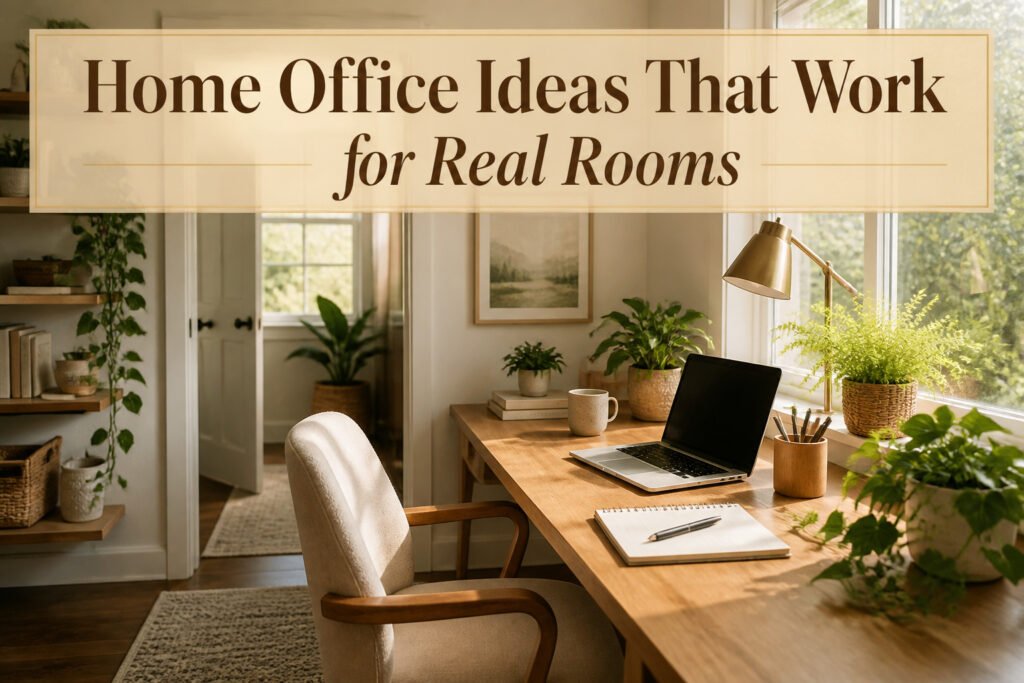
The right home office idea depends on whether you rent or own, how much wall you can touch, and whether your spare bedroom has a window at all. A tension-mounted shelf leaves dimples a landlord never notices, while a 5-by-8-foot rug under your desk draws a line between work hours and the rest of the room. The difference is not style; it is what you are allowed to change.
1. Built-In Shelves

Built-in shelves turn wall cavities into storage so you do not lose floor space to a bookcase or cabinet. In a small home office, that difference can be the room you need for a chair to swing around or for a second monitor to sit without crowding your desk. The payoff is storage that looks intentional and stays put, no wobbling when you bump it.
If you are renting, you are not stuck with freestanding furniture as your only option. Tension-mounted systems press a shelf unit against the wall between floor and ceiling, and most leave only small dimples that a landlord will never notice. Bracket shelves that screw into studs are another route; the holes are tiny, easy to spackle, and usually invisible once painted. I have watched friends debate for weeks whether to drill, then spend an afternoon installing brackets and wonder why they waited.
The cost stays modest either way. Tension systems run higher than basic brackets but skip the tools and the patching. Brackets cost less upfront and hold more weight, which matters if you are stacking reference books or a small printer. Choose based on how long you plan to stay and how much you need the shelf to carry.
2. Small Space Moves
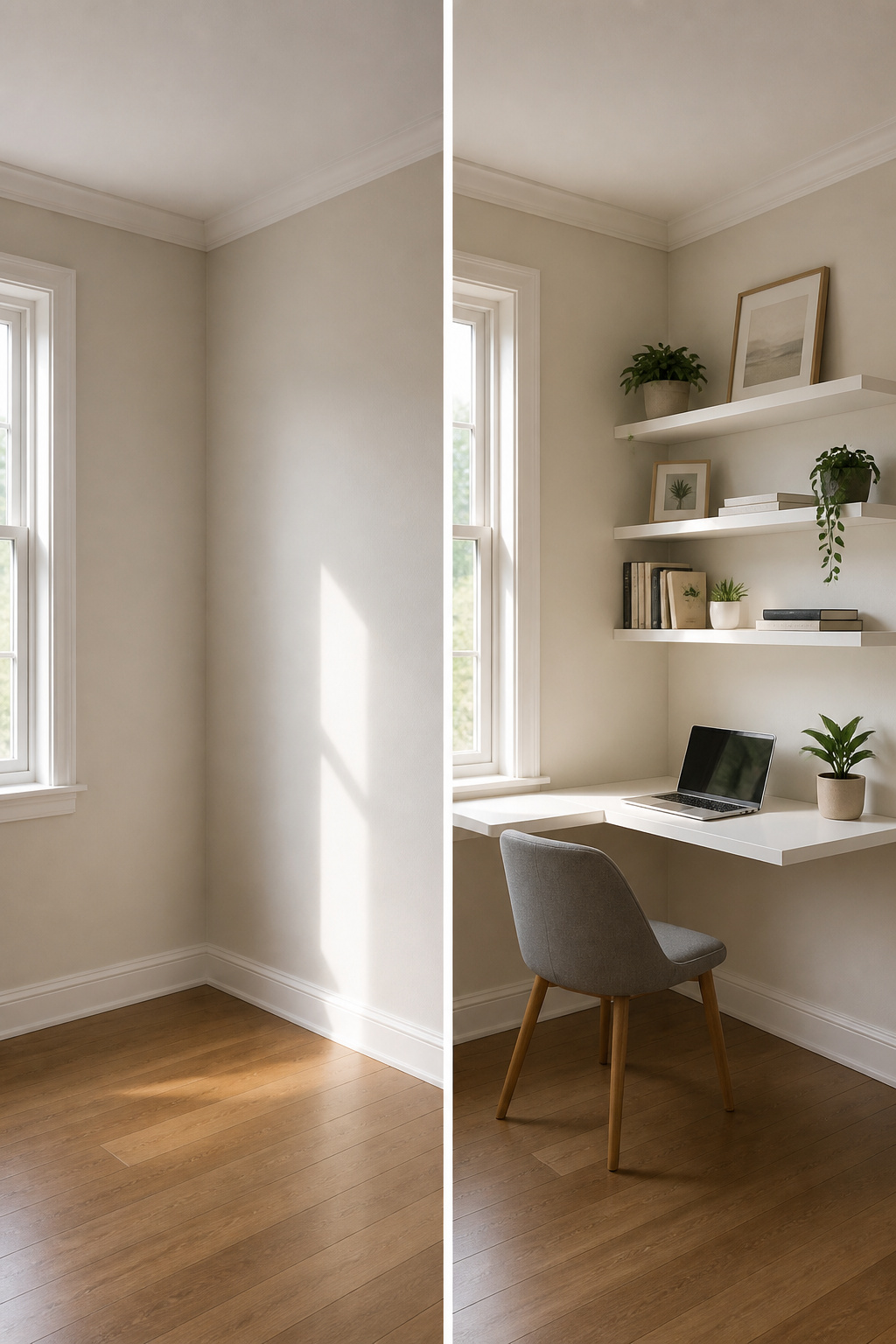
Most home office ideas you will actually use start with the wall you already have. A wall-mounted desk frees the floor entirely and lets a spare corner function as a workspace without claiming the whole room. If the corner is all you have, an L-shaped desk uses the two meeting walls to give you workable surface area in a footprint that reads as compact, not cramped.
The closet is another option that keeps the office out of sight when the day ends. Remove the rod, add a shallow work surface at desk height, and you have a zone that closes behind a door. Vertical storage above that surface, whether open shelving or a pegboard system, keeps supplies off the two feet of depth you are actually working with.
For a section of living room, the same principle applies: claim height, not floor. A wall-mounted unit with a fold-down desk face can disappear entirely after hours. The cost stays low because you are buying one piece, not furnishing a room, and the weekend timeline holds because you are anchoring to studs you can locate in an afternoon.
3. A Chair You Actually Want to Sit In
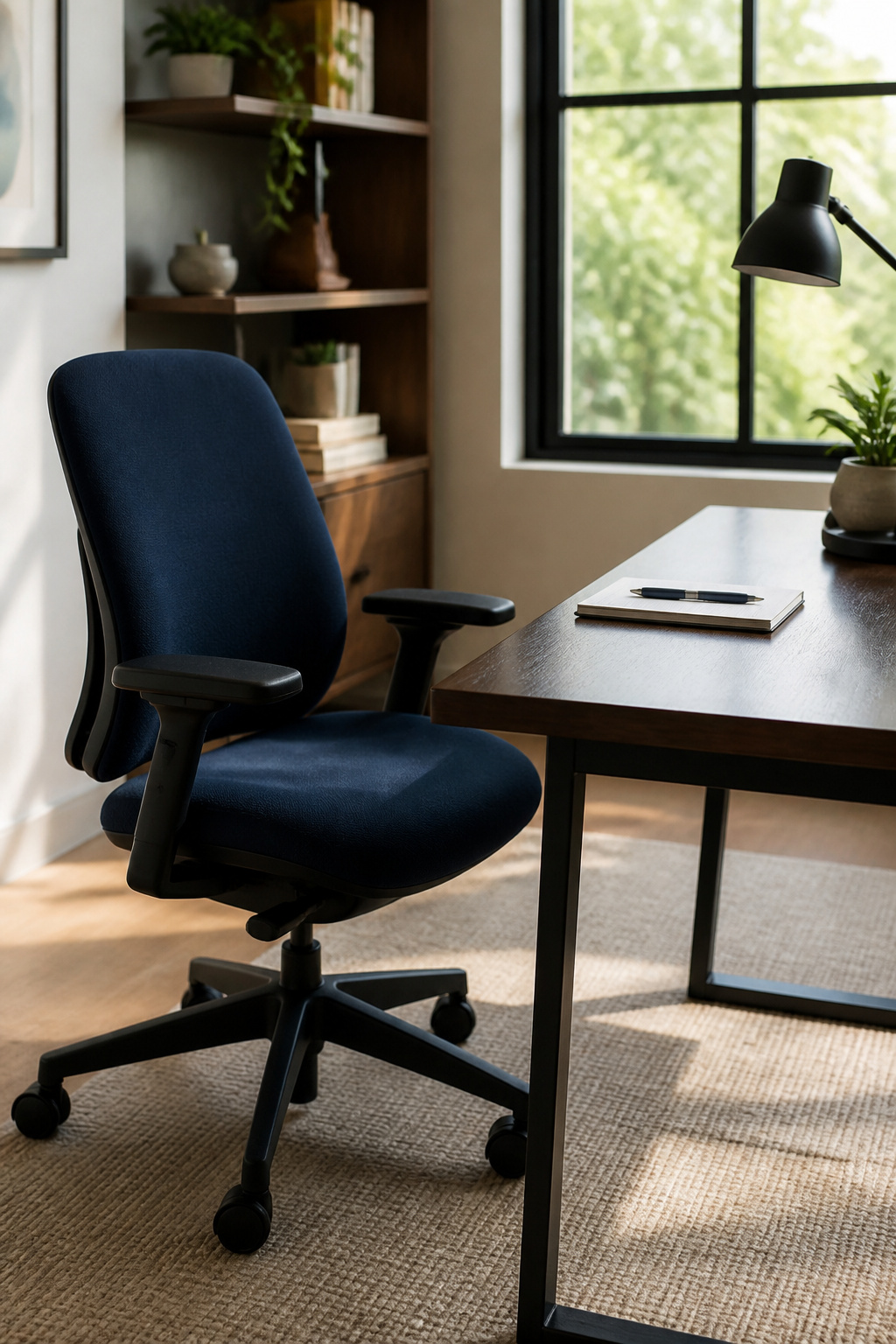
The chair will make or break your home office faster than any desk or light fixture. You already know this if you’ve ever stood up after three hours with a stiff lower back and decided to call it a day.
Seat depth is the detail most people skip, and it costs them. Too deep, and the front edge cuts into your thighs; too shallow, and you lose thigh support entirely. Look for a seat pan that slides or a depth between 16 and 20 inches, which fits most adult frames without forcing you to perch on the edge.
Armrests matter more than the marketing suggests. Fixed arms set too high or too wide push your shoulders up and out, and that tension travels straight to your neck. Adjustable arms let you drop them below desk height when you need to pull in close, or raise them to support your forearms while you read.
At under $300, you are shopping in the range where one feature usually gets sacrificed for another. Lumbar support and adjustable height are non-negotiable; tilt tension and arm width are where corners get cut. Test before you buy if you can. Office supply stores keep floor models, and some retailers let you return assembled chairs within thirty days. Sit in one for ten minutes, minimum. A chair that feels fine for two minutes can turn hostile by hour two.
The color and silhouette are up to you. Mesh backs breathe better in summer; upholstered seats soften faster. Neither choice fixes a bad fit.
4. Work Near a Window
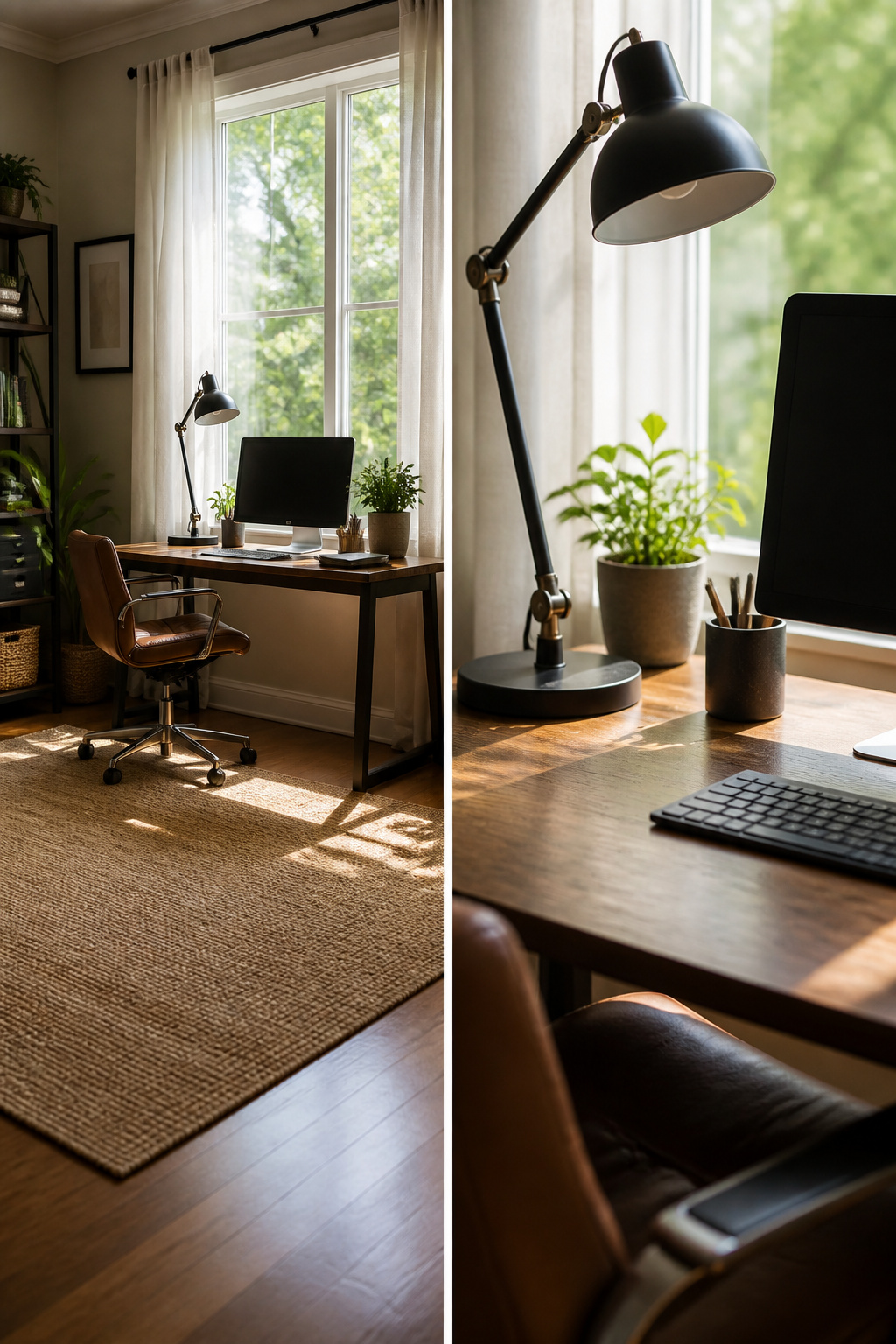
Set your desk so the window sits to one side rather than dead ahead. Morning light from the east hits your eyes at a lower angle, which keeps cortisol up and sleep cycles steady; afternoon sun is warmer but does less for alertness. If the only window faces a brick wall or a neighbor’s siding, you still gain from the brightness itself. Keep the curtain sheer, or add a woven shade you can lift partway, so the room does not feel like a basement.
Glare is the real fight. Angle the monitor so the window reflects off it at your shoulder, not your face. A task lamp with an adjustable arm fills in when the sky turns flat or you work past five. Skip bulbs that try to mimic daylight; a warm secondary source you can direct beats a ceiling wash for reading actual paper.
5. One Plant That Survives Neglect
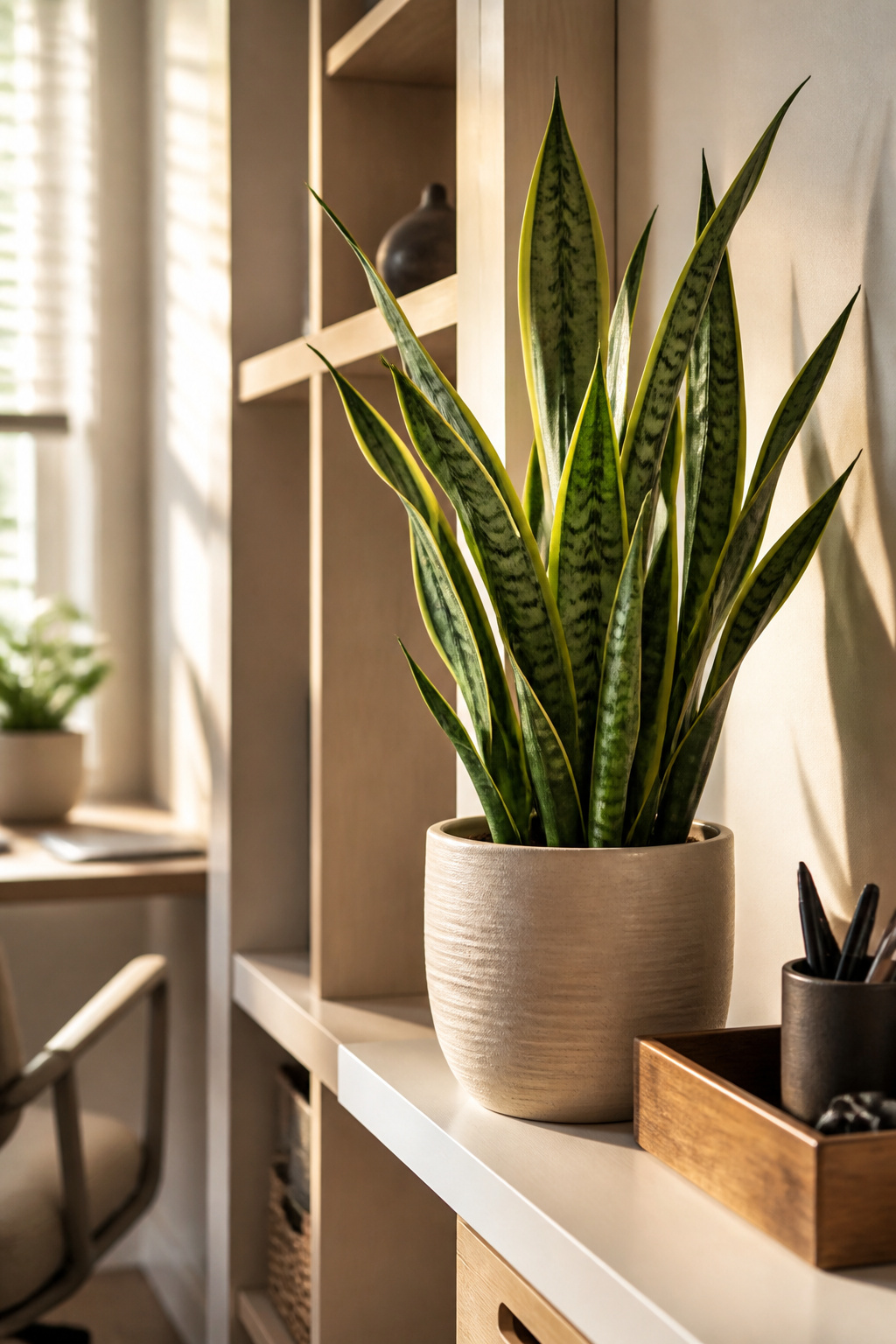
A snake plant handles the kind of light your home office actually has: the dim corner by the file cabinet, the spot three feet from a north window, the shelf that gets two hours of direct sun if you’re lucky. It will not turn yellow and dramatic if you water it every ten days instead of every seven. Let the soil dry out completely between waterings; the fastest way to kill one is to treat it like a fern.
If you have cats or dogs, skip the snake plant and go with a spider plant or a parlor palm instead. Both tolerate the same rough conditions, and they will not make your pet sick if they chew a leaf when you are on a video call and not watching. A parlor palm stays fuller and more office-appropriate in shape, though a spider plant gives you free baby plants to root in water and hand to coworkers.
Avoid fiddle-leaf figs entirely. They drop leaves in low humidity, sulk after being moved, and need light your spare bedroom does not have. The money you spend replacing one twice a year buys a lot of spider plant pups and the occasional coffee for your desk.
6. Ergonomic Setup Without the Price Tag
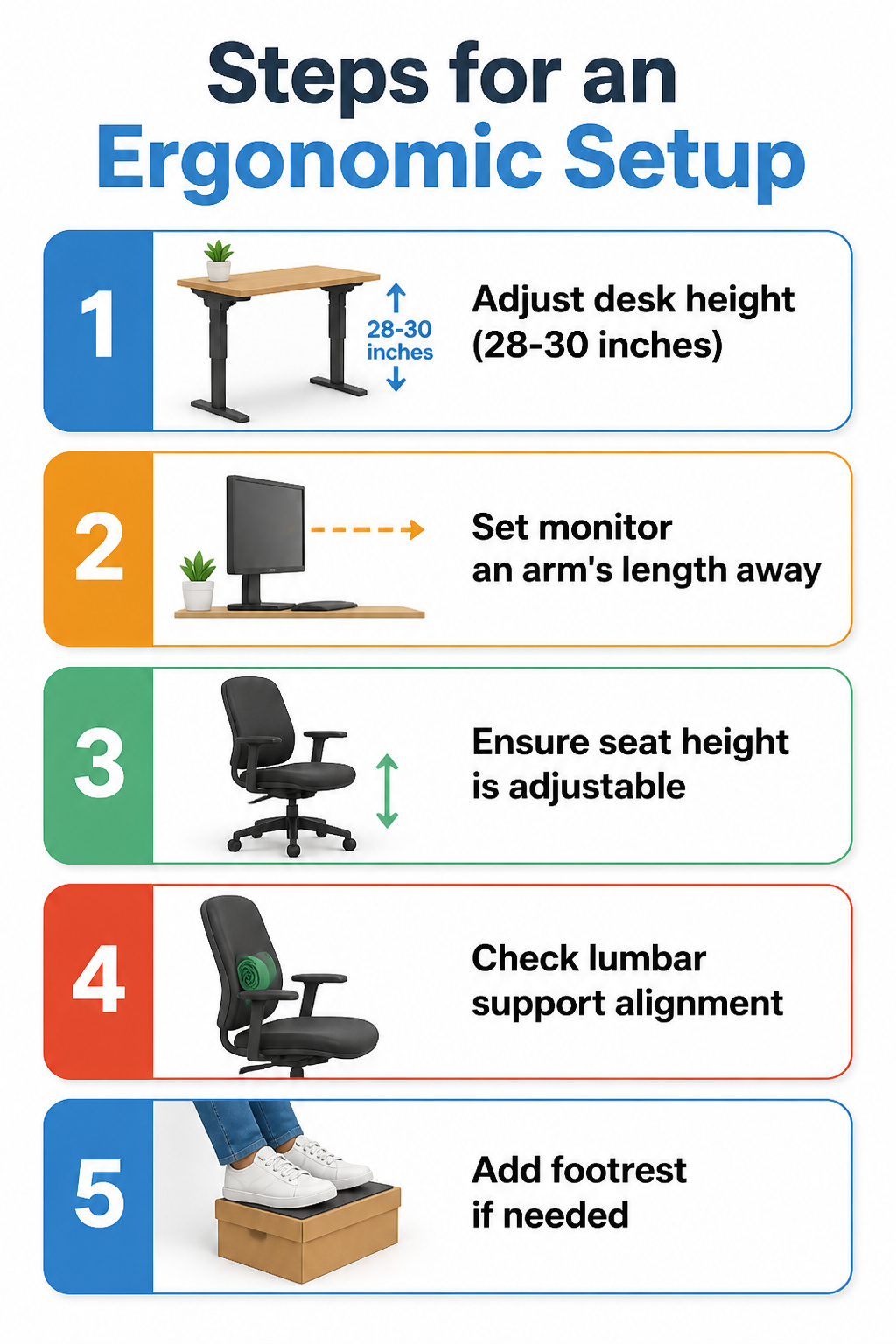
The right desk height for sitting work falls between 28 and 30 inches, while standing desks work best at roughly elbow height, with your forearms parallel to the floor. If your used desk sits too low, bed risers or a simple 2×4 frame under the legs can lift it two to four inches for under $15.
For monitor placement, keep the screen an arm’s length away, with the top of the display at or just below eye level. This matters more than the price of the monitor itself.
A used chair can serve fine if you check three things: the seat height adjusts so your feet rest flat, the lumbar support hits your lower back without a gap, and the armrests, if present, slide under your desk. Tighten any loose bolts before you commit. No budget for new? A rolled towel behind your lower back and a footrest from a shoebox fix the two most common posture failures for zero dollars.
7. A Defined Workspace
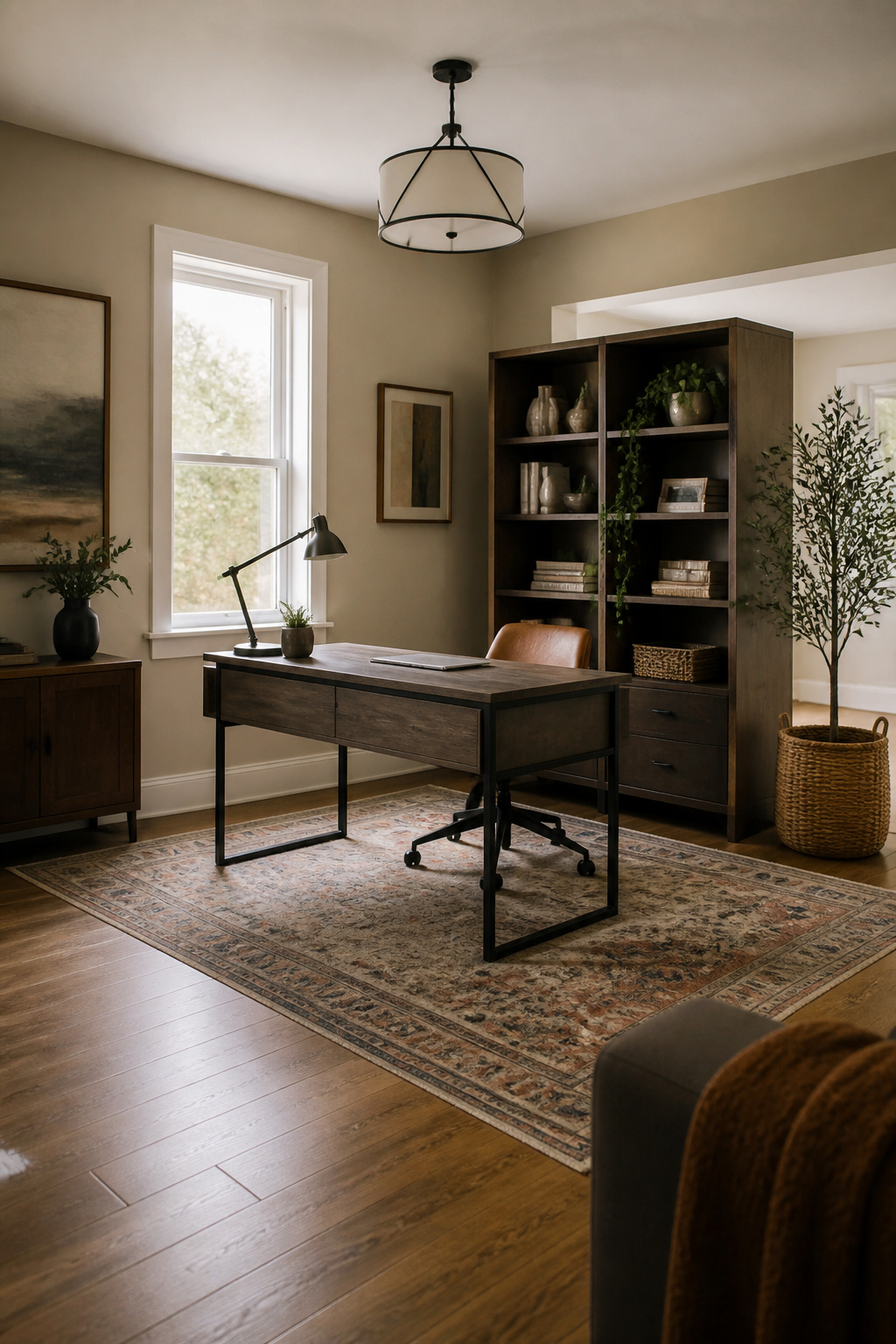
A rug under your desk does more than warm the floor. It draws a line between work and the rest of the room, and a 5-by-8-foot rug is usually enough to anchor a desk and chair without swallowing the space. Position it so the front legs of your desk rest on it, not the whole base, and the visual boundary reads as intentional rather than accidental.
Shelving works the same way. A tall bookcase placed perpendicular to the wall creates a partial screen that signals "office" without blocking light. The back side faces the living area, the front faces you, and both sides gain storage. If you rent, a folding screen does the job with no holes to patch later.
Behavioral cues matter as much as physical ones. When you sit at that rug, a specific lamp goes on. When you stand up at six, the lamp goes off and the chair gets pushed in. That lamp-off moment is the signal everyone in the household learns to read, including you. It replaces the commute home with something you can actually do in a studio apartment.
At the end of the day, put the work things out of sight. Laptop in a drawer, notebook in a bin, coffee mug to the kitchen. The rug stays, but the tools leave, and the room returns to itself.
8. A Desk Light That Does Something
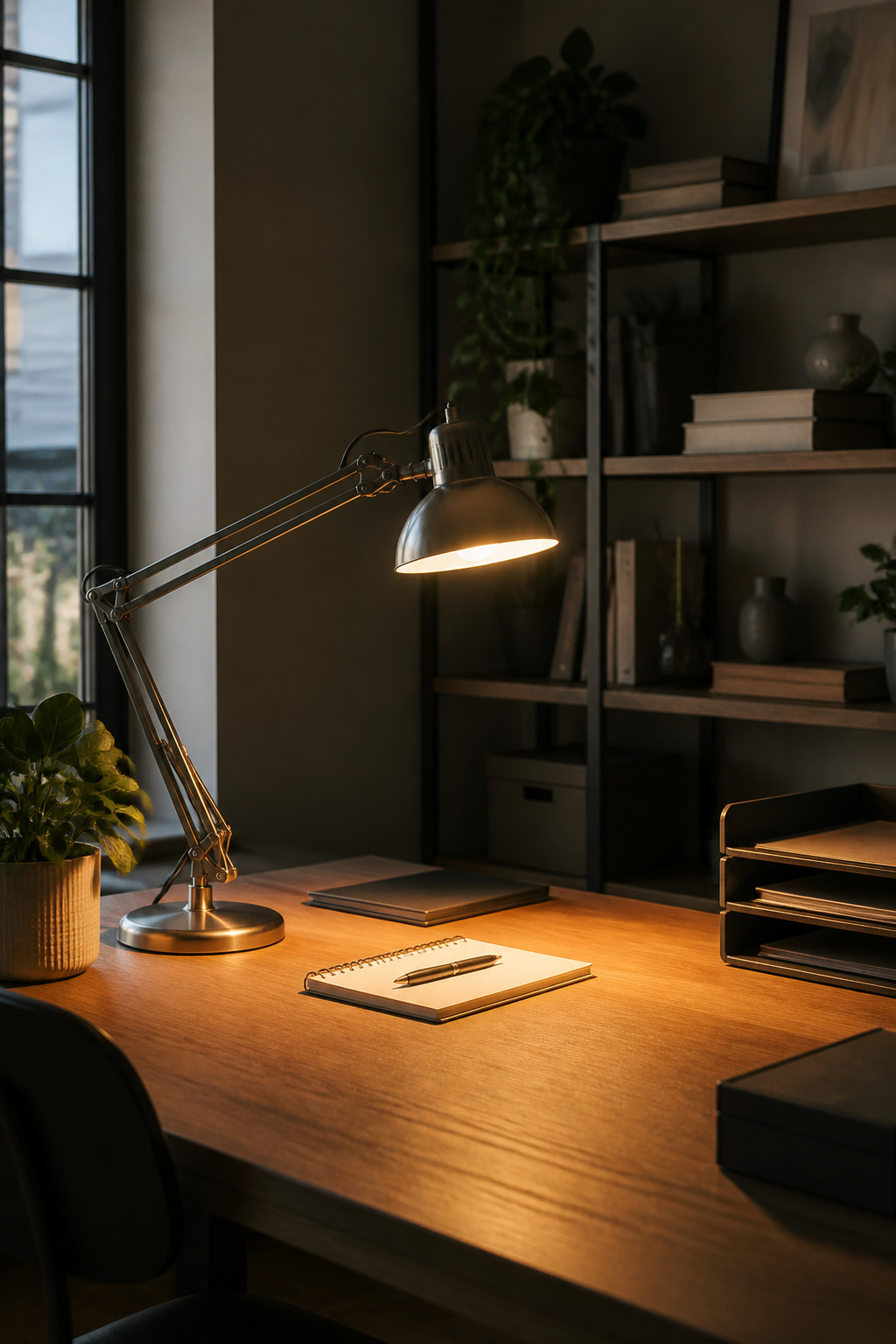
The desk light in most home offices is doing half a job, and the built-in glow from your monitor is part of the problem. That light is fixed in place, fixed in temperature, and aimed at your screen rather than your work. A separate task lamp with an adjustable arm fixes all three. Studies show that directed secondary lighting helps you focus on the project at hand, and an arm you can reposition beats a fixed base every time.
Color temperature matters more than people expect. Cooler light, in the 5000K to 6500K range, reads as morning light and keeps you alert during early hours. Warmer light, around 2700K to 3000K, is easier on your eyes by evening and does not fight your wind-down. A lamp with a switchable bulb or built-in temperature control lets you match the light to the hour.
Between $25 and $80, you are looking for a metal arm with at least two joints, a clamp or weighted base that does not drift, and a bulb socket or LED panel that lists lumens and Kelvins rather than vague "soft" or "daylight" labels. Skip anything decorative that cannot point directly at your keyboard or notebook. Natural light through a window is still the best productivity boost you can get, but when the sun drops, your desk light needs to earn its place.
9. Vintage Pieces That Hold Up
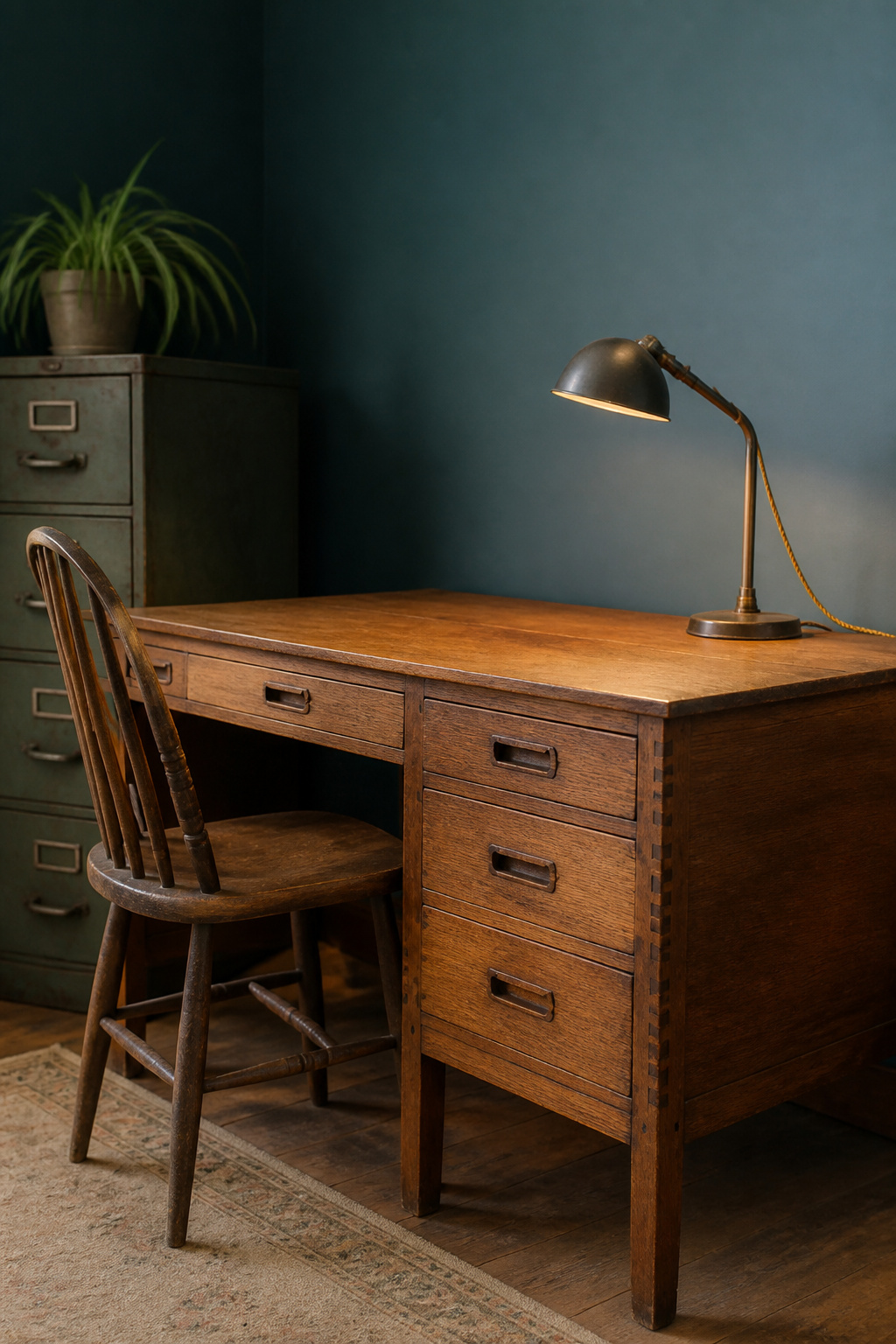
The hunt for vintage office pieces starts with what you can actually fix. Solid wood drawers with dovetail joints survive decades of overstuffing and still glide after a light sanding and wax. Metal filing cabinets from the 1960s and 70s weigh a ton but rarely fail; check that the suspension still lifts evenly and that rust is surface-only, not flaking through the bottom. Desk lamps with cloth-wrapped cords look the part, yet rewiring runs $25–40 at a lamp shop and is non-negotiable for safety. Skip anything with particleboard that has swelled, veneer bubbling over more than a corner, or drawers whose bottoms have split from their grooves. A wobbly leg is worth a clamp and a dowel; a sagging desk frame where the side rail has pulled from its tenon is not. Leave veneered tops with water rings that have darkened through to the core. The rosewood desks that turn up in high-end rooms started as factory pieces too, so hunt for that same density and joinery even if the label is gone. The built-in you pair it with can be new; the desk earns its place by still functioning after fifty years, which is the only real sign of quality worth paying for.
10. A Background for Video Calls
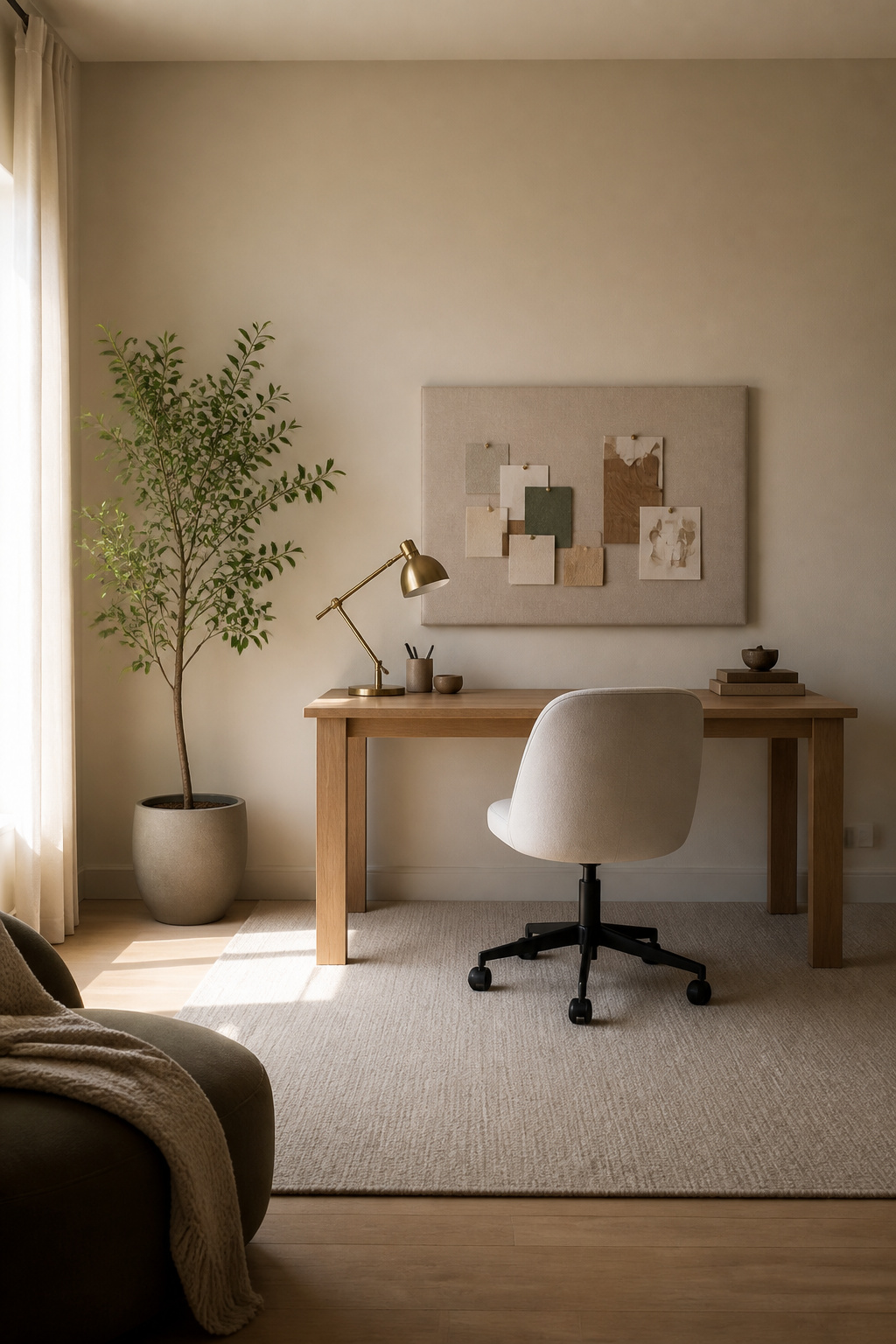
What reads well on camera is a clean wall, styled shelving, or subtle artwork behind you. A busy bookshelf or open closet steals attention from your face and makes you look unprepared. If the room behind you is a mess, shift your desk so the camera faces a painted wall section instead of the whole space. A mounted textile works too; a yard of heavy linen or a vintage rug fragment on a dowel runs about $15 and covers a lot of chaos.
Lighting for your face matters more than perfect decor. A desk lamp or task lamp positioned slightly above eye level fills in shadows the overhead fixture leaves behind. Natural light is best when you can get it, but a daylight-mimicking bulb in that task lamp keeps you visible on gray mornings. The background only needs to look intentional; your face needs to actually be seen.
Storage That Hides the Mess
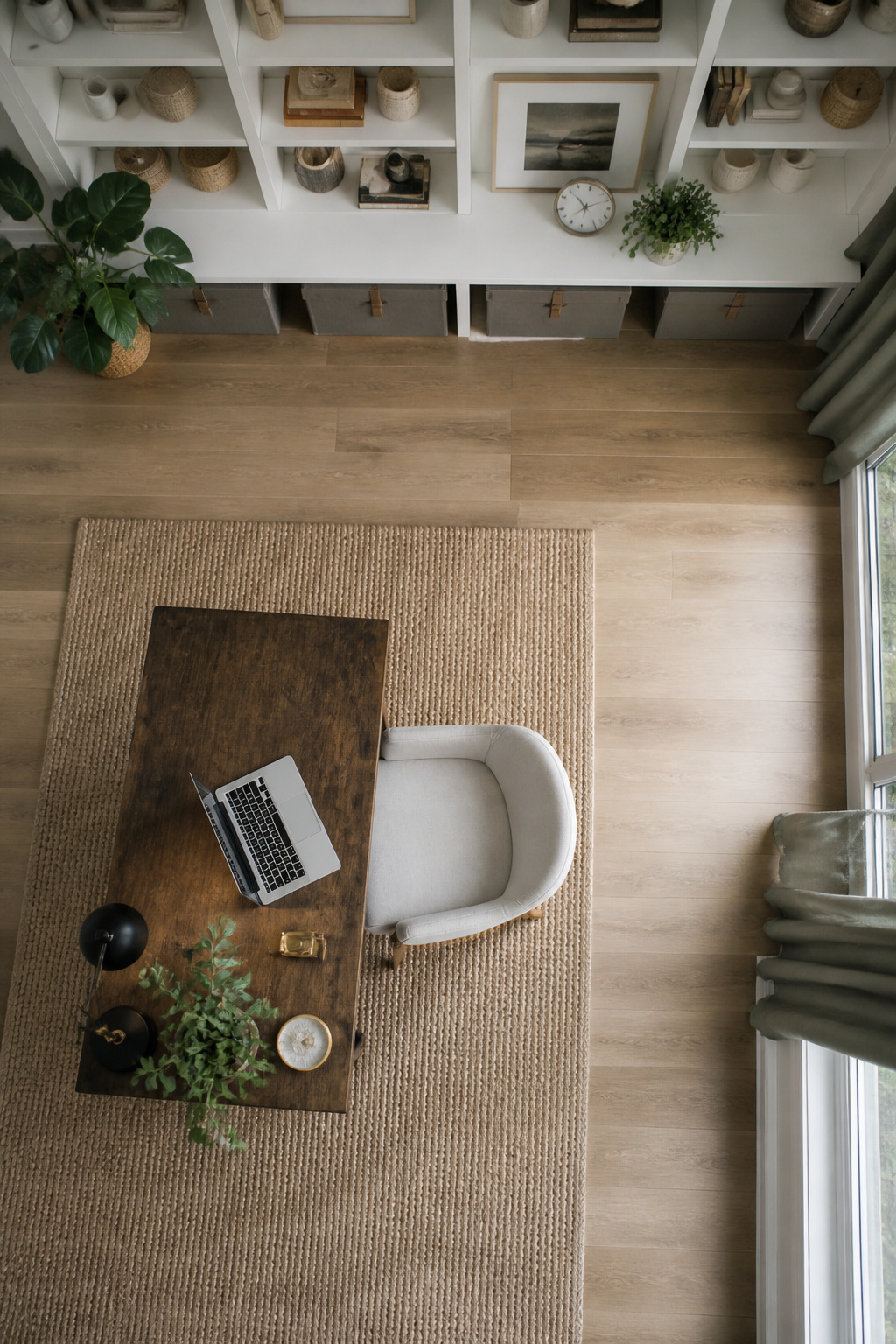
Built-in shelves with a filing system give you the storage depth that freestanding units rarely match. Designer Marie Flanigan used a wall-to-wall unit with two desks, a black bookcase, and cabinets in a Houston library, and the result handles both display and the files you do not want to look at. Measure the interior width of each shelf before you buy bins, because a basket that sits half an inch too wide will bow the front edge or sit crooked for years. Open storage looks good in photographs, but it fails in practice for anyone who is not already tidy. The eye reads every visible item as a task, and by Wednesday the shelf is a pile. Drawers, dresser units in the office, or lidded boxes on shelves hide the visual noise. For cables, the mountable accessories that keep cords off the floor work only if you leave service loops at each end. Pull the desk out before you buy anything, count the cords that actually reach the floor, and buy organizers for that number plus two. A dresser repurposed as office storage gives you drawer depth for files and a surface for the printer or supplies, and it costs less than most office-grade filing cabinets of the same capacity.
What to Put on the Walls
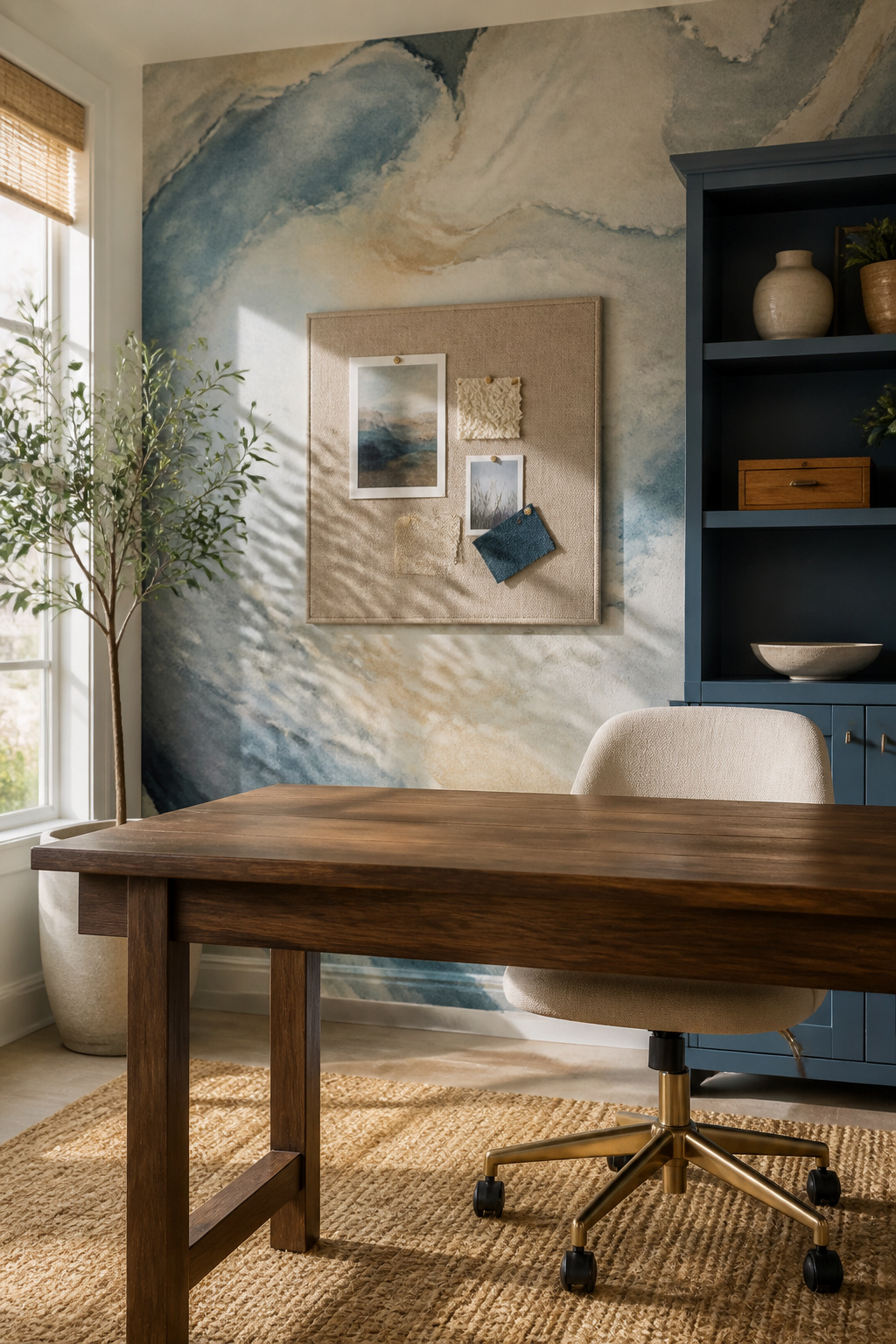
A mural or a single bold wallpaper can carry a home office wall without adding clutter that competes with your face on camera. The coastal blues and warm grays in the Houston office work because they stay low-contrast; they read as atmosphere, not distraction. If your video background is a wall, test it on a call before you commit: a pattern that looks subtle in daylight can flicker on a laptop camera.
For renters, a mural on removable panels or a peel-and-stick wallpaper avoids the patching that comes with stripping traditional paper later. Fabric bulletin boards give you the same flexibility with less commitment. Pin project materials, a single photo, or a scrap of color you are working with, and the wall becomes useful instead of merely decorative. The board itself becomes texture on camera, and it moves with you when you leave.
When to stop is the harder call. One statement piece, or one board, is usually enough for a room you actually work in. Add a framed photo or two and the wall starts to feel like a gallery you walk past, not a desk you sit at. Keep the rest clear for the eye to rest. The wall is background; your attention is the thing that belongs in the foreground.
A Corner for Resetting
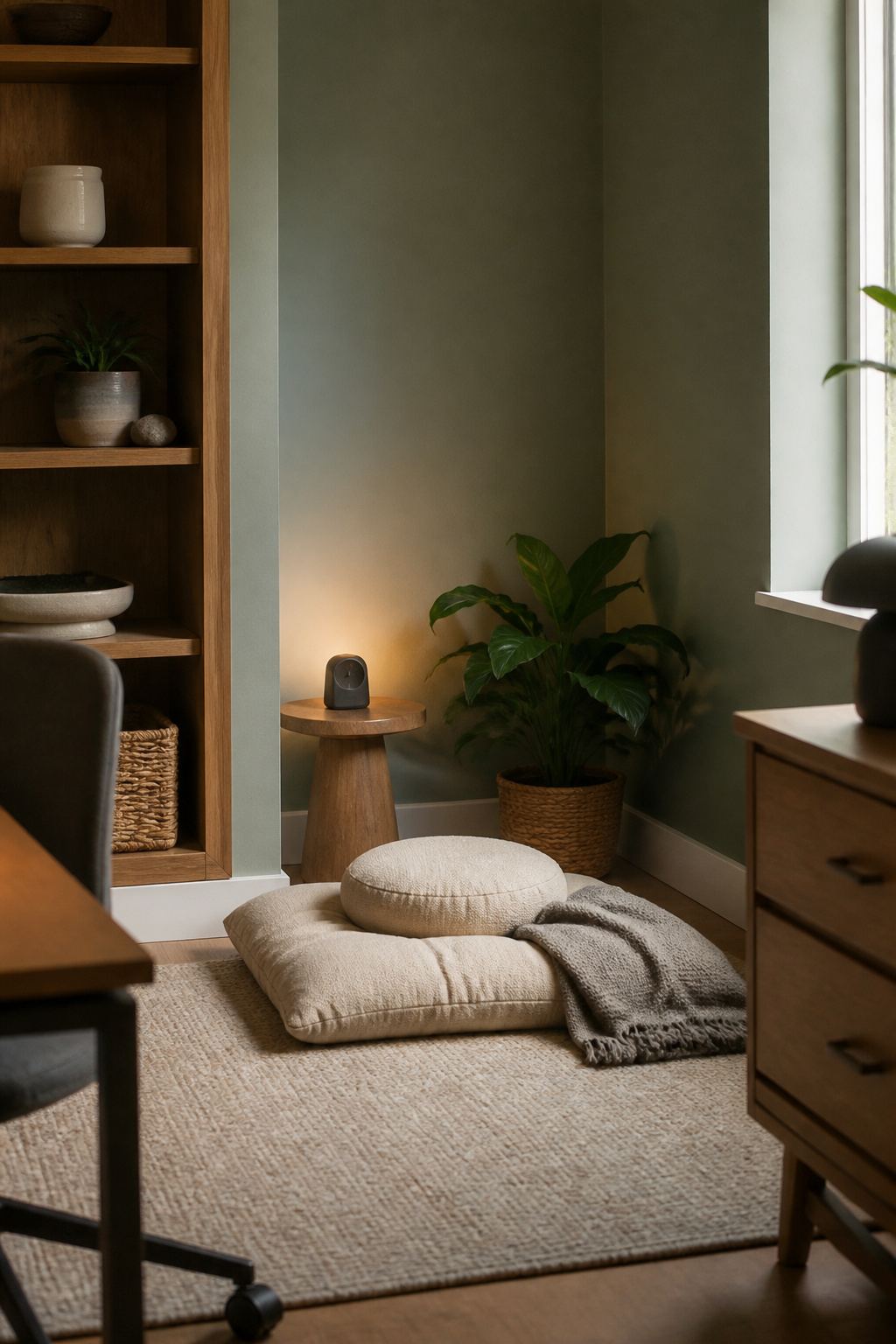
A meditation corner in a home office only works if you actually use it, and most people stop after the third time they sit down and remember seventeen emails they forgot to send. The ones that stick are the ones that ask almost nothing of you.
Keep the setup under two feet square, about the depth of a folded yoga mat against the wall. A floor cushion works better than a chair; a chair invites you to open a laptop. Add a small timer, not your phone, because the phone is the whole problem you are stepping away from. A single plant that tolerates low light, a throw in a texture you like running your fingers over. That is the inventory. What does not belong: candles you worry about leaving lit, a journal that turns the corner into another to-do list, speakers for guided meditation that require pairing and updates and eventually a password you forget.
The best placement is behind the door or in the dead space beside a bookshelf, somewhere your eye does not travel while you are working. If you face it from your desk, it becomes decor. You want it to require a physical turn, a small act of leaving the desk behind.
If you rent, a folding screen or a tall plant on a caster creates the boundary without hardware. Move it when the room needs to open up for something else. The corner does not need to be permanent to be real; it needs to be ready when you reach for it.
Coffee Within Reach
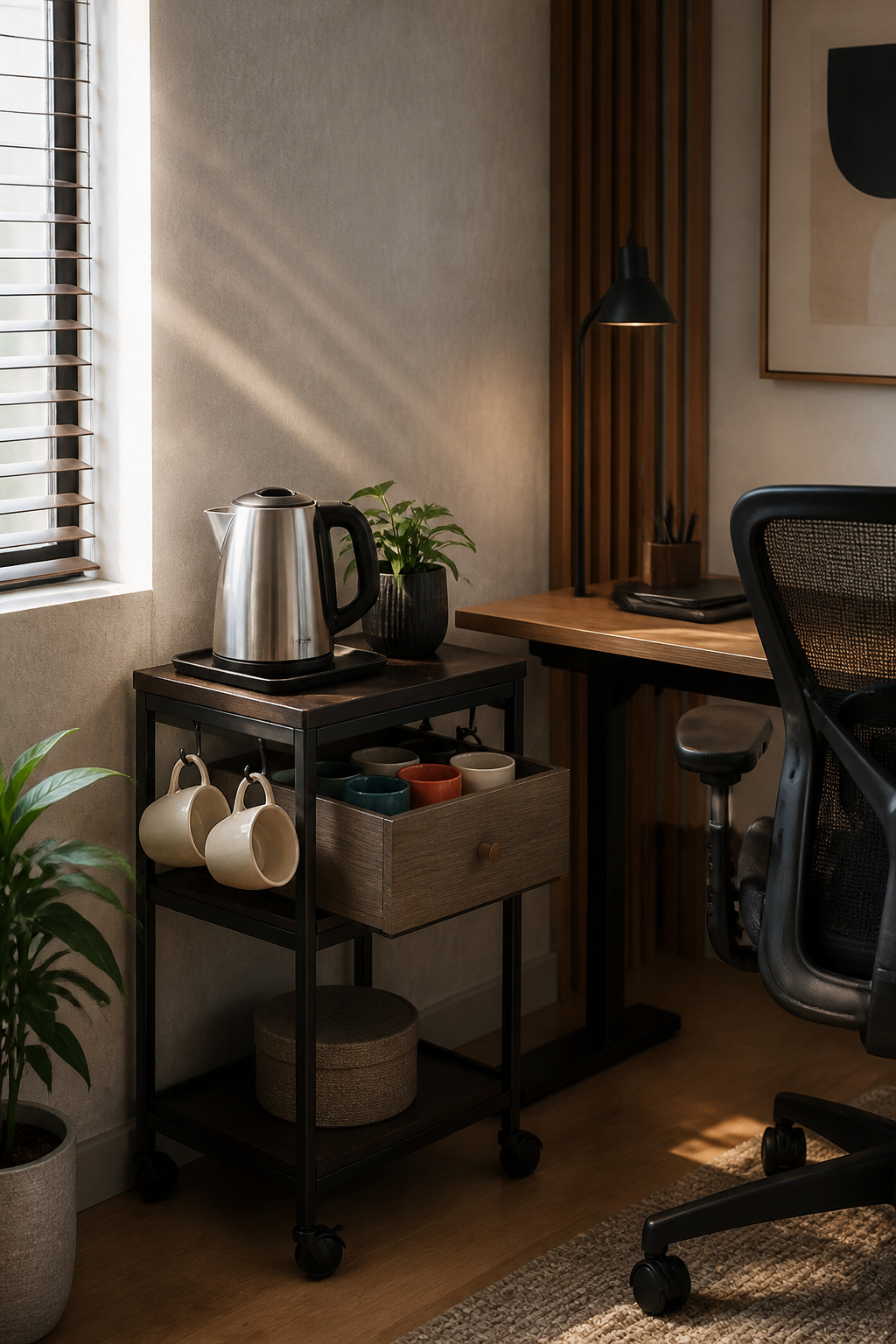
The electric kettle wins over a single-serve pod machine for most deskside setups. It heats water for tea or a French press without the ongoing cost of pods, and a basic model runs about the same as two months of daily K-Cups. The real question is where you put it, because the desk surface is the wrong place for anything with hot water and a cord. One bumped elbow and you’ve got coffee across a keyboard or a signed contract.
A narrow cart or rolling cabinet tucked beside your chair keeps the station within arm’s reach but off your work zone. Store mugs in the drawer below, or hang two on cup hooks screwed into the side if floor space is tight. A silicone mat under the kettle catches drips; choose one with a lip if you fill cups while half-asleep.
For power, a single outlet behind the cart beats running an extension across the floor. If your office is short on plugs, check whether the circuit can handle a kettle before you commit. Most small models pull around a thousand watts, which is enough to trip a shared breaker in older apartments.
Frequently Asked Questions
What are some home office ideas?
Built-in shelves or tension-mounted shelving save floor space in small rooms, while a wall-mounted desk or a converted closet can turn a spare corner into a workspace. For seating, look for a chair with adjustable seat depth between 16 and 20 inches and arms that slide under your desk. Add a snake plant or spider plant for low-maintenance greenery, and set your desk beside a window with the light coming from the side rather than straight ahead.
How can I make my home office more productive?
Position a task lamp with an adjustable arm on your desk to provide directed light that studies show helps you focus, and switch to cooler bulbs around 5000K–6500K in the morning for alertness, warmer 2700K–3000K by evening. Take advantage of natural light by opening curtains or adding a sheer shade, since sunlight has been shown to boost productivity. Keep clutter hidden in drawers or lidded boxes rather than open shelves, because visible items register as unfinished tasks and break concentration.
What should I include in my home office?
A desk that sits 28–30 inches high for sitting work, or at elbow height for standing, with your monitor an arm’s length away and the top of the screen at or just below eye level. A chair with adjustable seat height, lumbar support that touches your lower back, and arms that fit under the desk when you pull in close. A separate task lamp with at least two joints in its metal arm, plus storage that hides mess: drawers, a repurposed dresser, or lidded bins sized to your shelf width so they do not bow or sit crooked.