
A dark brown couch can anchor anything from a modern loft to a rustic farmhouse, but the right pairing depends on what the room needs most: light, contrast, or warmth. The trap is assuming brown plays well with everything. One 2700K bulb too cool, or a single gray with purple undertones, and the sofa turns muddy and basement-dim. The fix is knowing which textures, metals, and temperatures actually hold their own against that weight. Brass side table legs, a snake plant in a woven basket, a rug large enough for the couch’s front legs; these are the details that separate a finished room from a dark mass parked against the wall.
1. Play with Patterns

Mixing patterns on a dark brown couch works best when you vary the scale deliberately: one large, one medium, one small. The couch’s solid mass gives you room to experiment, but patterns of similar size fight each other and turn busy fast. A medium stripe pillow next to a medium geometric read as noise, not design, because your eye cannot settle on a focal point.
Stripes, small-scale geometrics, and faded florals all behave as neutrals against chocolate brown if you keep the palette tight. A cream-and-taupe stripe, a charcoal crosshatch, a blush botanical that reads almost beige from across the room, these layer without shouting. The mistake is reaching for three statement patterns and hoping the couch grounds them. It will not; the brown absorbs visual weight, it does not create balance.
Curtains can carry your largest pattern since they sit at the room’s edges, while pillows hold the medium and throws the small. If your curtain print feels too bold, swap it to a pillow and let the window stay quiet. What convinced me, reading through a dozen of these setups, is that renters get one expensive textile wrong and the whole room stalls. Buy the throw last, after the pillows and curtains are in place, so you know exactly what scale is missing.
2. Incorporate Metallic Accents

Brass, copper, and matte black are the three metals that actually hold their own against a dark brown couch without disappearing into it. Each reads differently: brass warms the room up, copper catches light in a way that feels lived-in, and matte black gives you the contrast without the flash.
The places to put them are smaller than you think. Side table legs, lamp bases, picture frames, and hardware on a media console or sideboard. A coffee table with a brass frame and glass top splits the difference between heavy and light, which matters when the couch already weighs the room down.
The mistake is mixing all three finishes in one space. You end up with a showroom floor effect where nothing relates to anything else. If you are choosing one, brass wins for renters: it is common enough to find at thrift stores and hardware swaps, and it ages into a softer gold rather than looking dirty. Matte black is easier to match across brands, but it can read cold fast against brown leather unless you have warm light in the room.
Use metallic finishes sparingly. A few pieces do the work; more than that and the room starts selling itself too hard.
3. Curate Complementary Furniture Pieces

A dark brown couch already carries visual weight, so the pieces around it need to work as counterbalance. Lighter accent chairs in tan or camel keep the seating area from feeling like a single dark mass. Natural wood coffee tables add warmth without the heaviness of espresso or walnut finishes, and a glass-topped piece reflects light through the frame so the room keeps breathing. The mistake that sinks most setups is adding a second dark wood piece right across from the sofa; that pairing can close the space in until it feels like a cave, especially under overhead lighting alone.
Scale matters just as much as color. If every seat and surface sits at the same height, the arrangement reads as a solid block. Vary the heights: a lower coffee table, a taller floor lamp, a mirror or vase that draws the eye upward. In a small living room, a low-profile sofa already helps, but the mix around it has to continue that language. An open-plan room gives you more room to repeat wood tones, yet even there, one lighter piece near the couch keeps the connection from turning into repetition.
4. Create a Gallery Wall
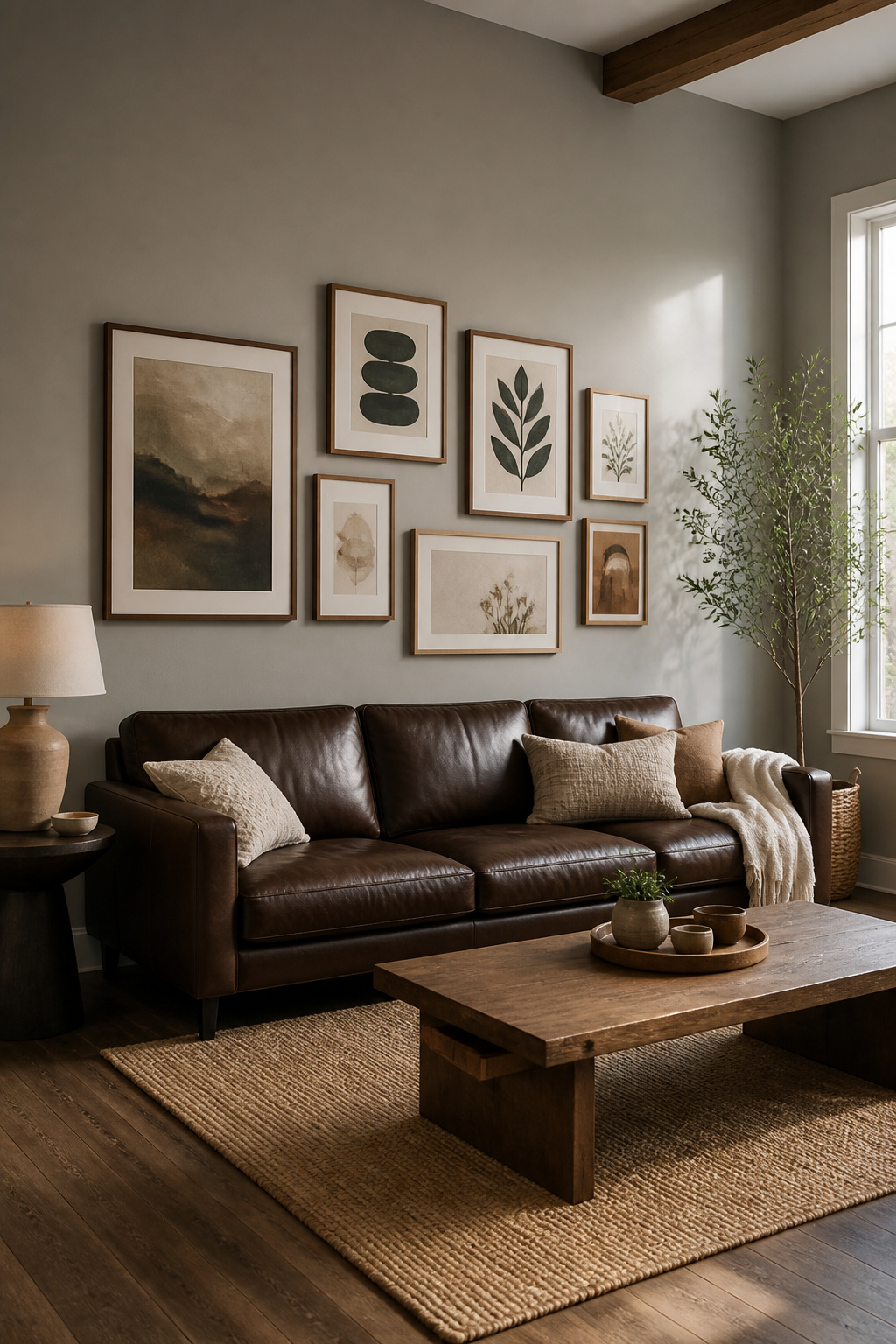
A gallery wall above a dark brown couch pulls the eye up and gives the room a finished feel instead of leaving that upper void empty. Hang the center of your arrangement 57–60 inches from the floor, a standard gallery height that lands at average eye level and keeps the collection from floating too high over the back of the sofa.
Frame choice matters more than the art inside. Mixed wood tones play well against a dark brown couch because they echo its warmth without matching it exactly. Thin metal frames, black or brass, give a cleaner edge if the rest of the room runs modern. Going all one color works too, but only if you vary the sizes enough to avoid a blocky, catalog look.
The real mistake is scale. A row of 8-by-10 frames stretched across a six-foot couch looks like floating postage stamps. Measure your wall width and fill about two-thirds of it with the overall arrangement, or the whole thing shrinks into the cushions below. Leave two to three inches between frames so each piece breathes; tighter than that and the frames fight instead of talking to each other.
5. Use Crisp Whites and Soft Grays

Cream, beige, and soft gray are the most recommended pairings for a dark brown couch because they lift the visual weight without starting a color war. Use them on walls, a large area rug, curtains, or oversized throw pillows; each one creates the lighter backdrop that keeps the sofa from sinking the room.
The mistake to watch is grays with purple undertones. A cool gray that leans violet will fight the warm brown instead of balancing it, and in daylight that clash becomes obvious. Test your paint swatch or fabric sample against the couch in morning and afternoon light before you commit.
A soft, hazy gray cools down the roasted-coffee warmth of a dark brown sofa and works across traditional and modern rooms alike. If you want more punch, crisp white walls make the couch pop but need black or metallic accents to keep the contrast from feeling too stark.
6. Embrace Earthy Tones
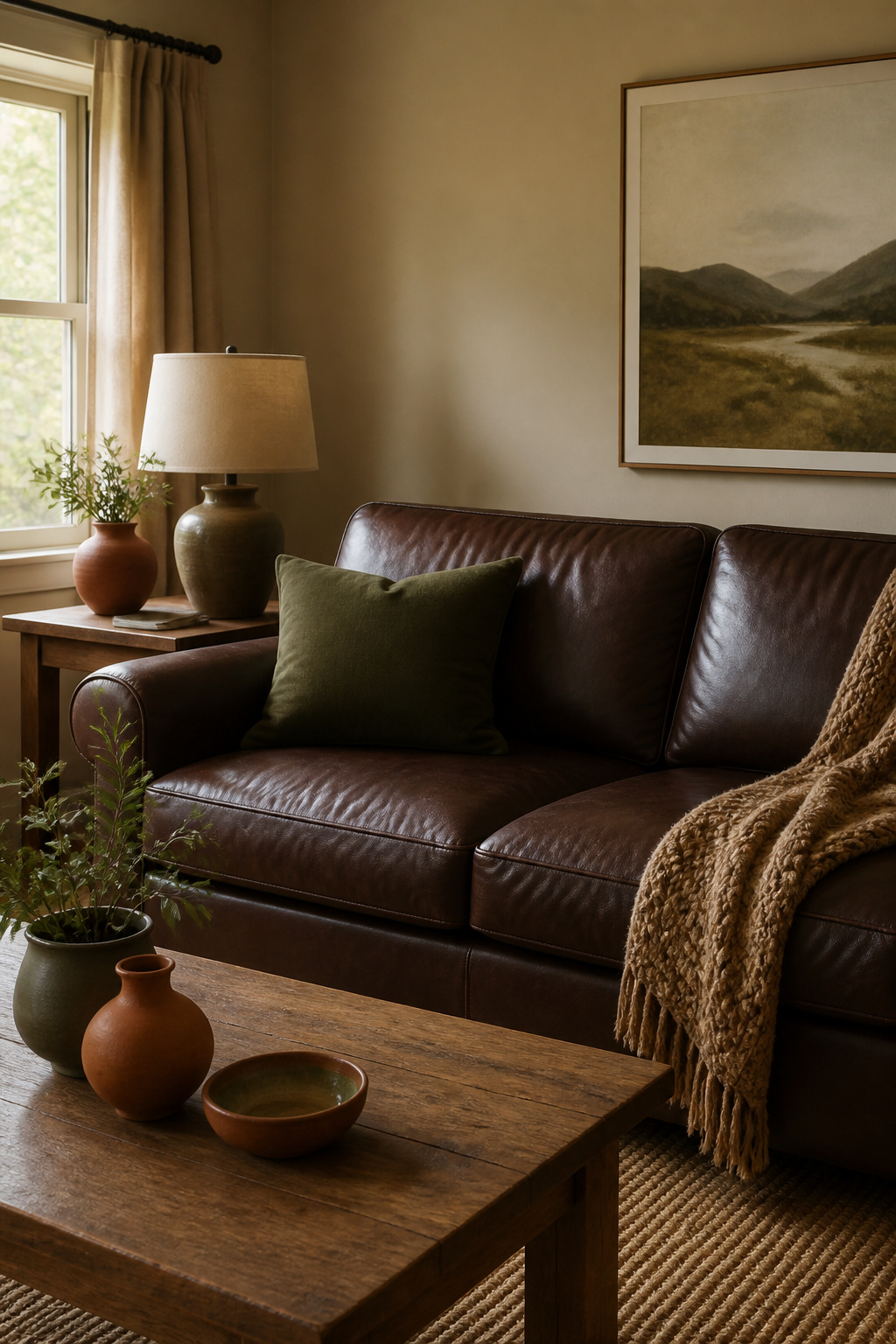
Olive green, rust, terracotta, and camel each deepen a dark brown couch’s warmth without ever brightening the room toward something cheerful and flat. Olive reads as shadowed foliage against the leather or weave; rust and terracotta carry the heat of old brick; camel softens the transition between the sofa and whatever wood lives nearby.
The mistake is loading all four in at once. One weekend I watched a friend layer olive pillows, a rust throw, terracotta pots, and a camel pouf into the same corner. The colors fought instead of settled. Each wanted to be the accent.
The fix is simpler than the error: pick two and let them repeat. Olive and terracotta stayed in her space. The olive went into two smaller linen pillows and a single ceramic vase. Terracotta held the one larger pot with a dried stem and a woven storage basket tucked beside the sofa’s arm. Camel and rust went back to the shelf.
Woven storage in terracotta or camel works because it sits low and quiet. Ceramics do the same on a side table or the shelf above. Keep the bigger color hits to textiles you can swap when the balance drifts.
7. Add Cheerful Accents

Deep blue, mustard, and burnt orange are the three colors that actually work with a dark brown couch without looking like you grabbed whatever was on clearance. The trick is treating them like a budget, not a shopping list for every pillow in the store. The 60-30-10 rule keeps it intentional: 60% neutral walls and floors, 30% earthy browns and tans in the couch itself and a rug, 10% reserved for those brighter accents. That 10% is roughly two throw pillows and one small object, maybe a ceramic vase or a book stack. Any more and the couch starts looking like the color section exploded on it.
The mistake most people make, and it is an easy one, is buying three bright pillows in different colors because each looked good alone on the shelf. You get them home and suddenly the couch looks like a fruit stand. Pick one cheerful color and repeat it, or use two that share the same depth so they read as a pair rather than a competition. A mustard pillow with a burnt orange blanket works because both are muted and warm; a saturated cobalt pillow next to a neon orange one fights for attention and loses against the brown every time.
8. Layer Textures

A dark brown couch left alone with one texture tends to sink into the room. The same fabric everywhere makes the sofa read as a flat block, even in good light. Velvet, boucle, knit, linen, and leather each catch light differently, and layering them is what pulls the couch forward visually.
The combination that works is one smooth against one nubby: a velvet pillow on boucle upholstery, or a chunky knit throw draped over leather. Pair smooth leather with soft faux fur for contrast, or add linen cushions a few shades lighter than the couch so they do not disappear into the chocolate tone. Light greens, grays, and blues in textured fabrics build the crisp contrast you need.
What fails is too many shiny surfaces competing. Multiple velvets or polished leathers together read as chaotic, not layered. One plush, shaggy rug underneath grounds the mix, and knitted throws over the arm soften the whole arrangement. Stop at three distinct textures in view at once. More than that, and the room feels like you emptied a basket of samples rather than finished a room.
9. Include Natural Elements

A dark brown couch will swallow light if everything around it is finished and flat. The fix is to bring in living things and raw surfaces that break up that visual weight. A snake plant, pothos, or fiddle leaf fig will all do the actual work of softening the corner, and they survive the low light that tends to sit near a heavy sofa. The fiddle leaf fig gives you height if the ceiling allows it; the pothos trails and fills a shelf without demanding a floor footprint. What undoes the whole gesture is the planter. A plastic pot cheapens the plant and the couch both, even from across the room. Spend the ten or fifteen dollars on a woven basket, a raw wood box, or a simple clay vessel instead. A stone object on the coffee table, a reclaimed wood shelf above the sofa, or a slate coaster stack does the same textural job without adding clutter. The point is not to collect a style but to let the couch feel like it sits in a room that is still growing and settling, not sealed in place.
10. Adopt a Modern Rustic Aesthetic

A dark brown couch already carries the weight and warmth that modern rustic needs, but the line between current and country-kitsch is thin. The safe play is to pair clean-lined pieces with one raw material at a time. A mid-century coffee table with tapered legs keeps the layout from feeling like a farmhouse showroom, and a live-edge bench beside it adds texture without going full barnwood. One project went too far with distressed everything, reclaimed signs, and a buffalo-check throw that tipped the room into theme territory. Pulling it back meant stripping out the literal references and keeping only the materials that had actual use: the bench stayed, the signs left, and a sleek metal floor lamp with a black or brass finish replaced the wrought-iron candelabra that had cluttered the corner. A hand-thrown ceramic vase on the coffee table, nothing matchy, finished the reset. The brown sofa anchors the warmth, the metal and mid-century lines supply the restraint, and the single rough piece in each sightline keeps it honest.
11. Optimize Lighting

A single overhead fixture will flatten a room with a dark brown couch into something that feels smaller and duller than it is. That one light source erases depth, so the brown reads as a dark mass instead of a rich color. Layered lighting fixes this: ambient light for baseline visibility, task light where you actually read or work, and accent light to pull the eye around the room.
2700K bulbs are the right warmth for brown upholstery. Anything cooler, and the couch turns muddy, almost gray-green. A too-cool LED in a friend’s living room made her chocolate sofa look like it had been left in a basement, which is what convinced me to check the color temperature on every bulb I buy now.
Dimmable fixtures matter just as much as the temperature. An overhead on a dimmer plus a floor lamp and a table lamp let you drop the brightness after dark without losing the shape of the space. Scatter the sources at different heights so no single pool of light dominates. The result reads as depth, not drama.
12. Use Colorful Rugs

A rug under a dark brown couch does two jobs, and the right one picks which job you need. Lay down ivory, cream, or beige and the couch stops swallowing light. Go navy or burgundy and you build a room that feels intentional and close, not accidental and dim. Patterned or textured rugs hide the wear that shows up fast in a lived-in space, which matters when you are not replacing things every season.
The most common mistake is size. A too-small rug floats in the middle of the room and breaks the seating area into islands. The front legs of the couch belong on the rug, full stop. That usually means 8 by 10 feet as your workable minimum in a standard living room, though the exact dimensions depend on what you are working with. Measure before you buy, not after you unroll.
Seasonal Refresh

A dark brown couch stays the same year-round, but the room around it does not have to. In spring, swap heavy textures for lighter linen throws and pale, sun-faded pillows in cream or soft sage. The contrast against the deep brown reads as fresh without fighting the sofa’s weight. Come fall, trade those out for velvet in rust or forest green, add a few woodsy accents like cedar or pine in a bowl, and the same room feels pulled inward and warm.
The off-season pieces need a home that keeps them reachable, not buried. A shallow bin that slides under the couch, or a canvas box on a closet shelf at eye level, beats a storage tote in the garage. You will actually swap twice a year if the switch takes under ten minutes.
What you should skip: the holiday pillow with a reindeer on it, the orange-and-black October throw. These look dated by January and leave you buying replacements for eleven months of bare use. Solid colors and natural textures shift across seasons; themed items do not.
Color Pairings That Actually Work

The most common question about a dark brown couch is also the simplest: what colors actually go with it. Keep your walls and rug lighter than the couch and you have already solved half the problem. The other half is choosing accents that either lift the brown or ground it.
| Color | Best used in | Effect |
|---|---|---|
| Cream | Throws, pillows, curtains | Brightens without stark contrast |
| Beige | Rugs, walls, large textiles | Softens and expands the room |
| Soft gray | Walls, upholstery | Cools the tone without going cold |
| Olive green | Pillows, plants, small accents | Adds depth in earthy or rustic spaces |
| Rust | Pillows, woven textiles, art | Brings warmth that talks back to the brown |
| Deep blue | Accent chairs, ceramics, art | Contrast that stays moody, not jarring |
| Mustard | Small accents, one statement piece | Cheerful lift if the room faces north |
Two ways to play this. For a calm, pulled-together room, stay in the cream-to-olive range and let the textures do the work. For more energy, bring in rust or deep blue, but keep them to textiles you can swap out. Mustard works best as a single hit, a lamp or a pillow pile, not a rug.
Furniture Arrangement Rules

A dark brown couch already pulls the eye harder than a lighter piece, so the space around it matters more. Leave about 18 inches between the couch and coffee table so legs cross easily without the gap feeling like a no-man’s land. Walkways need 36 inches clear, anything tighter and the room starts to feel like an obstacle course whenever someone stands up. The rug should extend 6 to 12 inches past each side of the couch, not stop flush underneath it; that bare floor strip frames the seating like a mat in a frame and keeps the brown from reading as a floating block.
What convinced me, reading through a dozen of these layouts, is how often people shove every piece against the walls thinking it opens the room. It does the opposite. The middle goes dead, the couch dominates one perimeter, and conversation turns into shouting across a void. Float the couch inward even six inches, let a console sit behind it, and the same square footage starts working like a larger room. The dark color needs that breathing room more than a pale sofa would; light pieces forgive crowding, brown just looks parked.
What to Avoid

A dark brown couch gives you a solid anchor, but a few predictable missteps can drag the whole room down.
- Too many dark pieces — The sofa already carries visual weight. Stack it against dark walls, a dark rug, and heavy furniture and the room closes in rather than opens up. Lighten at least one major surface: walls, floor, or the largest secondary piece.
- Matching wood tones exactly — Brown works best when the shades vary. Mix walnut, tan, camel, and espresso so the room reads layered and natural rather than flat and staged.
- Cool grays with warm browns — These two temperatures fight each other. Without a bridge color or warm undertone, the space feels assembled by accident.
- Undersized art — A small frame over a substantial sofa looks like an afterthought. Go bigger than you think, or group smaller pieces into a single block that relates to the couch’s width.
- Single-source lighting — A dark couch turns into a void at night. Scatter floor and table lamps with warm-toned bulbs instead of relying on one overhead glare.
- Rugs that float — A rug sitting in the middle of the room with bare floor all around breaks the seating area into islands. The front legs of the couch and any chairs should rest on it to tie the space together.
Frequently Asked Questions
What colors go with a dark brown couch?
Cream, beige, soft gray, olive green, rust, deep blue, and mustard all pair well. Keep walls and rugs lighter than the sofa to balance its visual weight, and use accents that either lift the brown or ground it. A calm room stays in the cream-to-olive range; for more energy, add rust or deep blue in textiles you can swap out.
How can I brighten a room with a dark brown sofa?
Layer lighter textiles like cream throws and pale pillows, add warm 2700K lighting from multiple sources, and bring in plants with proper clay or woven planters. A glass-topped coffee table or lighter accent chairs also reflect light and keep the space from feeling closed in.
What type of rug should I use with a dark brown couch?
Ivory, cream, or beige rugs stop the couch from swallowing light; navy or burgundy builds an intentional, moody room. An 8 by 10 foot rug usually works as a minimum in standard living rooms, with the front legs of the couch resting on it so the seating area stays connected.