
Boho bedroom ideas run from a $25 weekend macramé project to years of collected vintage furniture, and the difference is not budget but patience. Rushing the look reads hollow; the style lives in gaps that take seasons to find. Start with what touches your skin, bedding and textiles first, then let the walls and larger pieces follow.
1. Macramé Wall Hangings
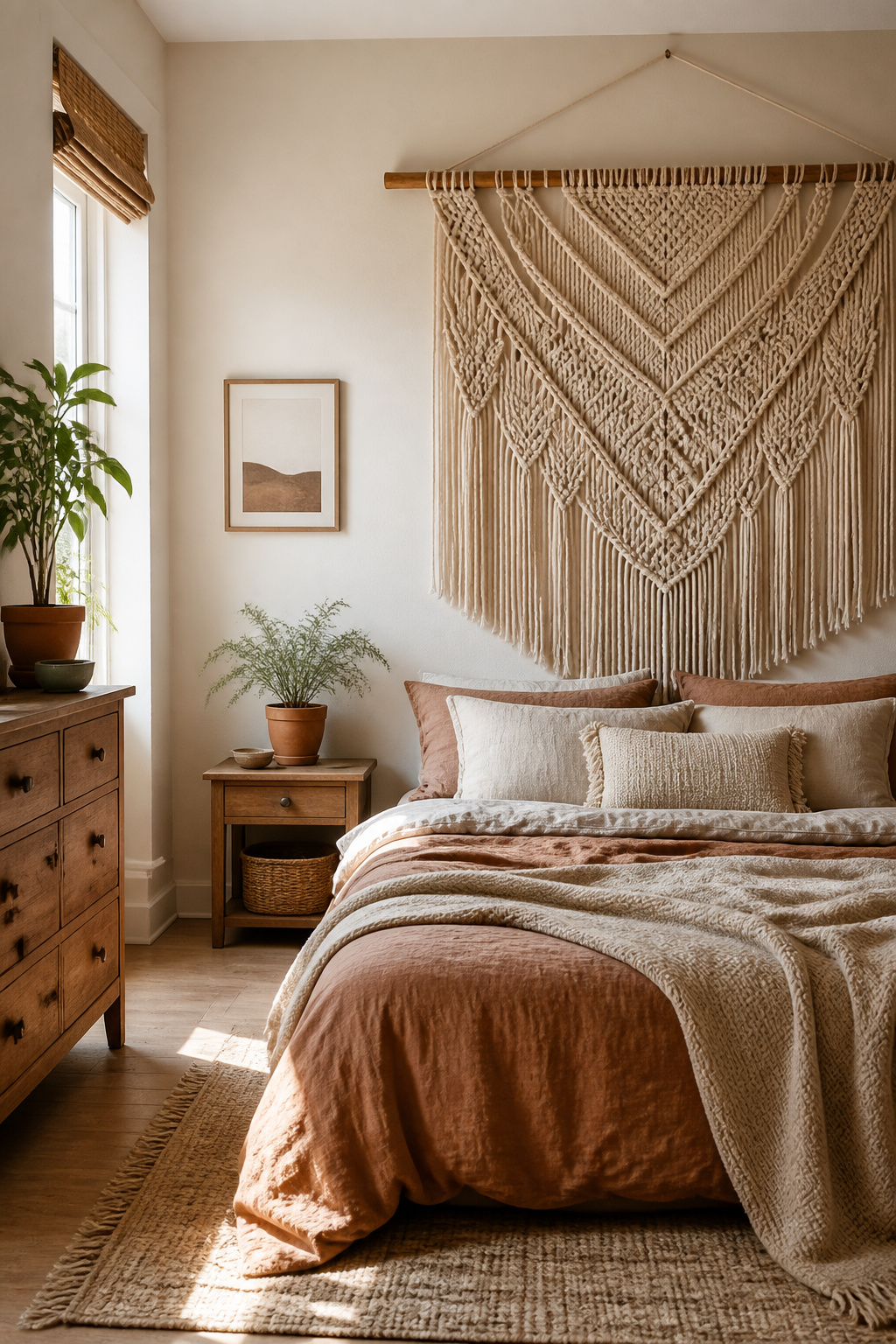
Macramé wall hangings are the piece most people picture when they think boho bedroom, and for good reason: the knotted cotton or jute texture brings immediate warmth that flat paint and framed prints do not match. A large piece hung above the bed replaces a headboard entirely, anchoring the room without the cost or commitment of mounted furniture. For a blank wall that needs more than one focal point, group smaller hangings at staggered heights so the eye moves instead of settling on a single center.
The work is genuinely DIY-friendly. A weekend project needs only cotton cord and a wooden dowel rod, materials you can find at most craft stores for under $25 total. The mistakes happen in spacing: pull the knots too tight and the piece warps, leave them too loose and it sags. If you have narrow walls above a window or door, a smaller hanging fills the awkward gap without demanding a whole redesign. Layer macramé with hanging planters nearby and the textures stack without competing; the cord and the greenery read as one collected moment rather than two separate ideas.
2. Layered Textiles and Mixed Patterns
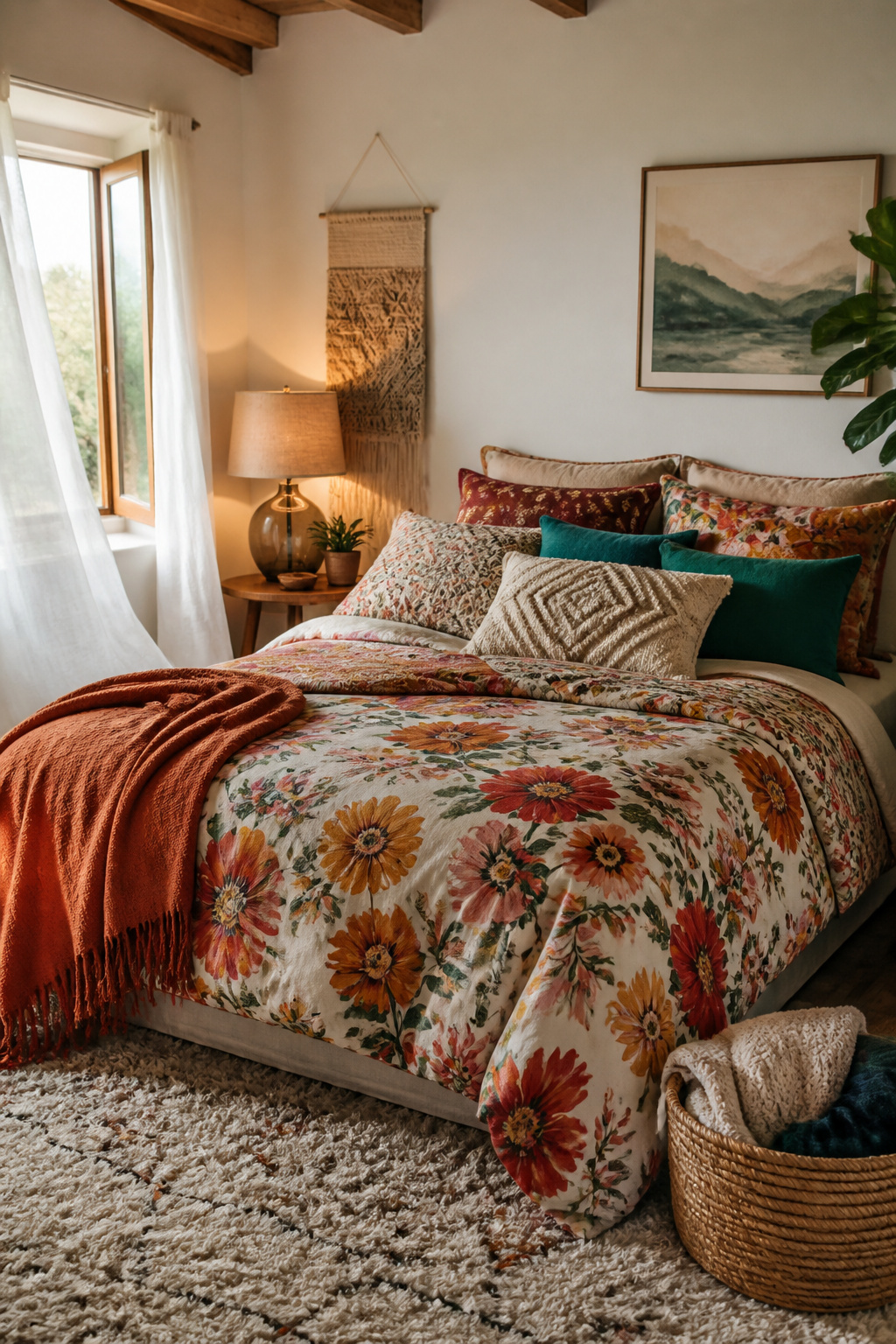
Layered textiles are what separate a boho bedroom from a room that just has a few plants. Throws, pillows, and bedding stacked together create the warmth that makes the style feel collected rather than decorated.
The trick to mixing prints without chaos comes down to three rules. Stick to a shared color family, vary the scale so your eye has somewhere to rest, and let one pattern dominate while the others play backup. A large floral on the duvet reads as the main event when smaller geometric prints on pillows stay in the same warm neutrals or jewel tones.
Sources push this in two directions. Some rooms go full saturation, layering kilims with bright florals and geometric prints until the bed looks almost crowded. Others keep the palette restrained and let texture, not color, do the work. For a weekend project on a real budget, the restrained route wins: you can build from bedding you already own and add two or three pieces rather than starting from zero.
What reads as effortless is actually intentional restraint. The "more is more" look only holds together when the color thread runs through every layer. Without that, you get clash, not boho.
3. Natural Wood Furniture and Bed Frames
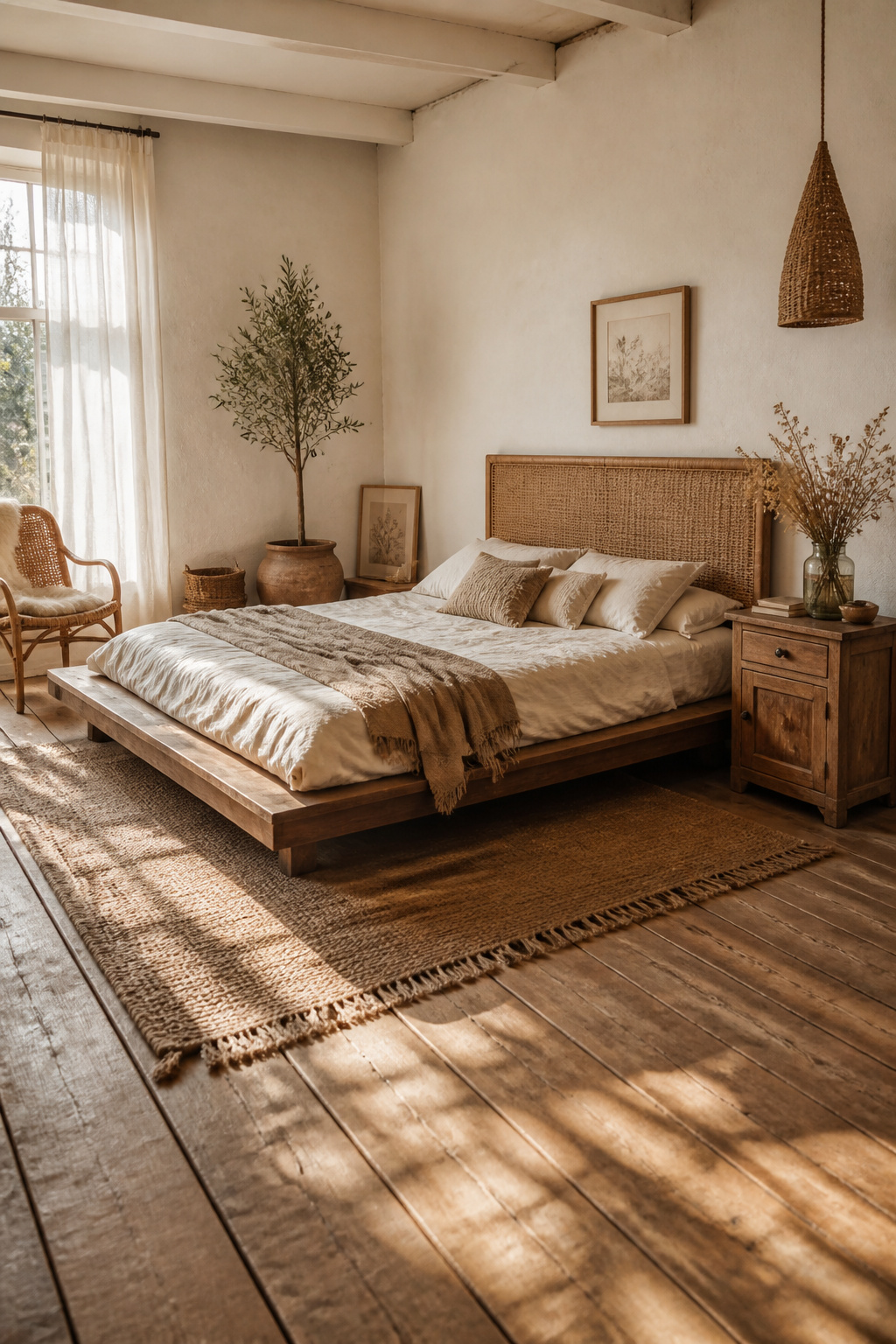
Natural wood furniture gives a boho bedroom its bones, and you do not need to buy new to get the look. A low-profile platform bed in solid or reclaimed wood anchors the room without shouting, and rattan or cane headboards hit the same note for less visual weight. Rattan in particular shows up in nearly every boho space, whether through the bed frame itself, a bench at the foot, or a statement light overhead.
Check the joints before you buy secondhand. Look for dovetail or mortise-and-tenon joinery in drawers and frames; screws alone loosen over a few moves, and you will feel it every time the nightstand wobbles. Reclaimed timber and live-edge pieces add the irregular, one-off character that makes the room feel collected rather than decorated, but the wood itself matters less than whether someone built it to stay square.
Mix the tones freely. A darker mango-wood dresser against a lighter bed frame creates depth without clutter, and the contrast keeps a low-profile room from going flat. If the furniture runs dark overall, balance it with lighter bedding and rugs so the space still breathes.
4. Plants and Living Greenery
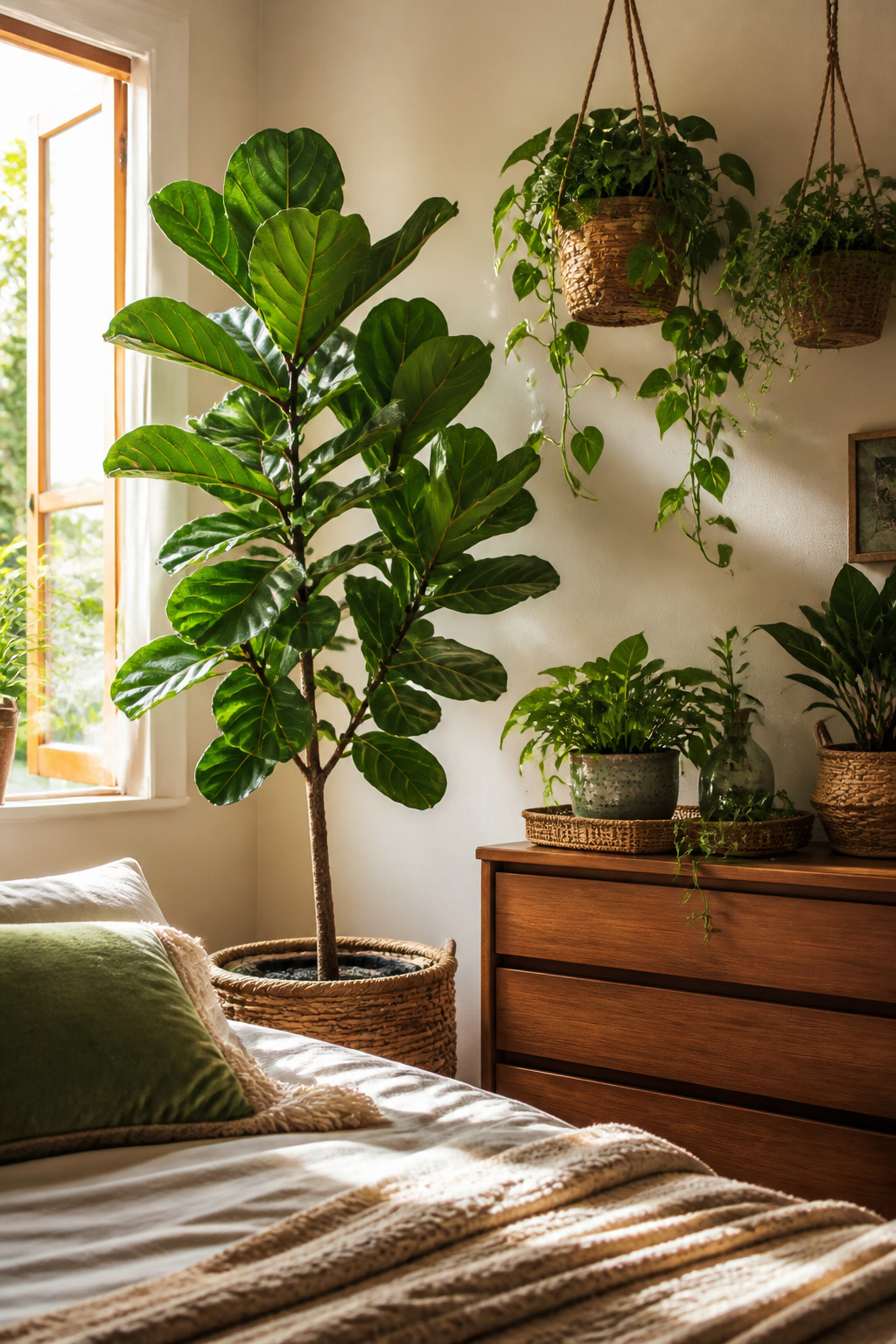
A boho bedroom without plants is just a room with a lot of throw pillows. The goal is a mini-jungle: palms or fiddle leaf figs in the corners, smaller plants on stands, and trailing pothos in hanging planters to draw the eye upward and fill vertical space. Group them in odd numbers, three or five, on a dresser or windowsill so the arrangement looks collected rather than staged.
The killing fields of good intentions are real, so start with snake plants, pothos, or ZZ plants if your track record is spotty. These tolerate low light and the kind of irregular watering that happens when weekends get busy. Water when the top inch of soil is dry, roughly once every week to two weeks depending on your humidity. Repot when roots circle the bottom of the pot or poke through drainage holes, usually every couple of years.
For travel, cluster plants in the tub with an inch of water and a towel underneath, or ask a neighbor to check them once. Skip the self-watering spikes unless you have tested them before you leave; a flooded plant is as dead as a dry one. Faux plants work if you have killed enough already, but woven baskets and terracotta pots still matter for the texture.
5. Earthy Colour Palette and Neutral Tones
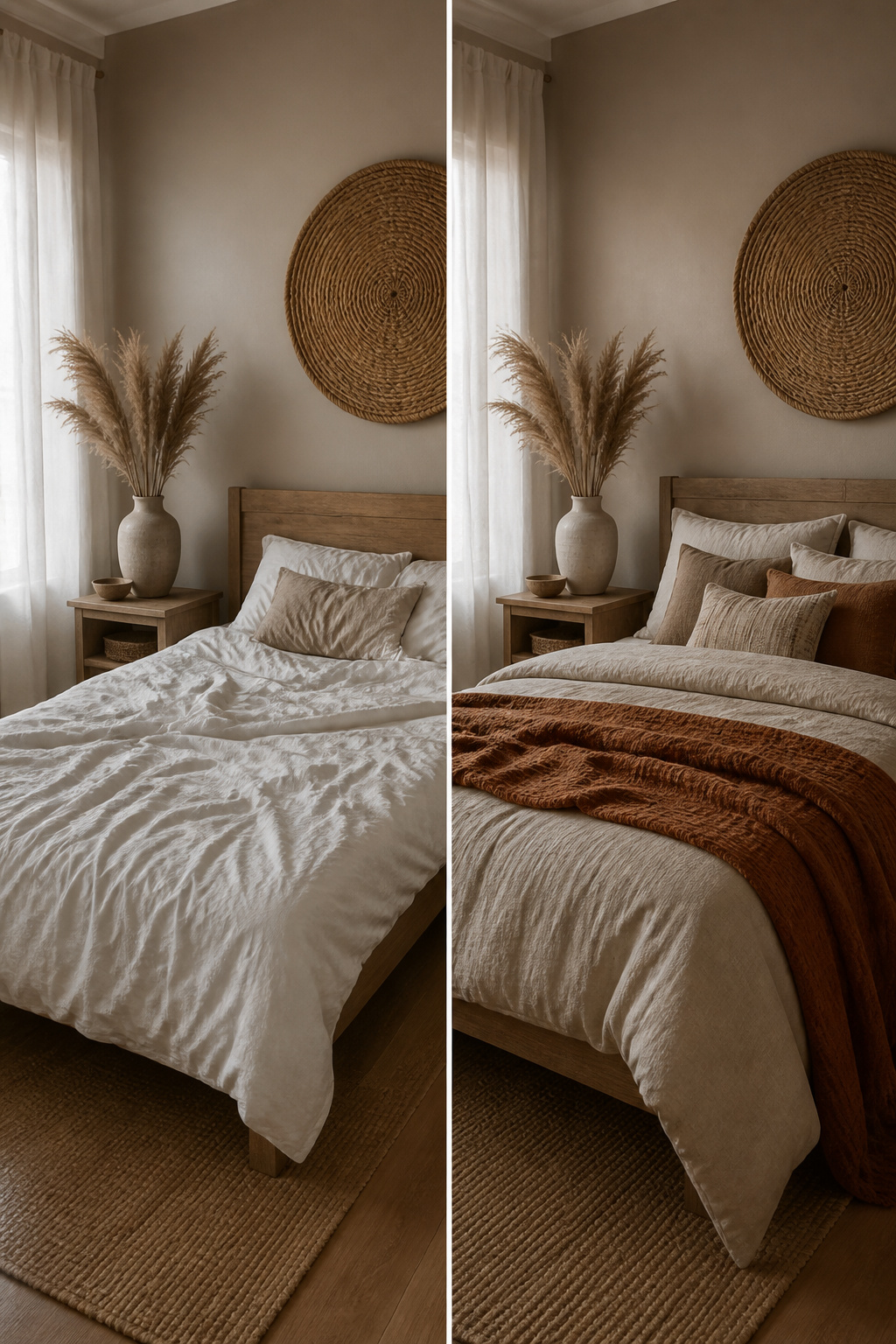
Warm neutrals, muted taupes, terra-cottas, rusts, and clay tones are the backbone of a boho bedroom that still feels livable on a Tuesday morning. Start there and you give yourself room to add pattern and color later without the room shouting back at you.
A neutral base does the heavy lifting. It keeps the space grounded enough that a bright textile or a busy vintage find reads as intentional, not chaotic. Layer tonal shades in the same family to build depth: beige walls with tan bedding, sand cushions, a deeper brown throw. If you want one moment of saturation, paint the wall behind your bed in a rich earthy tone like terracotta or olive green, but keep the rest quiet.
Buy a sample pot and live with it for two days. Paint a patch you will actually look at, morning light and lamp light both. Colors shift more than you expect, and a quart of wrong paint costs more than the sample did.
6. Vintage and Thrifted Décor Accents
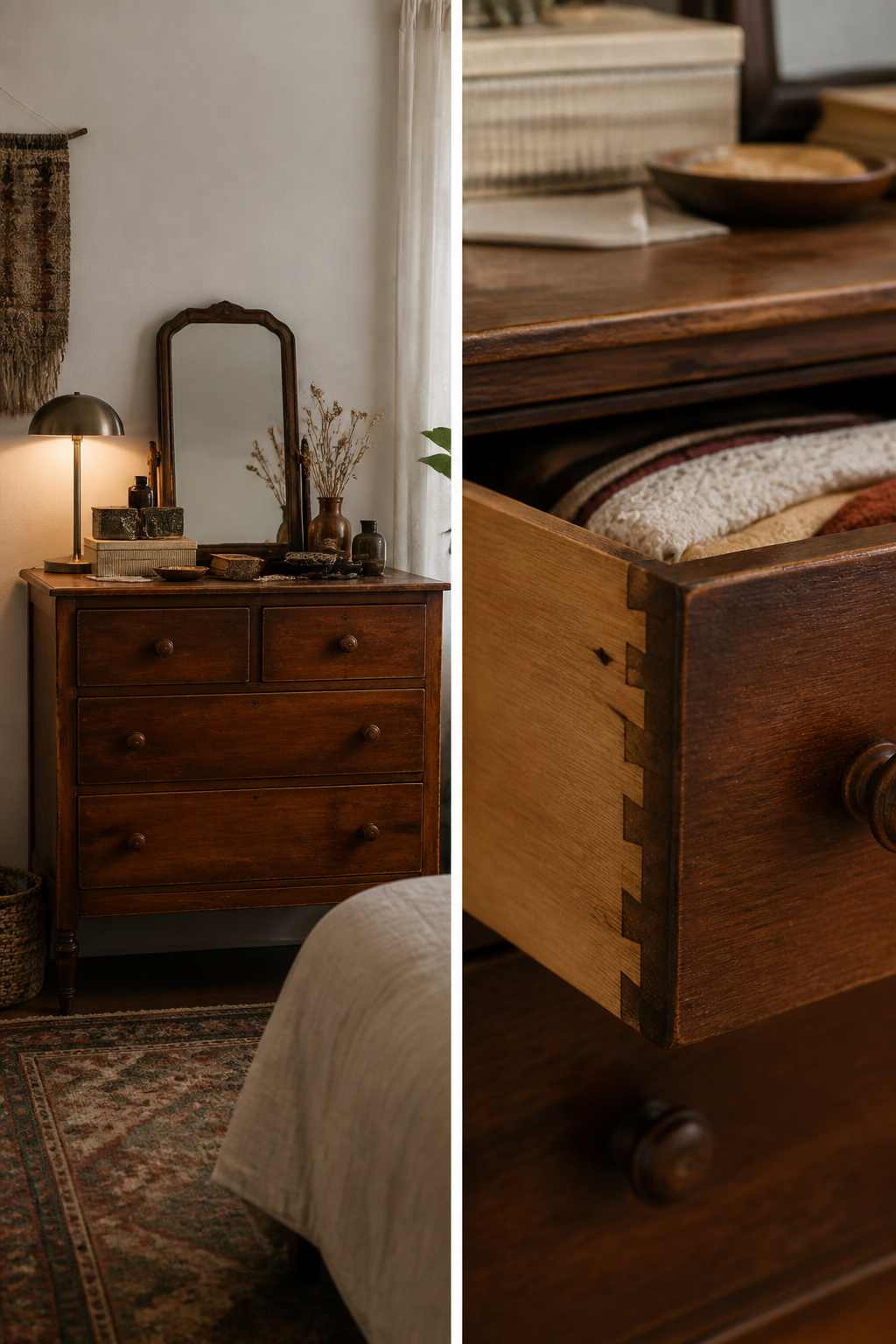
The real character in a boho bedroom comes from pieces that already lived somewhere else. Estate sales and flea markets are where you find solid wood dressers with dovetailed drawers, the kind of construction that survives three moves and still opens smooth. Lift the piece and feel the weight; solid wood is heavy and sounds dull when you knock it, while veneer hollows out and rings thin. Look inside drawers for rough, interlocking joints rather than staples or flat panels glued at the edges.
Thrifted textiles need more than a glance. Old quilts, kilims, and embroidered throws can carry dust mites, moth eggs, or worse. Freeze smaller pieces for 72 hours if you have the space, then air them in direct sun. For anything too large, a hot wash if the fabric allows, or a trip to a cleaner that handles vintage. The $25 you spend there beats replacing your closet’s contents later.
Balancing these finds keeps the room from looking like a storage unit. Pair that heavy carved headboard with a simple, modern platform frame, or set a sleek metal lamp on a warped farmhouse nightstand. The contrast is what makes both pieces readable. Online marketplaces like Etsy and Chairish widen the hunt when local stock runs thin, though shipping runs the cost up fast. Start within driving distance; patience there costs nothing extra.
7. Bohemian Rugs and Floor Layering
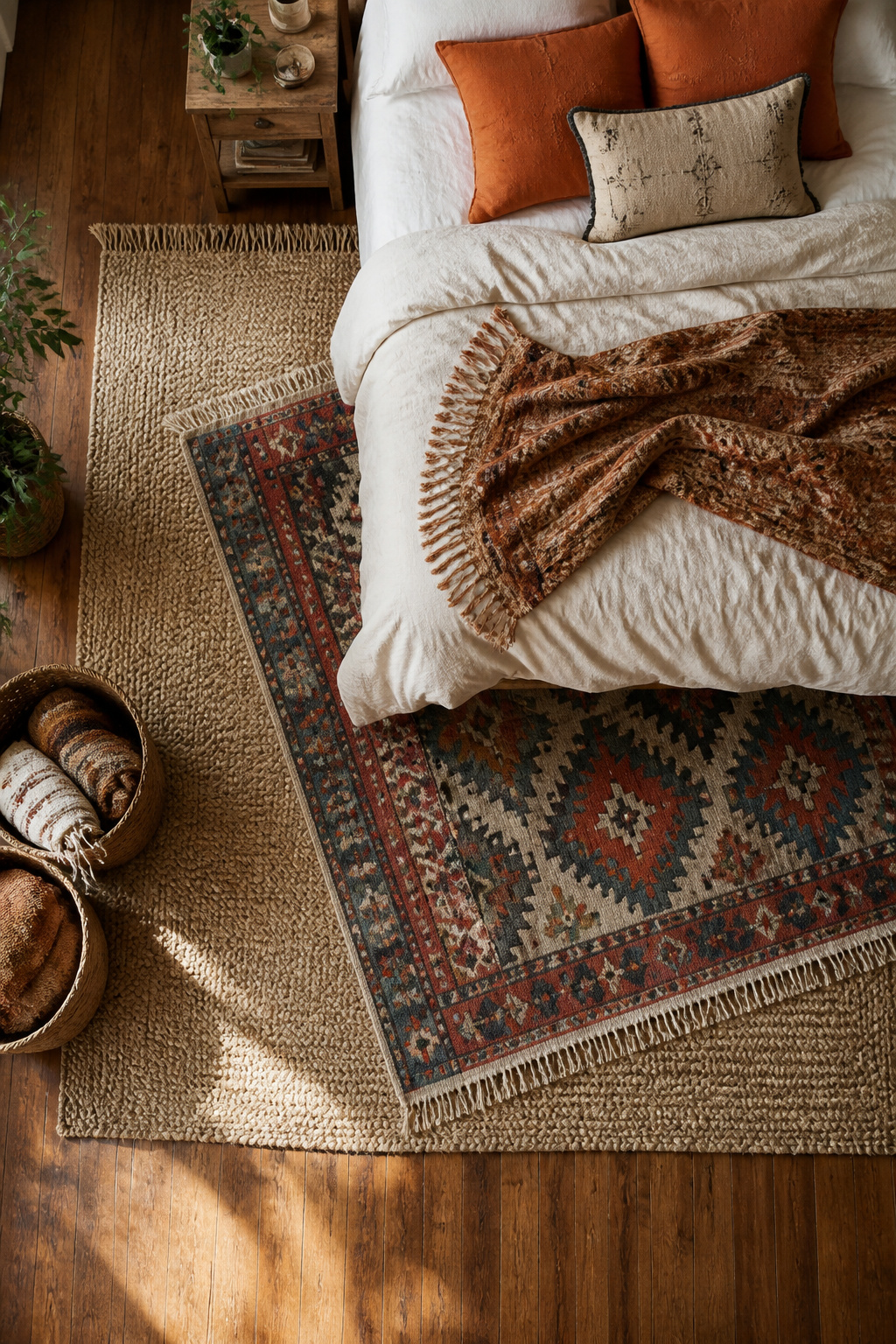
Layered rugs are where a boho bedroom starts to feel finished rather than decorated. The move is a large natural-fiber base, usually 8×10 or 9×12, with a smaller patterned rug on top, something in the 5×8 range with kilim or Moroccan motifs. The base gives you the footprint; the top layer gives you the story.
On hardwood this is straightforward. On carpet, it still works, though the effect is quieter. A flat-weave or low-pile top rug sits better over wall-to-wall than something shaggy, which starts to feel like you’re walking through a drift. The geometric pattern does more of the visual work when the texture can’t.
The part people skip is keeping the layers from sliding. Rug pads between each layer help, but on carpet you can also anchor the corner under a bed leg or nightstand. Without that weight, you’ll be straightening the top rug every morning. That collected-over-time look stops reading as relaxed and starts reading as neglected when the kilim is permanently askew.
Budget-wise, this is where you can build in stages. The base rug is the investment; the top layer is where you hunt secondhand or wait for a sale on something with the right wear and color. The pairing matters more than either rug alone.
8. Soft Lighting with Lanterns and String Lights
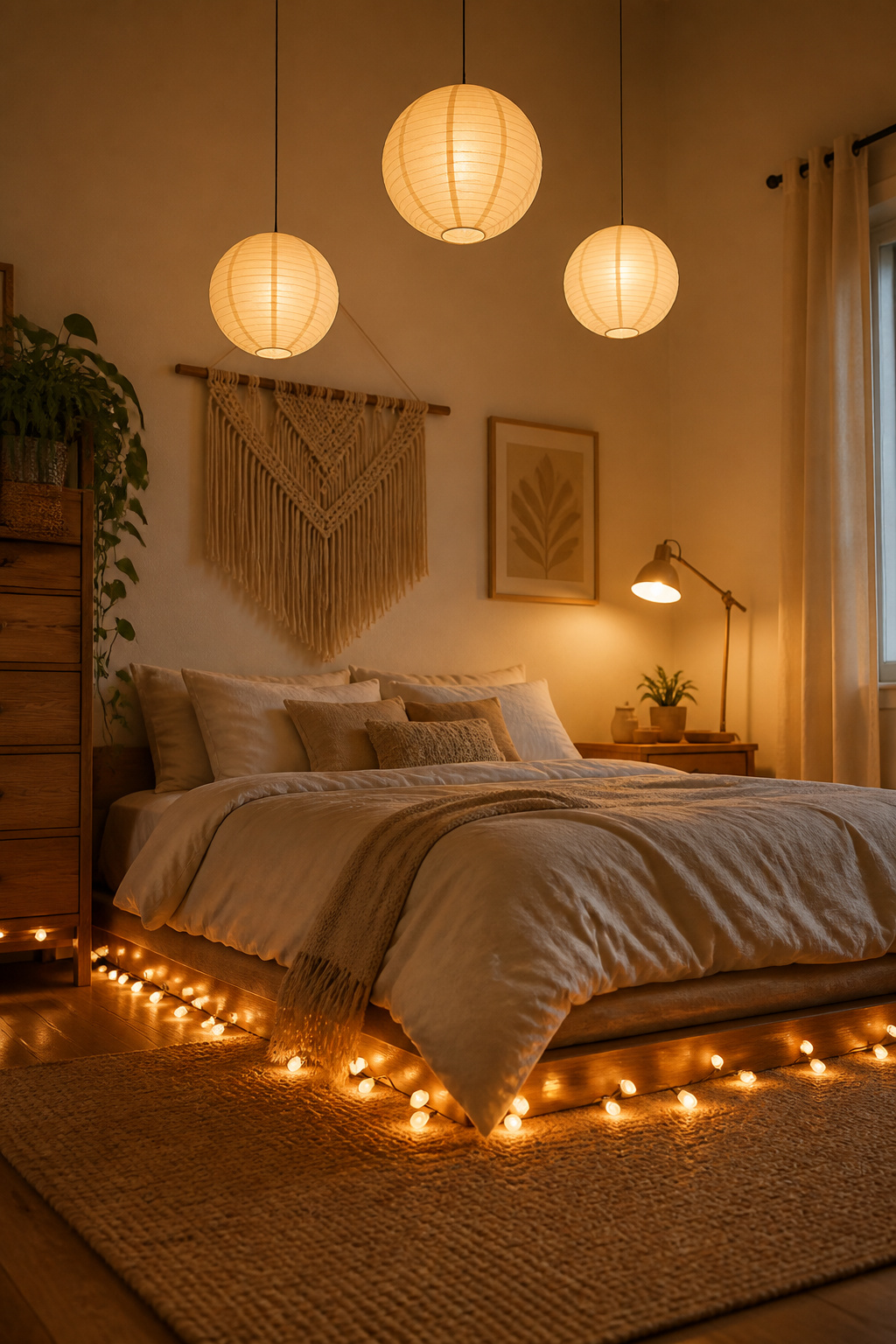
Warm, intimate light is what separates a boho bedroom from a room that simply has a lot of stuff. You want layers of soft glow rather than one harsh overhead source, and you do not need an electrician to get there.
Plug-in and battery-powered options are the renter’s advantage here. Paper lanterns in the 12-to-16-inch range cluster well above a bed or in a corner; hang three at staggered heights from ceiling hooks that leave pinholes you can spackle later. Edison string lights at 2700K wrap cleanly around a headboard frame or mirror edge, and the warm color temperature keeps the light golden rather than clinical. For reading, clip-on lamps with fabric shades bolt to a headboard or shelf without touching the wall.
Cord management decides whether the look reads intentional or messy. Run string light cords behind the headboard or down the back corner of a dresser, secured with clear cord clips. For plug-in lanterns, a fabric cord cover in a neutral tone routes the line along the ceiling edge and down to the outlet. Battery-operated puck lights inside a Moroccan-style lantern on the dresser eliminate one cord entirely, though you will trade the glow quality for convenience. The setup that has worked most often: Edison strings for the perimeter glow, one paper lantern cluster as a focal point, and a single clip-on lamp where you actually read.
9. Bohemian Wall Art and Gallery Displays
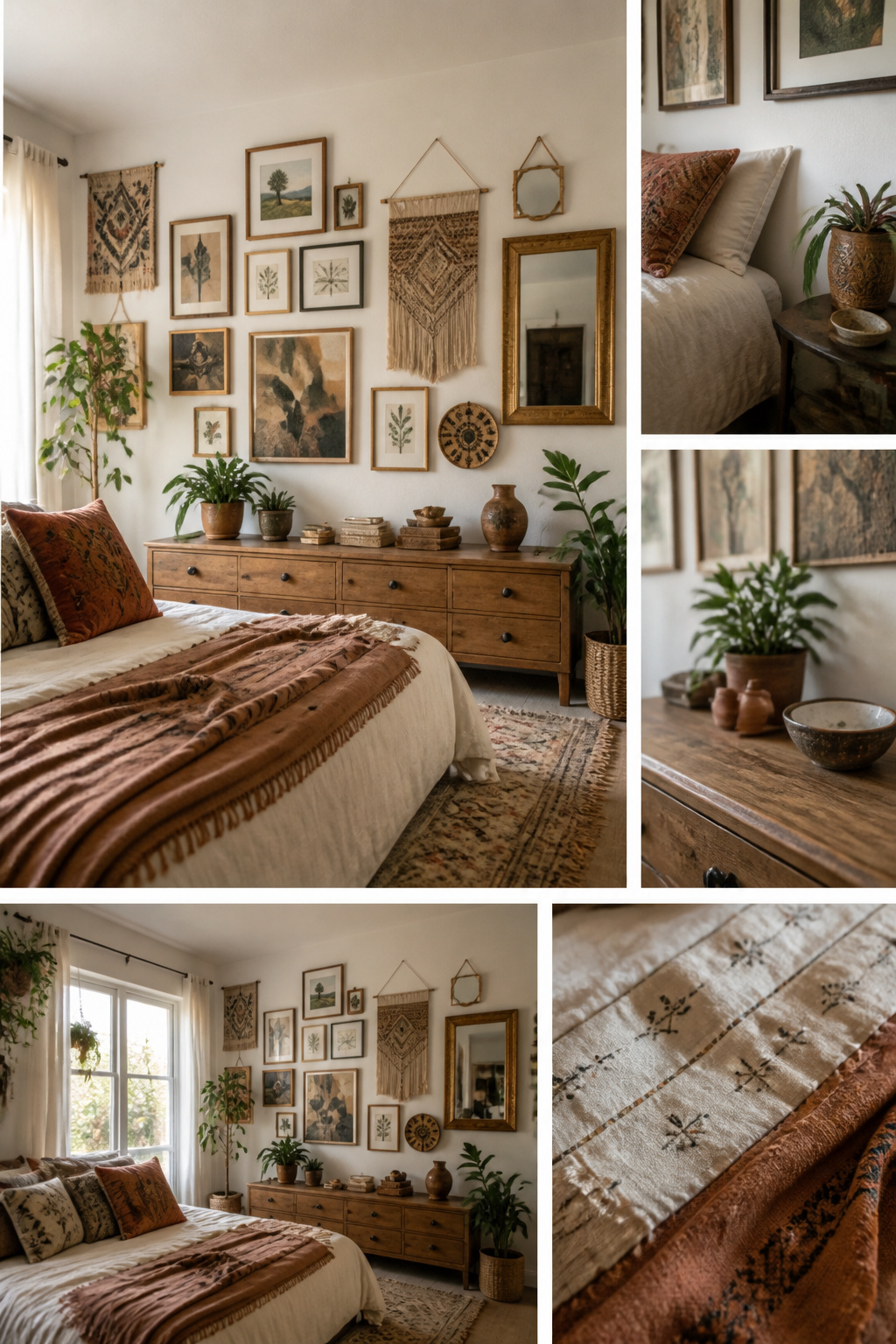
A gallery wall is where boho style lives or dies, and the mistake most people make is hanging every piece at the same height. That reads as a department store display, not a collection built over time. Mix the heights, overlap the edges slightly, and let the arrangement feel accidental even when it is not.
For renters, Command Picture Hanging Strips solve the deposit problem. They hold firmly and peel clean, so you can layer in textile art, vintage mirrors, even a hat wall without a single hole. Mix frame styles deliberately: a thin brass border next to a chunky wood frame, a frameless canvas beside both. The contrast is what gives the wall its depth.
New York designer Mikel Welch recommends textile art specifically for boho bedrooms. A woven piece or a small rug mounted as art adds the warmth that prints alone cannot. Play with arrangements on the floor first, photograph the layout, then transfer it upward. The ten minutes of planning saves an hour of patched holes and crooked rehangs.
10. Window Treatments with Flowing Fabrics
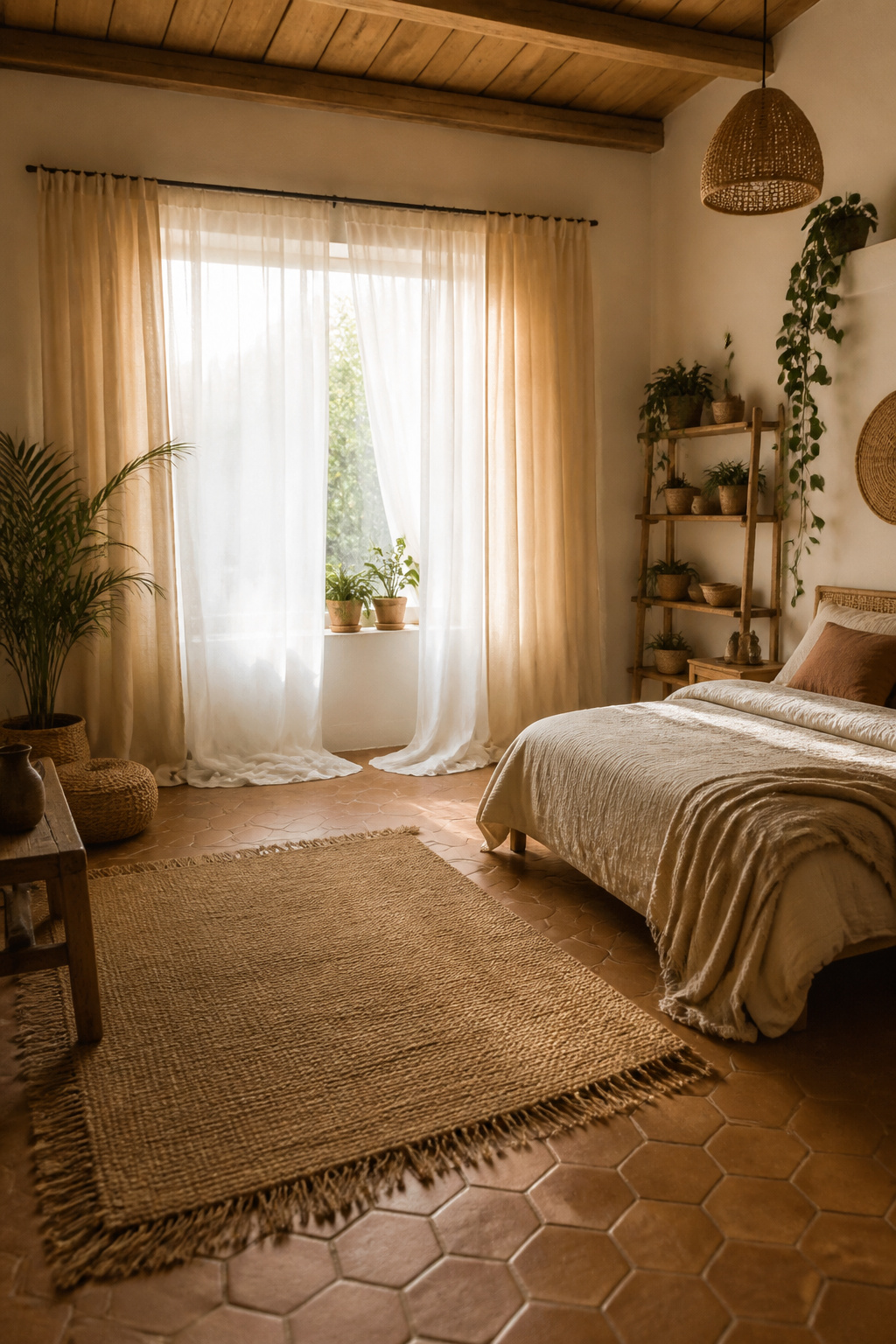
Heavy curtains read as formal; they fight the loose, unplanned feel that makes a boho bedroom work. Sheer panels, lightweight linen, or even a vintage sari hung on a tension rod will give you the drift and softness without asking you to drill holes or commit to hardware you cannot take with you.
Privacy is the place where flowing fabric can fail if you do not plan for it. Layer a sheer underneath something slightly heavier, still in cotton or linen, so you have coverage after dark without losing the daylight quality that makes the room feel open. The puddled effect, where the fabric pools a few inches on the floor, works best when the curtain is deliberately long; buy for the drop you actually need rather than hemming to exact length.
Rental windows are rarely standard. Measure the width at three points, top to bottom, and use the widest reading. For the drop, measure from your hanging point to where you want the fabric to fall, adding six to eight inches if you want the puddle. Tension rods buy you flexibility on width, but they max out around ten pounds of weight, so keep the fabric light. If the window is wider than about forty inches, a tension rod will sag; that is the point where a simple brass or wooden rod, hung with removable hooks, becomes the better call.
What Boho Style Actually Means
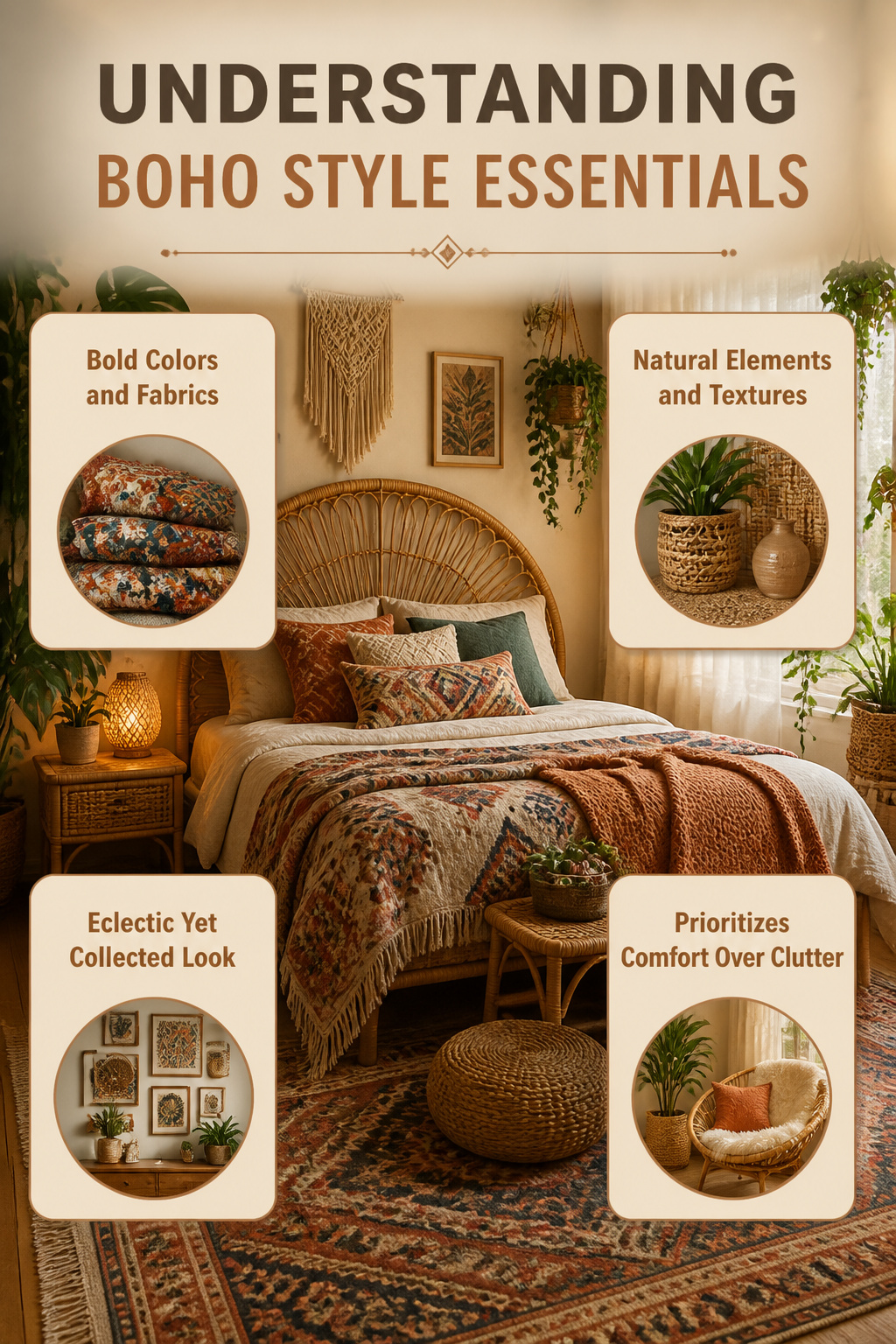
Boho style mixes bold colors, fabrics, prints, and textures into an eclectic aesthetic, then softens the whole thing with natural materials like wood, wicker, and jute. In a bedroom, that boldness has to quiet down enough that you can actually sleep. The florals and loud patterns you see in living-room boho stay present, but they layer through rugs, throw pillows, and bedding rather than hitting you from every surface at once. The result is collected, not chaotic: imperfection and personal eccentricity read as comfort instead of clutter. Bedrooms also pull in more organic elements than other rooms might. Plants soften hard lines and add living texture; flowing fabrics at the window move with the breeze and celebrate natural light rather than blocking it out. The bedroom version of boho keeps the style’s freedom, but trades some of its energy for rest.
Two Ways to Build a Boho Bedroom
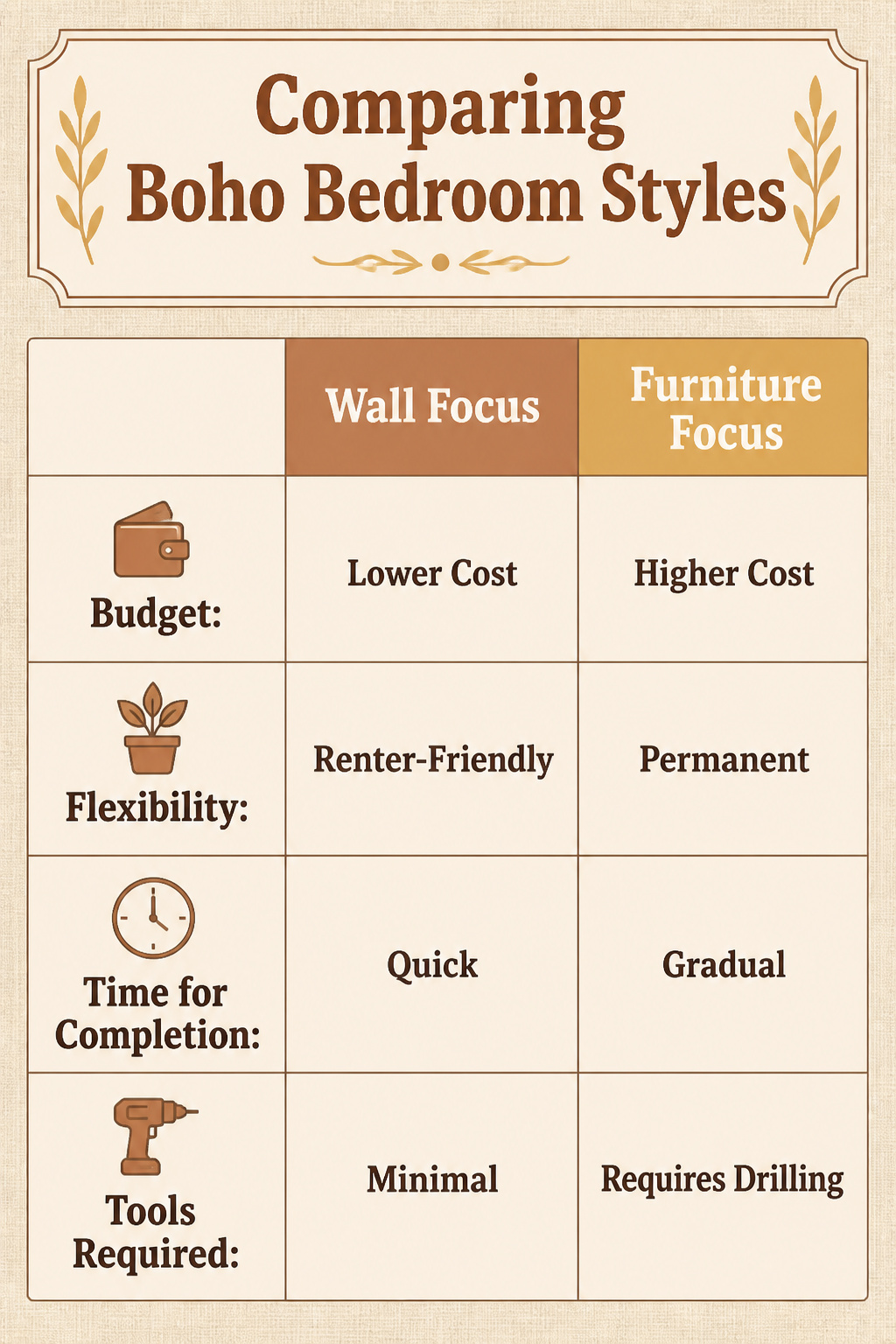
You can build a boho bedroom through the walls or through the furniture, and the budget splits almost in half between them. Letting the walls do the talking means textile art, vintage mirrors, maybe a hat wall, hung with removable strips so nothing scars the paint. That path runs lighter on cash, lighter on tools, and moves with you when the lease ends. It is the renter’s play by default.
The other path layers pieces collected over time, neutral bedding first, then wood side tables, sculptural lighting, reclaimed benches. That approach costs more at each step and asks for walls you can drill, floors you own, space to store the half-found thing until the room calls for it. It suits first-home owners who are staying put and can wait for the right second-hand score.
"To achieve a boho style in the bedroom, embrace a layered, collected approach that feels curated yet lived in."
What that means in practice: start with bedding in a tone you can live with, then add one natural material or one found piece per season. Speed kills the look. The gallery wall can happen in a weekend; the collected room needs years, and reads hollow when rushed.
Budget Sources That Work
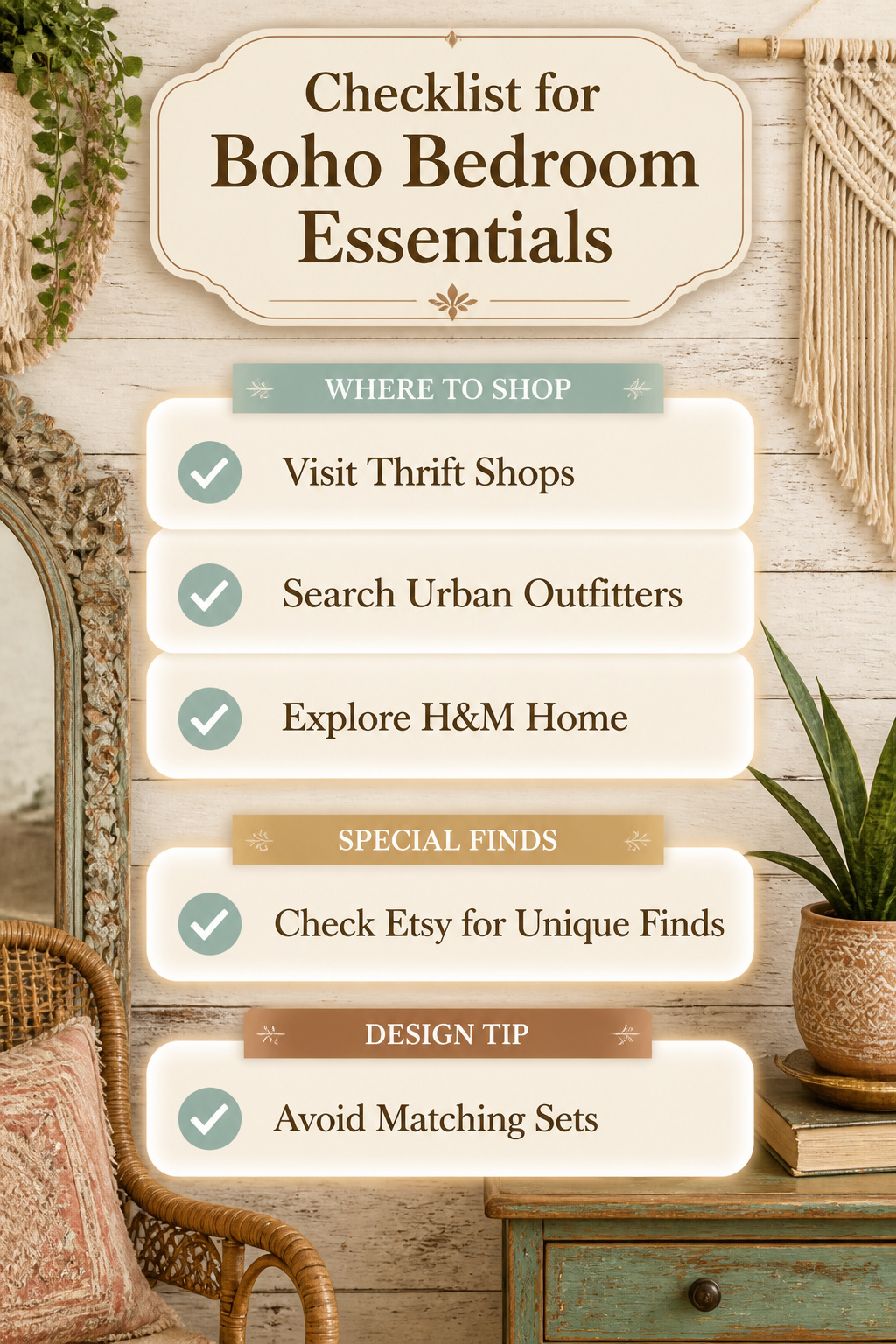
Thrift shops are the first place to look for boho bedroom ideas that actually feel collected rather than staged. The vintage pieces you find there, the ones with real wear and odd proportions, are what give a room its story. A carved wooden mirror with chipped paint or a rattan chair that sags just slightly will do more for the look than anything shipped in a flat box.
For new items, Urban Outfitters, Anthropologie, World Market, H&M Home, and Etsy each serve a different purpose. Urban Outfitters and Anthropologie carry the heavier, statement pieces, bed frames and dressers with the right lines, but you pay for the curation. World Market and H&M Home are where you fill in: textiles, small storage, the things that layer in without draining the budget. Etsy works best when you need something specific, a hand-thrown planter or a particular textile, and you have the patience to sort through shops.
The mistake is buying a matching set from any one of them. A room full of Anthropologie reads as a display, not a bedroom. Mix sources deliberately: thrift the furniture, buy new bedding, add one or two pieces from a higher-end store. The balance keeps the room from looking like you decorated it in a single afternoon, which, if you are honest, you probably did.
One Weekend Boho Refresh
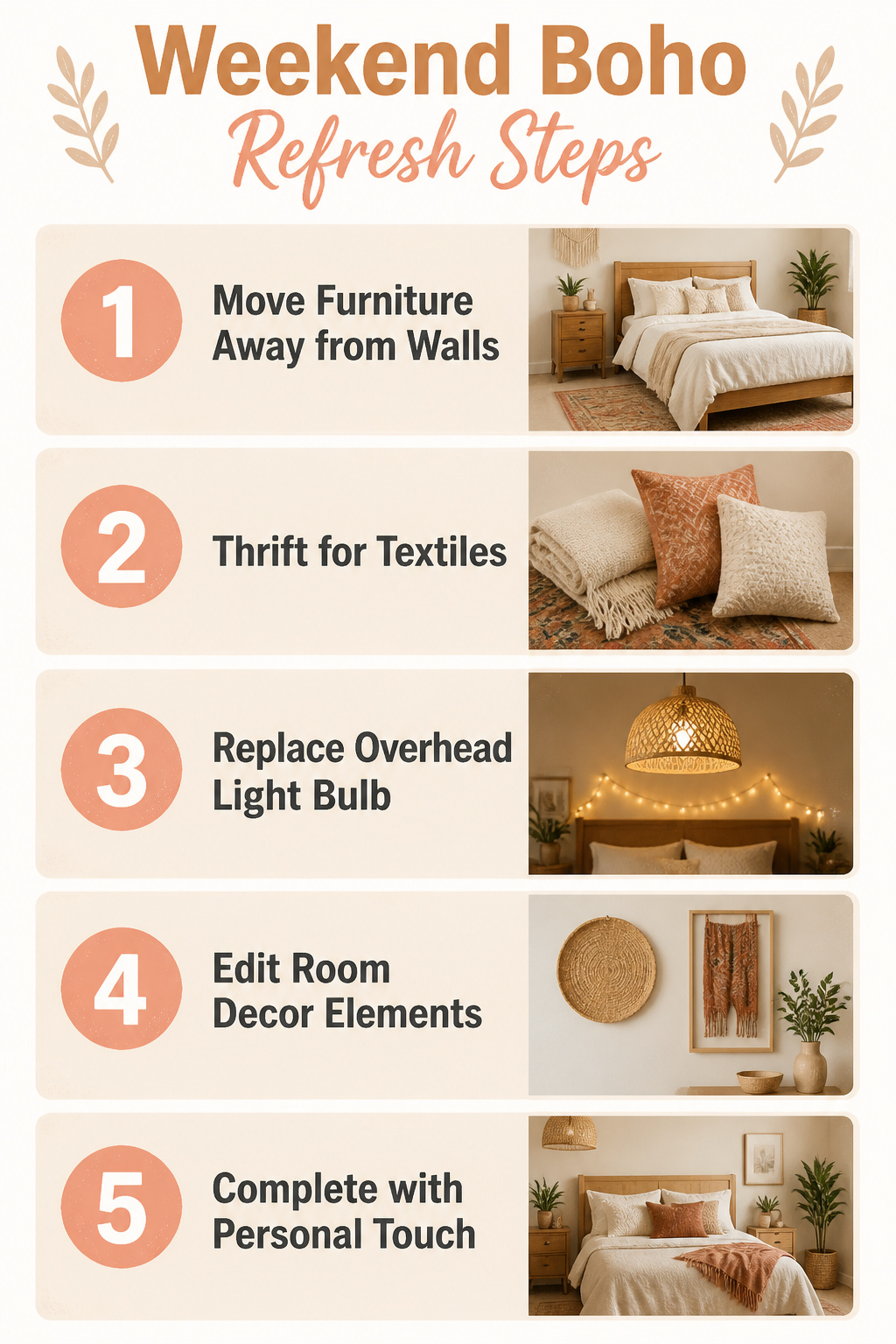
Start Friday evening by moving every piece of furniture at least six inches from the wall. Vacuum what you find, then decide what stays shifted. The new floor plan costs nothing and often matters more than anything you buy.
Saturday morning, hit one thrift store for textiles: a flat woven rug to layer over carpet, two pillow covers in different textures, and a cotton throw. Wash and dry everything on hot before it touches your bed. Afternoon, swap your overhead bulb for a warm 40-watt equivalent and hang string lights behind the headboard if you have a frame, or along one corner if you don’t.
Sunday, edit. Pull one color from your new textiles and move anything that fights it to another room. Hang one thing on the wall: a scarf in a clip frame, a woven tray, your own printed photo. Stop before the room feels finished. Boho lives in the gaps.
If time runs short, skip the lights and keep the textiles. If money runs short, skip the rug and keep the rearranged layout.
The common mistake is buying a "statement" piece first: a carved headboard, a vintage dresser, an oversized mirror. Those sit there while the room around them stays unchanged. Start with what touches the floor and your skin. Build toward the big purchase in a later weekend, once you know what the room actually needs.
Frequently Asked Questions
What is boho style?
Boho style mixes bold colors, fabrics, prints, and textures into an eclectic aesthetic, then softens everything with natural materials like wood, wicker, and jute. The look often includes florals and geometric patterns that show up in rugs, throw pillows, and bedding. In a bedroom, the boldness quiets down enough that you can actually sleep.
How to do boho style in a bedroom?
Let the walls do the talking with textile art, vintage mirrors, or even a hat wall hung with removable strips, or layer collected pieces over time starting with neutral bedding and adding natural materials or found objects season by season. The first path costs less and moves with you; the second suits homeowners who can wait for the right secondhand score. Speed kills the look, so add one piece per season rather than rushing.
What colors look good in a bohemian bedroom?
Warm neutrals, muted taupes, terra-cottas, rusts, and clay tones form the backbone of a livable boho bedroom. Start with a neutral base so brighter textiles or vintage finds read as intentional, not chaotic. If you want one moment of saturation, paint only the wall behind your bed in a rich earthy tone like terracotta or olive green.
How can you create a boho bedroom on a budget?
Shop secondhand at thrift stores and estate sales for the vintage pieces that give a room its story. A carved wooden mirror with chipped paint or a sagging rattan chair does more for the look than anything shipped in a flat box. For new items, mix sources like World Market and H&M Home for textiles and small storage rather than buying a matching set from any single store.
Where can you buy boho bedroom decor?
Thrift shops are the first place to look for pieces that feel collected rather than staged. For new items, Urban Outfitters and Anthropologie carry heavier statement pieces, World Market and H&M Home fill in with textiles and small storage, and Etsy works well for specific handmade finds. The mistake is buying a matching set from any one source; a room full of Anthropologie reads as a display, not a bedroom.