
A basement living room can run from a weekend paint job to a full built-in overhaul, and the deciding factor is not budget but moisture. Before you pick a single swatch or rug, run your hand along the walls after heavy rain; damp concrete will bubble standard paint and ruin wall-to-wall carpet within a season. Benjamin Moore White Dove or Sail Cloth on matte-finished walls buys you the most change for the least money, but only if the air down there actually dries.
1. Start with Light Paint Colors

White and cream tones on basement walls and ceilings do more than look clean; they bounce back every lumen your lights put out, which matters when the windows are small or few. Benjamin Moore White Dove and Sail Cloth are two shades that keep coming up for this job. White Dove reads as a true soft white without going sterile, while Sail Cloth pulls in warm beige undertones that keep a below-grade room from feeling like a clinic.
The finish matters as much as the color. Flat or matte paint hides the uneven seams, patched cracks, and texture quirks that basements almost always have, especially on older ceilings. Gloss catches raking light and turns every flaw into a shiny announcement. Save the eggshell and satin for upstairs, where the sun smooths things out.
If your walls are cinderblock, paint is still the fastest way to stop them from looking like a utility space. One weekend, a few hundred dollars in supplies, and the room already feels less like a basement and more like part of the house you actually want to use.
2. Hang Large-Scale Art

Oversized art does something counterintuitive in a basement. Instead of swallowing the wall, a single tall piece pulls the eye upward and stretches the ceiling line. A gallery wall breaks that vertical line into fragments, which is the last thing a low-ceilinged room needs.
Hang the center of the piece at eye level or slightly above, not the midpoint of the wall. In a standard eight-foot basement, that usually means the bottom edge sits about eight to ten inches above the sofa back, not the twelve to sixteen inches you might use upstairs. The closer the ceiling, the higher the art needs to ride to create breathing room.
One large canvas or framed print also costs less than you would expect compared to assembling five or six smaller pieces. You skip the matting, the multiple frames, and the spacing math that never quite works out. The sources I read kept coming back to this: select a few large-scale, tall pieces you love, and the difference is immediate.
3. Layer Textiles for Warmth

Basements collect hard surfaces the way upper floors do not. Concrete floors, block walls, and exposed joists all bounce sound and pull warmth from the room. Textiles are the fix you can carry in with both arms and spread out in an afternoon.
Start with the largest plane. A wall-to-wall carpet makes the most difference in an enclosed basement that does not open straight to mud or yard traffic. If that is not an option, layer multiple large area rugs, even over existing flooring. Faux wood laminate, concrete, engineered wood, whatever is down there, rugs on top cut the chill and the echo.
Then build up. Throw pillows in varying patterns, chunky knit blankets, waffle weave throws, bouclé cushions. Faux fur reads as luxury at a discount-store price point. Soft upholstery on the seating you already have, or a slipcover if buying new is not in this year’s budget, does the same work as the rugs: it breaks up the hard surfaces that make a basement feel like a basement rather than a room you actually want to sit in.
The lived-in look comes from the overlap. A rug on carpet, a throw draped where someone left it, pillows that do not match too carefully. Each layer traps air, absorbs sound, and gives your eye something soft to land on.
4. Build Layered Lighting
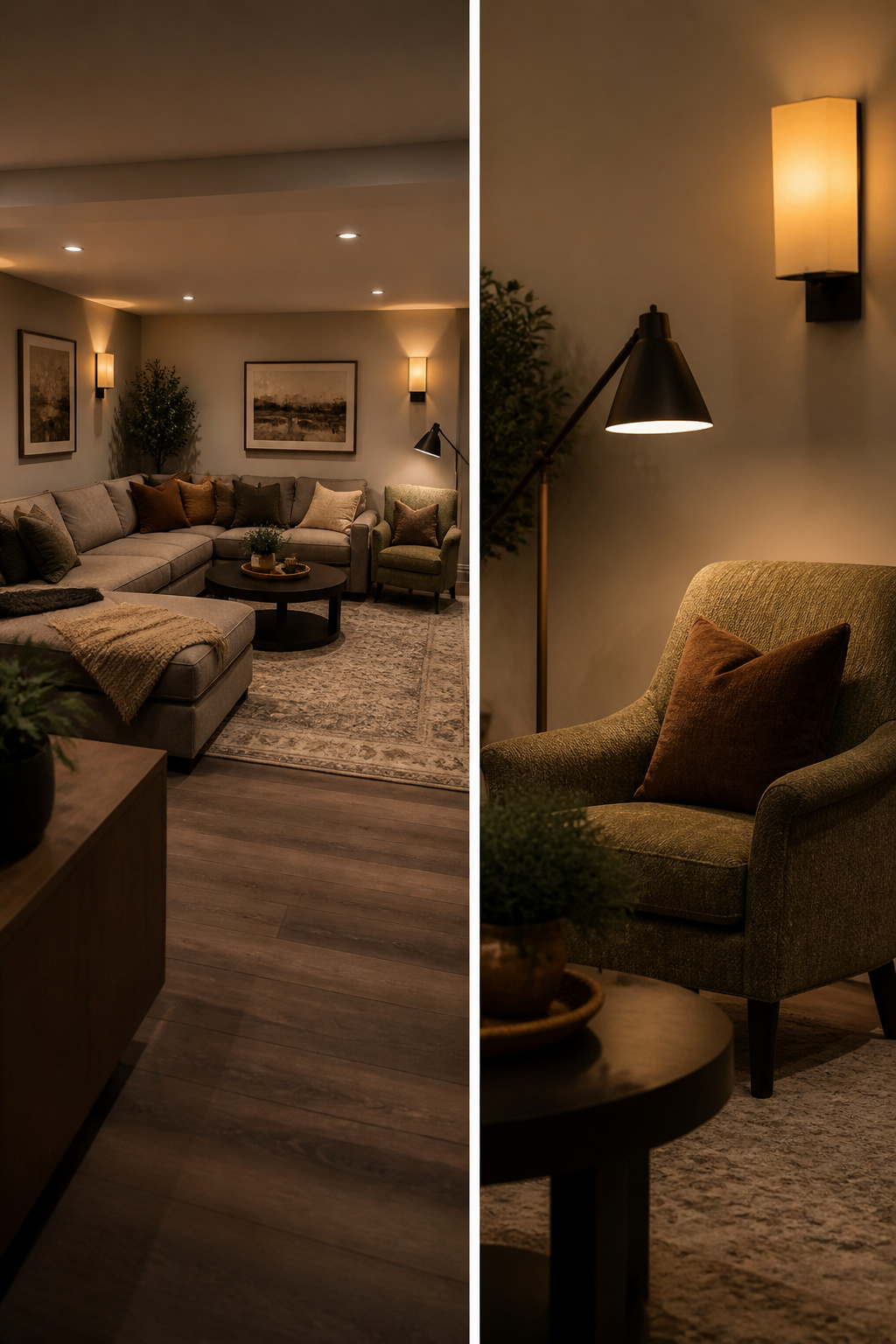
A basement living room needs more light sources than the rooms upstairs because the walls are already swallowing daylight before it reaches you. Plan on three layers minimum to keep the space from flattening into a single dim wash.
Recessed lights are your base layer, and in a low ceiling they are often the only overhead option that keeps headroom. Use them for tasks: folding laundry, finding a dropped remote, walking through without tripping. Wall sconces pick up what the cans miss, washing vertical surfaces so the walls read as space rather than shadow. Floor lamps finish the room, pooling light at seating height where people actually live. A lamp behind a reading chair does more for mood than another can in the grid.
Warm tone bulbs are the choice here. Cool light in a basement reads institutional fast; warm light lets the same paint color feel like evening instead of storage. Place sconces between the recessed fixtures, not directly under them, so each layer fills in where the others fall off. Without that stagger, you get the dark rings that make a finished basement still feel like a basement.
5. Choose Furniture With Personality

Basements start with concrete, joists, and ductwork. Personality has to be moved in. A cozy sectional does more seating and more than that: it draws a border around where living actually happens, the way a rug does upstairs. Skip the sofa-and-chairs setup. Everyone ends up with the same good seat instead of fighting over the one decent armchair.
Low ceilings make scale the real problem. A low-profile sectional, something with a tufted back or rounded arms that sit below window height, keeps sightlines open. Measure your stairwell turn before you fall for anything. A standard 78-inch sectional arm will not make a tight basement stair landing, and discovering that at delivery is a Saturday you do not get back.
Vintage pieces help too. A scuffed wood stool from a marketplace listing works as extra seating and somewhere to set a drink, and it carries warmth no new factory finish matches. The trick is mixing one or two of those finds against the cleaner lines of the sectional so the room does not turn into a storage pile. Texture does the work here, not clutter.
6. Define Zones With Layout

A sectional does more than seat more people. The back of it becomes a soft wall, turning one open room into two without a single stud. Face the U or the long side toward your TV for lounging, and the rear automatically shields a game table or a couple of gaming chairs behind it. Traffic still moves around both ends, which matters because most basements carry at least one support column you cannot move. Leave thirty to thirty-six inches of walk space on the open sides; anything tighter and the path between couch and column becomes a bottleneck every time someone stands up with a drink.
If you are working with what you already own, the same principle holds. Float a sofa with a console behind it, or back two armchairs up to the edge of a rug. The rug itself does the rest of the work, signaling where one zone ends and another begins. Keep the coffee table light enough to shift when you need the floor for VR or a board game that sprawls. A fixed ottoman looks finished, but a tray-top piece on casters earns its space twice.
7. Place Mirrors to Bounce Light
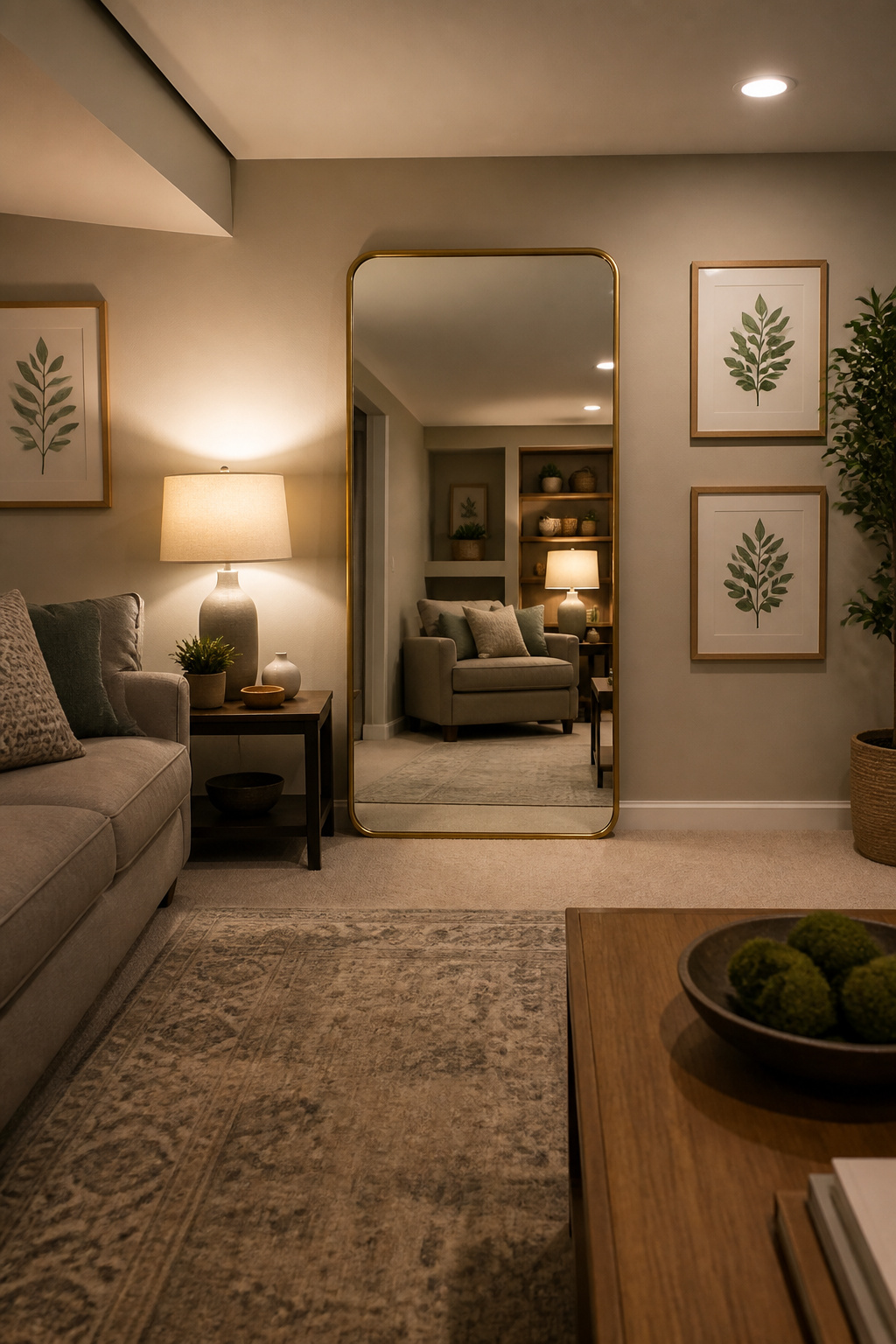
A mirror hung opposite your basement’s best light source, even a single bright lamp, throws that brightness back into the room and keeps it from pooling in one corner. The effect is straightforward: you see the light twice, and the walls feel farther apart than they are.
Size matters more than frame. A mirror too small for the wall reads as decoration and does almost nothing; one that spans roughly two-thirds of the wall height actually works. Go thin on the frame if your basement has low ceilings, bulky frames eat visual space you do not have. Metal or raw wood both fit basement aesthetics without trying hard.
If your light source is a table lamp or an upward-facing floor lamp, angle the mirror to catch the glow directly. Test the placement by switching the lamp on after dark and standing where you normally sit. The mirror should throw a soft patch of light onto the opposite wall, not glare back at you.
8. Add a Small Bar Station

A bar station does not need to dominate the room to earn its place. One homeowner split their basement into a bar zone on one side and a conversation area on the other, each anchored to its own television. That layout only works if the bar stays compact enough to read as furniture, not as a kitchen installation.
A 24-inch depth is about all the counter you need for mixing drinks and setting down a plate. Anything deeper and the piece starts eating into walking paths. Store bottles and glasses in closed cabinets below or on open shelves above; either way, keep them within arm’s reach so you are not crossing the room mid-conversation. Place the bar adjacent to your main seating, not across from it, so the host stays part of the group while pouring.
If you are working with a few hundred dollars, a used dresser with the top drawers removed for bottle storage and a stone or laminate remnant laid across the surface will do what the custom builds do. The mistake is treating the bar as a display piece rather than a working surface. Build it to be used, and it will get used.
9. Soften Floors With Rugs or Carpet
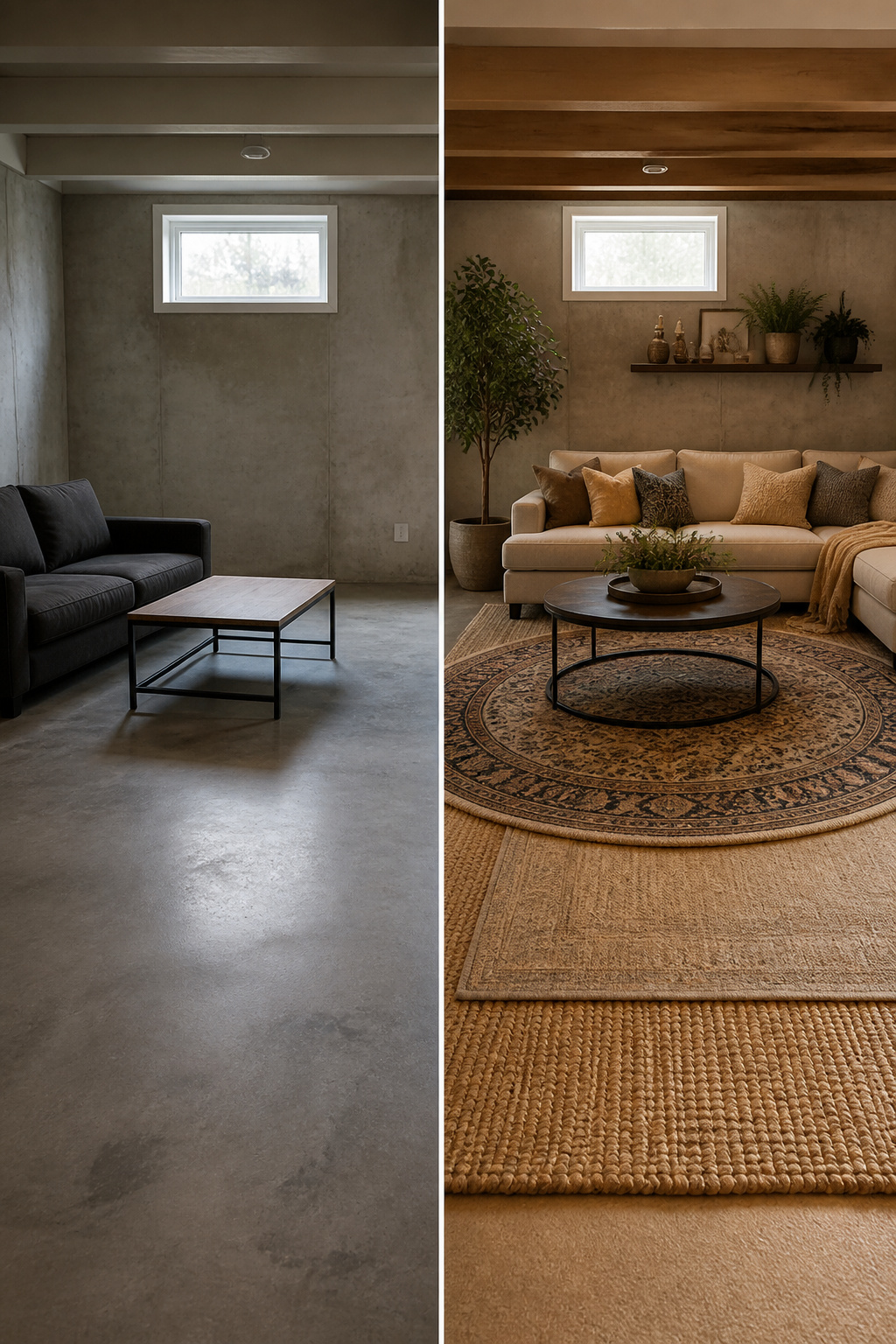
Wall-to-wall carpet will warm up a basement faster than almost anything else, but it is also the first thing you roll to the curb when water finds its way in. That tension is what drives the decision. If your basement is enclosed, stays dry, and does not open straight onto mud or a backyard patio, wall-to-wall can work. Layer a rug on top near the seating area and the room starts to feel finished.
For most basements, large area rugs are the safer play. Synthetic fibers in nylon or polypropylene handle residual dampness better than wool, and if the space takes on water you carry the rug upstairs instead of cutting out and dragging soaking wet wall-to-wall up the stairs. Carpet tiles split the difference: one section gets damaged, you lift and replace that square.
Sound absorption matters in a basement. Soft flooring knocks down echo against concrete or subfloor, and the right pad underneath adds actual insulation value. The pad matters as much as the surface. A dense rubber or synthetic pad resists moisture better than felt, and it keeps the rug from sliding on hard flooring.
This is about coverage, not throw pillows or draped blankets. The floor is where the cold lives. Cover it generously and the whole room shifts from storage space to somewhere you want to sit.
10. Maximize Any Natural Light

Basement windows are usually small, but the right treatment makes them count. Sheer or light-filtering shades let the most daylight through while still giving privacy from the street-level view into a window well. Skip heavy drapes or dark cellular shades on any window that actually sees sun; they steal what little light you have before it reaches the room.
Mirrors do the rest of the work. Place one on the wall adjacent to a window, not across from it, and the light bounces deeper into the space instead of straight back out. A mirror opposite the window can actually glare and flatten the room.
Egress windows have to stay clear by code, so keep furniture at least three feet from the opening and never mount treatments that require a frame or hardware inside the well itself. Even a 20-inch basement hopper window with a metal well deserves attention in your layout; angle a floor mirror to catch it, and that dim corner becomes readable light by afternoon.
Use Paneling for Texture
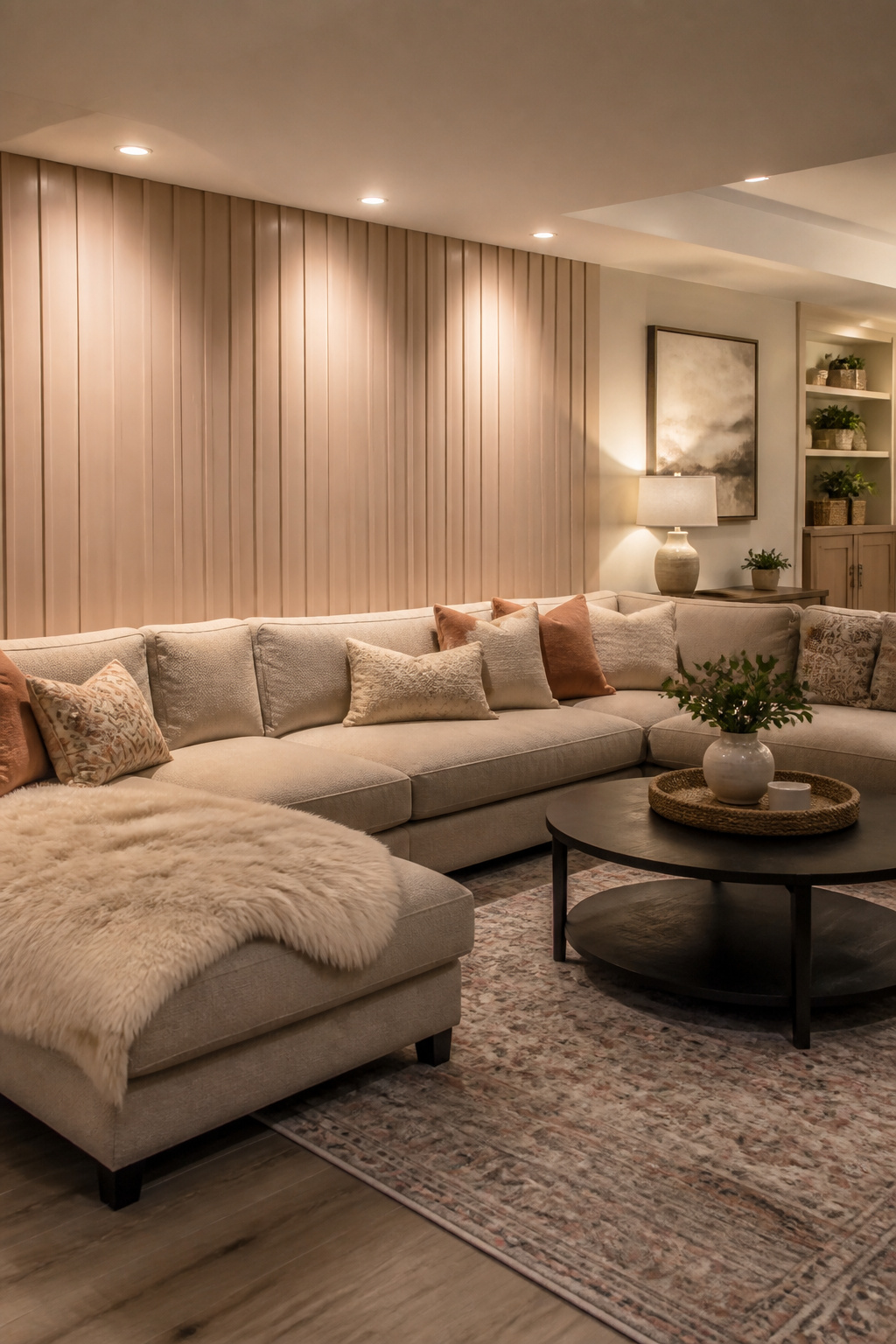
Drywall in a basement reads as an afterthought because it is one. Paneling, even inexpensive pine or cedar from the lumber yard, gives walls a texture that signals someone planned the space. In a room with no windows and a low ceiling, that texture matters more than the species of wood. If solid walnut is outside the budget, painted V-groove or shiplap achieves the same effect for less labor cost than most people assume, and finished drywall is not free either once you factor in mud, tape, and sanding.
Vertical boards draw the eye upward, which helps when the ceiling sits at eight feet or below. Run shiplap from floor to ceiling and the wall reads taller than it measures. Over concrete, you will need furring strips or a pressure-treated bottom plate with a moisture barrier behind it; skip that step and the boards will cup within a season. For renters, peel-and-stick plank products exist, though they read as thinner and less convincing up close.
White paneling works, but white drywall does not. The difference is the shadow line between boards, which catches what little light a basement offers and bounces it around. Paint the boards a warm color, something with a little rose or green in it, and the room stops feeling like a storage unit. Gray, especially in northern climates where the sun already leaves by four in winter, only reinforces what you are trying to fix.
Build in Storage That Hides Clutter
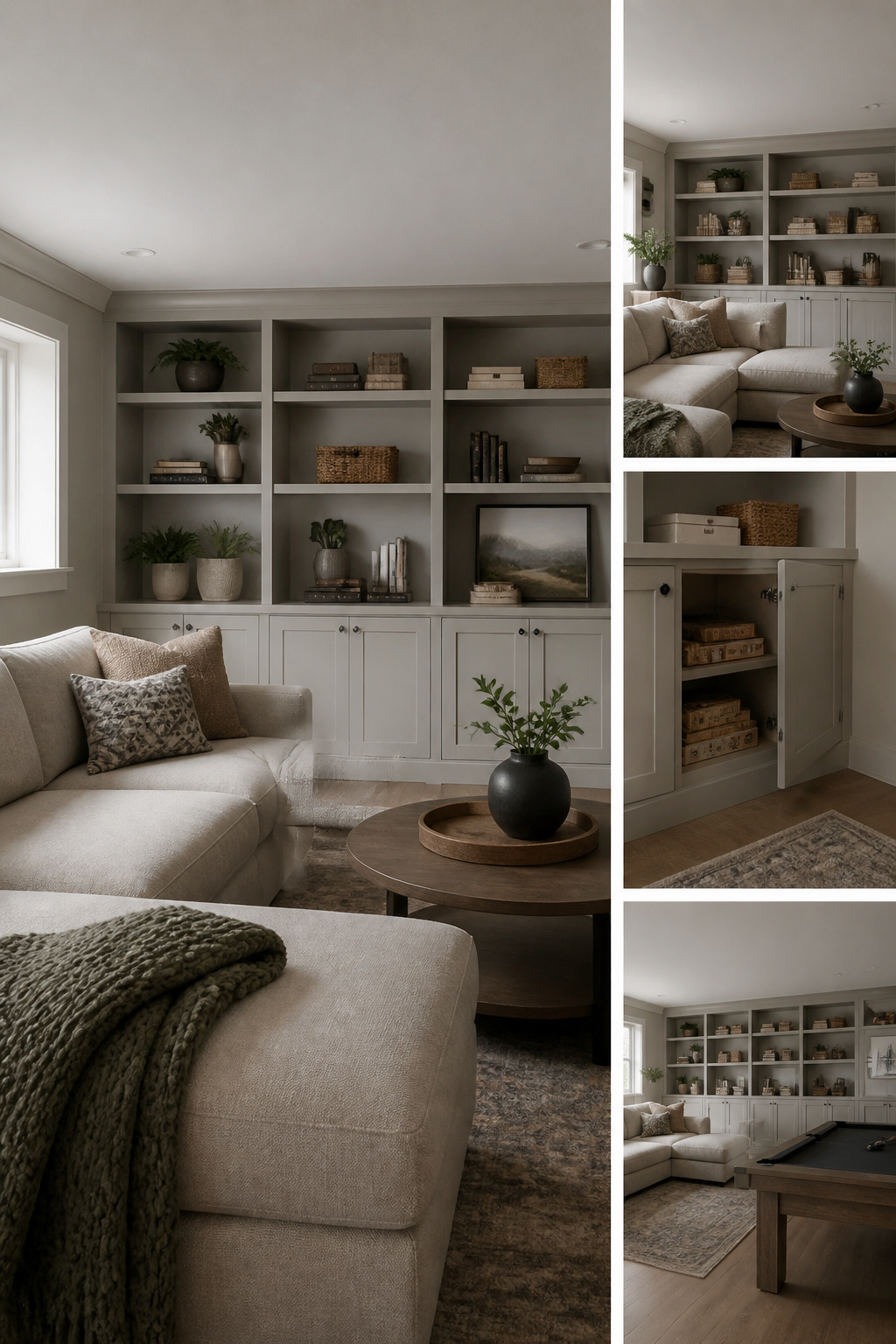
You will notice the difference the moment you clear the floor of the storage bins that have been sitting there since move-in day. Visible storage kills a living room faster than low ceilings do, because your eye stops on every label and lid instead of resting anywhere. The basement already fights an uphill battle for comfort; giving it clutter to display is a choice you can undo.
Built-in shelving along one wall turns the stuff you keep into background noise. Paint the backs the same color as the wall behind them, and the objects soften into texture rather than shouting for attention. If you have stairs, the triangle underneath is square footage you already own. A cabinet built into that cavity holds board games, extra blankets, or the router and cable box you do not need to see.
Furniture with hidden compartments costs more than open shelving, but it earns its price in a basement where every piece does two jobs. An ottoman that opens for linens, a coffee table with a lift-top drawer for remotes and chargers: these let you keep the room stocked without keeping it messy. The tradeoff is access speed. If you use something daily, hidden storage becomes annoying fast, so reserve it for weekly or seasonal items.
Start with what you actually own. Measure the clutter that is out now, then design around that volume. Building for imaginary organization systems is how you end up with empty shelves and full floors.
Consider a Faux Fireplace

Electric and ethanol faux fireplaces give you the warmth of a focal point without punching a hole through concrete for a flue. In a basement, that matters. Most electric units run from 36 to 50 inches wide, which fits the scale of a standard 12-foot basement wall without swallowing it. An ethanol model burns bioethanol in a stainless tray, so you get an actual flame, but the output is modest, more mood than heat.
Place it on the longest wall, dead center, and build around it. A narrow console or a pair of floor lamps on either side turns the fireplace into an anchor whether it is on or off. Electric units with a no-heat setting let you run the flame effect in July without cooking the room, which is worth checking for before you buy. Ethanol needs refilling and a bit of air circulation; skip it if your basement already struggles with humidity or stuffiness. Either way, budget $200–$600 for something that looks intentional, not like a space heater in a metal box.
What to Know Before You Start

Most basement living room ideas skip straight to paint swatches and rug piles without addressing what actually determines whether any of it lasts. Check for moisture and humidity before you buy a single can of paint or roll of carpet. Basements hold dampness that above-ground rooms simply do not, and that dampness will ruin standard finishes fast.
Paint bubbles and peels off walls that sweat. Textiles grow musty in air that never fully dries. Even synthetic rugs meant for high traffic will degrade if the concrete underneath them stays cool and damp year-round. You are not looking for obvious flooding here. Run your hand along the walls after a heavy rain. Note whether the air feels heavier down there in summer. If you are in a wet climate, or your area sees spring snowmelt, assume moisture is a factor until proven otherwise.
This is not a call to install a full drainage system before you decorate. It is a check that changes what materials you choose and where you place them. Wall-to-wall carpet, for instance, holds water like a sponge and is difficult to dry out. FLOR carpet tiles or polypropylene rugs lift up if they get wet, which is why you see them in finished basements that actually stay finished. The same logic applies to any textile you are considering: can it survive getting damp, and can you remove it if it does?
Once you know what you are working with, the rest of the project becomes simpler. Paint color and lighting and furniture placement are all easier decisions when you are not fighting the room itself.
Weekend Project Order

Paint and paneling come first because every drop drips downward and sawdust settles. You will regret a fresh rug installed before the ceiling gets its second coat. Tackle walls and any built-in surfaces across one weekend, then let them cure.
Lighting runs second. Wiring and fixture swaps stir up dust that would have ruined new upholstery, and you need working light to judge how paint reads at night. Plan this for the following Saturday.
Flooring waits until surfaces are finished. A stray screwdriver or ladder foot leaves marks on vinyl plank or carpet that padding won’t forgive. You also avoid boxing yourself into a paint color that clashes with a floor already down.
Textiles and furniture come last. By then the air has cleared, you can see true color temperatures under your new bulbs, and you are not maneuvering a sofa around wet baseboards. This is also when budget pressure eases; you will know exactly what the room still needs rather than buying pieces the space has to accommodate.
Order matters most for flooring. Install it early and you spend the rest of the project covering it, or worse, cleaning paint out of seams you cannot reach.
Frequently Asked Questions
What are some budget-friendly basement living room ideas?
Paint, layered lighting, and textiles deliver the most change for the least money. A few hundred dollars in supplies and one weekend of work can shift a basement from utility space to actual living area. Start with flat or matte paint in a soft white like Benjamin Moore White Dove or Sail Cloth, add lamps rather than rewiring, and layer rugs and throws you can carry in yourself.
How can I make my basement feel less like a storage room?
Hide visible clutter first, then add warmth through textiles and defined zones. Built-in shelving painted the same color as the walls turns stored items into background texture rather than visual noise. A sectional back used as a soft wall separates lounging from other activities without construction, and layered rugs, throws, and pillows break up the hard surfaces that signal basement.
What furniture is best for a basement living room?
A low-profile sectional works better than a sofa-and-chairs setup because it seats more people and draws a border around where living actually happens. Keep the back low to preserve sightlines under standard eight-foot ceilings, and measure your stairwell turn before buying; a 78-inch sectional arm often fails to make a tight basement landing.