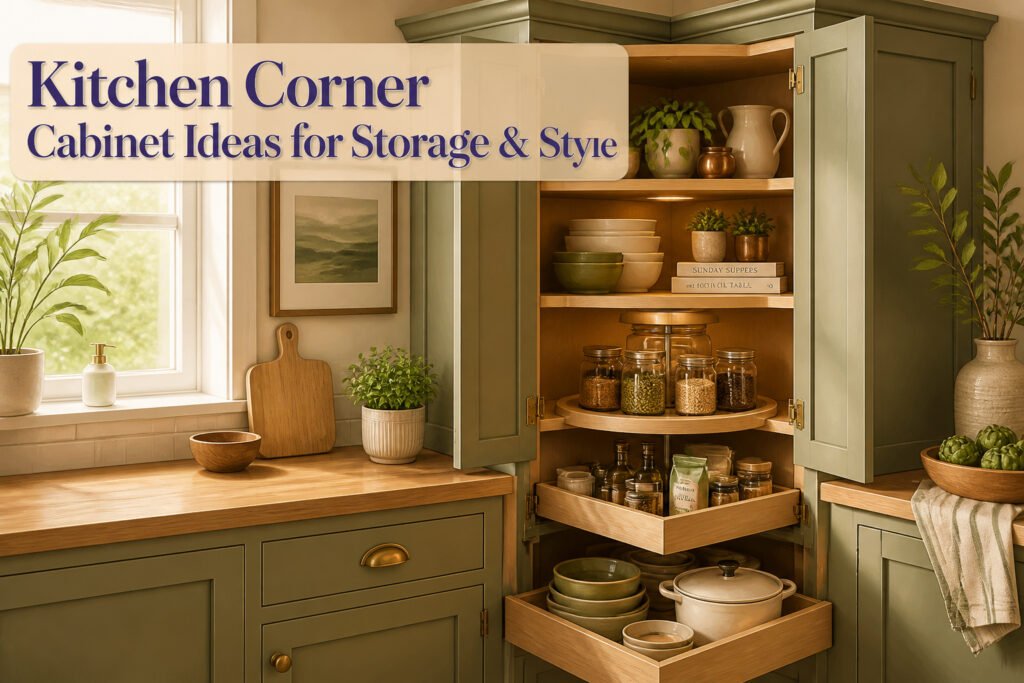
Corner cabinets range from a $15 battery-powered LED strip to a custom built-in hutch that costs more than a full appliance package. What separates the two is how long you plan to stay in the kitchen. Renters and short-timers gravitate toward Lazy Susans and false-panel doors that install without cabinet surgery; owners building for the next decade spend the money on pull-down uppers and corner drawers with angled hardware.
The detail that stops most projects is door swing. A floor-to-ceiling corner pantry sounds ideal until the open door bangs into your refrigerator every time you reach for a can.
1. Lazy Susan Corner Cabinets
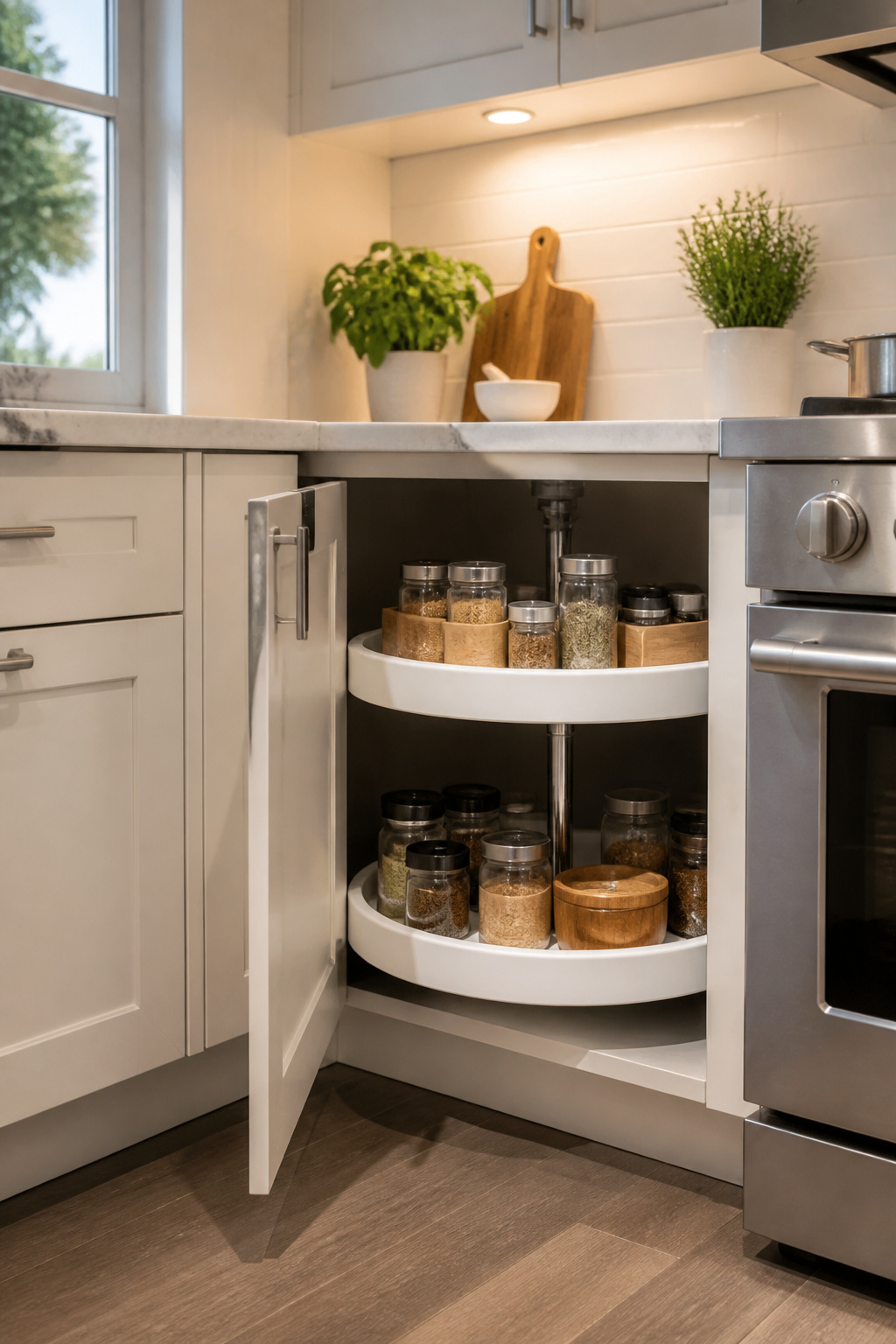
A Lazy Susan still earns its spot in most kitchen corner cabinet ideas because it actually solves the problem: you spin the shelf and the item in back comes to you. Full-circle trays fill cabinets with a single door, while half-moon or kidney-shaped trays work where a door post or hinge blocks the rotation. The shapes matter because a tray that scrapes the frame jams after six months of grease and dust settle in.
These setups handle spices, snack bins, and mid-size cookware well. Adjustable-tier models help when you need clearance for a tall pot one year and want three levels of jars the next. What convinced me, reading through how these get used, is that the hardware quality matters more than the tray shape. Cheap bearings seize; center poles wobble and dump contents. The newer pull-out systems and swing trays get attention now, but Susans stay popular because they install into existing cabinets without custom carpentry and cost less than a full retrofit. If you are renting or planning to sell within a few years, that is the deciding factor.
2. Diagonal Corner Cabinets
A diagonal corner cabinet meets the corner at a 45-degree angle, turning what would be a sharp junction into a smooth transition between two cabinet runs. That angled front breaks up the long horizontal line of standard boxes and gives your eye something to follow.
The geometry changes what you can store. The wedge-shaped interior is deeper at the back than a standard blind corner, but the door itself is narrower, so you are working through a smaller opening to reach it. A lazy Susan or pull-out drawers inside fixes the reach problem, and the 45-degree face still reads as intentional from across the room.
The angled front also shifts your kitchen’s sight lines. Where two standard cabinets meet at 90 degrees, the corner disappears visually; the diagonal front pushes forward and creates a subtle focal point. It works for uppers and lowers, and it pairs with most styles without fighting them. The tradeoff is the lost wall space on either side of the angle, and the door hardware has to clear the adjacent cabinets when it swings. Measure your landing space before you commit.
3. Corner Pantry Cabinets
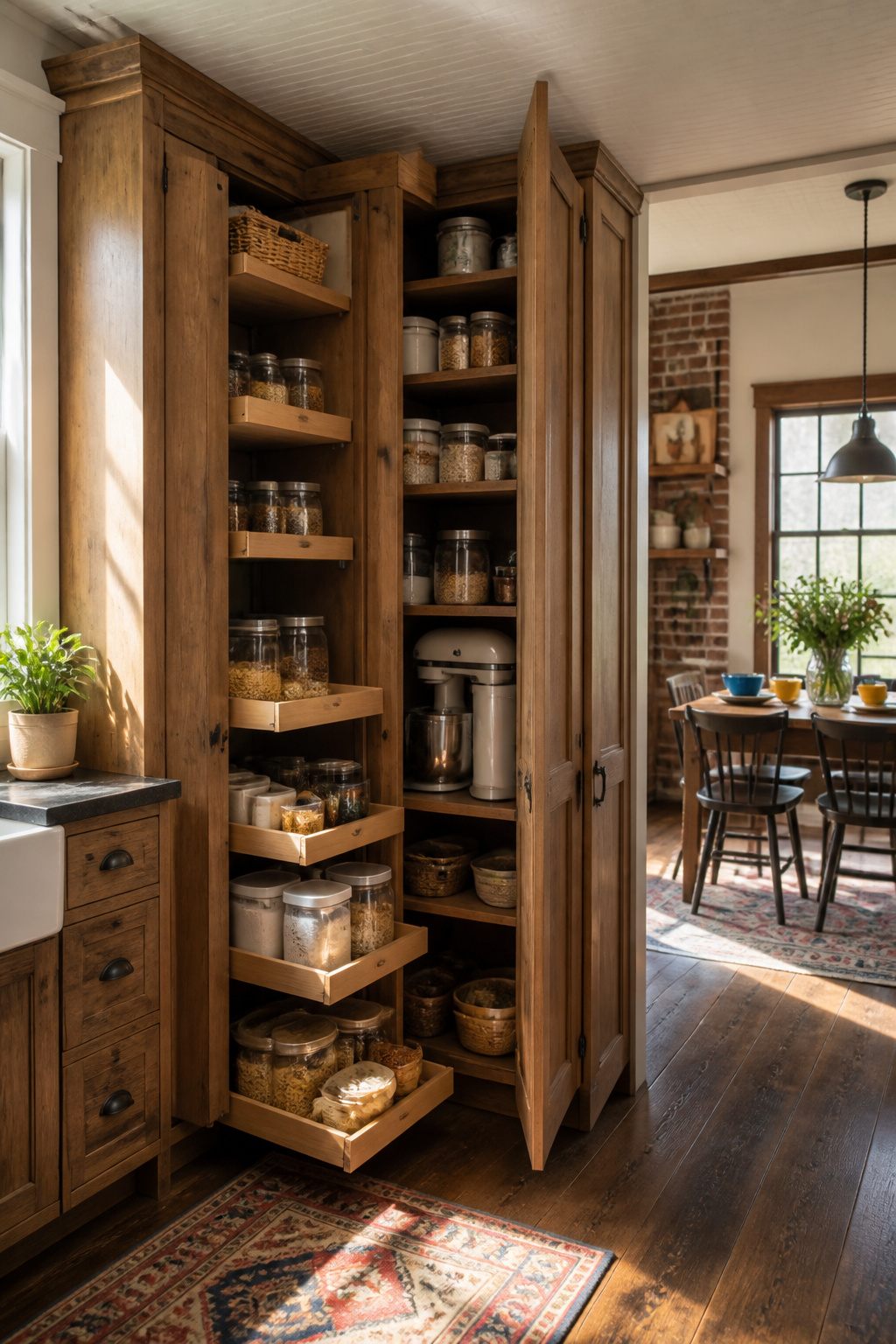
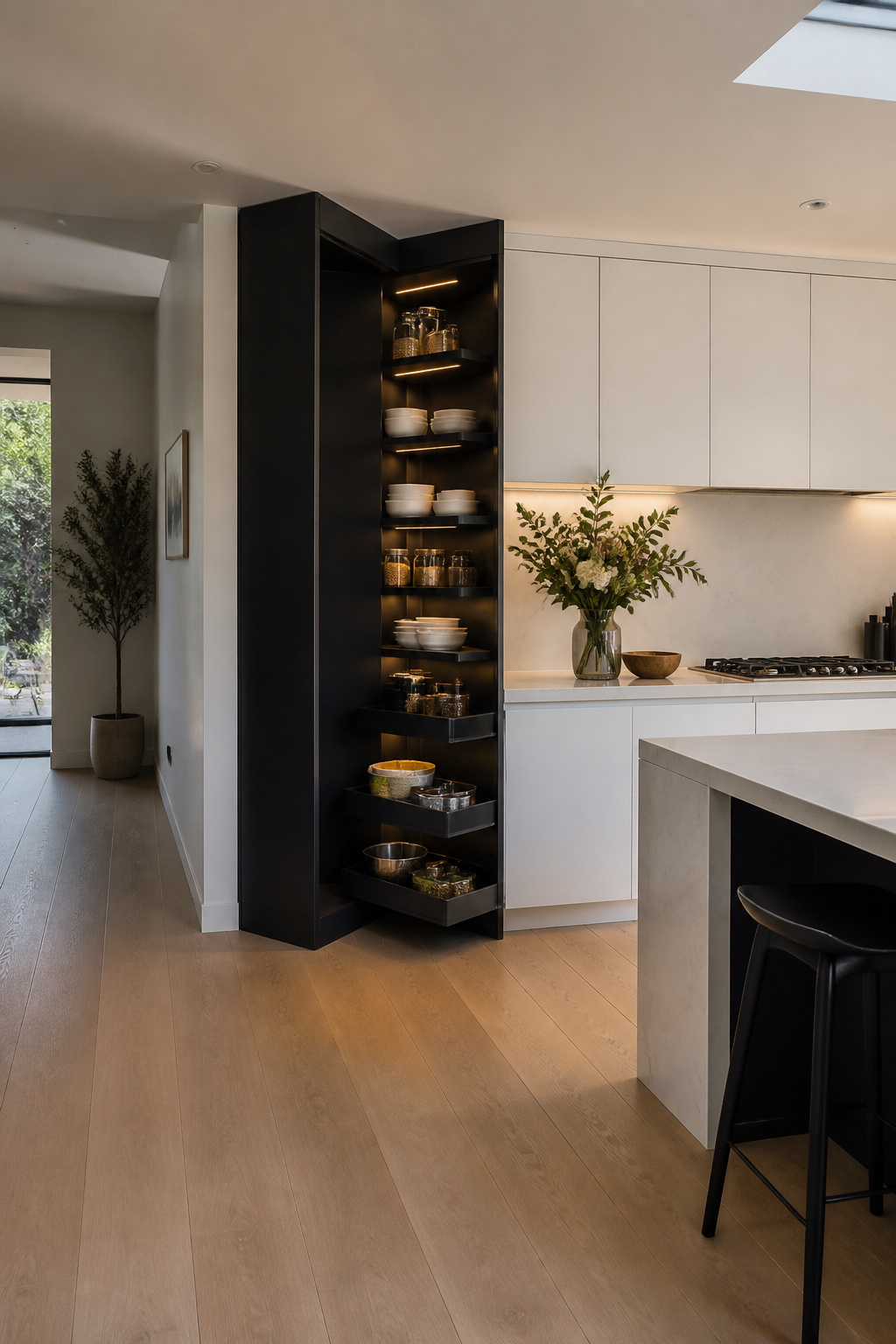
A corner pantry cabinet runs floor to ceiling and swallows the full depth of the corner that a standard cabinet would waste on a blind box. You open one door and face shelves or pull-out racks stacked from the kickplate to the ceiling plate, with dry goods, cans, small appliances, and whatever else you need to store.
The pull-out versions work on the same idea but bring the goods to you. Tall vertical racks slide forward on tracks so you can read labels without crouching into the corner or unpacking half a shelf to reach the back. The full-height units give you pantry storage where no wall exists for a walk-in, which matters in galley kitchens or U-shaped layouts where every flat surface is already claimed by counters or appliances.
LED strips inside solve the shadow problem cheaply. Rechargeable battery-operated ones now run under $30 and stick to the interior sides, so you are not hiring an electrician to hardwire a cabinet. The light turns on when you open the door and stays on long enough to find what you came for.
The tradeoff is door swing. A tall single door needs clearance you may not have if an island or another cabinet sits nearby. Splitting the front into two narrower doors that fold or hinge opposite directions fixes this but adds cost. Measure your arc before you order; a pantry cabinet that bangs into your refrigerator every time you open it becomes storage you avoid using.
4. Blind Corner Pull-Out Cabinets
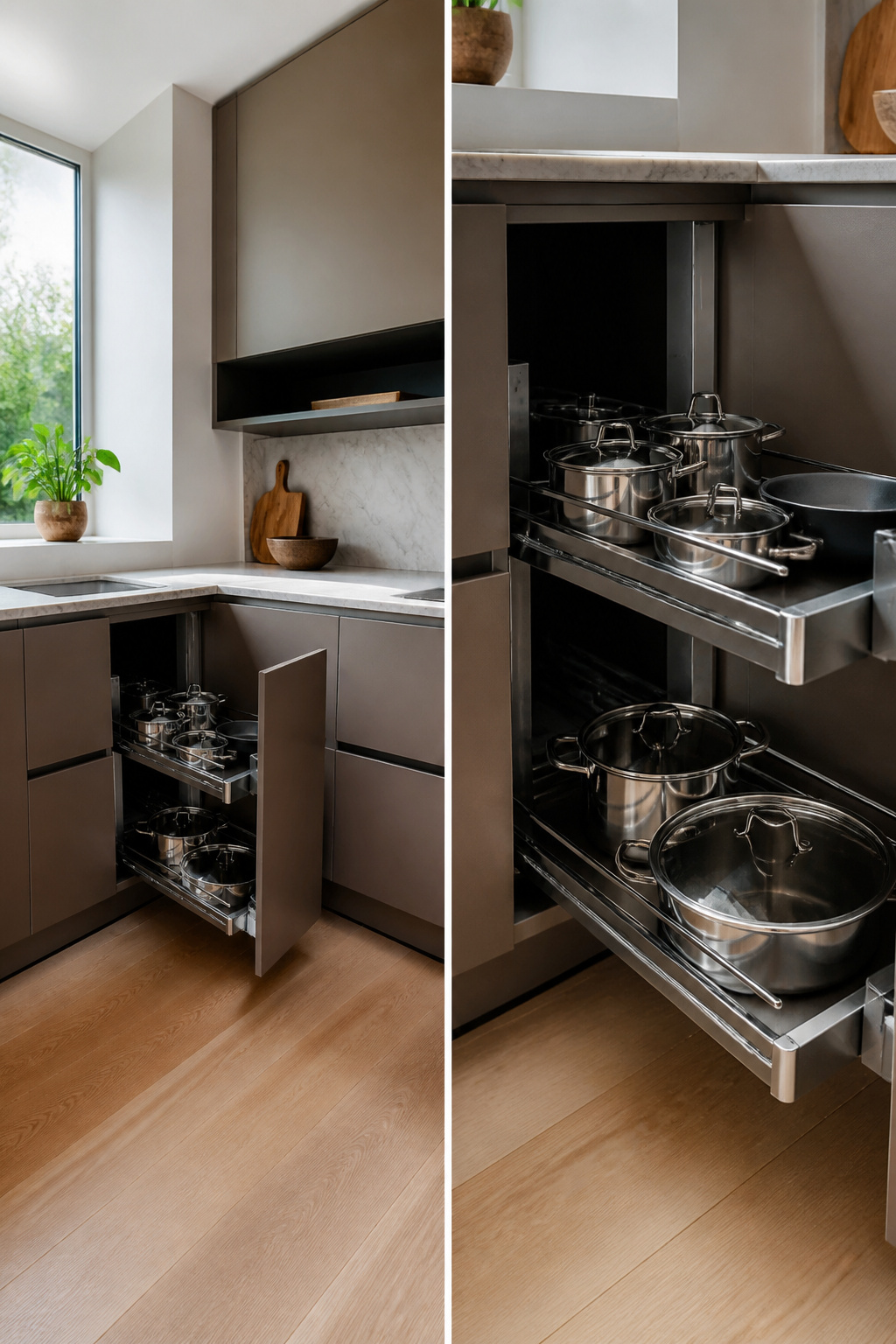
A blind corner cabinet is the deep void where two base cabinet runs meet at 90 degrees, dark and nearly impossible to reach into. The cabinet door on one side blocks direct access, so the back half disappears behind it.
Pull-out shelves or swing-out mechanisms bring that hidden space back into use. A pull-out system slides out and over the opening, carrying the contents with it. Swing-out trays pivot outward so you do not have to bend or reach deep inside. Both move items from the back of the cabinet to the front, where you can actually see and grab them.
These systems work best in lower blind corners; upper cabinets rarely have the clearance for the same hardware.
5. Corner Drawer Cabinets
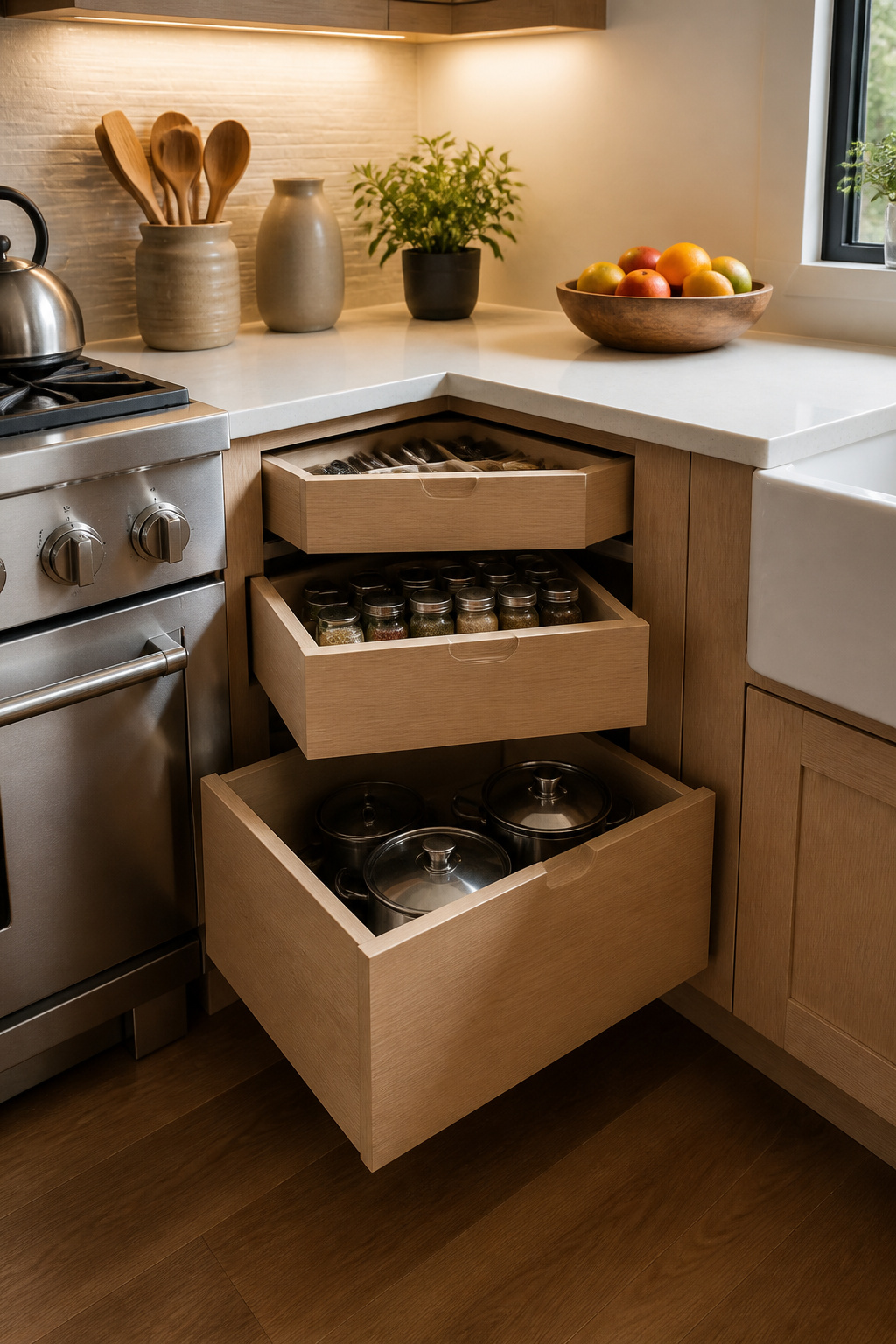
Corner drawer cabinets replace the standard door with a stack of three drawers that radiate diagonally from the corner, each one a different depth. The top drawer stays shallow for utensils and linens, the middle drops lower for spice jars, and the bottom runs deepest to swallow pots, pans, or even a small appliance. You pull straight out, and everything sits in front of you. No kneeling, no reaching into shadow.
This design costs more than other corner base options. The hardware runs at an angle, the drawers need custom sizing, and few cabinet lines stock them as standard. What you buy back is time and patience: every inch is controlled access, not a cavern you dig through. If you cook daily and the corner is prime real estate in your layout, the upcharge erases itself in a year of not fishing around a blind cabinet.
6. Open Corner Shelving
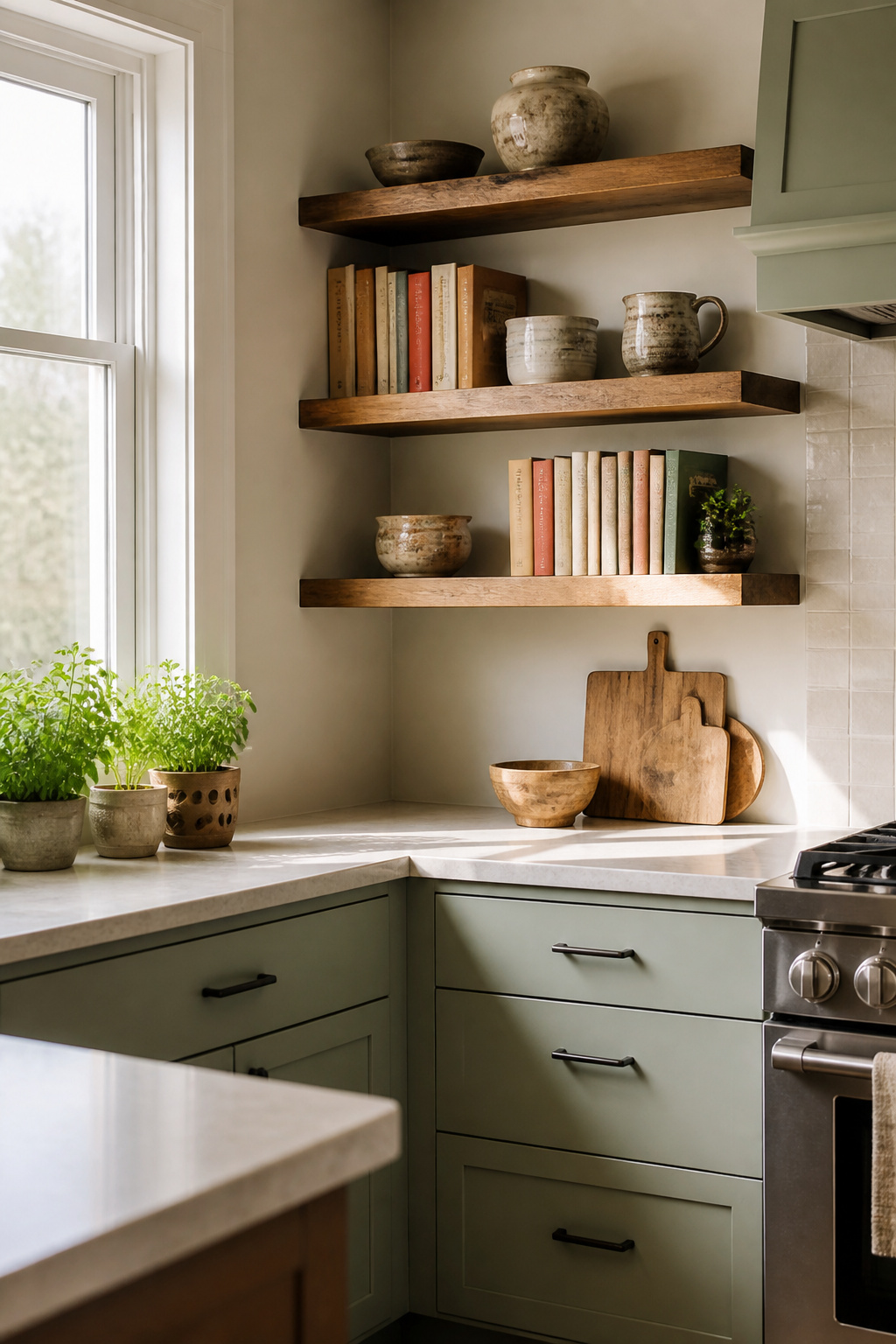
Pull the cabinet box out entirely and you open up the corner for shelving that holds plants, cookbooks, or the dishes you reach for daily. The trade is direct: you lose enclosed storage but gain visual breathing room and easy access to whatever you keep there. Tight corners stop feeling boxed in, and you skip the cost of a corner cabinet altogether.
What you put on those shelves stays visible, so this works best if you already trend toward minimal. Small kitchens feel the pinch more, since every cubic foot of hidden storage matters. If the clutter of daily dishes wears on you, mixing one open corner with closed cabinets elsewhere keeps the airiness without surrendering all your cover.
7. Appliance Garage in the Corner
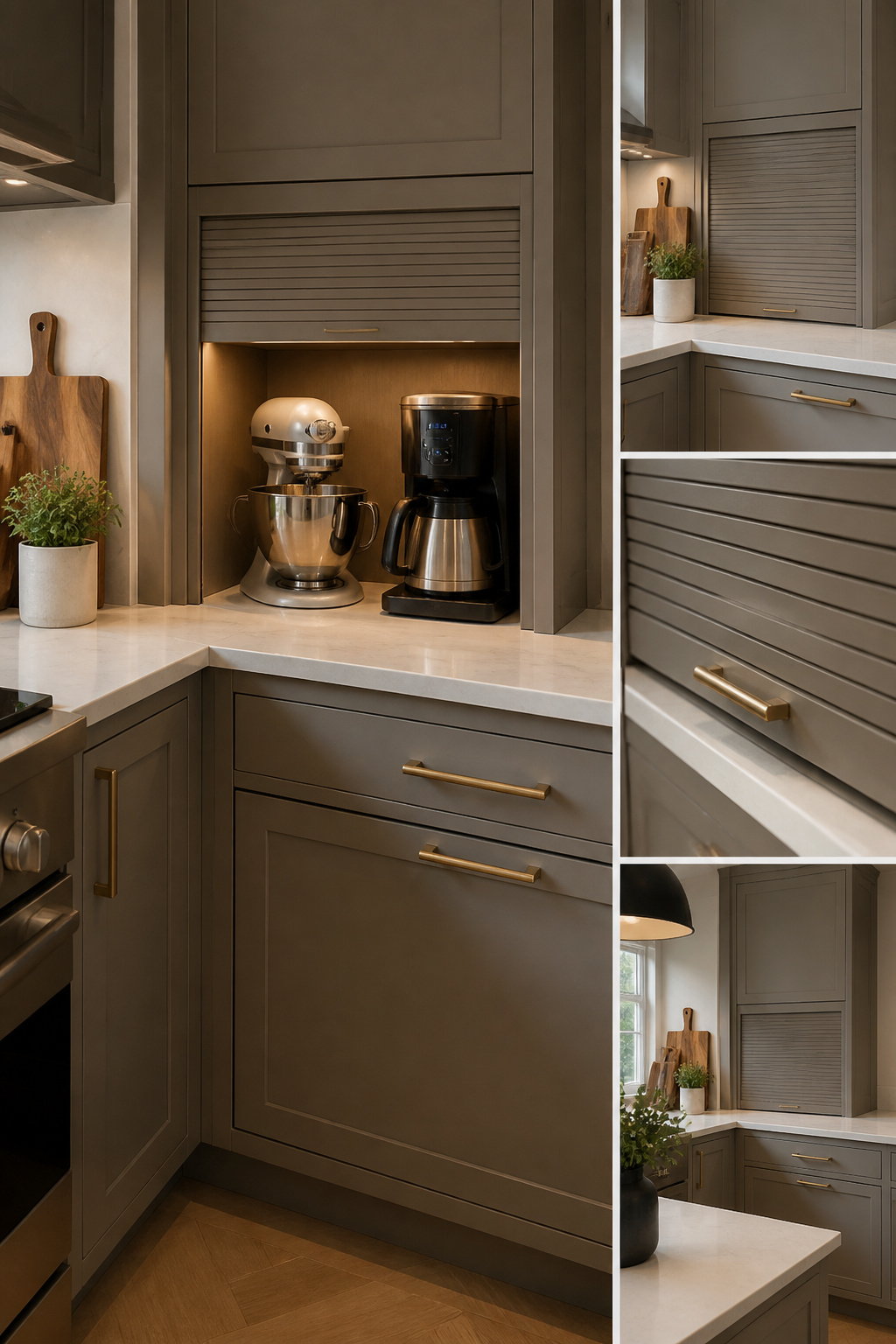
A corner appliance garage with a tambour or lift-up door lets you keep the stand mixer, toaster, or coffee maker plugged in and running without letting them own the counter. The door slides or lifts clear, you pull the appliance forward to use it, then slide it back and close the face. No daily unplugging, no cord nest on the backsplash.
The tambour track curves inside the cabinet box, so the door disappears into the cavity rather than swinging out into the workflow. That matters in a tight kitchen where an open hinged door blocks the sink or the range. Lift-up doors need clearance above, usually a foot or more, but they show less hardware and read cleaner in a modern line.
You will give up some interior depth to the door mechanism and the slope of the corner. A mixer on a sliding platform helps; you pull the platform out, not the whole appliance up and over the lip. Build the shelf low enough that the door closes over the tallest item you plan to hide, or you end up storing that item on the counter anyway.
8. Hidden Storage Behind Corner Panels
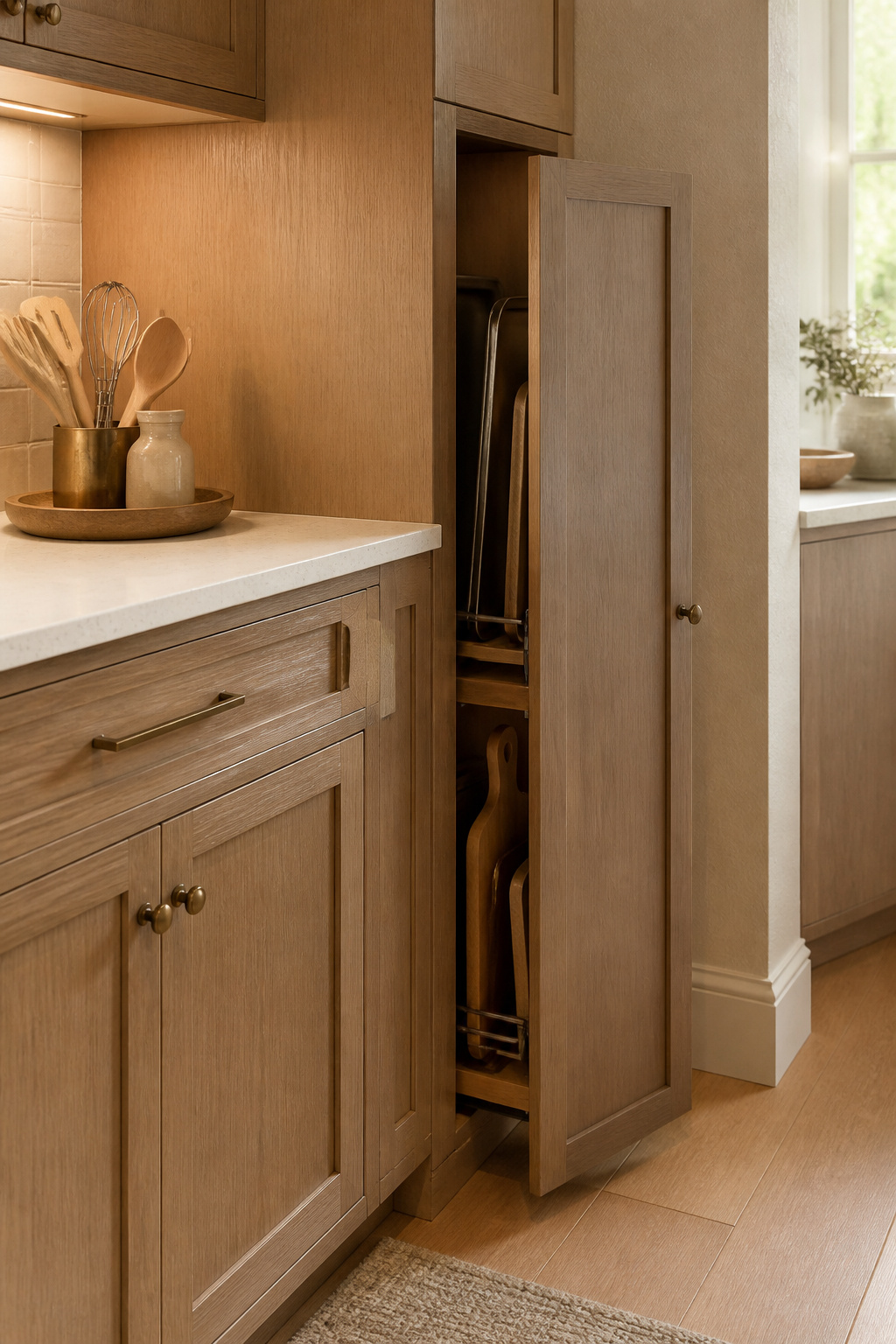
The dead corner where two cabinet runs meet is usually covered by a fixed panel that does nothing but hide the void. Swapping that panel for a false door on a push-latch hinge turns it into shallow storage for the flat items that always clutter drawers: baking sheets, cutting boards, tray dividers, or the spray bottles you reach for after dinner.
You keep the clean visual line of the cabinet face. The door sits flush with its neighbors, often with the same edge profile and paint, so the corner reads as uninterrupted cabinetry until you press the corner and it pops open. Inside, depth is typically limited to three or four inches before you hit the structural posts of the corner box, which is exactly right for standing trays on edge rather than stacking them.
The sources split on what belongs back there. One approach treats it as spillover kitchen storage for cleaning supplies or a small emergency kit; another narrows it further to a tilt-out bin behind a false drawer front, sized for sponges and scrubbers. Either works, but the tilt-out demands more precise depth: too shallow and the bin binds, too deep and you lose the benefit of the disguise. For a weekend project on a few hundred dollars, the simple hinged false panel is the safer bet. You are adding function without reconfiguring the cabinet box, and if the latch ever fails, a magnet catch from any hardware store costs under two dollars.
9. Pull-Down Mechanisms in Upper Corner Cabinets
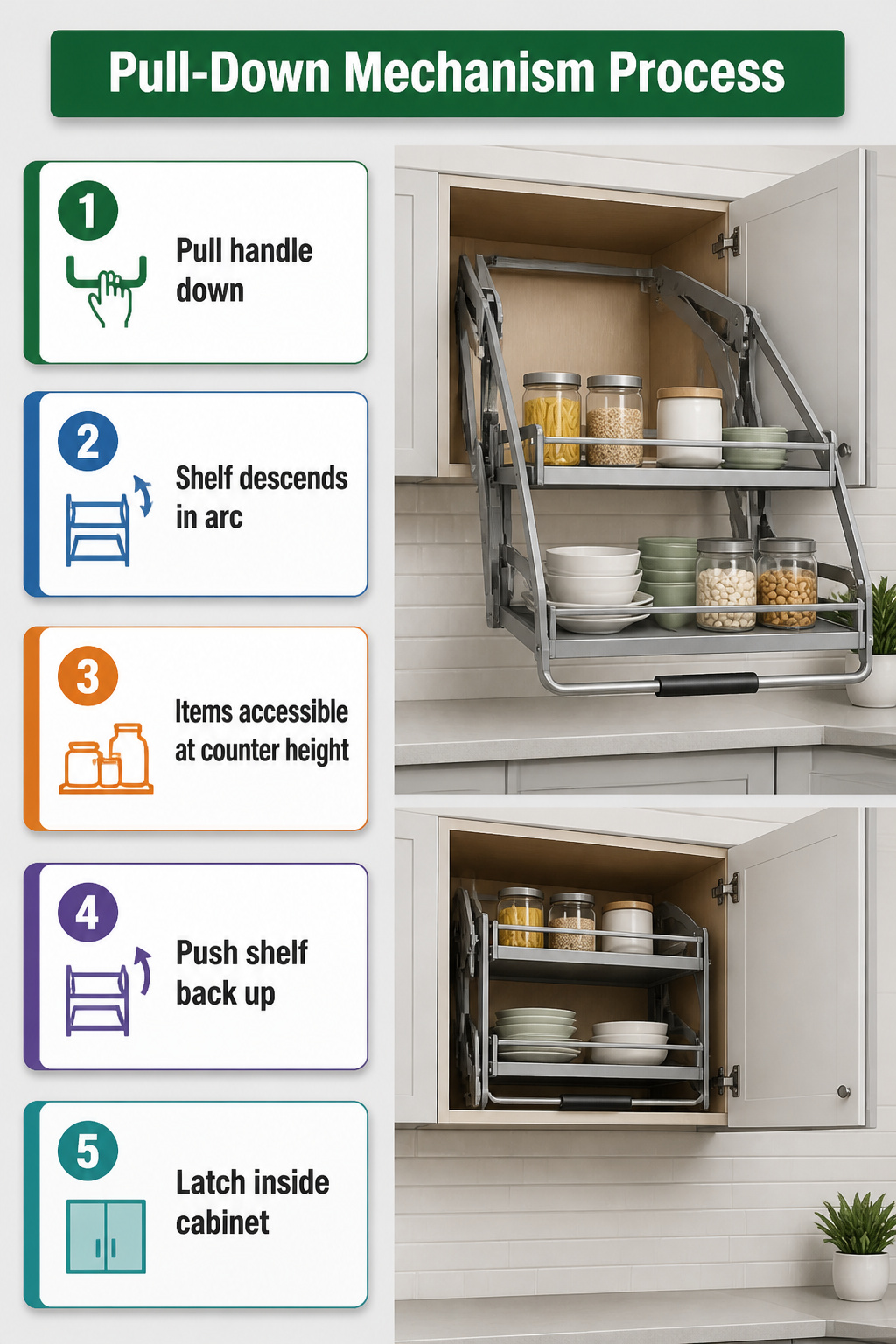
Upper corner cabinets collect the kitchen items you use least, because reaching over your head into a deep corner is awkward even on a good day. A pull-down shelf system lowers the whole rack to counter height with a handle pull, bringing dishes or dry goods to you instead of sending you climbing.
The mechanism is hinged at the back and rides on a pair of folding arms. Pull the handle and the shelf descends in an arc, staying level so nothing tips. Push it back up and it latches flush inside the cabinet box. Most systems fit standard 24-inch-deep uppers, though the diagonal corner box needs a specific width, so measure the opening before ordering.
This is the option that matters if the kitchen serves more than one height of cook, or if you are planning to stay in the house past retirement. A fixed shelf in an upper corner is storage you pay for twice: once to install, once in the inconvenience of using it.
10. Corner Microwave Cabinets
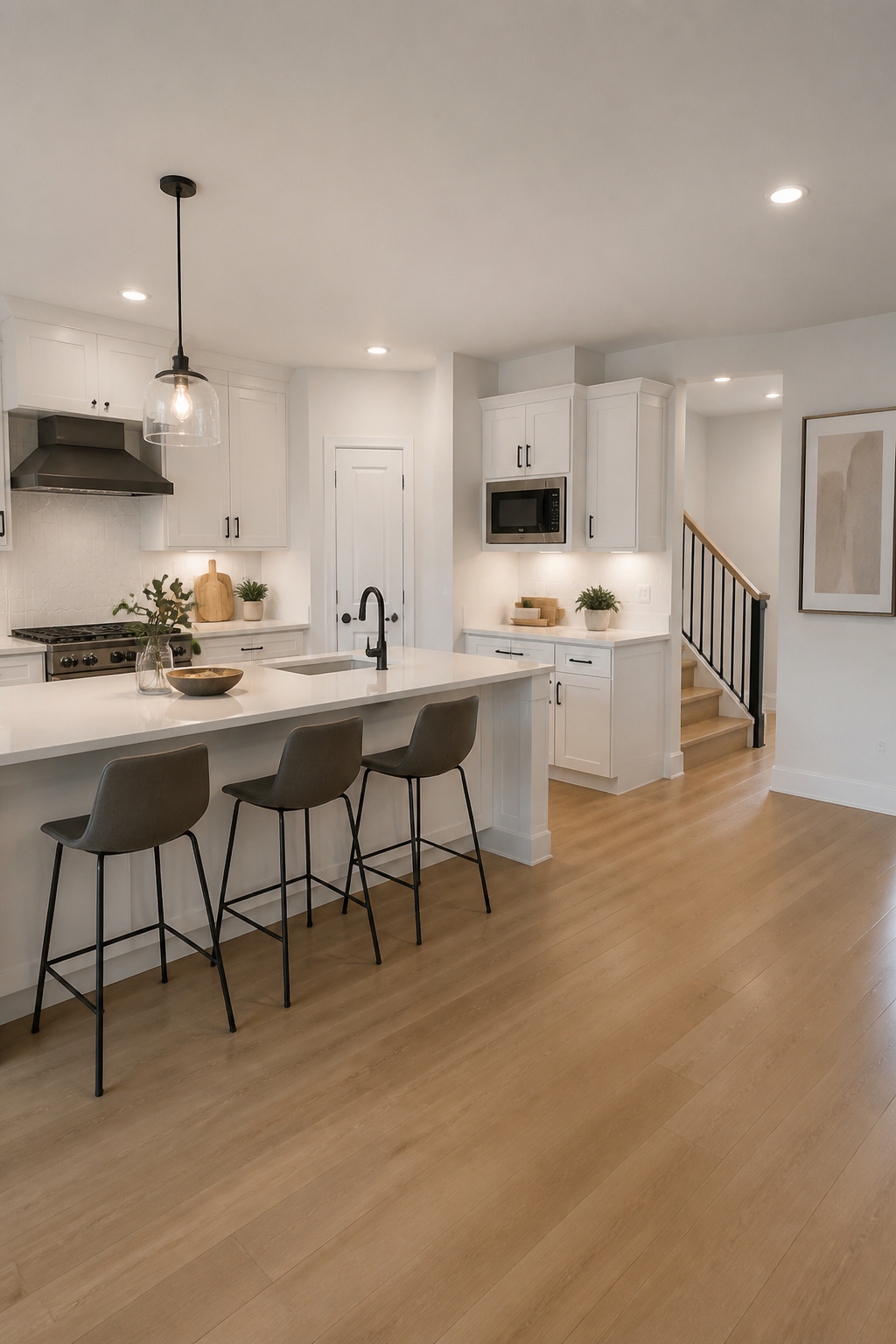
Tucking the microwave into an upper corner cabinet frees the counter space you would otherwise lose to a countertop model and the wall space a mounted unit demands. The corner placement works best at counter height or just above, roughly 15 inches up from the countertop surface, so you are not reaching overhead to pull out a hot bowl of soup. That height keeps the door swing clear of your head and puts the control panel at eye level when you stand at the adjacent counter. You do sacrifice the full upper corner to one appliance. The cabinet interior is sized to the microwave’s footprint, so you lose the shelf stack you might otherwise have for plates or small appliances. Under-cabinet lighting underneath the microwave box itself helps, since the corner tends to shadow whatever counter remains below. This layout suits mid-sized or U-shaped kitchens where the alternative is giving up scarce prep space or a stretch of backsplash. If your kitchen is galley-style or already short on upper storage, the trade may not feel worth it.
Counter height or just above is the height that saves your shoulders; anything higher turns reheating into a reach exercise.
11. Triangular Base Corner Cabinets
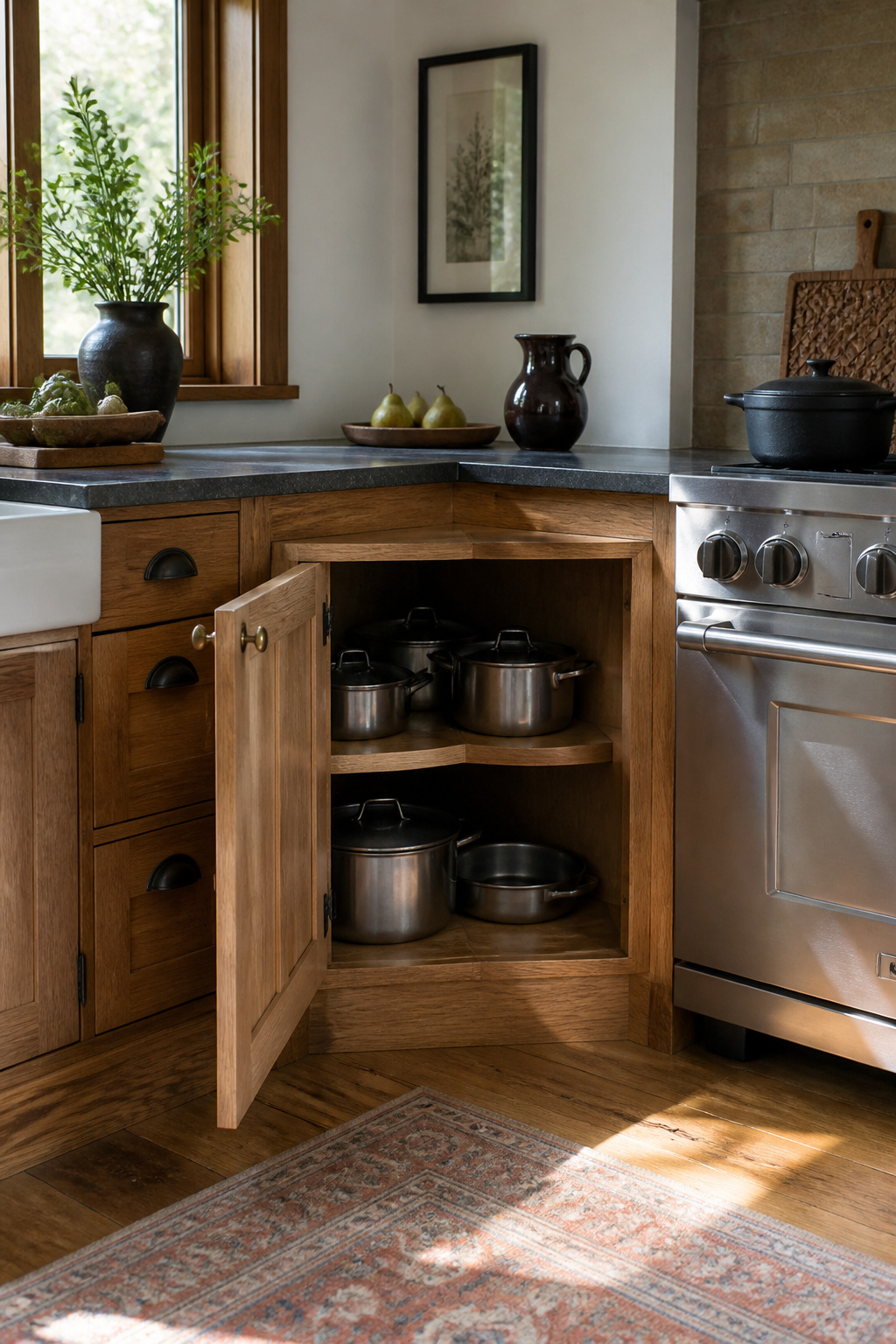
The simplest way to fill a corner is a cabinet with a single door cut on the diagonal, creating a triangle front that faces you squarely when you stand at the counter. Inside, the box is still roughly square, so you get the full footprint for storage. What you do not get is access.
You will kneel and reach. The door swings wide, but the opening is narrow and deep, and anything stored toward the back sits behind the neighboring cabinets. A pot lid or a mixing bowl you use weekly ends up buried. You learn to store the roasting pan you need twice a year in the rear and keep a step stool nearby.
This shape costs less because the mechanics are basic: one door, standard hinges, no rotating hardware or curved shelves. For a rental or a first kitchen on a tight budget, that matters. The tradeoff is real, though. After a few months of fishing around, you either accept the inconvenience or you start leaving the front half empty and treat the back as dead space. Some people add a small riser or a half-shelf to split the height, which helps with cans and jars but not with anything wide.
If your corner sits near the stove and you cook daily, this is the option you settle for when money is the deciding factor. It works. It just does not work easily.
12. Coffee Bar in the Kitchen Corner
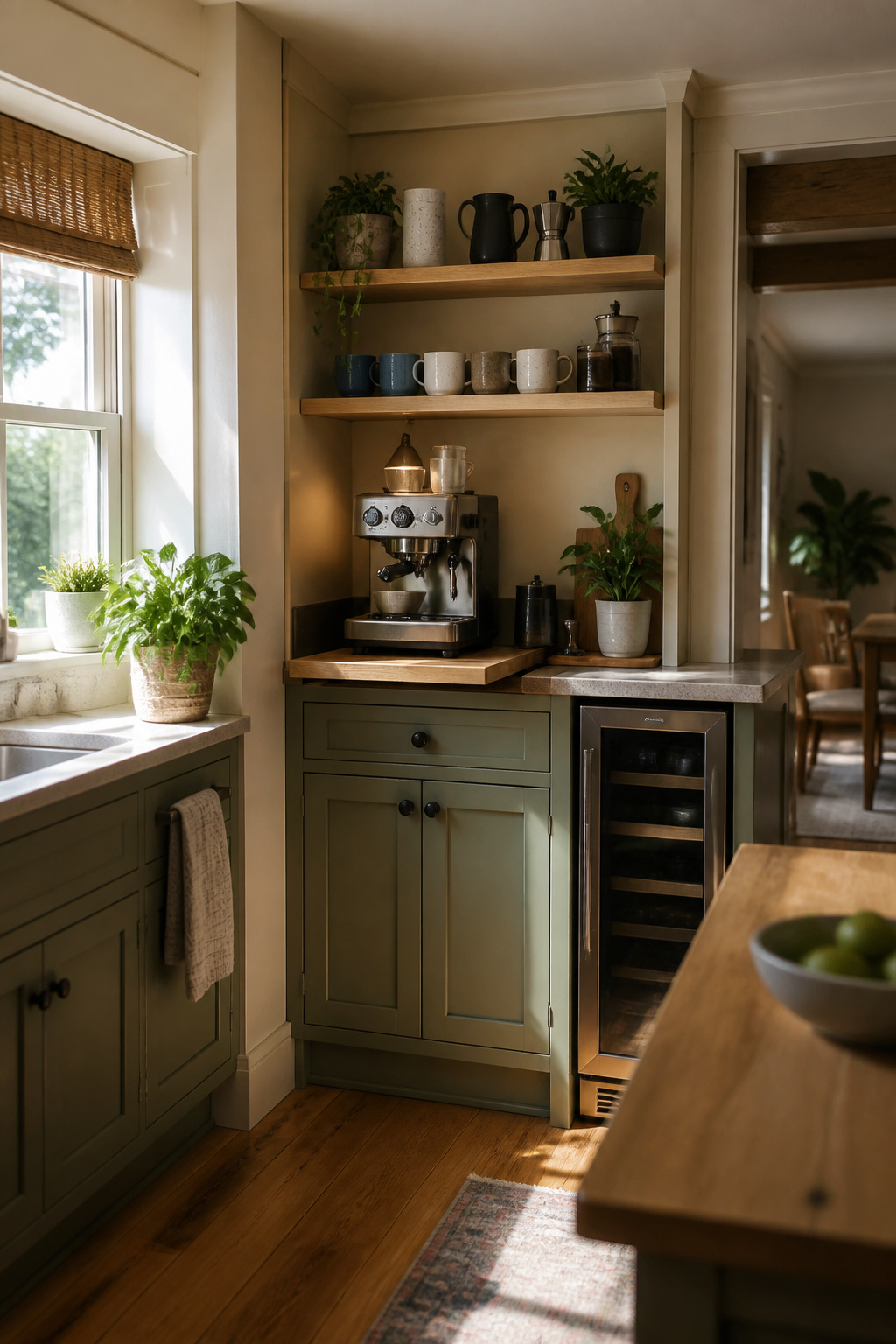
A corner base cabinet with a stretch of counter beside it can become a morning coffee station without giving up the storage the corner already holds. The machine sits below, usually on a pull-out shelf or the cabinet floor if the height works, and mugs store on open shelves mounted in the upper corner above. That upper space is often awkward for plates anyway, so dedicating it to cups you grab by the handle makes better use of the depth.
This layout only really works if the corner sits near a water source. You will refill the reservoir daily, and running a pot across the kitchen gets old fast. If the sink is on the adjacent wall, the setup earns its square footage; if not, the corner is better used for something you do not need to feed.
13. Open-Lattice Corner Cabinets
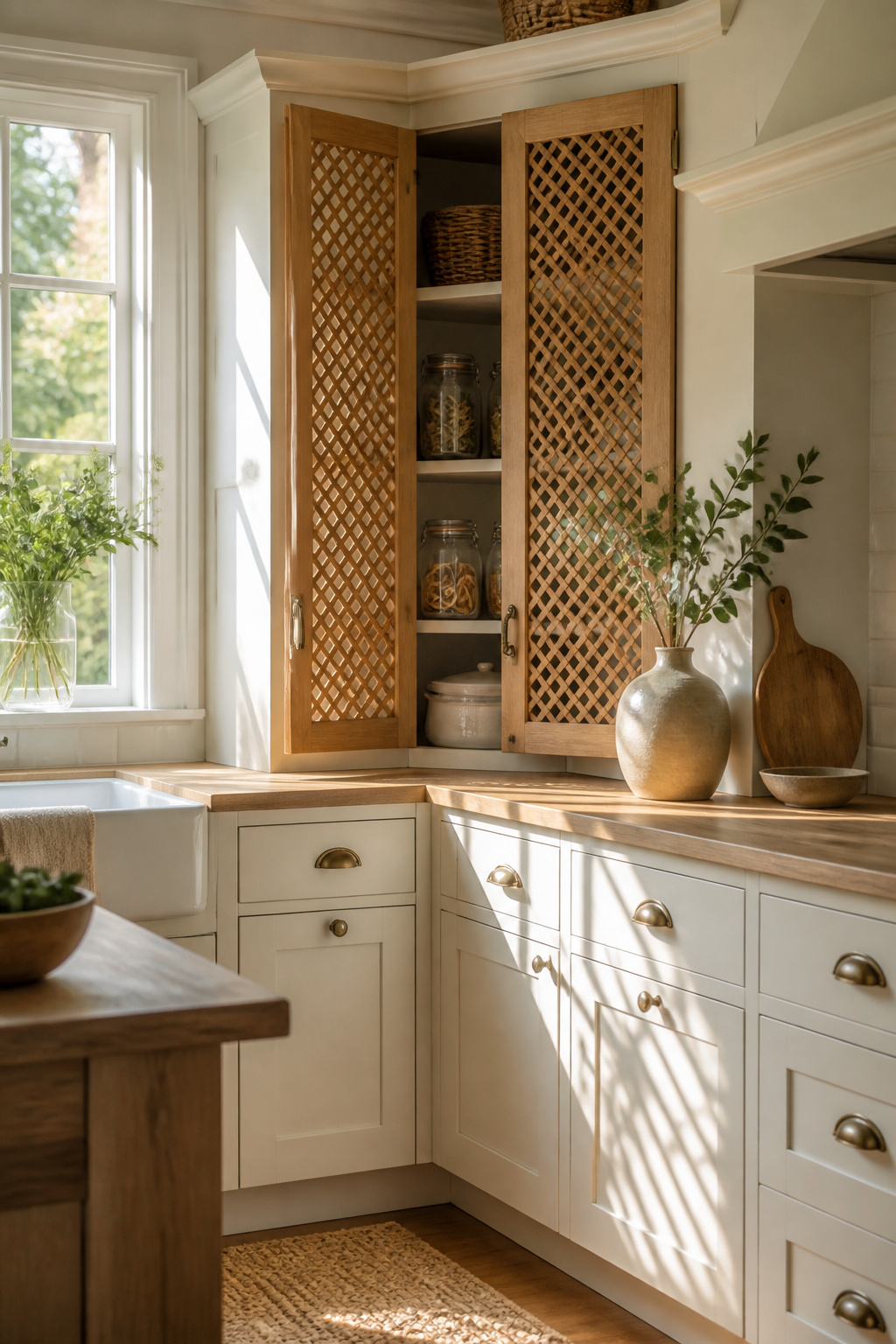
Lattice or cane inserts in a corner cabinet door let air move through while still hiding the clutter behind it. That airflow matters if you store onions, garlic, or winter squash in the cabinet, since trapped moisture rots them faster than open air does. The weave is tight enough to read as texture from across the kitchen, not as a window into whatever is stacked inside.
This style reads as cottage or farmhouse because of the material itself, not because of hardware or trim. Paint the frame white or cream and the lattice keeps the same informal, slightly worn feeling that those kitchens already aim for. You are not adding a new statement; you are extending one that is already there.
The tradeoff is upkeep. Woven inserts collect grease and dust in a way flat panels do not, and wiping between the strips takes more patience than a quick swipe with a damp cloth. If you cook with oil most nights, expect to clean the doors more often than the rest of the cabinetry. For a weekend project, swapping standard doors for lattice-front ones is straightforward: measure your existing door frames, order inserts cut to fit, and attach them with the same hinges already in place.
14. Smart Corner Cabinets with LED Lighting
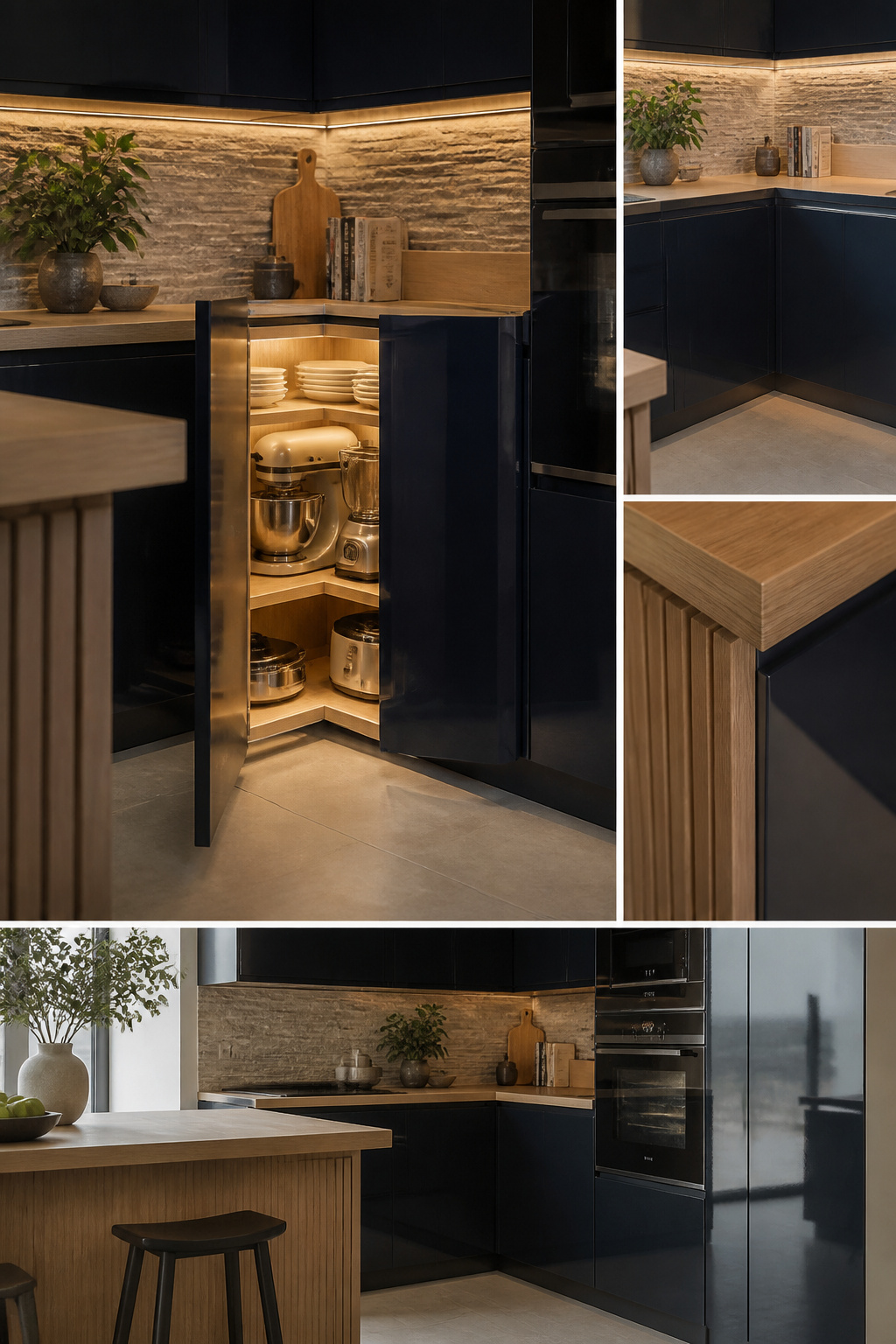
Motion-activated LED strips solve the problem you already know: opening a corner cabinet and squinting into a black hole. The sensor fires when the door swings, and you see what you actually own before your hand disappears into the void.
Battery-powered strips run $15–30 a set and install with adhesive backing in about ten minutes. They last six months to a year on a charge, depending how often you cook. Wired options cost more upfront and need an outlet or hardwiring, but they never dim at the wrong moment. For a rental or a first project, batteries win. For a permanent kitchen you plan to sell, wired looks cleaner and adds to the appraisal.
The light matters most in blind corners, the deep cabinet where two doors meet and no daylight reaches. A single strip mounted to the underside of the top shelf catches plates and small appliances. Glass-front corners benefit too, the glow turning storage into display when the room goes dark. Skip the floor of the cabinet, the shadows down there are less useful and the wiring fights gravity.
15. Pull-Out Pantry Towers

A tall pull-out pantry tower turns the corner cabinet into vertical storage for dry goods, cereals, and oils, sliding straight out into the aisle on full-extension glides so nothing sits beyond arm’s reach. You avoid the kneeling and reaching that static corner shelving demands, where the back half of every shelf tends to become a graveyard for expired cans and forgotten bags.
The difference is simple: static shelves keep you moving toward the corner, while the tower brings the corner out to you. Most units run 84 to 96 inches tall, the full height of standard cabinetry, with four to six narrow shelves you can categorize by use rather than by what fits where. Installation means removing the old corner shelf and screwing the glide hardware to the cabinet floor and ceiling; the tower box itself ships assembled and drops in.
Weight adds up fast. A full tower of canned goods can top 150 pounds, so check that your glides are rated for the load before you load them. If your corner sits near the range, keep oils and spices on the upper shelves where the heat is less intense. For renters, this is one of the less reversible upgrades: the glides leave screw holes in cabinet surfaces that survive removal.
16. Custom Built-In Corner Hutches
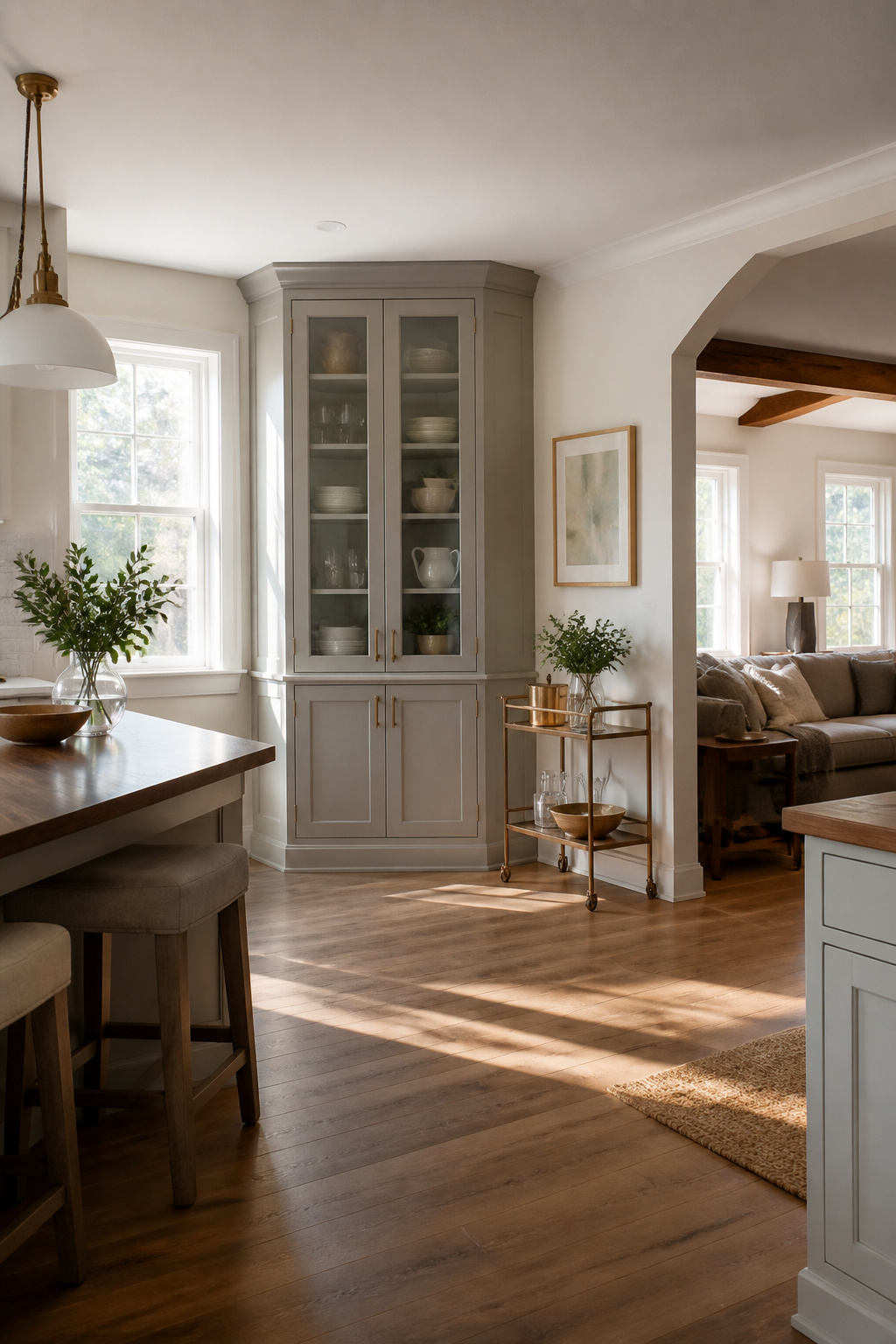
A custom built-in corner hutch is the one option on this list that reads like furniture your grandmother might have left you. You will see plate grooves built into the shelves, glass doors that show off dishes rather than hide them, and crown molding that ties the piece to the rest of the kitchen. In an open floor plan, this kind of unit can stand in for a buffet or a bar area, holding wine glasses and serving pieces where the living space meets the cooking space.
This is the most expensive route, and it is almost always custom work. The cabinetmaker has to build to your corner’s exact dimensions, match the finish to your existing cabinetry or island, and fit the decorative details you choose. You are paying for both the labor and the fact that nothing here is standard size. If you are already spending on a full kitchen remodel and want one corner to feel special, this is where the money goes. For a weekend project on a few hundred dollars, this is not the answer.
17. Multi-Use Corner Cabinets with Charging Stations
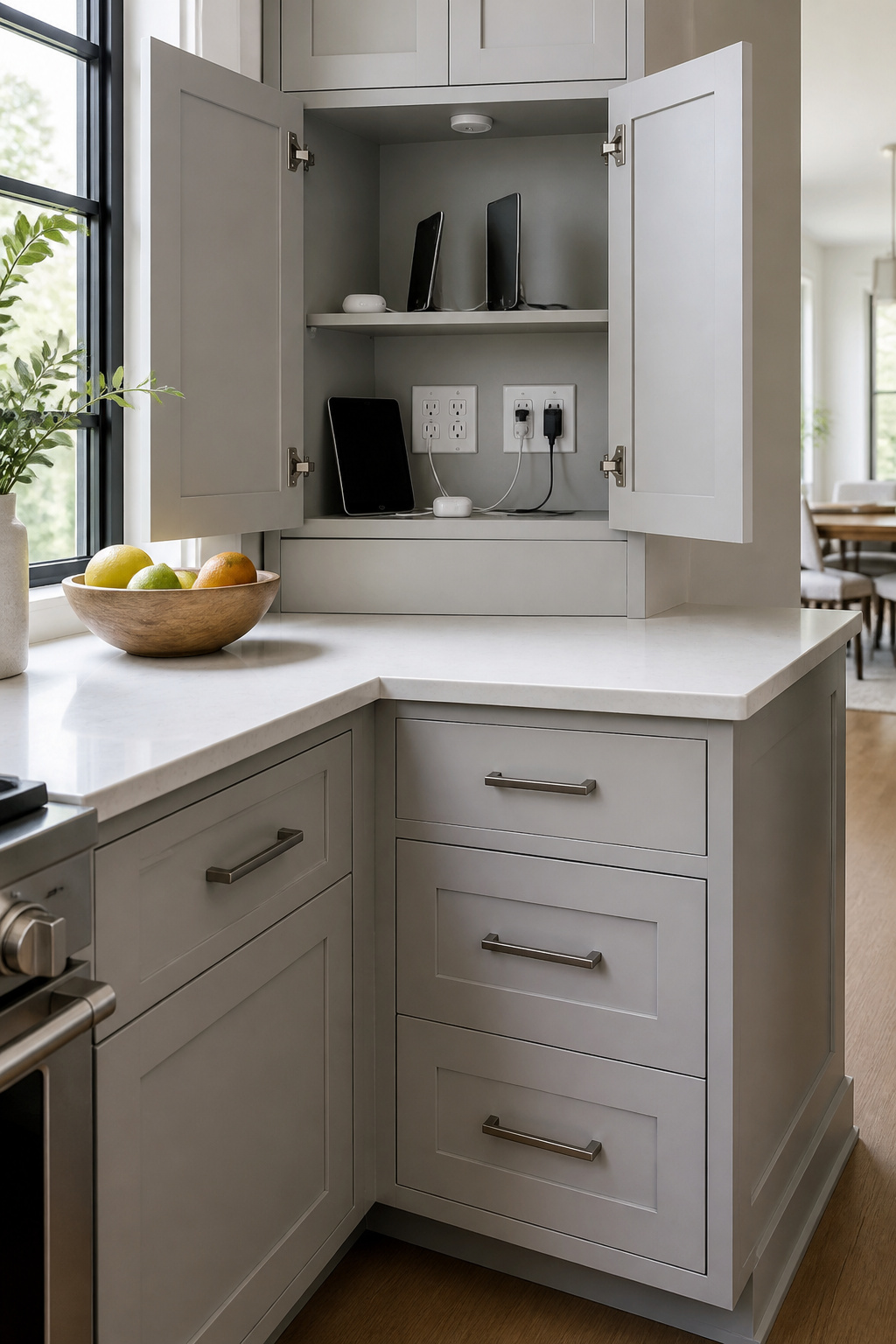
A base corner cabinet at desk height turns an awkward kitchen corner into a working spot. Install an outlet strip with USB ports inside, and the space becomes a place to charge phones, stash tablets, and run a laptop without cords trailing across the counter.
You lose some storage volume to the electrical rough-in and the shallower shelf needed for headroom, but for households that live on devices, the trade is straightforward. The cabinet doors keep the mess hidden. Phones sit on a shelf inside instead of competing for the two outlets above the backsplash.
Most kitchens have a corner near the breakfast area or the back entry that never held anything useful. This is where the command-center setup works: one person charges gear, another checks email, and neither blocks the main prep path. The charging hardware costs less than most cabinet organizers, and the install is within reach if you have already opened a wall for a backsplash renovation.
The limit is ventilation. A cabinet full of charging electronics needs a gap at the back or a louvered door, otherwise heat builds behind closed panels. Plan for that gap in the design, or the convenience becomes a fire risk you cannot see.
18. Fold-Out Corner Shelves
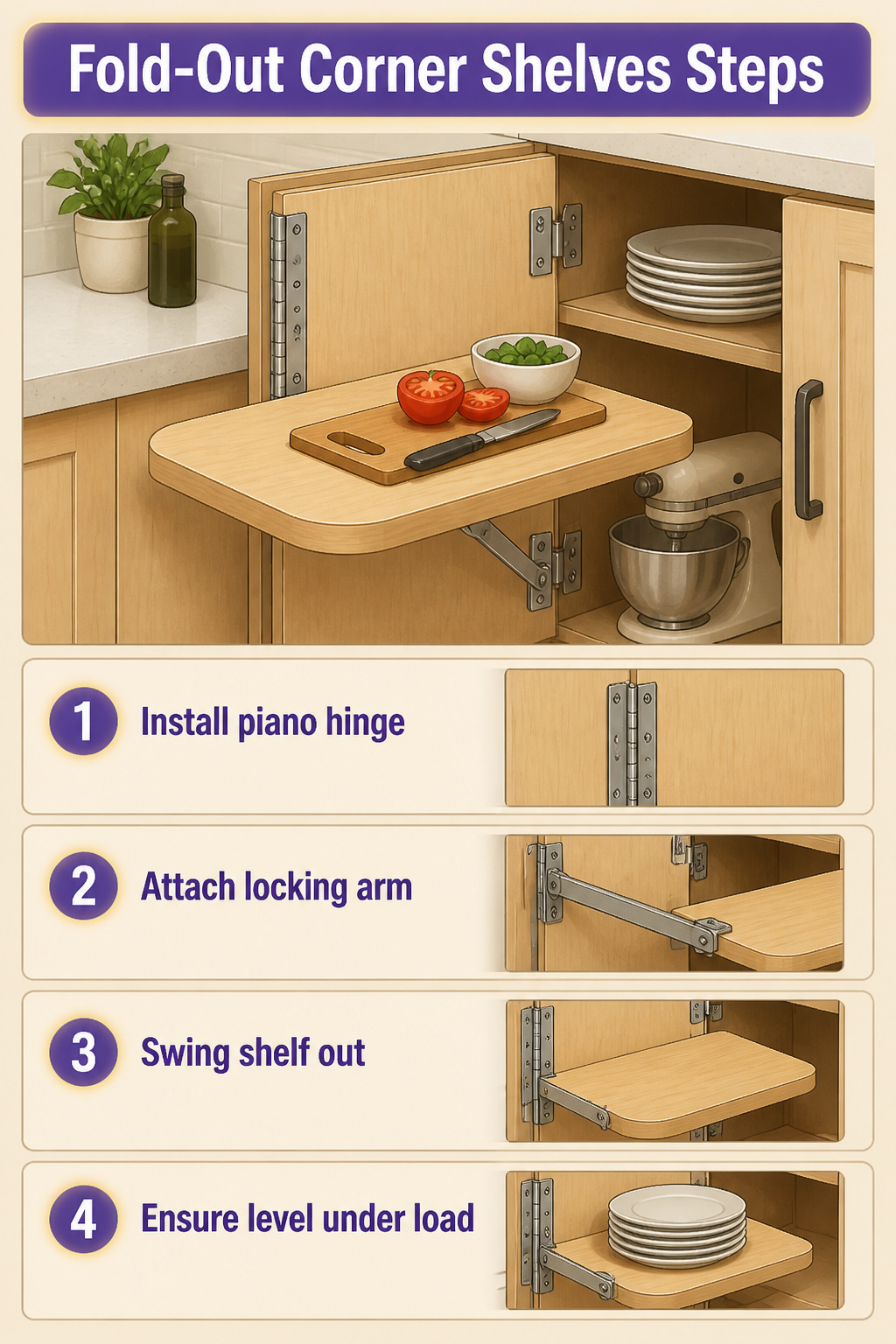
Hinged shelves that fold flat against the cabinet sides solve the corner problem without stealing permanent floor space. When you swing them out, they create a temporary landing spot for a cutting board or serving tray during prep, then disappear again. The hardware is the make-or-break detail: you need a piano hinge rated for kitchen moisture, not the bare-bones kind sold for closet doors, plus a locking arm that holds the shelf level under load. Most fold-out systems top out around fifteen to twenty pounds, enough for a mixer or a stack of plates but not for a full stockpot. If you overload one, the hinge sags and the shelf never sits flush again. Installation means drilling into the cabinet side panel, so check whether yours is solid wood or particleboard; the latter needs a backing plate or the screws strip out within a year. For a weekend project, this is mid-range effort: one cabinet, a few hours, and hardware that runs less than a Lazy Susan mechanism but more than a simple fixed shelf.
19. Corner Sink Cabinets
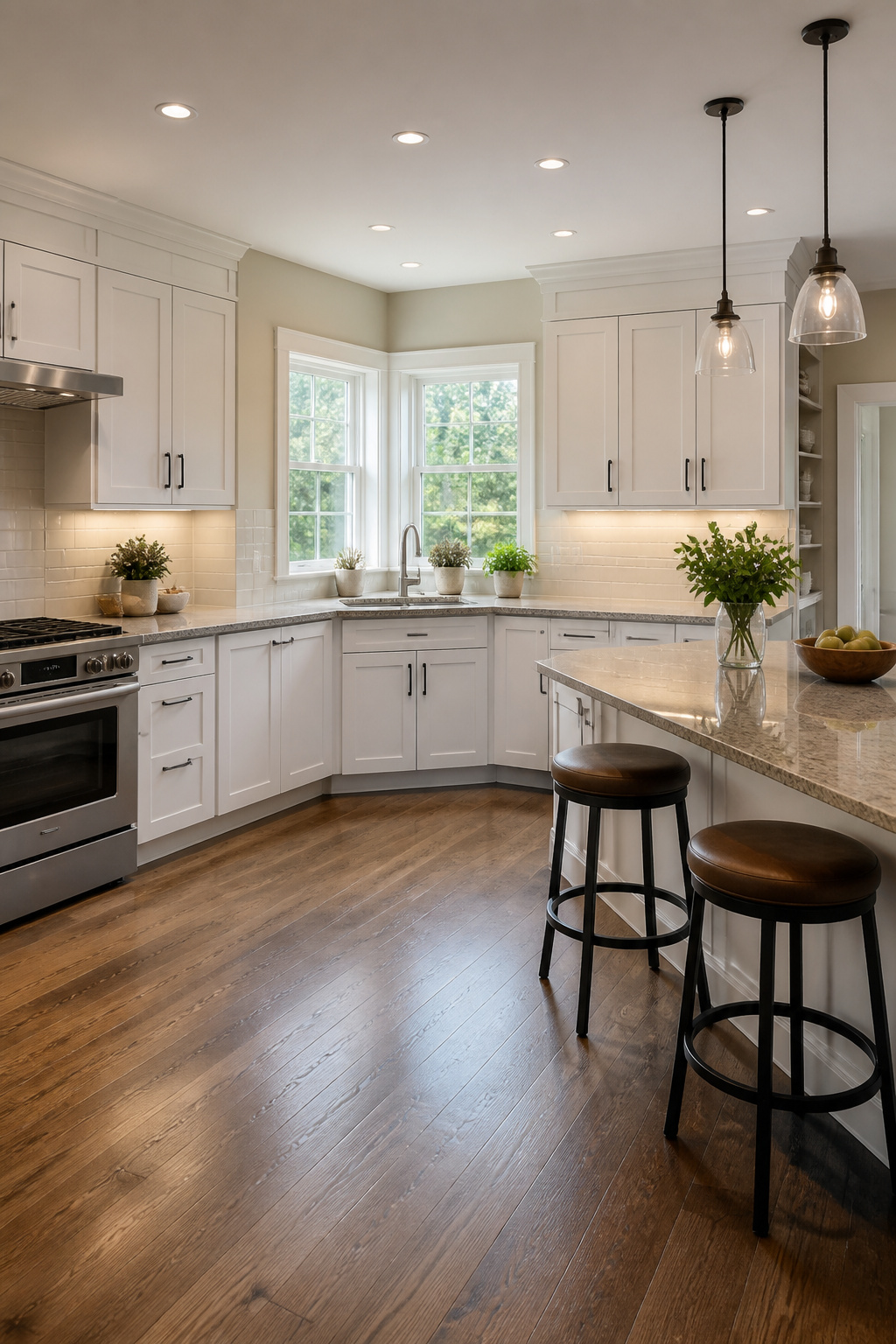
Moving your main sink into the corner frees the full run of both walls for uninterrupted counter space. You gain a straight stretch on the left and another on the right, which matters more than it sounds when you are laying out a cutting board next to a bowl next to a cooling rack.
The countertop has to be fabricated to match, usually with a diagonal or clipped front edge that wraps the corner. Fabricators call this out specifically because the seam or grain direction changes, and the cutout for the basin sits at an angle most standard sinks are not shaped for. You will need a sink sized for the corner geometry, or a custom template, and the quote reflects that.
Facing the corner while you wash dishes feels stranger than facing a window or a wall. Your body wants to square to the counter edge, but the basin pulls you forty-five degrees off. After a week or two the oddity fades, though guests will stand at it wrong every time. The real test is whether the trade in counter space pays for the adjustment, and for most small kitchens it does.
20. Corner Plate Racks
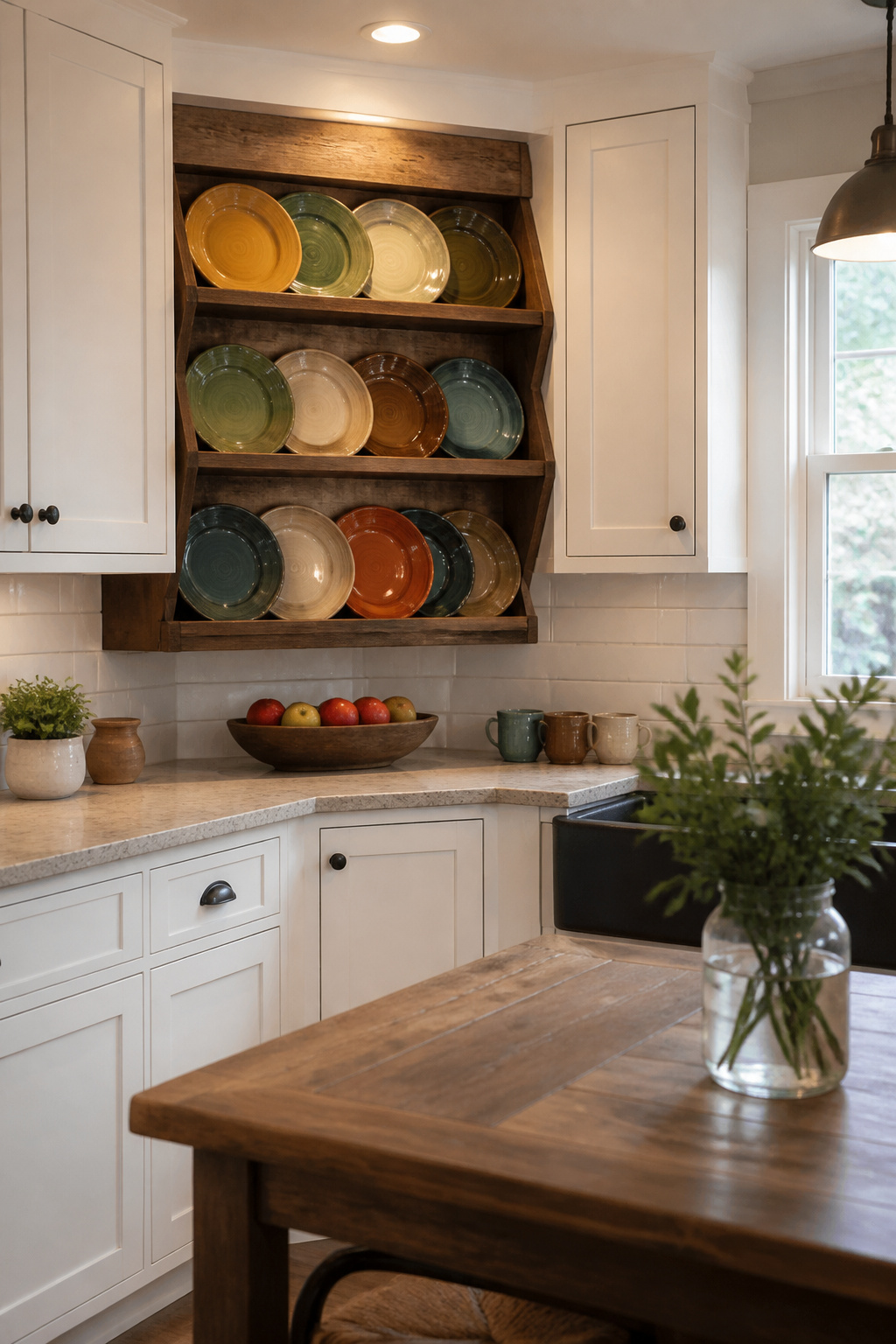
A corner plate rack trades stacking height for reachability. Slots or dowels set at an angle hold plates vertically so you can pull one without unsettling the rest, which matters in a corner where your body already twists to access the space.
Upper cabinets suit this setup well. The plates stand on display, angled toward the room, and gravity does the drying if you put them away damp. Base corners work too, though you bend lower and the rack competes with the countertop edge for clearance.
You lose capacity, no question. A stack of twelve plates might shrink to six or eight in the same footprint. What you gain is the ability to grab the plate you actually want without lifting half the stack onto the counter first. For daily dishes you reach for constantly, that trade often pays off. For holiday platters you touch twice a year, standard stacking still wins.
21. Corner Spice Racks
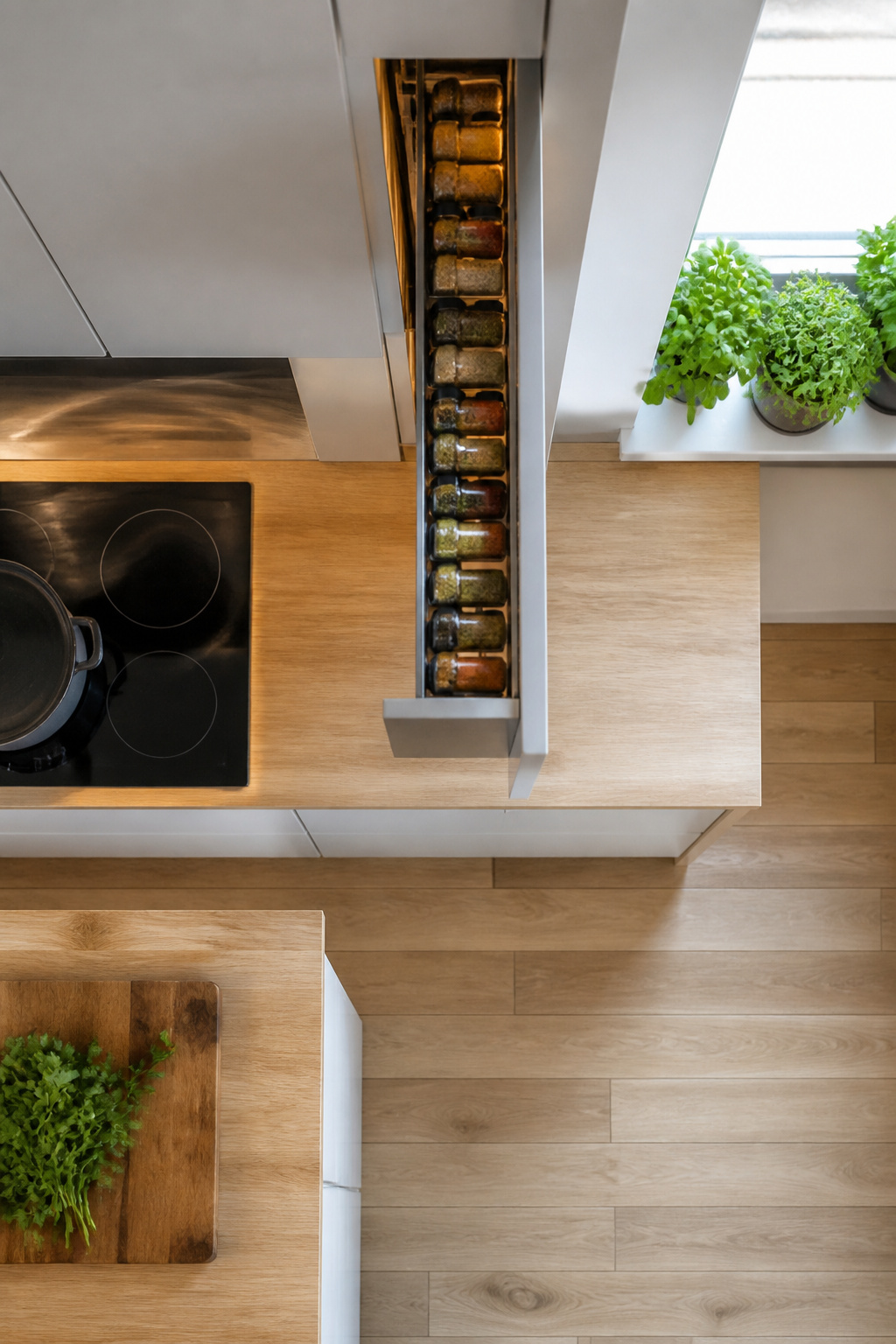
Upper corner cabinets sit too deep against the wall for most storage, but their shallow front edge is just right for spices. A narrow pull-out rack or a rotating carousel tucks into that six-inch depth and brings every jar forward so you are not reaching past the turmeric to find the cumin. Tiered organizers help, since a single flat shelf leaves the back row hidden; stepped levels or a half-moon lazy Susan style let you read labels at a glance.
If that upper corner sits next to the stove, keep the heat in mind. Spices pressed against a wall that backs onto a cooktop dry out faster and lose punch. Pull them to the opposite side of the corner if you can, or at least choose a rack with a solid back panel to block some of the warmth. The rack itself is a Saturday install on a rental budget, usually just a few screws into existing shelving.
22. Corner Wine Rack Cabinets
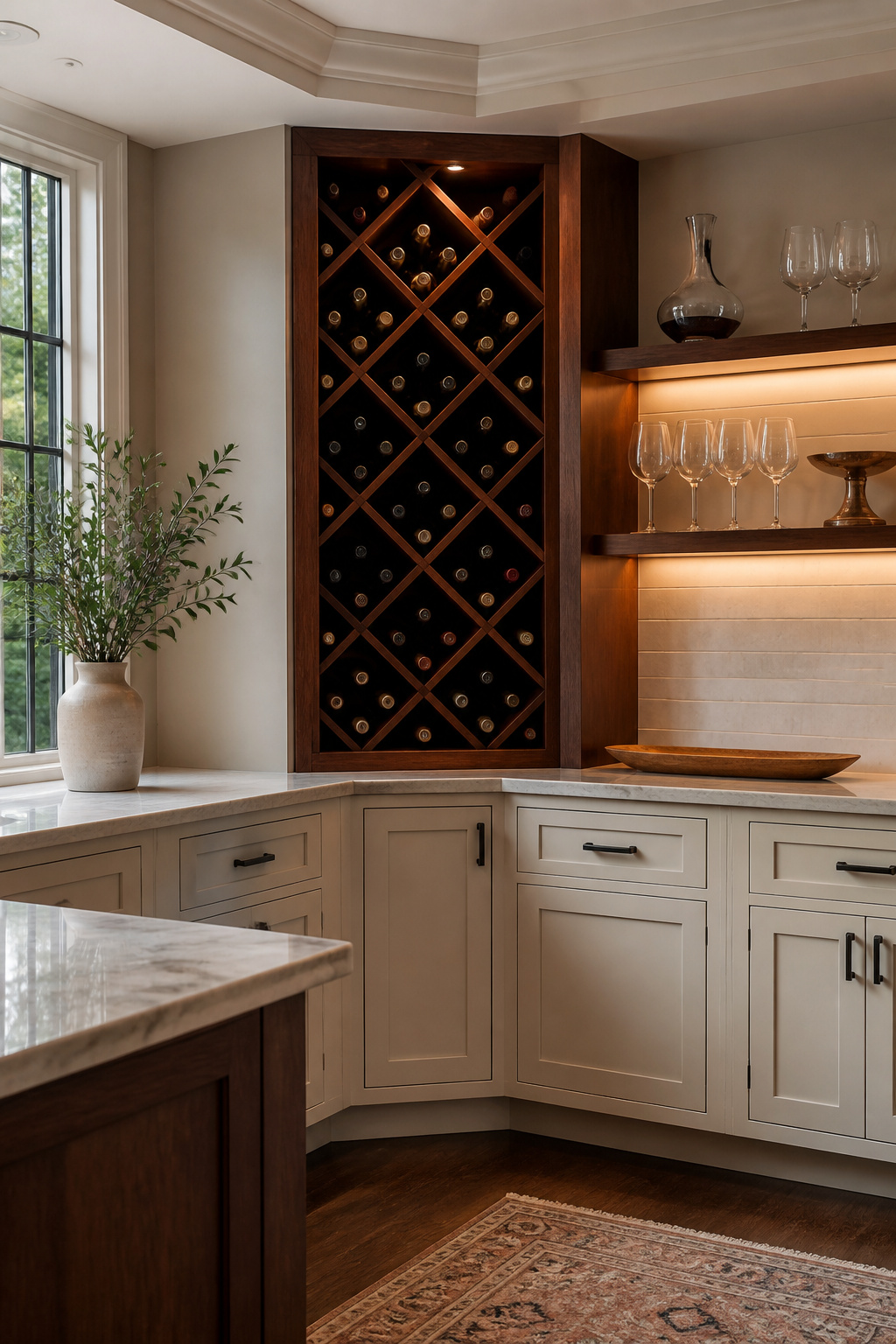
X-shaped lattice racks and horizontal bottle slots turn an awkward corner cabinet into dedicated wine storage, but the placement matters more than the joinery. Upper corner cabinets stay too warm for long-term wine storage, since heat rises and kitchen lighting bakes the upper reaches. Base corner cabinets keep bottles closer to the floor where temperatures stay steadier, though even there you are working with kitchen ambient temperatures rather than true cellar conditions.
Horizontal storage keeps corks wet, which is the whole point, while X-shaped lattices look sharper but limit you to standard 750 mL bottles. Magnums and wider sparkling bottles simply will not fit. If you are already planning a corner cabinet retrofit, a lattice front on a base unit gives you display and function without the temperature gamble of mounting wine overhead.
23. Corner Drawer Organizers
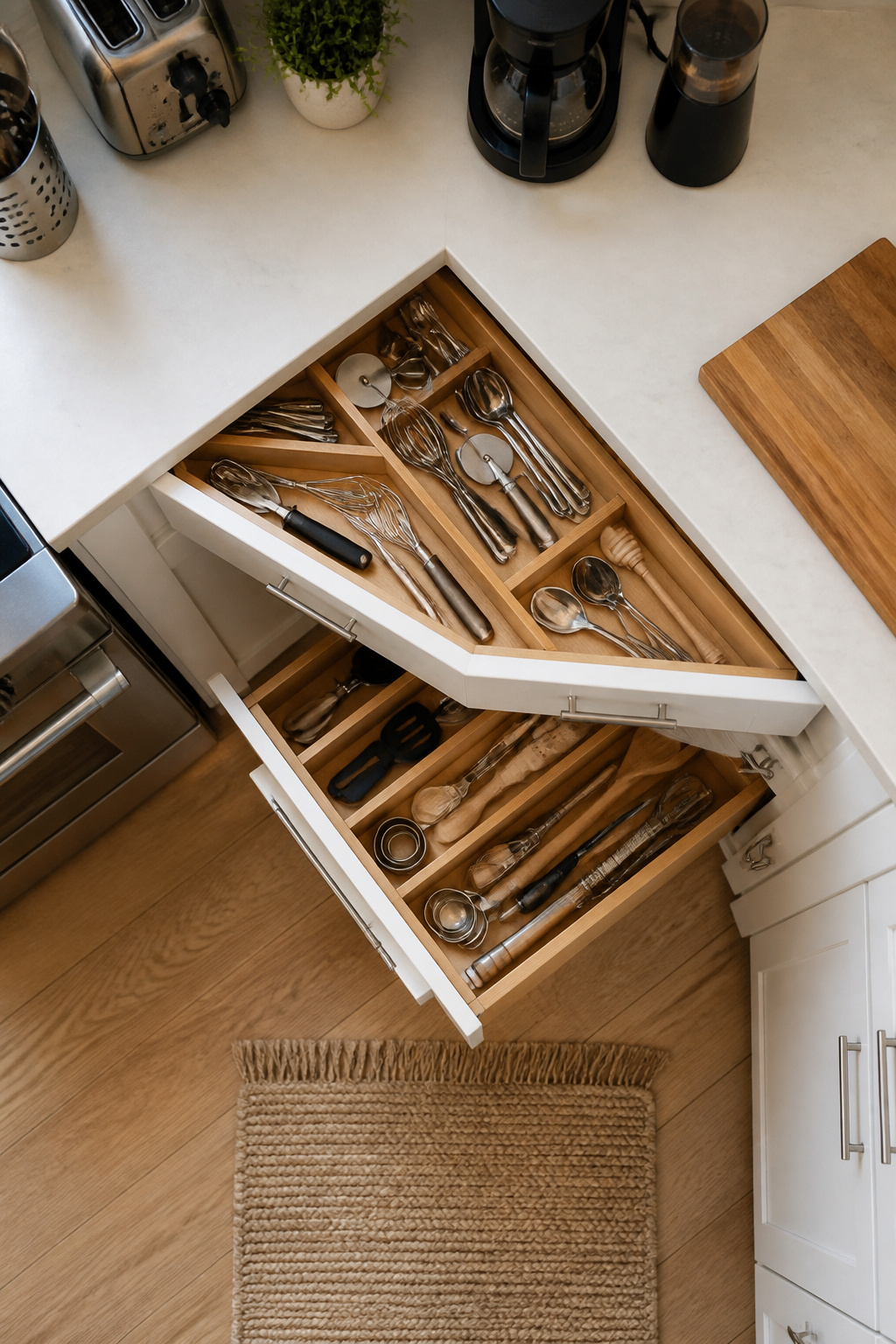
A standard utensil tray will slide around in a corner drawer like a puzzle piece forced into the wrong cutout. The geometry radiates from the back corner, so every divider has to follow those angles or you lose the narrow wedges on either side. Custom-cut organizers turn that radiating shape into actual zones: one triangle for flatware, a deeper wedge for dish towels, a long slot for knives or tasting spoons. Wood shops will cut Baltic birch to your drawer’s specs for roughly the cost of three generic bamboo trays, and the fit means nothing shifts when you slam the drawer shut on a busy Tuesday night. If you are renting, a piece of ¼-inch hobby board and a jigsaw will get you close enough; seal it with food-safe mineral oil so it does not swell. The real mistake is buying a standard organizer first and hoping you can make it sit still.
24. Magic Corner Cabinets
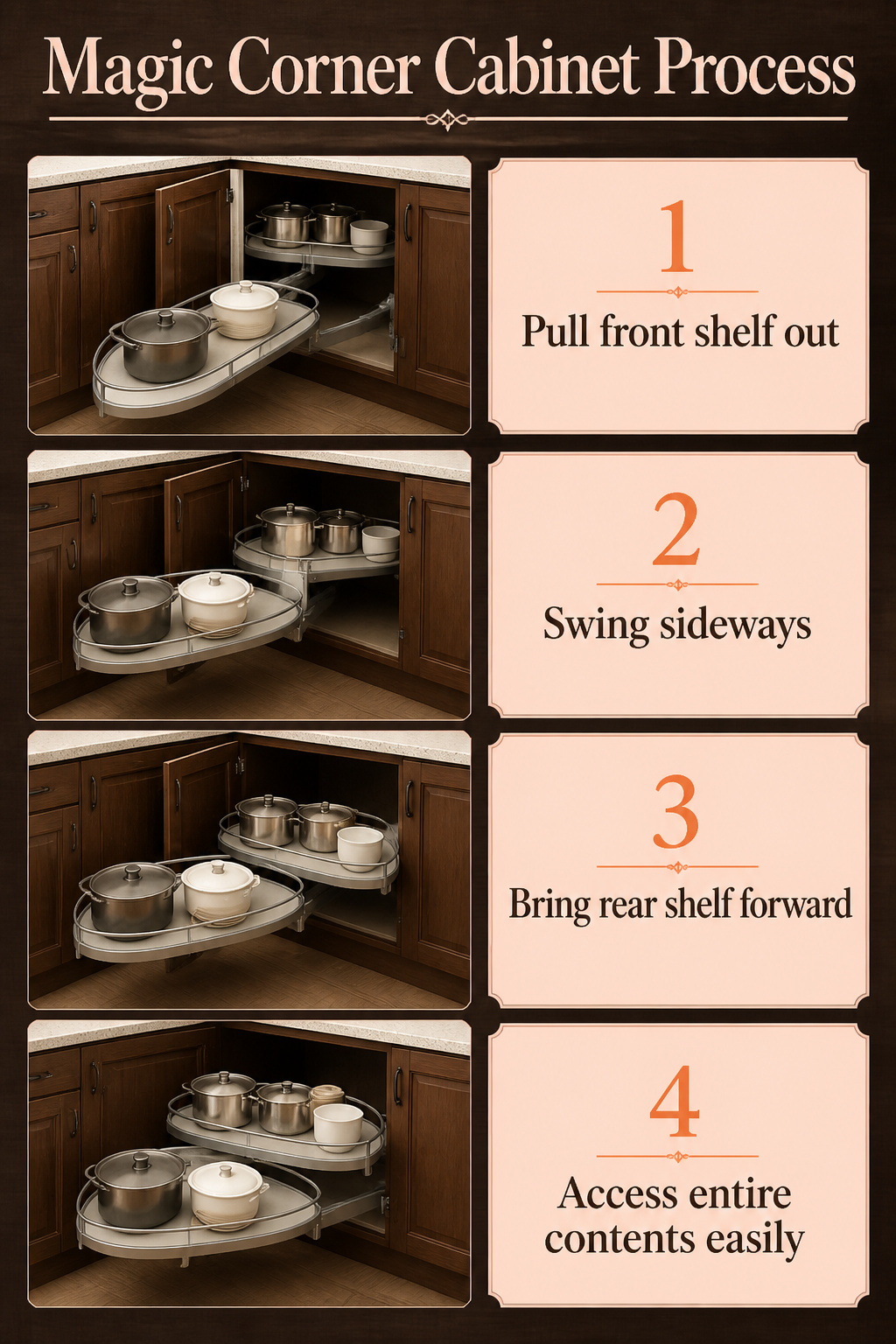
A magic corner cabinet does what its name promises: it brings the entire contents of a blind corner out into the open aisle. The mechanism works as a single unit. You pull the front shelf straight out, then it swings sideways into the doorway, carrying the rear shelf with it from the depths of the cabinet. Everything hidden becomes reachable in one motion.
This is the fullest accessibility you can get from a corner without changing the cabinet footprint. The trade is space and money. The swing arc needs clearance, so you lose a few inches of aisle width while the unit moves. You also pay more than for standard pull-outs. The hardware is complex, and installation is precise.
For a kitchen you plan to keep ten years or more, the cost often pays out in daily use. For a rental or a quick refresh, the price and the clearance requirements can push this into overbuilt territory. Measure your aisle carefully: if you are already near the 36-inch minimum for two people to pass, the swing may narrow your workable space below comfort.
25. Corner Shelves Without the Cabinet
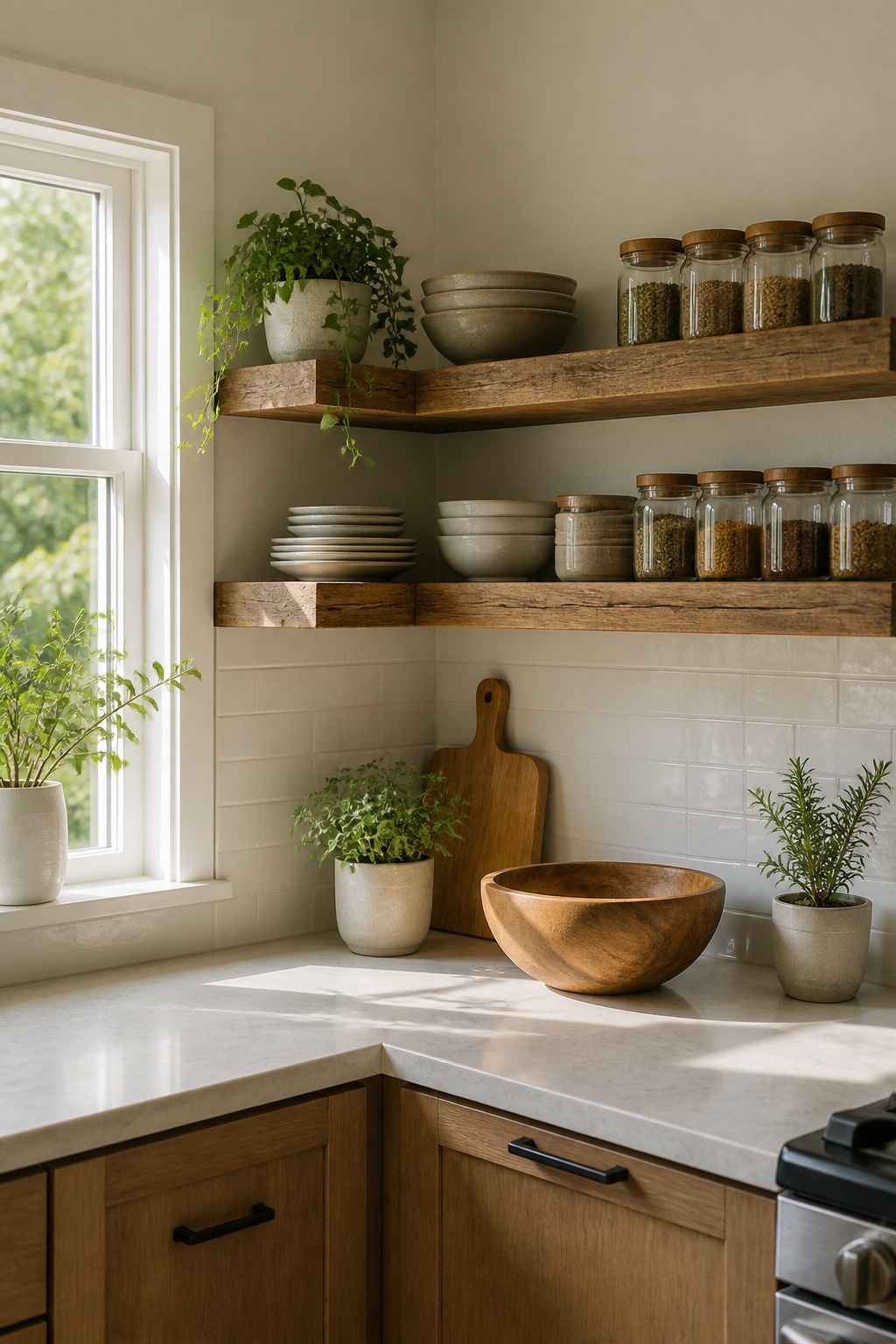
Sometimes the best storage is no cabinet at all. Floating shelves or simple bracketed boards in a corner keep the wall open, the floor clear, and the cost down to lumber and a few screws. You gain a place for the daily stuff you actually reach for: coffee mugs, a small stack of plates, the jar of utensils you use every morning. What you lose is enclosure, and that matters more than people expect.
Leave the rarely-used out. A gravy boat on an open corner shelf becomes a grease trap above a stove. The same shelf three feet away, holding only cereal bowls, stays clean enough. Dust settles on what sits still, so rotation matters more here than in any closed cabinet. If you touch it weekly, it belongs. If you touch it twice a year, it collects fuzz and you stop seeing it.
Bracketed shelves run about half the price of even a basic wall cabinet, and a renter can patch four screw holes when the lease ends. The trade is visual noise. A corner shelf done well looks intentional; done carelessly, it reads as storage you ran out of time to hide.
What Makes Corner Cabinets Hard to Use
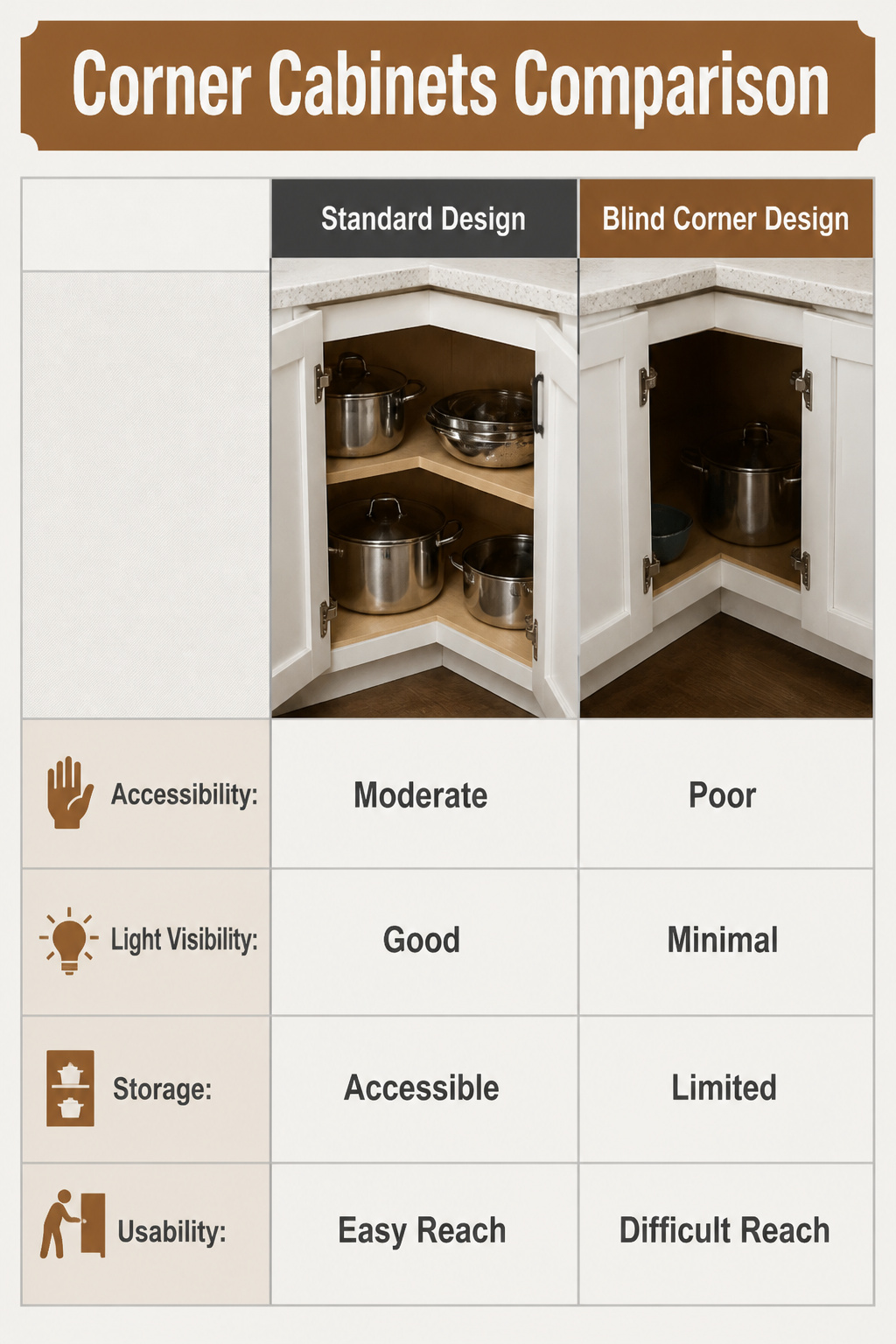
The corner where two base cabinets meet at a right angle creates a space that looks generous on paper and wastes nearly half its volume in practice. The diagonal depth runs far enough back that you cannot reach the rear wall without climbing inside, which means the things you store there migrate forward until the front six inches are jammed and the back two feet sit empty.
Adjacent doors compound the problem. Open the cabinet to the left and its swings into the same airspace as the door to the right; stand in the middle and your elbows fight both of them while you are trying to retrieve a single lid. Older kitchens from the 1970s especially suffer this layout, with blind corner frames that block light and sightlines together, turning the interior into what amounts to a dark void where pots go to disappear. You learn to keep a flashlight on hand, or you stop using the space entirely.
That is why the ideas that follow matter less for style than for simple reach. The best solutions do not add storage; they reclaim what is already built into your kitchen and currently lost to geometry.
Accessibility Solutions That Actually Work

The real problem with corner cabinets is not the corner itself. It is the diagonal depth that forces you to reach past what you can see.
Three principles fix this, and they show up in almost every solution that actually works. Bring the contents to you instead of reaching in. A Lazy Susan does this by rotating, so the back corner spins to your hand. Pull-out shelves do it by sliding the entire shelf forward. Magic corners do it with rotating drawer runs that pull out as a single unit, bringing the entire contents into the open. Each approach removes the need to kneel and fish with a flashlight, which is how most people end up using blind corners.
Adding light helps only after the contents move. A cabinet that still requires deep reaching will frustrate you even when lit. But once the storage moves toward you, a small LED strip inside makes the difference between finding the lid you need and searching by feel.
Eliminating the deep diagonal is the third principle, and it is where corner drawers or a diagonal cabinet door change the geometry entirely. A diagonal door cuts across the blind corner and opens the space from the front. Corner drawers split the triangle into usable rectangular boxes that pull straight out. Neither leaves a hidden void behind the door.
You will still see half-moon and full-round Lazy Susans marketed as the classic fix, and they are, but only for lower cabinets. Upper corners need a different approach, which is why pull-down mechanisms exist in a separate category. For base cabinets, the choice between a rotating tray and a full pull-out depends on what you store. Heavy pots favor the solid shelf of a pull-out. Small containers and jars work better on a Lazy Susan where you can spin to browse.
Budget drives most decisions here. Retrofitting an existing 1970s blind corner with a pull-out system runs more than a new Lazy Susan insert, but the access is better. If you are already replacing cabinets, corner drawers cost more in carpentry but save you from ever owning another blind corner.
DIY Upgrades for Existing Corner Cabinets
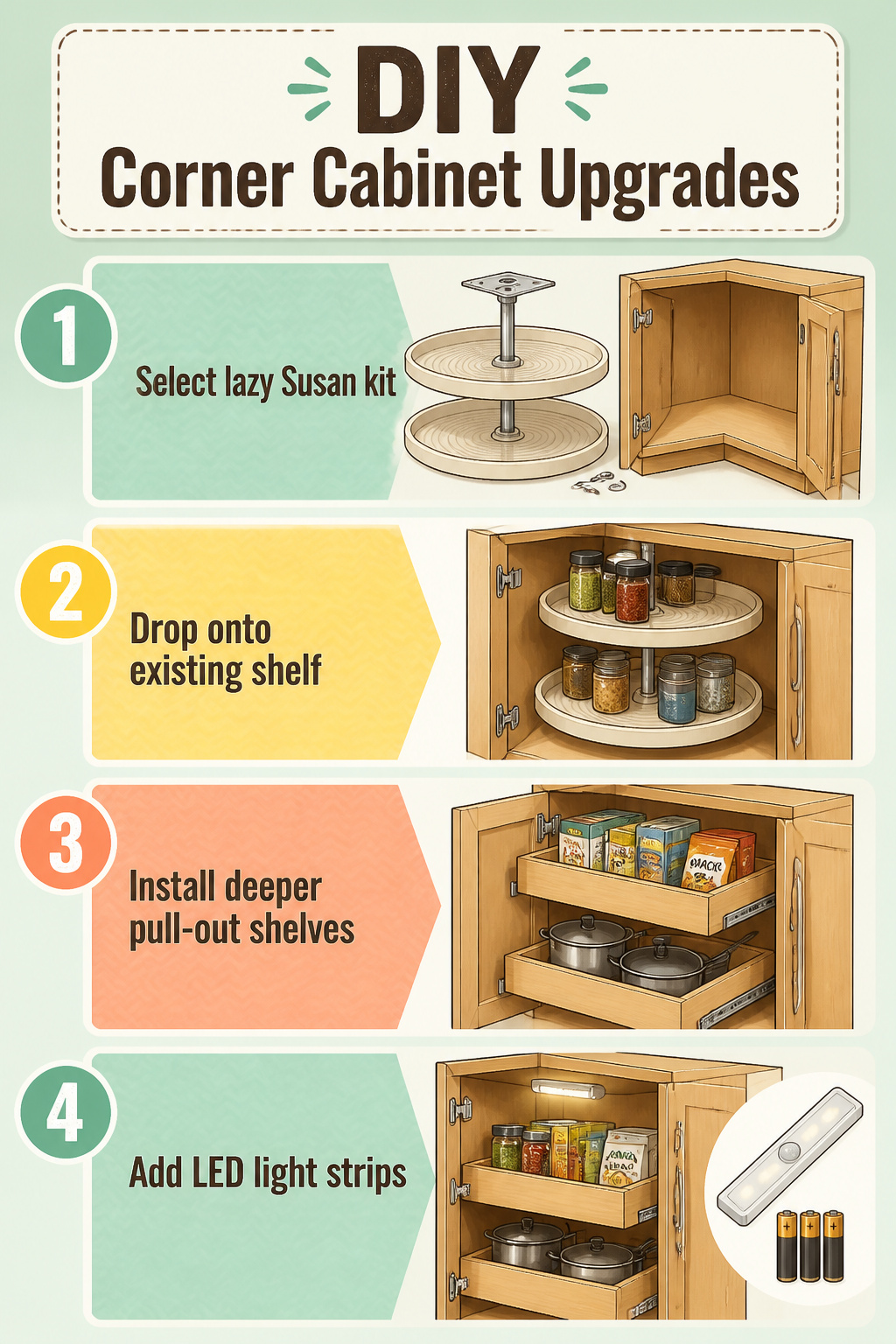
A lazy Susan retrofit turns a static corner base cabinet into spinning storage for spices, snacks, or cookware without replacing the box itself. Most kits drop onto the existing shelf and center on a single pole; no drilling if your shelf is flat and level, though you will need a hole saw for the pole if the shelf is notched around a center stile. Adjustable-tier models flex around whatever you store, and the whole job finishes inside a weekend.
Pull-out shelves on existing glides are trickier. If your cabinet already has side-mounted drawer glides, you can often swap in deeper trays that reach the blind corner, but the hardware must clear the door swing and any face-frame rails. Where glides are missing, you are drilling new mounting blocks into the cabinet sides, which means checking for plumbing or electrical first.
Battery LED strips are the only truly tool-free option. Motion-sensor versions stick to the cabinet ceiling or door frame and light the dark geometry blind corners create. They run on AA or AAA cells, so you are trading a small recurring cost for no wiring and no holes at all. For renters, this is usually the place to start.
Design Choices That Affect the Whole Kitchen

Corner cabinets sit where two walls meet, which means they shape how the rest of the kitchen reads from the doorway. A solid run of uppers to the ceiling can feel heavy; swapping one corner section for open shelving breaks that mass without giving up storage. You keep the same footprint, but the wall breathes.
Glass fronts do similar work on upper corners. They reflect light back into the room and let color from dishes show through, so the cabinet reads as depth rather than bulk. In a galley or small U-shaped kitchen, that openness can matter more than the square inches you lose to frame.
Diagonal cabinets take the 45° angle literally, turning the corner into a visible hinge between two runs. The geometry draws the eye along rather than stopping it, which helps in kitchens where traffic passes through the corner rather than turning at it. Pair that diagonal face with the same hardware and finish as the straight cabinets, or it becomes a novelty that ages fast.
Built-in hutches are the heavier move. They stack display over storage and anchor the corner as a focal point, which works when the kitchen opens to a dining area and you want one deliberate moment of furniture against simpler cabinetry elsewhere. The risk is visual weight: in a kitchen under ten feet across, a full hutch can shrink the room more than a blind corner ever would.
Frequently Asked Questions
What is a blind corner cabinet?
A blind corner cabinet is where two rows of base cabinets meet at a 90-degree angle, creating a deep, dark void that is notoriously difficult to reach into. The door on one side blocks direct access, so the back half disappears behind it. Pull-out shelves or swing-out mechanisms bring that hidden space back into use by moving items to the front where you can actually see and grab them.
How do I organize a deep corner kitchen cabinet?
The best approach is installing a pull-out system like a Lazy Susan or swing-out trays that bring items from the back to the front. Tiered bins or a turntable inside also help keep smaller items visible and reachable. For upper corners, pull-down shelf systems lower the whole rack to counter height with a handle pull so you are not climbing to reach dishes or dry goods.
Are lazy Susans still popular?
Yes, lazy Susans remain popular because they solve the corner access problem without custom carpentry and cost less than a full retrofit. Full-circle trays fill cabinets with a single door, while half-moon or kidney-shaped trays work around door posts or hinges. The hardware quality matters more than the tray shape; cheap bearings seize and center poles wobble, so invest in solid mechanics.
What can I store in an upper corner kitchen cabinet?
Upper corner cabinets work well for dishes, glasses, spices, or items you do not need daily since they are harder to reach. Pull-down shelf systems or a Lazy Susan inside improve accessibility. Glass-front doors let you display decorative pieces or frequently used dishes, while solid doors with interior organizers keep clutter hidden.
Can I customize a corner cabinet to fit my kitchen style?
Absolutely. Corner cabinets can be tailored to match your kitchen style, layout, and storage needs through custom sizing, finish matching, and specialized hardware. Options range from built-in corner hutches with plate grooves and crown molding to modern appliance garages with tambour doors, pull-out pantry towers, or hidden charging stations behind false panels.