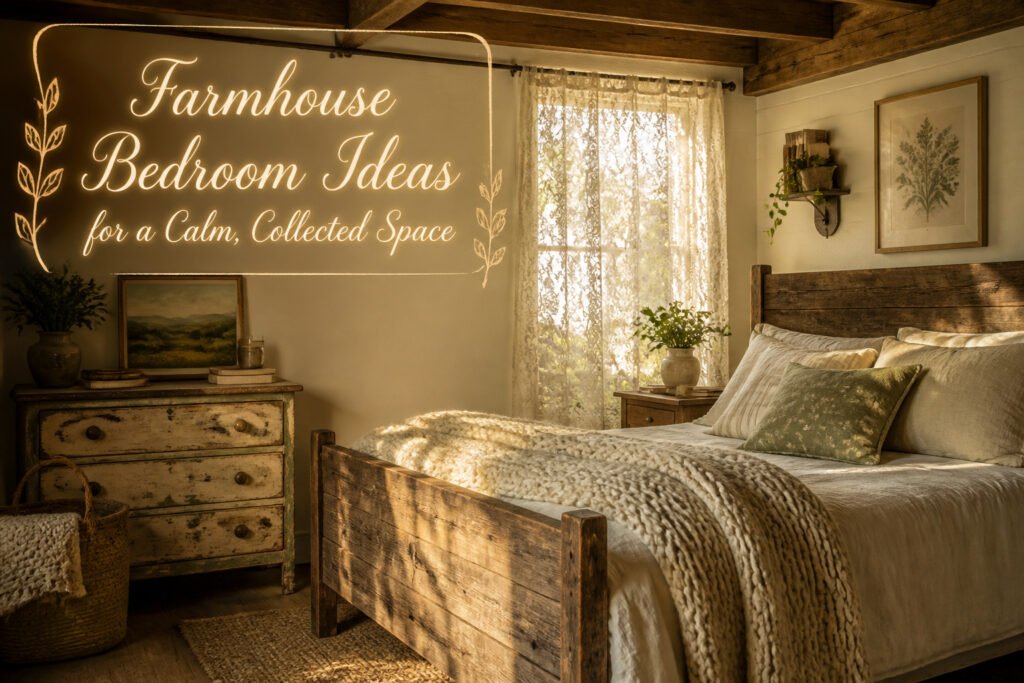
Farmhouse bedroom ideas range from a $30 thrifted print to full shiplap walls you mill yourself, and the dividing line is how much imperfection you can live with. The rooms that last treat a sand-through spot or a shimmed leg as history, not error, and stop at two sources of rustic wood so the space does not become a showroom. A single under-bed bin of seasonal textiles is the limit; when it is full, you edit.
1. Layered neutral bedding

Start with crisp white or cream sheets and build upward. A lightweight quilt goes on first, then a coverlet or thin duvet in a matching neutral, and a textured throw folded at the foot. The whole stack should cost less than $100 if you shop cotton and linen-look fabrics rather than the real thing. Sheer or semi-sheer window treatments in the same tone keep the bed from looking heavy against the wall.
Cotton and wool are the materials that read as farmhouse rather than hotel. A waffle-weave or ruffled cotton duvet cover adds the texture that plain percale misses, and a knit or loosely woven wool throw breaks up the smooth layers without introducing color. Linen pillow covers in warm neutrals do the same job at lower cost than full linen bedding.
The mistake is treating "neutral" as "identical." White sheets, cream quilt, oatmeal throw: the slight shifts in temperature keep the bed from going flat. If everything matches exactly, the room feels staged rather than slept in. Layer for the variation, not despite it.
2. Wooden bed frames
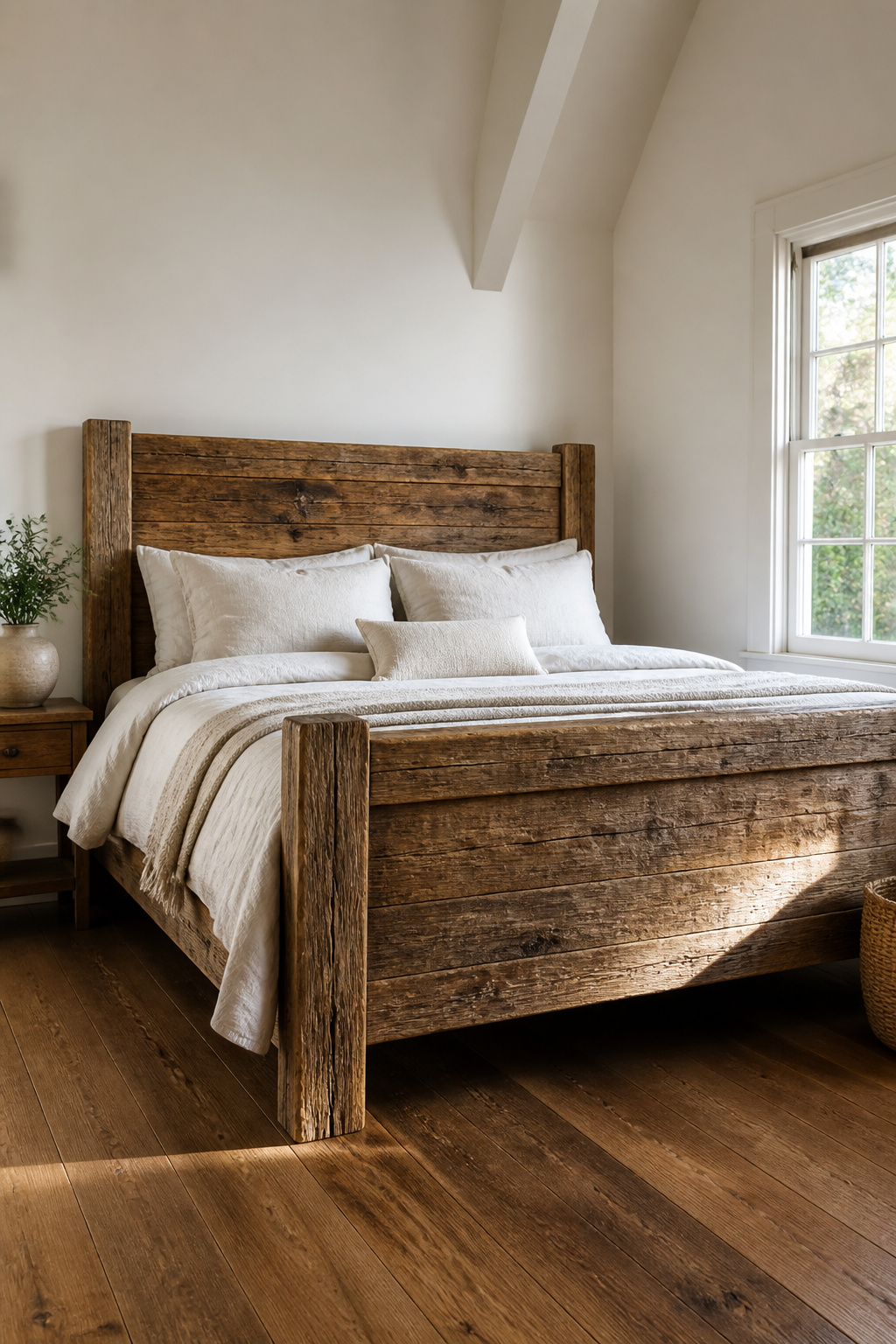
A wooden bed frame does the heavy lifting in a farmhouse bedroom. It gives the room its center of gravity and keeps pale walls and soft bedding from floating away into too much sweetness.
Reclaimed or rustic wood carries the most character, but a clean-lined frame in a natural tone works for modern farmhouse without feeling stripped down. The source material matters less than the finish: raw, lightly oiled, or weathered surfaces read authentic; glossy lacquer or ornate carving fights the calm you are after.
You will find solid candidates at estate sales, Facebook Marketplace, and the usual mid-range retailers. Thrifted frames often run under $200 and sand back well if the joints are sound. Avoid anything too dark or red-toned; it closes the room in and drifts toward lodge territory. Skip four-poster and canopy styles too, unless your ceiling clears nine feet. They read dramatic in photos and cramped in real bedrooms.
The mistake to watch for is matching your frame too closely to the floor. A little contrast, even just a shade or two, keeps the bed from disappearing into the boards beneath it.
3. Shiplap accent walls

A single wall of shiplap behind the bed adds texture without crowding the room. You get the farmhouse feel in one contained gesture instead of wrapping the whole bedroom in boards. Start with the wall behind the headboard, not the one you see first when you walk in. That second wall reads as the main event and throws off the room’s balance; the bed wall stays quiet until you’re actually using the space.
You can buy prefab shiplap panels that click together over a weekend, or you can mill your own from plywood if you have a table saw and a nail gun. The DIY route runs cheaper but eats time in leveling each board. Either way, paint it soft white or leave it natural. A colorful and chippy reclaimed wood look works in some rooms, but in a bedroom it competes with sleep. Keep the tone low and let the shadow lines between boards do the work.
4. Vintage-inspired nightstands

A nightstand with a slightly distressed finish or antique-inspired details brings more personality than a matching set from a big-box store. You do not need two identical pieces for the room to feel pulled together.
Look for mismatched pairs with the same height or wood tone, and the difference reads as intentional rather than accidental. One might have a turned leg and a single drawer; the other could be a small cabinet with a paneled door. If the scale is close and the finish is warm, they will coexist.
Thrift stores and estate sales are where the real one-of-a-kind pieces live, though you will need to check that drawers slide and joints are solid. Reproductions skip that hunt and often cost less upfront, but the distressing can look painted on rather than earned. Either route works if you inspect the edges: genuine wear concentrates on corners and handles, not evenly across the surface.
5. Soft white walls
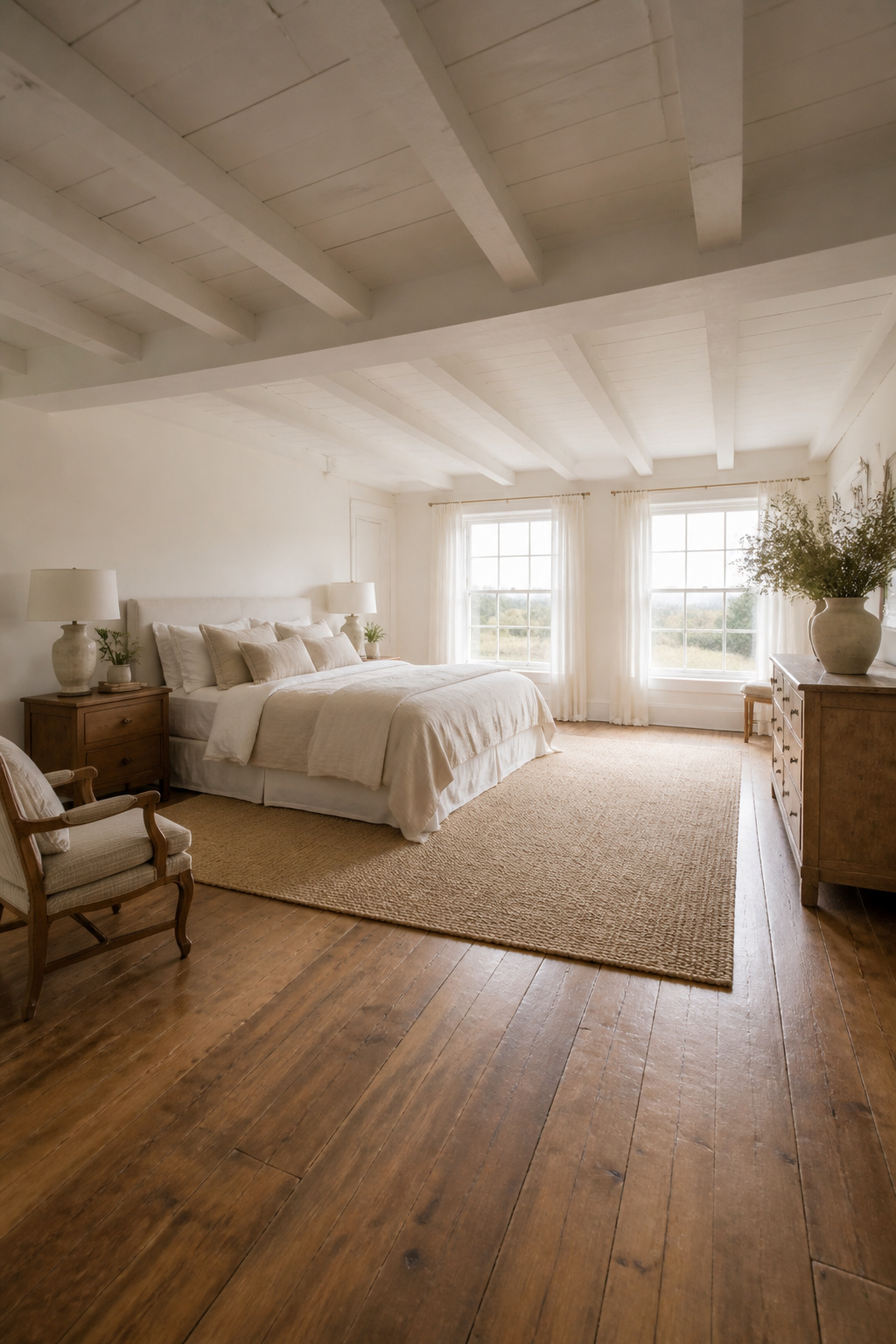
Soft white walls set the tone for a farmhouse bedroom that actually feels restful, not clinical. The difference between a warm white and a stark one is the difference between a room you want to linger in and one that feels like a rental turnover. Warm whites carry yellow, cream, or beige undertones that keep the light airy without turning cold. Whites with blue or gray bases read icy in north-facing rooms; pink-leaning whites, especially those with mauve undertones, clash against natural wood and look muddy by lamplight.
Leann Ford and Grace Mitchell used varying shades of white across walls, ceiling, bedding, and floors in an attic bedroom to build a calm, layered quiet. That restraint matters more than matching perfectly.
Before you buy a gallon, test the actual paint. Brush two coats on poster board, not the wall, and move it around the room across a full day. Morning light, afternoon shadow, and lamplight will tell you whether the undertone shifts where you do not want it to.
In modern farmhouse bedrooms, soft neutrals reign. Layer in earthy tones for contrast and use natural wood tones to add warmth and depth.
The practical takeaway: pick a warm white that stays warm in your particular light, then let texture and material do the decorating.
6. Cozy textiles

A chunky knit throw in a weight around 2 to 3 pounds does the heavy lifting for coziness without sliding off the bed every time you turn. Drape it at the foot, folded once lengthwise so the texture shows, not spread flat like a bedspread. Wool and cotton blends hold their shape better than acrylic, which pills after a season of real use.
For rugs, layer a low-pile natural fiber rug directly on the floor, then a softer cotton or wool rug on top. The bottom layer should be the larger of the two, usually an 8-by-10 foot base with a 5-by-8 foot top rug, leaving a visible border of 12 to 18 inches on each side. This traps air between the layers and adds actual warmth, not just the look of it.
Thrift stores are where to hunt the top rug. The bottom layer takes the beating and hides under it, so buy that one new in a durable weave like jute or sisal. The visible layer is where a faded pattern or worn fringe reads as character, not damage, in farmhouse style.
7. Natural materials

Wood and cotton do the heavy lifting in a farmhouse bedroom, but the comfort comes from where you put them, not just that they are there. A wooden door with real grain, left unstained or finished in a warm neutral like taupe or sand, reads softer than a painted panel even when the paint is matte. Cotton and linen curtains filter morning light without blocking it; that slight weave variation is what keeps them from looking like hotel sheers. Wicker or natural-fiber storage, an ottoman or a side table, adds texture against white or cream walls without the fuss of pattern.
The mix matters. Pair a heavier material, wool in a throw or a rug, with lighter cotton bedding so the room does not flatten into one note. What reads synthetic even when it is not: overly distressed finishes, shabby-chic distressing, or that particular gray wash that turns wood cold. Jamie Gernert of WYC Designs calls the core of farmhouse style timeless, rooted in traditional craftsmanship and comfort. Stick with earth tones, warm gray, mushroom, or soft greige, and let the materials show their age naturally rather than forcing it.
8. Exposed farmhouse beams

Nothing signals farmhouse character like a ceiling with actual timber overhead, but most bedrooms built after 1950 never got them. If you are staring up at flat drywall, you have two paths. The honest one is learning to live without a feature your house never had; the manufactured one is installing hollow urethane or lightweight foam beams that glue or screw to the ceiling surface.
Faux beams run a few hundred dollars for a standard bedroom and a single Saturday of measuring, cutting, and bracing. They read as beams from the floor, especially if you stain them soft brown or driftwood gray rather than trying to match existing trim exactly. Where they fail is at the edges: the seam where beam meets ceiling, the hollow sound if something bumps them, the way they flatten under direct light from a ceiling fixture. You will find yourself avoiding upward-facing lamps.
If you add beams, stop before you also add a plank wall, a barn door, and a reclaimed wood headboard. Two sources of rustic wood in one room layer nicely; four make the space feel like a furniture showroom. Let the beams carry the weight, and keep the bed frame simple and paint-grade.
9. Earthy tones and muted colors

Warm whites and creamy beiges give you the canvas, but taupe and warm gray are what keep a farmhouse bedroom from reading sterile. Use them where the eye lands: a throw folded at the foot of the bed, the bench you sit on to pull on socks, a ceramic lamp base. These earthy tones sit one step deeper than your walls without breaking the calm.
For pairing, work in muted blues or soft sage through small accents, a vintage rug, or a single paneled wall in moody olive green if you want the room to feel grounded rather than airy. Natural wood tones, caramel to deep, bridge the gap between your neutrals and these cooler accents.
What to skip: colors that muddy. Earthy orange and brick red can work, but only in small, intentional doses. A large swath of either, or anything that reads as mustard or dusty rose in the wrong light, drags the palette toward dated rather than timeless. Test your accent in the actual room before you commit.
10. Vintage artwork and botanical prints

Vintage artwork turns a bedroom from staged to particular, the kind of space that looks collected over years rather than ordered in a single afternoon. Botanical prints and pastoral scenes are the natural fit for farmhouse style, and you do not need an estate sale budget to find them.
Aim for a mix of half vintage and half new pieces, which keeps the wall from feeling like a museum corner. Sources like Chairish carry original flower oil paintings in the $30–$70 range, though shipping can push the total. Thrift stores and estate sales run cheaper if you have patience for the hunt. The frames matter as much as the art inside them. Antique frames give even a generic print some age, but they cost. A cheaper route: buy a new pre-made frame and rough it up yourself, or choose a simple wood frame and let the patina of the print do the work.
Hang what you actually like looking at. One large piece above the bed reads calmer than a crowded gallery wall, and in a farmhouse bedroom, calm is the whole point. If you do group smaller pieces, keep the spacing tight, two inches or less, so they read as one unit instead of scattered afterthoughts.
Soft ambient lighting

A farmhouse bedroom dies under a single overhead fixture. You need three sources at different heights to get the softness this style is after.
Start with a chandelier in wood, wrought iron, or distressed metal. The vintage lines do the farmhouse work for you, and the material matters more than the size. A too-small iron piece over a king bed beats a polished nickel one that fits perfectly.
Wall sconces belong beside the bed, especially if you read there. Adjustable arms let a guest angle light without disturbing a partner. Keep them wired if you can; plug-in cords fight the uncluttered look this room wants.
For the third layer, string lights behind gauzy curtains cost little and run on a timer. The glow reads as evening even at full dark, and the fabric diffuses what would otherwise read as dorm-room territory.
Bulb warmth is where people slip. Anything labeled daylight or above 3000K will fight every other choice you have made. Stay at 2700K or lower, the color of filament bulbs, and match every source in the room. Mixed temperatures feel like a mistake even when nothing else is wrong.
DIY shiplap and custom pieces

Real shiplap is just rabbeted pine boards nailed to studs, but you can fake the groove with plywood strips ripped on a table saw and tacked over drywall. Either way, start behind the baseboard and work up, because the bottom row is where your gaps will show if the floor is not level. A brad nailer keeps the rhythm fast enough for a Saturday.
For furniture, a headboard built from two barn doors on a simple 2×4 frame looks built-in without the commitment. Renters have used French cleats hung on a single stud line; the wall patch when you move is a strip of spackle, not a reconstruction. The same cleat system works for floating nightstands with a drawer box screwed underneath, and you can build those from one sheet of birch plywood if you keep the depth under 15 inches.
What convinced me, reading through a dozen of these builds, is that the farmhouse look lives in the mistakes. Boards that do not quite match, a sand-through spot that shows the primer underneath, a nightstand leg cut an eighth short and shimmed with a washer. Those read as history, not error, and they save you the weekend of filling and re-spraying that perfection would cost.
Seasonal touches

Swapping throw pillows and a folded blanket at the foot of the bed costs almost nothing and reads as a different room. Warm rust and olive work for fall, a washed blue or bare branch arrangement for winter, soft pink peonies for spring. The trick is stopping before it becomes a storage problem. One under-bed bin per season is the limit. When the bin is full, you edit, not expand. Woven baskets beside the bed or stacked in a closet keep the off-season set visible enough to actually rotate and compact enough to forget. A single neutral duvet cover stays year-round; it is the constant that lets the smaller pieces move. If you rent and under-bed space is tight, a slim lidded basket slid behind a door holds two or three pillow covers without claiming real estate you do not have.
Mixing patterns the relaxed way

Gingham and plaid together read as farmhouse because both grew out of the same woven tradition, but they fail when the scales fight each other. The rule is one large, one small, and nothing else in the same view. A two-inch gingham check on your duvet cover can live with a six-inch plaid on a throw at the foot of the bed. Reverse it, or add a third pattern at the same scale, and the eye stops relaxing and starts comparing.
Stop at two patterns in a bedroom. The temptation is to keep layering because the fabrics are cheap and the yardage is small, but a farmhouse room needs empty visual space to feel collected rather than crowded. Let the wall or the bare wood floor do the resting. If you already have a patterned rug, that counts as your large scale; choose a solid quilt or risk the room looking like you emptied a fabric bin.
What convinced me, reading through a dozen of these rooms, is that the successful ones treated pattern as an accent, not a theme. The bed carries it, or one chair, and everything else quiets down. That restraint is what makes the mix read as relaxed rather than busy.
What farmhouse design actually means

Farmhouse design comes down to three rules: simplicity, natural materials, and quality craftsmanship. Everything else is optional, and much of what trends sell you is worth ignoring.
The "farmhouse" label gets slapped on anything with a distressed finish or a word sign reading "Gather." Those pieces age badly. What actually holds up are neutral colors and natural textures, because they do not fight the architecture of an ordinary room. Wood, cotton, and wool for bedding, curtains, and rugs give the grounded feel without the theme-park effect.
Vintage or reclaimed materials help, but only when the craftsmanship is honest. A badly built reclaimed piece is still badly built. The same goes for modern touches: they work when they bring function, not when they are added to hit a style checklist.
Skip anything that asks you to sacrifice your own taste to fit the look. The goal is a room that feels collected over time, not assembled from a single catalog page. If a piece would not work without the farmhouse label beside it, it will not work in your bedroom.
Frequently Asked Questions
What colors look good in a farmhouse bedroom?
Soft neutrals like warm whites, creamy beiges, gentle grays, and muted taupes create the right backdrop. Layer in earthy tones such as taupe, warm gray, sand, and mushroom for contrast, and let natural wood tones add warmth and depth. A restrained, tonal palette keeps the look timeless while textures and materials do the actual work.
How to style a farmhouse bedroom?
Start with neutral wood furniture and light colors, then build around natural materials and honest craftsmanship. A wooden bed frame gives the room its center of gravity, while layered cotton and wool textiles keep it from feeling staged. Vintage or reclaimed pieces work when the construction is solid, not just the look.
What are the rules of farmhouse design?
Farmhouse design comes down to three things: simplicity, natural materials, and quality craftsmanship. Wood, cotton, and wool for bedding, curtains, and rugs give a grounded feel without the theme-park effect. Skip anything that would not work without the farmhouse label beside it.