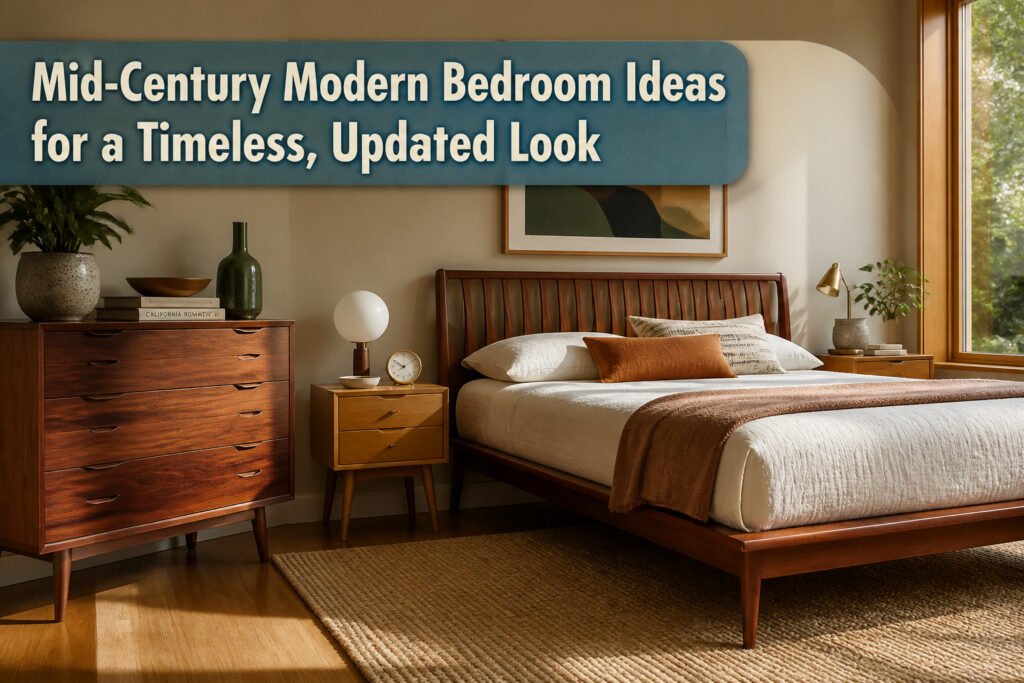
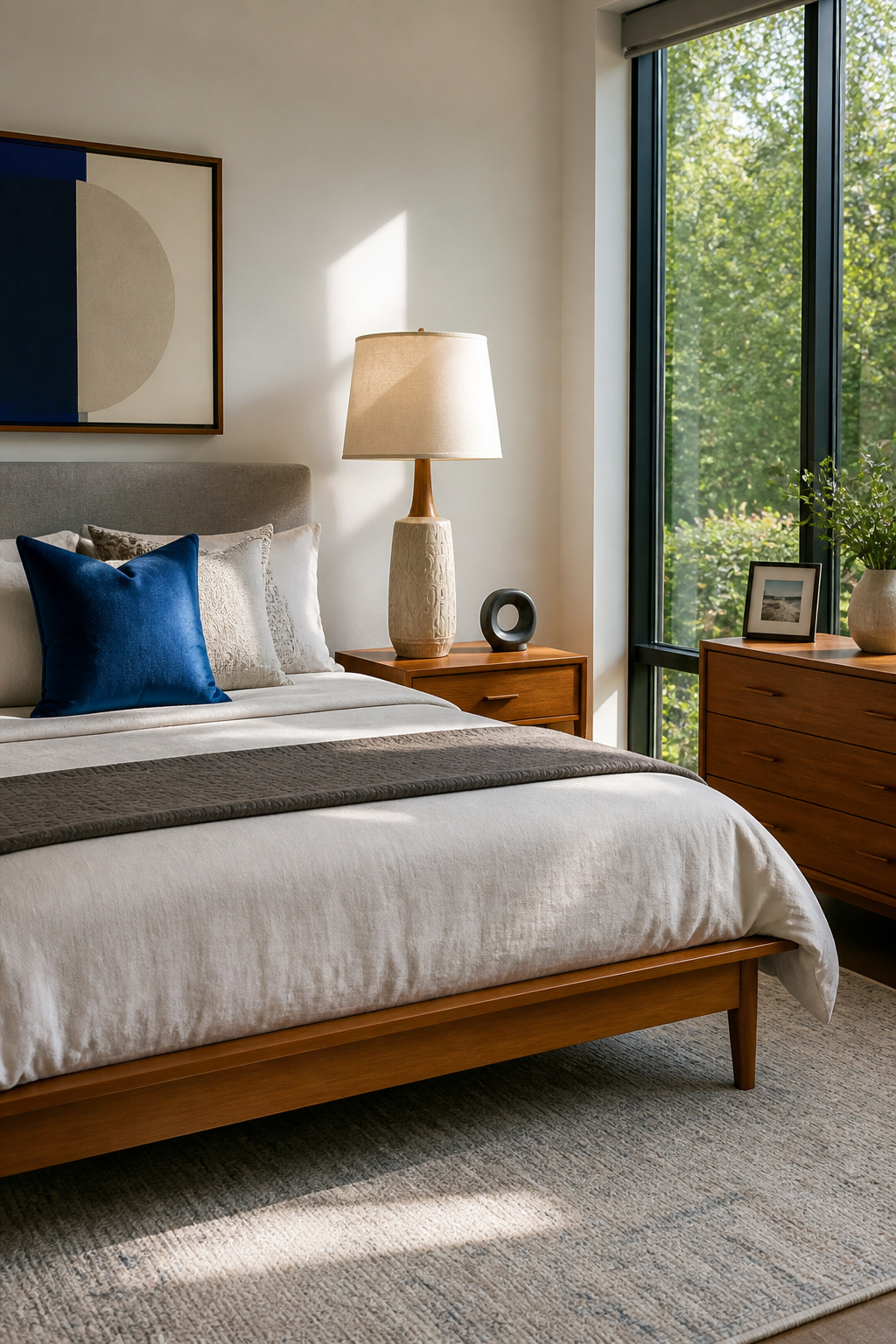
Mid-century modern bedrooms run from a $6 roll of wood-look contact paper to an authentic Eames lounge chair at five figures, and the single choice that decides which end you land on is the bed frame. Get the platform right, with tapered legs and visible grain, and a mismatched walnut dresser beside an oak nightstand reads as intentional rather than budget. The rest of the room simply responds to that one piece.
1. Warm Wood Tones

Walnut, teak, and oak are the three woods that anchor mid-century modern bedrooms, and the difference between them is worth knowing before you buy. Walnut runs darkest, with a chocolate depth that reads as furniture-grade even on a simple nightstand. Teak sits in the middle, the tone most people picture when they think of the era’s Danish pieces. Oak is lighter, more casual, and easier to mix with things you already own. You do not need matching sets; the era itself mixed these tones freely, and a walnut dresser beside an oak bed frame looks intentional, not mismatched.
For renters, wood tone comes in without touching the walls. A low-profile bed frame in any of these three species changes the room’s temperature immediately. Removable wood paneling systems that press-fit against existing walls have gotten better in the last few years, though they still read as accent rather than architecture. Wood-look contact paper on a flat-front dresser or IKEA nightstand is the cheapest entry point, and it holds up fine on vertical surfaces if you prep the original finish with rubbing alcohol first. Expect to replace it in two to three years, or sooner if it sees moisture.
The sources consistently rank warm wood tones first among mid-century modern bedroom ideas, which says something about how much this single choice carries the look. Start here and the rest of your decisions get easier.
2. Stylish Platform Beds

A mid-century modern bedroom lives or dies on the bed you choose, and the signature piece is a low-profile platform frame with tapered legs that lift the box spring off the floor and into view. Look for simple construction with visible wood grain, walnut or teak if you can find it, though honest veneer over solid rails works fine at a weekend-project budget. The legs matter more than the headboard: angled, slim, and present enough that you could sweep beneath them without moving the frame.
What to skip on a tight timeline and a few hundred dollars are upholstered surrounds that box the mattress in and hide the legs entirely. Those read contemporary, not mid-century, and they swallow visual space a small rental cannot spare. If you are buying online, zoom in on the rail joint and the leg attachment. A bolt-on leg in solid wood will outlast a slotted metal bracket that loosens every six months, and that distinction shows up in the reviews more often than in the product title.
Designers pairing pieces for this look often mix wood finishes rather than buying a matched set, so your bed in walnut and your nightstands in a lighter teak is not a compromise but the move. The bed carries the style; everything else responds to it.
3. Neutral Color Palettes with Bold Accents
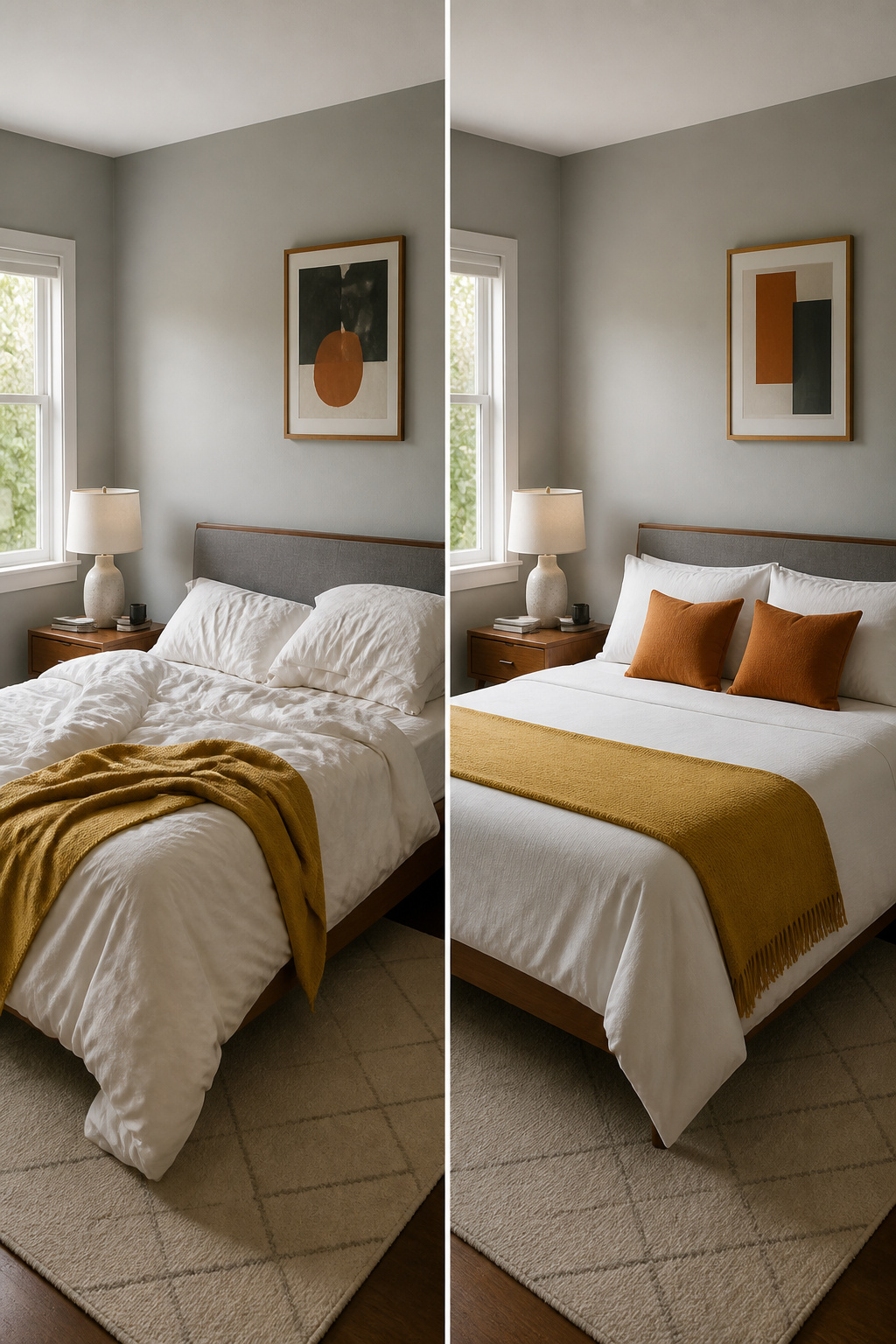
The base colors in a mid-century modern bedroom stay quiet: white, beige, gray, or taupe. Against that calm, one accent color does the work. Mustard yellow, olive green, burnt orange, or a muted red each carry the 1950s–60s feel without shouting. The rule is simple: if you cannot name the accent in three words, it is too complicated. "Mustard" passes; "dusty sun-faded ochre" fails.
Gray walls and white bedding give you the cleanest stage for this. Add orange and mustard cushions, a patterned throw, or a bright yellow Eames chair if the budget allows, and the room gains energy without losing its hold. One or two accent pieces are plenty. More than that, and the calm base starts to look like an accident you are covering up rather than a choice you made.
4. Statement Pendant Lighting

The ceiling fixture in a mid-century modern bedroom does more light work than anything else you plug in, so it pays to choose one that actually reads as period-appropriate. Globe pendants, sputnik fixtures, and saucer shapes are the three silhouettes that scan as authentic without requiring a design degree to identify. A milk-glass globe on a thin brass rod reads quieter than a sputnik, which spreads its arms wide and throws patterned shadows across the walls; saucer shapes fall between, wide and low and good over a low platform bed where head clearance matters.
Renters have more options than the listings suggest. A plug-in swag kit lets you suspend any hardwired pendant from a hook in the ceiling joist and run the cord to the nearest outlet, no electrician needed. The hook takes a small pilot hole, easily patched later with spackle the color of your ceiling paint. Anchor the second point on the opposite wall or a corner to keep the cord taut and the shade level; a slack cord sways and looks like a mistake. If your ceiling is concrete or you cannot drill at all, a tension-mounted floor-to-ceiling rod exists for exactly this situation, though it costs more than the swag and reads slightly industrial. For most bedrooms, the swag kit wins on price and disappears if you paint the cord to match the ceiling.
5. Floating Nightstands

Wall-mounted nightstands with a single drawer and clean lines give you the storage you need without the visual weight of legs or a bulky frame. The style grew out of mid-century city apartments where floor space was tight, and it still reads that way: open underneath, calm above.
If you rent, you have three workable paths. A French cleat lets the table lift off the wall cleanly when you move, leaving only a slim bracket and a few screw holes to patch. Heavy-duty wall anchors rated for the loaded weight work on drywall without finding a stud, though you will want to check the package limit against the nightstand plus whatever sits in the drawer. The third option skips mounting entirely: choose a piece with narrow, tapered legs set far back under the body so the table reads as floating from the angle you actually see it in bed. The Modway Render and similar slatted designs pull this off at a lower price point than true wall-mount pieces, and you take it with you when the lease ends.
Walnut or a warm wood tone keeps the mid-century connection without trying too hard. One drawer is enough if you use it for what you reach for in the dark and let the top hold a single lamp or a small stack of books.
6. Bold Geometric Patterns
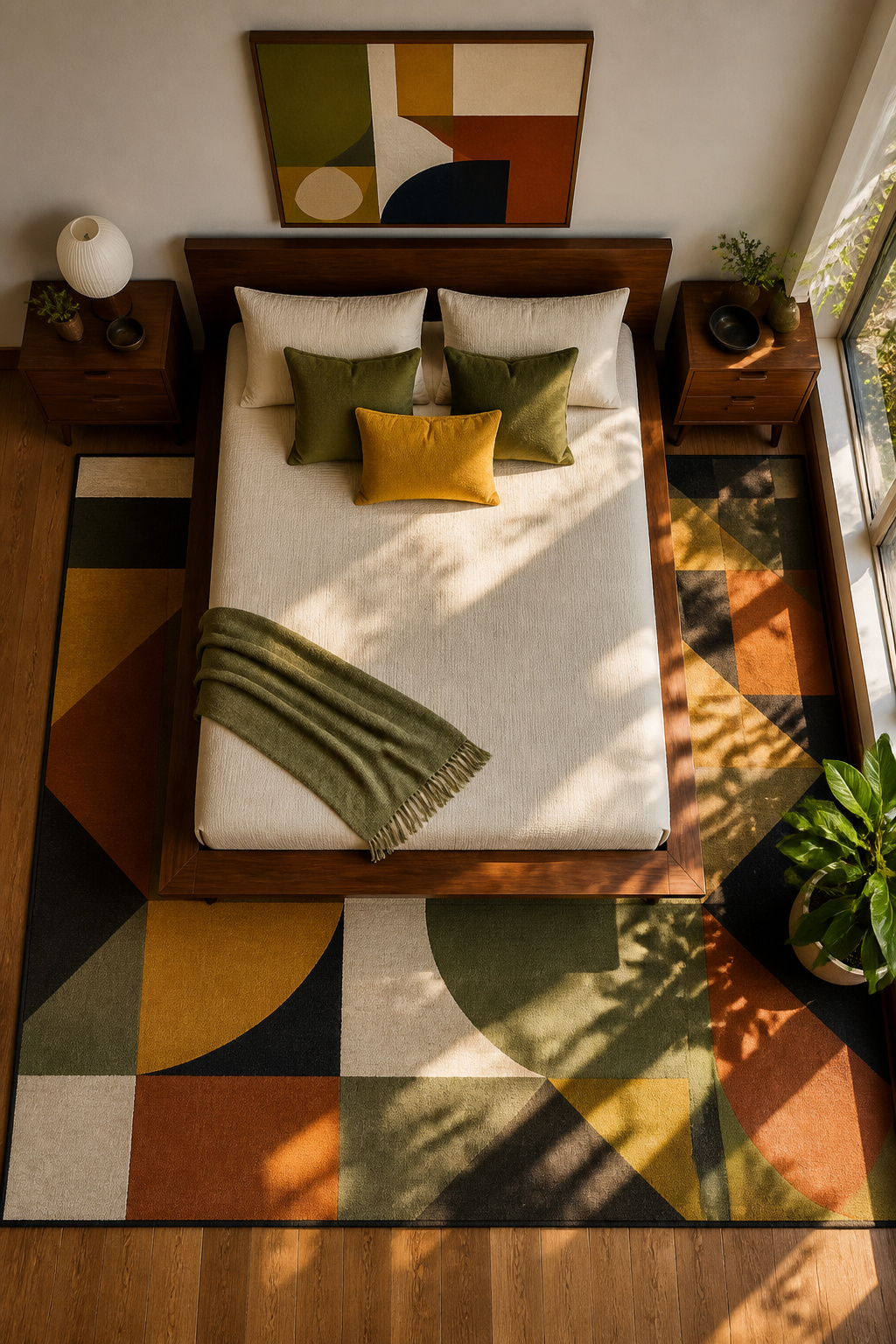
Bold geometric patterns can anchor a mid-century modern bedroom without turning it into a period set. The move is to choose one place for them and stop there: a single textile, one wall, or one rug. Bedding or throw pillows in starbursts or atomic shapes read as playful against neutral furniture, while a plaid area rug adds texture without competing for attention. Clean stripes and gentle curves work the same way, especially when you pull a color from the pattern into a smaller accent like a moss green pillow or olive lounge chair to keep the room from feeling busy. If you are unsure, start with a low-stakes piece you can live with for a few days before deciding whether to add more.
7. Vintage Finds

Estate sales are where you handle the piece before you pay, which is the only way to know if a drawer still slides square. Facebook Marketplace and Chairish widen the search, but the photo that hides water rings or a warped veneer is the rule, not the exception. Ask for a shot of the underside and a video of the mechanism moving; if the seller stalls, move on.
Flea markets and thrift stores reward patience. Teak and ash were the dominant solids of the era, and a genuine frame in either still turns up for less than reproduction plywood. The test for buying is simple: if it needs more than a weekend of repair, pass. Reglue a joint, yes. Strip and refinish a top, maybe. Rebuild a carcass or track down missing hardware for days, and you have bought someone else’s project, not a bedroom piece.
A single vintage nightstand or dresser anchors the room in actual history. Pair it with a new lamp and the mix reads intentional, not inherited. Burl wood bowls or a starburst mirror add the small touches without the weight of a major purchase.
8. Clean-Lined Dressers

A mid-century modern dresser sits long and low, its silhouette closer to a sideboard than a vertical chest. Tapered legs, flat drawer fronts, and plain pulls are the details that read authentic, not costume. The Savanna 6-Drawer Dresser at roughly 56.9 inches wide hits the proportions right, six drawers spread across one low piece rather than stacked tall.
Solid wood is the material that separates the real thing from the veneer-wrapped lookalike. Walnut, teak, and rosewood carry the warmth that defines the era, though oak and dark ash hold their own. A cheap imitation in the same price range often hides particleboard under a thin skin and substitutes chunky hardware for the minimal pulls that keep the front clean. Run your hand along the drawer face: if the grain pattern repeats exactly at the seam, it is printed, not grown.
Designers skip matched sets and pair pieces in different wood finishes instead. A walnut dresser against oak nightstands, or teak against upholstery, keeps the room from looking like a showroom floor. The restraint is the point. Crisp edges and no ornamentation read calm, not cold, when the wood itself carries the interest.
9. Sculptural Lighting Fixtures

The bedroom lighting in that New York City apartment by Lenz stuck with me: a brass dome chandelier from Lawson-Fenning paired with two sculptured ceramic table lamps by Dumais Made. That combination of one overhead piece and two very different table lamps is the move. One sculptural lamp beats three matching ones because mid-century modern lives on contrast, not symmetry.
For the floor, look for a tripod base or a brass arc that curves over the bed. Ceramic table lamps with geometric shades work on the nightstand. In a subdued bedroom by Tali Roth, a double-arm sconce and sculptural pendant light carried the whole room while everything else stayed quiet.
Lighting here does two jobs. It lights the space, but it also reads as a small piece of art. And it is one of the cheapest ways to signal the style. A sconce above the nightstand keeps the table surface free, which matters in a small bedroom. Pablo Di Francesco chose two Pastille lamps by Wästberg for exactly that reason; their simple design lets them fade against the wall when you do not need them.
Skip the matching sets. Mix a brass arc floor lamp with a ceramic table base, or pair an angular sconce with a globe pendant. The variation is what makes it feel collected rather than staged.
10. Creative Wall Art
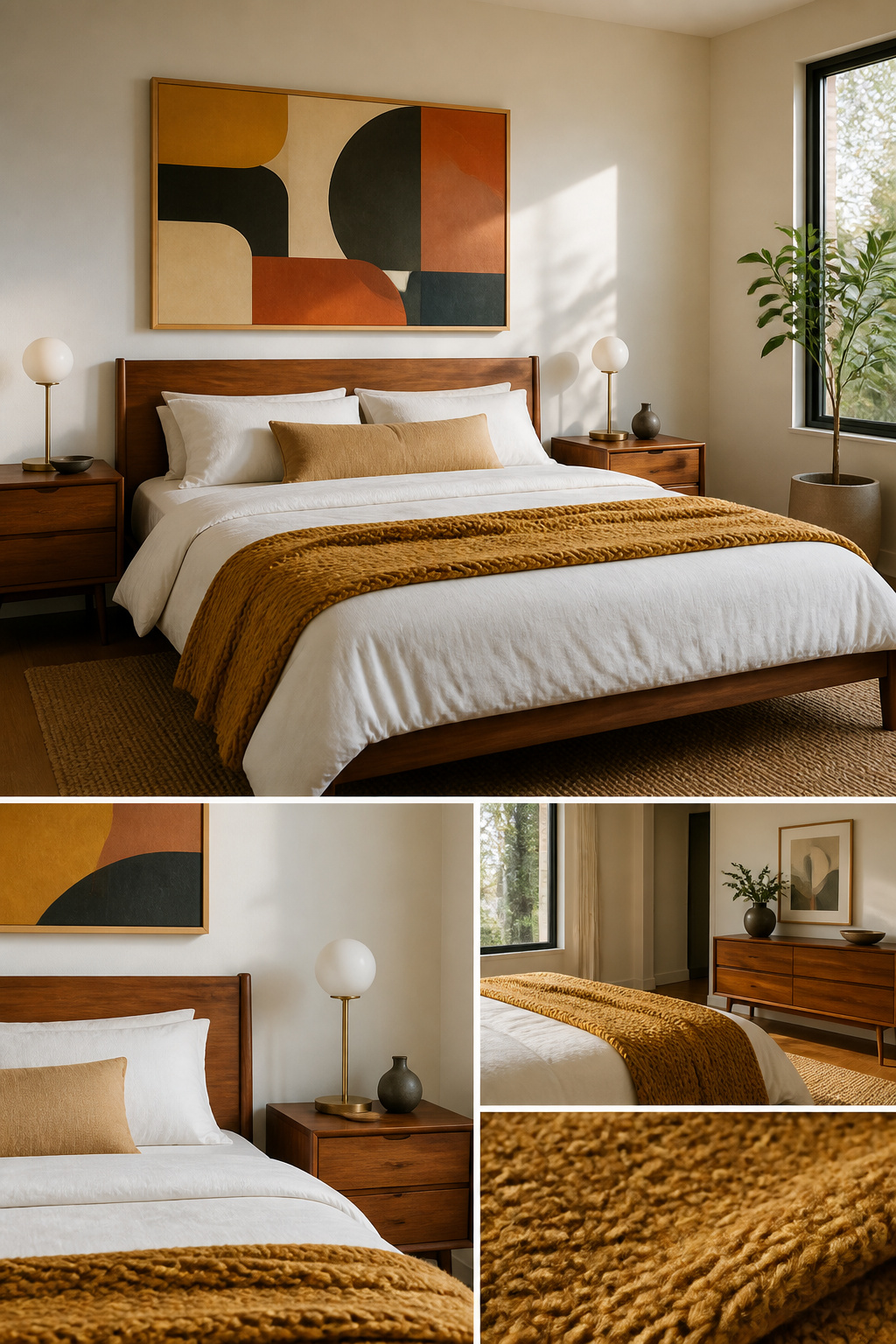
The wall art that reads mid-century falls into four clear categories, and you probably already know which one fits your room. Abstract prints with geometric shapes or retro color schemes hang above most beds in this style; a single large-scale piece often works better than a cluster if your bedroom is small and your furniture is simple. Sunburst mirrors carry the era’s signature without demanding a gallery wall’s planning. Grouped botanical illustrations soften the geometry elsewhere in the room. For renters, Command strips handle light pieces under a few pounds; picture rails, where your building has them, let you swap art without patching drywall. If you are testing whether a bolder pattern belongs in your space, one framed print or a single mirror is the low-stakes move. Live with it for a few days, then decide whether to build outward. Vintage finds from estate sales or online marketplaces can mix with new reproductions; a burl wood accent or a Bauhaus print layered against a modern lamp keeps the room from feeling like a set.
11. Mixing Textures

Texture does the decorative work in a mid-century modern bedroom so you do not need clutter to make the room feel finished. The style keeps ornament spare, which means the contrast between velvet or wool against wood, leather against linen, and ceramic against metal carries the whole visual load.
Layer these pairings where you already touch the room. A velvet headboard against lacquered walnut framing, as Christian Bense paired in a Ponti-inspired design, gives the bed wall its depth without adding a single extra object. Bedside lamps in metal, standing near leather or velvet upholstery, keep the contrast active at nightstand height. On the floor, a high-pile wool or shag rug under a teak bench does the same job.
The risk is piling too many textures into one sightline. Spread them across the three planes you actually use: vertical surfaces like headboards and curtains, horizontal ones like bedding and rugs, and the small hard pieces like lamps, ceramic bowls, or a magazine rack. Two textures per plane is usually enough. Three in the same glance starts to look collected rather than lived-in, and this style was never about the collected look.
12. Accent Walls

A mid-century modern accent wall usually goes one of three ways: one saturated color, one wood treatment, or one large-scale pattern. The signature palette runs to mustard yellow, olive green, burnt orange, rust, navy, teal, and muted red. One wall in one of those tones is plenty; two at most if you are feeling brave.
Wood paneling is the other classic route, especially when the bed frame and side tables read as an extension of the wall itself. That built-in look was common in the original era and still reads as intentional rather than added later.
For renters, the permanent options are off the table, but the look is not. Removable wallpaper in a retro pattern can come down in twenty minutes when the lease ends. Temporary paneling, the kind that installs with a few nails or even adhesive strips, works for a single feature wall without touching the rest. A single large textile hung on a dowel rod gives you the scale and warmth of wood or pattern without altering the wall at all. Move it with you, or roll it up when the mood shifts.
13. Layered Textiles

Soft layers keep a mid-century bedroom from feeling like a showroom. Start with a flat-weave wool rug under the bed; it adds texture without the pile height that fights platform bed legs. For bedding, cotton percale sheets give you the crisp, cool hand that reads period-appropriate without going costumey. One chunky knit or woven throw across the foot is enough; the look is intentional, not accumulated.
What convinced me, reading through a dozen of these rooms, is how fast they tip from curated to cluttered. Velvet and chenille show up constantly, and they work, but only if you stop while the bed still looks chosen. The rule is: add textiles until the room feels finished, then remove one layer. That last subtraction is usually the difference between a bedroom you want to sleep in and one that looks like it was assembled for a photograph.
A single yellow rug or a rust curtain can carry the color story so the textiles do not compete. The rattan or metal accent elsewhere in the room handles the contrast; the bedding does not need to do everything at once.
14. Metallic Accents

Brass, copper, and matte black are the metals that read mid-century without screaming for attention. Use them on lamp bases, drawer pulls, picture frames, and mirror edges so they sit in the room as punctuation rather than paragraphs. A brass arc lamp beside the bed, matte black pulls on a walnut dresser, or a thin copper frame around a sunburst mirror gives the era’s feel without sourcing expensive period pieces.
Mixing metals is where rooms go wrong fast. Two finishes in one space is the practical limit; three starts to look like you collected things accidentally. If your bed frame is black metal, carry that through the pulls and one lamp, then add brass on a second lamp or a single mirror. Let one metal do most of the work and the other show up once or twice, distant enough that the eye does not ping back and forth comparing them.
The cheap test is the hardware store display board: hold your chosen finishes next to each other under the same light. If they argue, swap one out before you buy.
15. Dual-Purpose Furniture

Small mid-century bedrooms force a hard choice between clean sightlines and enough storage, which is why dual-purpose furniture became a signature of the period rather than a modern compromise. A storage bed only earns its place if the lift mechanism works smoothly with a mattress on it, not just in the showroom with no weight. Test that before you buy, because a gas strut that needs two people defeats the purpose in a room you use alone.
Desk-vanities share the same risk. The best pieces from this era have a mirror that flips down to become a writing surface, or a desk depth that works for both purposes without your knees hitting drawer hardware. If one function feels like an afterthought, it probably was, and you will stop using it.
Bench seating at the foot of the bed follows the same rule. The lid should stay open on its own, and the interior height needs to fit actual items, not just a spare pillow. What convinced me, reading through a dozen of these builds, is that the pieces still in use fifty years later were the ones where both jobs were designed equal from the start.
16. Incorporating Vintage Accessories

Vintage accessories hit the mid-century note without the hassle of hauling home a credenza. A ceramic ashtray that reads "Riviera Hotel" works as a catchall on your dresser. A rotary phone with a damaged cord becomes shelf sculpture for roughly the cost of a sandwich. A vintage alarm clock keeps actual time on your nightstand.
The look lives in these small objects: a starburst mirror, a sculptural vase, a retro lamp with a worn brass stem. Thrift stores and estate sales carry them for less than imitation versions from modern sellers. A 1950s table lamp paired with bedding you already own does more for the room than a matched set ever would.
One route is the single statement piece, like a classic record player that spins vinyl on Saturday mornings. Another is clustering smaller finds, a burl wood bowl beside a framed Bauhaus print, until the collected feel reads as intentional rather than inherited. The second approach wins if you rent and pack light every few years.
Designer Meredith Owen notes that in a sparse mid-century room, even small decor choices become focal points. That means you can stop at one or two vintage items and let them breathe. The mistake is crowding the nightstand until it looks like a flea market stall. Leave the rotary phone off the hook, literally, and it stays an object instead of becoming clutter.
17. Personalizing Decor
A mid-century modern bedroom can still look like yours if you add just three things that do not belong to the era: one object with history, one color you actually like, and one modern piece that solves a real problem. The rest stays disciplined.
Start with the object that carries weight for you. A family lamp, a vase from your first apartment, a record player you already own. These work because they bring age the way new reproductions cannot, and they give the room a reason to look collected rather than bought in a set. The rule is placement: one spotlit corner, not three surfaces crowded with stories.
Color is where most rooms drift into pastiche. Build the calm base first: neutral walls, warm wood, maybe a black and white palette on the bedding. Then add one bold note, not two competing ones. A single rust pillow, one deep teal throw. If you want pattern, keep it to one framed piece that pulls the palette together and stop there.
The modern piece is usually the hardest choice because it needs to earn its place functionally. A sculptural table lamp with a USB port, a platform bed frame that ships in three boxes, a dresser that actually fits your closet depth. Let it read as deliberate contrast, not apology.
What breaks the look is accumulation. The moment personal items look like they landed where they fell, the room becomes storage with a theme. Each piece should look chosen, which means some of what you own stays in a drawer.
18. Iconic Eames Lounge Chair
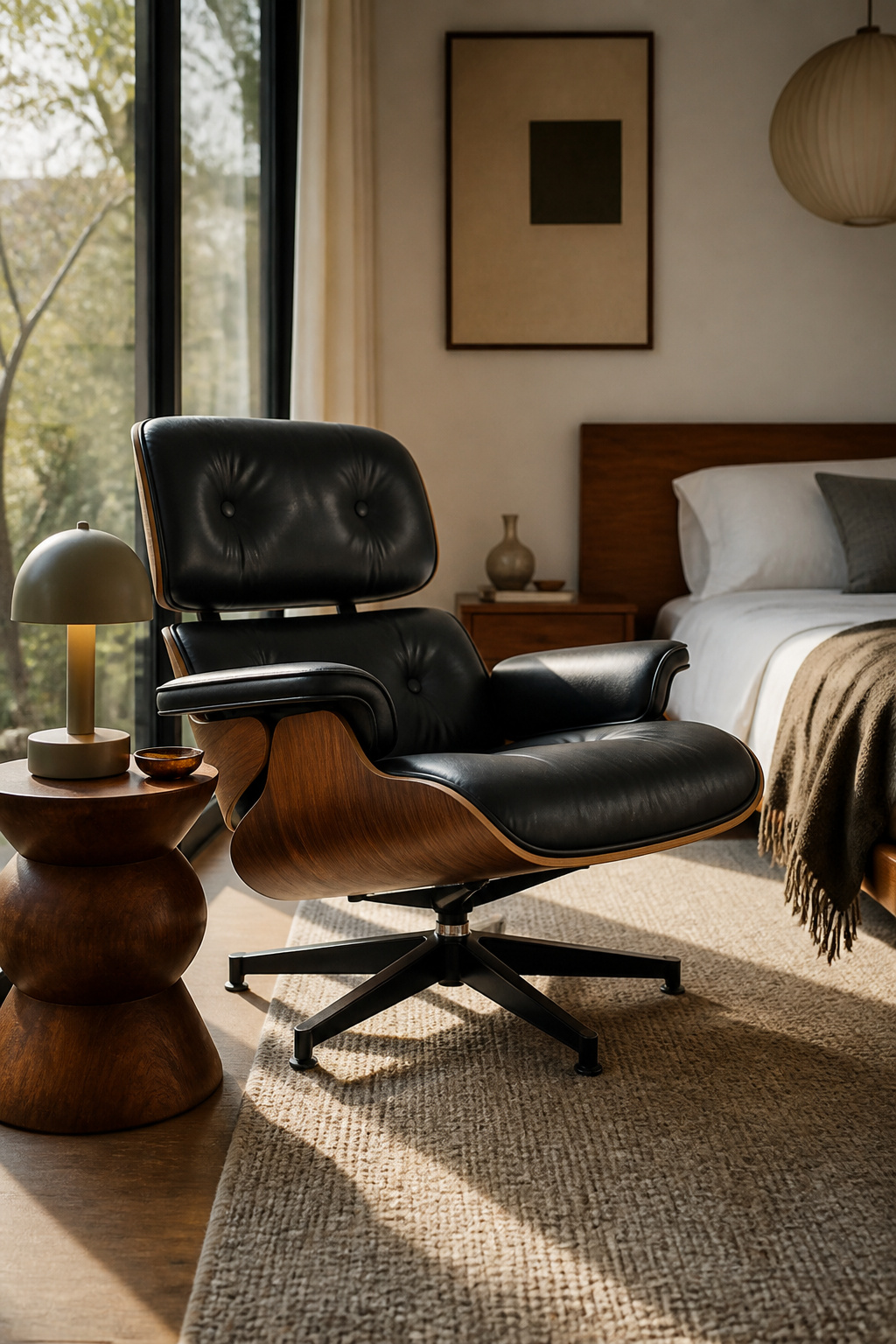
An authentic Eames lounge chair and ottoman will run you somewhere between five and eight thousand dollars, and vintage examples climb even higher. For a bedroom you actually sleep in, that is a hard cost to justify against rent or a first mortgage. What reads from across the room is the silhouette: the low-slung recline, the molded plywood shell, the leather cushion that looks like it has been there since 1956. That shape is what you are paying for, not the Herman Miller stamp on the underside.
If you are hunting reproductions, check that the plywood shells are actually molded and not just bent, and that the cushions attach with shock mounts rather than direct screws. Cheap versions skip the mounts and the leather cracks at the stress points within a year or two. There are also honest mid-century alternatives, like the Plycraft recliner or the Selig Z chair, that hit the same visual note for a fraction of the price and often fit tighter bedroom corners better than the wide Eames footprint.
In a bedroom, this piece works best as a reading nook anchor near a window or at the foot of the bed if your layout leaves at least three feet of walk space around it. It is not a desk chair; the recline fights you on a laptop. It is also not a clothes rack, though that is what it becomes in most bedrooms. Put a small side table within arm reach and a lamp with a warm bulb, and you have the one spot in the room that feels finished without trying.
19. Indoor Plants

The plants that read mid-century modern are the ones with clean, almost architectural silhouettes. A snake plant stands straight without asking for attention. A fiddle leaf fig gives you the height and broad leaves that show up well against teak or walnut. Rubber plants carry that same deep green gloss, and monstera adds the cut-leaf shape that reads vintage without trying too hard.
Planters matter as much as the plants. Ceramic in a matte white or muted earth tone keeps the look period-appropriate. Turned wood stands raise the pot off the floor and echo the tapered legs on mid-century furniture. Simple terracotta works when you want the plant itself to do the talking.
Here is the honest part about light. Snake plants tolerate low light and still grow; they are the forgiving choice for a bedroom with one window. Fiddle leaf figs need bright, indirect light or they drop leaves within weeks. Rubber plants and monstera fall somewhere between, wanting more light than a snake plant but not the exacting conditions of a fiddle leaf. Something will die anyway, usually the one you paid most for, and replacing it with a smaller specimen is cheaper than fighting the room you have.
20. Symmetry in Design

The easiest way to settle a mid-century modern bedroom is to center the bed and match what sits on either side: two nightstands with tapered legs, paired lamps in brass or gold, even twin footstools if you have the floor space. That mirrored setup borrows directly from the era’s architects, who used deliberate symmetry to calm a room.
You do not have to lock into perfect pairs. One nightstand can differ from the other if the asymmetry solves a real problem, like fitting a narrow wall or adding storage you actually use. The same goes for art: a single large piece off-center, or two prints sized differently, keeps the eye moving without breaking the calm that symmetry built. The lamps are where you stay consistent; matching cone or globe shapes in ceramic or metal give you the simplified balance that holds even when other pieces wander.
What Mid-Century Modern Actually Means

Mid-century modern design took shape between roughly 1945 and 1969, when postwar optimism made people believe everyday objects could be better rather than merely fancier. That attitude still reads clearly in the four pillars every serious source returns to: clean lines, functional furniture, natural materials, and minimal ornamentation.
Clean lines mean crisp edges and tapered legs rather than carved scrollwork. A low-profile platform bed anchors a room precisely because it stays close to the floor and keeps its silhouette uncomplicated. Functional furniture insists each piece earns its place; storage, seating, and surface all arrive with a clear job already assigned. Natural materials, wood and leather especially, supply warmth that the spare shapes might otherwise drain away. Minimal ornamentation follows from the other three: the design itself does the work, so extra trim becomes redundant.
The period’s faith in better design over more decoration is what separates mid-century modern from minimalism. A minimalist room might strip away feeling; a mid-century room keeps the warmth by choosing the right walnut credenza rather than the wrong ten accessories. That distinction matters when you start shopping, because sellers will slap the label on anything with angled legs.
How Lighting Builds the Mood

The three-layer rule still holds in a mid-century modern bedroom, but the fixtures themselves do more of the work than in most styles. Start with ambient light around 2700K. That warm temperature is what keeps walnut and teak from reading gray or flat. Cooler bulbs turn those wood tones institutional; warmer ones let the grain do what the era’s furniture was built for.
Sculptural pieces earned their place in this style because they solve both problems at once. A brass pendant or a tripod floor lamp with a frosted glass shade throws the right color light while standing in as the room’s focal point. Globe sconces beside the bed free up nightstand space and give the layered look without clutter. Some designers skip overhead lighting entirely and run two bedside lamps on dimmers; the shadows become part of the geometry.
Brushed metal, copper-toned brass, and chrome all fit the period. Chrome is having a particular moment right now, though brass has the longer track record for warmth. Pick one metal and repeat it: mixed finishes read as accidental unless the fixture itself was designed to combine them.
Mixing Mid-Century with What You Own

You do not need to replace every piece you own to get a mid-century modern bedroom. The trick is knowing which styles already speak the same language.
Bohemian layers are the easiest place to start. A rust throw blanket over your existing bed, a macramé wall hanging, and a few potted plants with emerald tones will pull toward mid-century warmth without a single new frame. The casual bedding arrangement keeps it from looking staged.
Contemporary clean lines are even simpler. If your current furniture is already low and uncluttered, add one wood accent in teak or walnut and a geometric lamp. The shapes match; you are just warming up the palette.
Traditional warmth takes more care, but it works. A moody floral painting, softer than typical mid-century graphics, keeps the room from feeling like a period set. Wood, metal, and leather are the bridge materials here. Mix in wool or cotton bedding and the two styles settle together.
For renters, this approach saves money and keeps your security deposit intact. Peel-and-stick wallpaper in a retro pattern, a retro lamp you can carry to the next apartment, and bold bedding do the heavy lifting without permanent changes.
What Not to Buy at Any Price
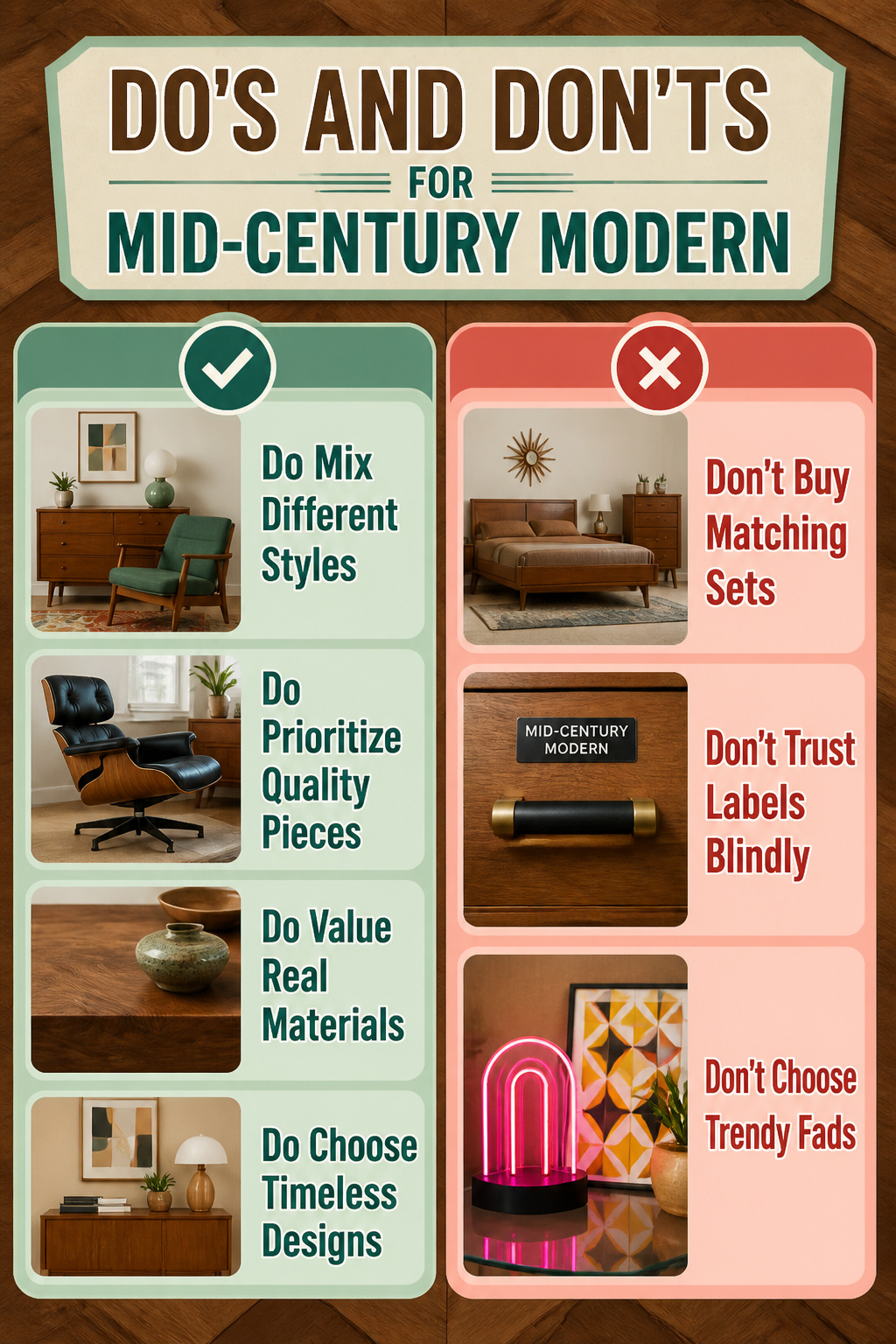
The fastest way to kill a mid-century modern bedroom is to buy the matching set. Dresser, nightstands, bed frame, all from the same collection with the same tapered legs and the same drawer pulls. It reads as furniture-store floor, not a room someone actually lives in. The era you are drawing from mixed manufacturers, woods, and lines; your space should too.
"Mid-century modern" printed on a tag means almost nothing now. The label gets slapped onto pieces with no relation to the design values of the period: no concern for proportion, no honest use of material, just a vague retro shape and a markup. A dresser with chunky plastic hardware and a wood-grain foil veneer will not improve with age. It will not survive a move without chipping, and it will not look better in three years than it does the day you assemble it.
Trend pieces built for the moment are the same risk in a different wrapper. A neon acrylic lamp or a geometric print so loud it drowns the room might photograph well, but you will tire of it before you have paid off the credit card. Spend your weekend budget on one solid piece you can carry to the next apartment instead.
Frequently Asked Questions
What colors work best in a mid-century modern bedroom?
Start with a quiet base of white, beige, gray, or taupe, then add one bold accent color such as mustard yellow, olive green, burnt orange, or muted red. The rule is to keep the accent simple enough to name in one word. One or two accent pieces are plenty; more than that and the calm base starts to look accidental.
How to choose lighting for a mid-century modern bedroom?
Pick one period-appropriate silhouette such as a globe pendant, sputnik fixture, or saucer shape, then add one or two sculptural table or floor lamps that read as small art pieces. Mix metals and materials rather than buying matching sets; a brass arc lamp paired with a ceramic table base feels collected, not staged. A plug-in swag kit lets renters hang a hardwired pendant without an electrician.
What is the best way to incorporate vintage pieces into a mid-century modern bedroom?
Anchor the room with one genuine piece such as a nightstand, dresser, or table lamp, then pair it with new items so the mix reads intentional. Estate sales let you test drawers and joints before you pay; online, ask for underside photos and mechanism videos. If a piece needs more than a weekend of repair, pass and wait for one that does not.