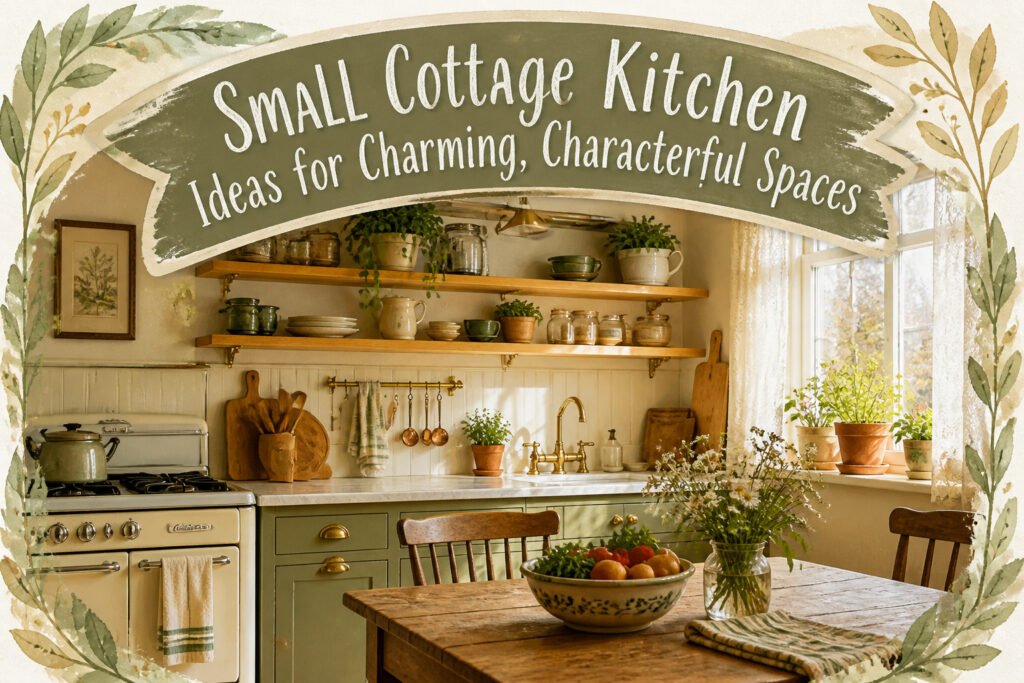
A small cottage kitchen can cost a few hundred dollars or push past a thousand, and the deciding factor is how much of the labor you do yourself. The catch is that reclaimed barn wood, the material most associated with the look, often eats those savings in hidden fasteners and warped boards that throw off a whole run of shelving. What actually keeps the budget intact is knowing where to spend on brass hardware and where to save with pine open shelves you cut to length in an afternoon.
1. Characterful Reclaimed Materials
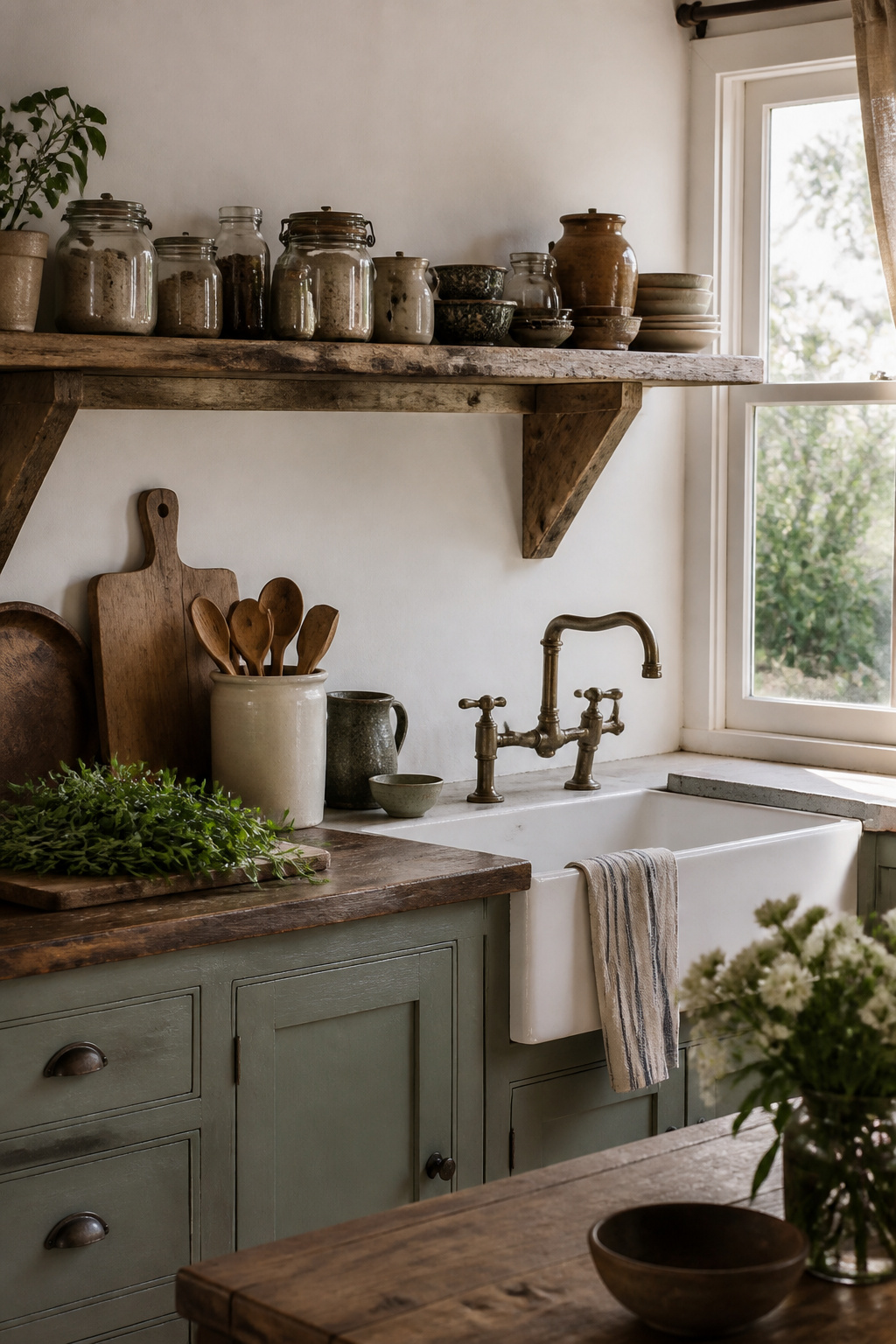
You pull a board from a salvage pile and see two centuries of grain, a few nail holes, a dark streak where water ran for years. That is the moment that justifies the extra work.
Reclaimed barn wood runs 30–50 percent less per board foot than new white oak, but the savings disappear fast if you do not budget time for sorting. Every board needs to be checked for hidden fasteners, run through a metal detector, and flattened. Warped pieces are common; one bowed beam can throw off a whole run of open shelving. The labor is the real cost.
Old doors work well as standing pantry panels or as the face of a range hood cover. Salvaged beams for ceiling work need to be sized before you fall in love with them: a beam that looks modest in a barn loft can drop a small cottage kitchen headroom below code. Ask the yard to surface one face so you can see what you are buying. If they will not, walk. What reads as character from ten feet away can read as rot up close, and you cannot return a truckload of pine because the smell of old manure never left it.
2. Glass-Front Cabinets
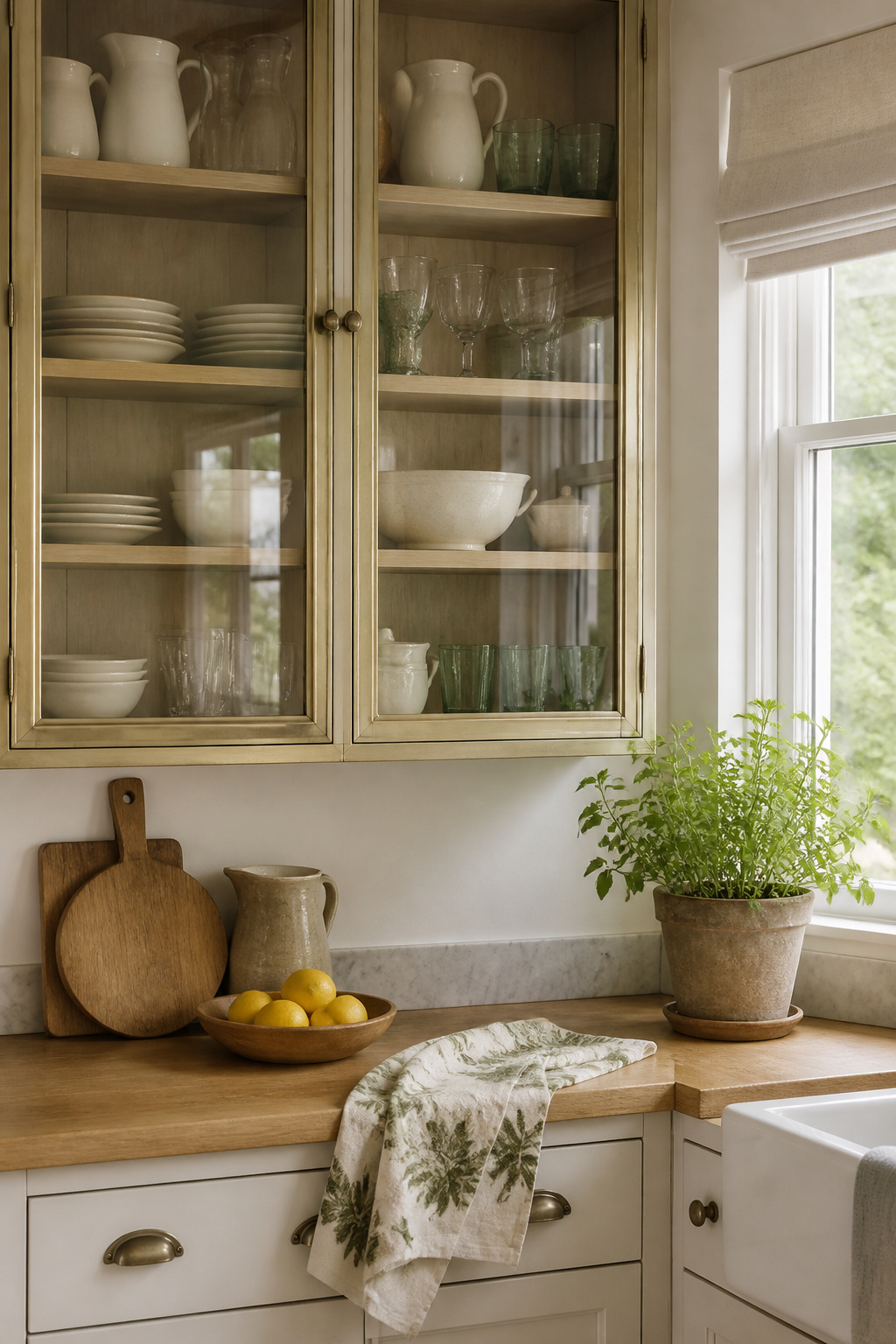
Glass-front cabinets earn their spot in a small cottage kitchen only when you actually want to look at what’s inside them. They open the room visually, which matters in tight quarters, but that openness comes with a dust burden solid doors never ask you to carry. You will wipe the interior glass more often than you expect, especially near the stove or sink where grease and moisture travel.
If your dishes match, the styling is simple: stack plates by size, set bowls in single rows, keep the color story tight. A mismatched collection needs more intention. Group by material, not by set; all white ceramics together, all clear glass together, so the eye reads unity even when the shapes vary. A few pieces can hide behind solid doors below while the best-looking dozen live in glass up top.
The dust question is real. In a kitchen you cook in daily, glass fronts need attention every few weeks to stay presentable. Whether that trade is worth it depends on how much visual breathing room you need. In a galley kitchen with one window, the lightness usually wins. In a square kitchen already bright, solid doors spare you the upkeep.
3. Pot Fillers
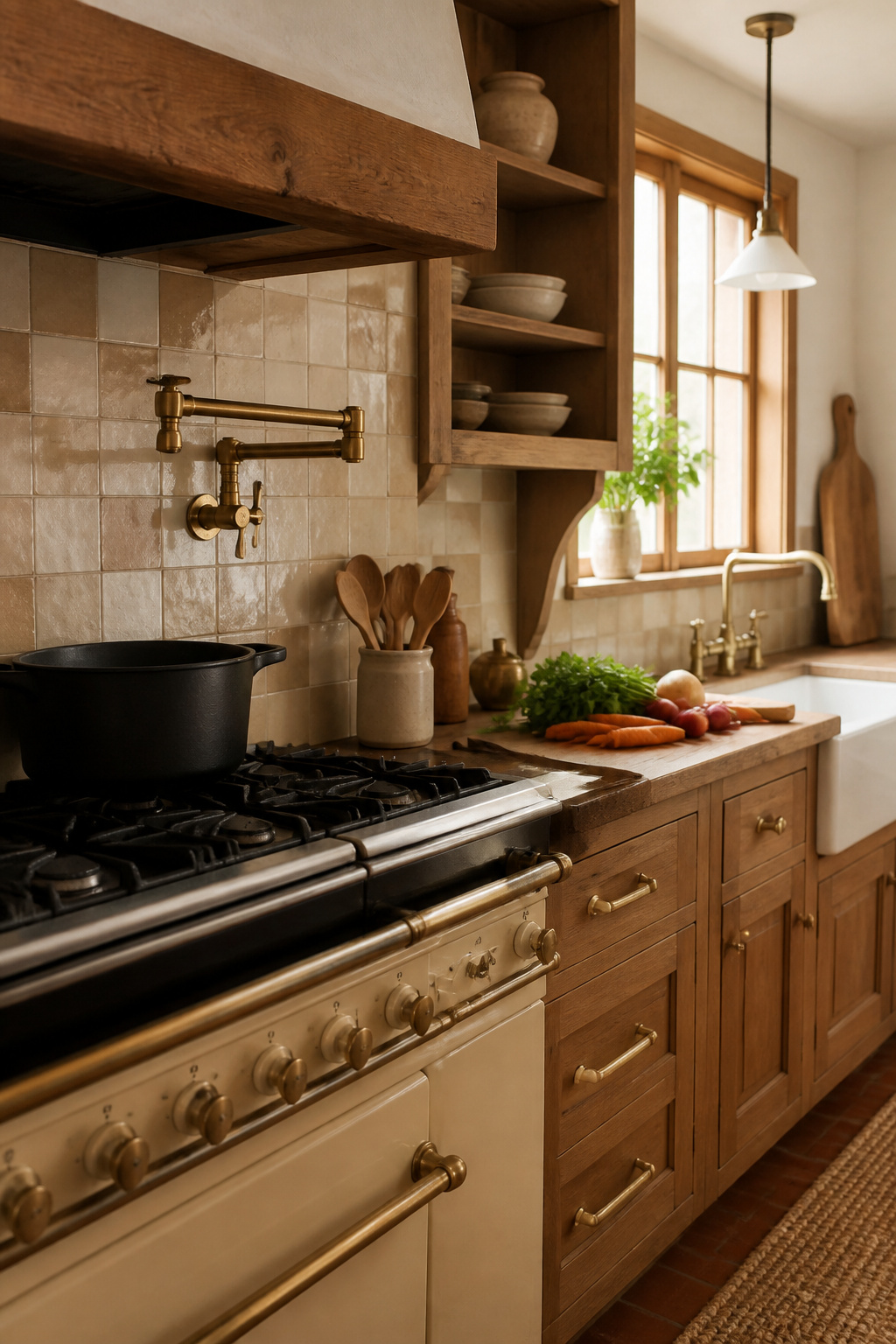
A pot filler above the range looks charming in cottage photos, and the convenience is real when you are filling a heavy stockpot that would strain your wrists at the sink. You turn the tap and water flows directly into the pot while it sits on the burner. But you still have to carry that full pot to the sink to drain pasta or rinse beans, so the labor savings are partial at best. If your wall already has plumbing stubbed behind the range, installation is straightforward for a plumber. If not, opening the wall to run supply lines adds cost and disruption that rarely fits a weekend budget. A swing-arm faucet at a deep side sink gives you most of the same reach without the extra pipework, and you drain the pot right where you filled it.
4. Open Shelving in Place of Uppers
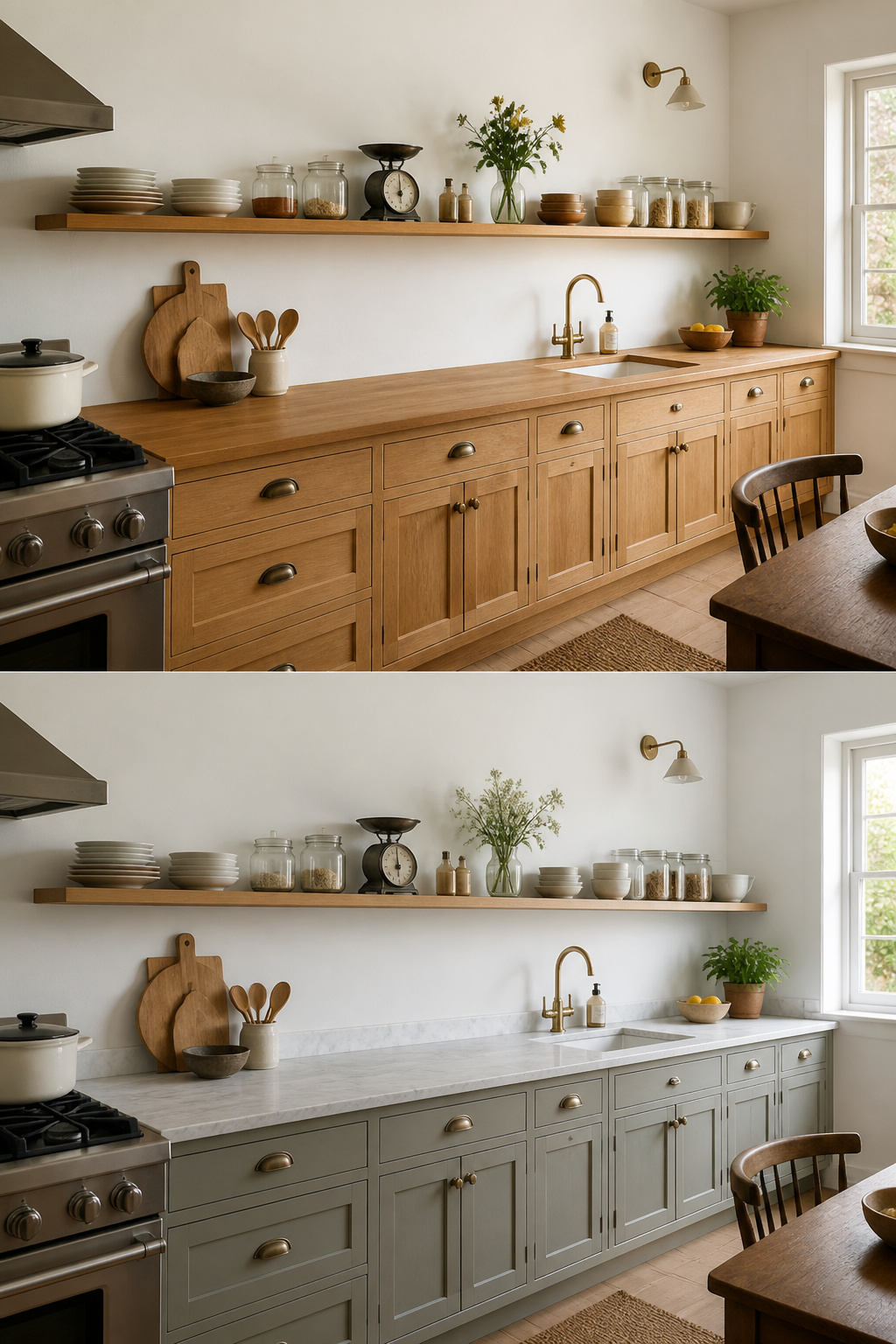
Removing upper cabinets entirely earns back about a foot of visual depth your small cottage kitchen never had to spare. In their place, a single open shelf running the wall gives you storage without chopping the room into smaller sections. The plates land there, the everyday glasses, maybe a row of jars; everything else drops to base cabinets below, so the storage math only works if you commit to enough lowers and accept that some items will live farther from the sink than before.
The ceiling reads higher the moment the wall clears, and in cottages where ceilings already run low, that matters more than the cubic feet you lose. But the dust lands weekly, and grease from a sauté pan travels farther than you expect. You will wipe these shelves more often than you wiped cabinet fronts.
What breaks this look is weight without support. A bracket every sixteen inches handles everyday dishes; span much farther and the shelf bows under a stack of plates, or worse, pulls from the wall. The other failure is visual noise. An open pantry only reads as intentional when the jars match or the color stays tight; otherwise it looks like storage you forgot to hide. One shelf, one strong gesture, and the room holds together.
5. Shaker-Style Cabinets
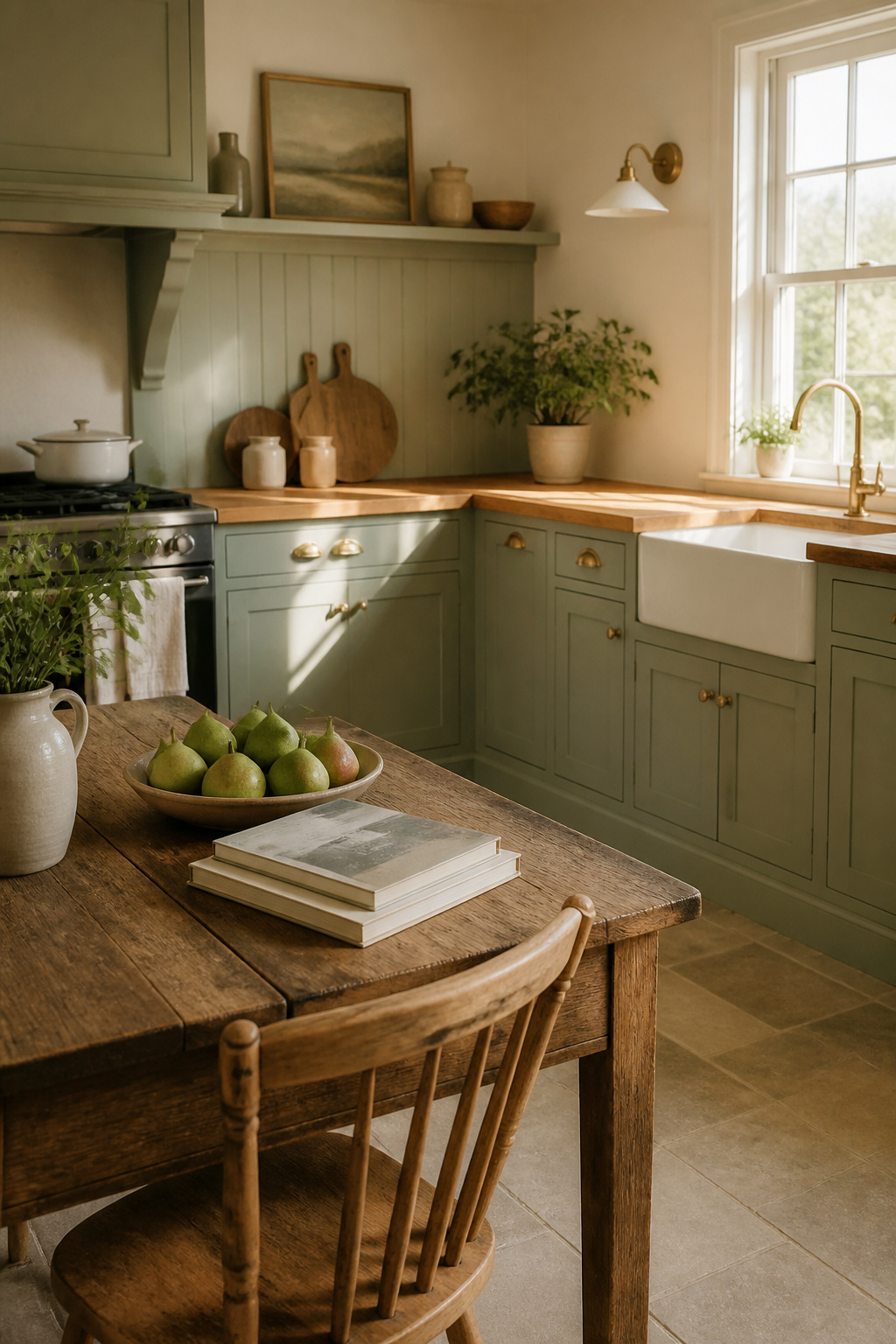
The flat center panel on a Shaker door reads simpler than a raised panel, which keeps a small cottage kitchen from feeling busy where every inch is already working hard. The frame around that panel adds just enough detail to feel considered, but it stops short of ornament that would clutter the room. That restraint is why the style has held on in cottages for two centuries without looking dated.
You can paint Shaker cabinets or stain them, and either finish looks correct. Muted colors like light sage tend to read as cottage, though a simple white works if you are designing around a statement appliance. Gold vintage-style drawer pulls dress them up without fighting the plain door.
The overlay type is where a budget order goes wrong. A full-overlay door covers most of the frame and reads more modern; a standard overlay leaves more frame visible, which suits the cottage look better. Stock Shaker cabinets at big-box stores usually run standard overlay, but you have to specify it, not assume.
For price points, ready-to-assemble Shaker lines from those same stores land well under custom work, and the simple construction means you are not paying for applied molding you did not want.
6. Painted Cabinets Matching Walls
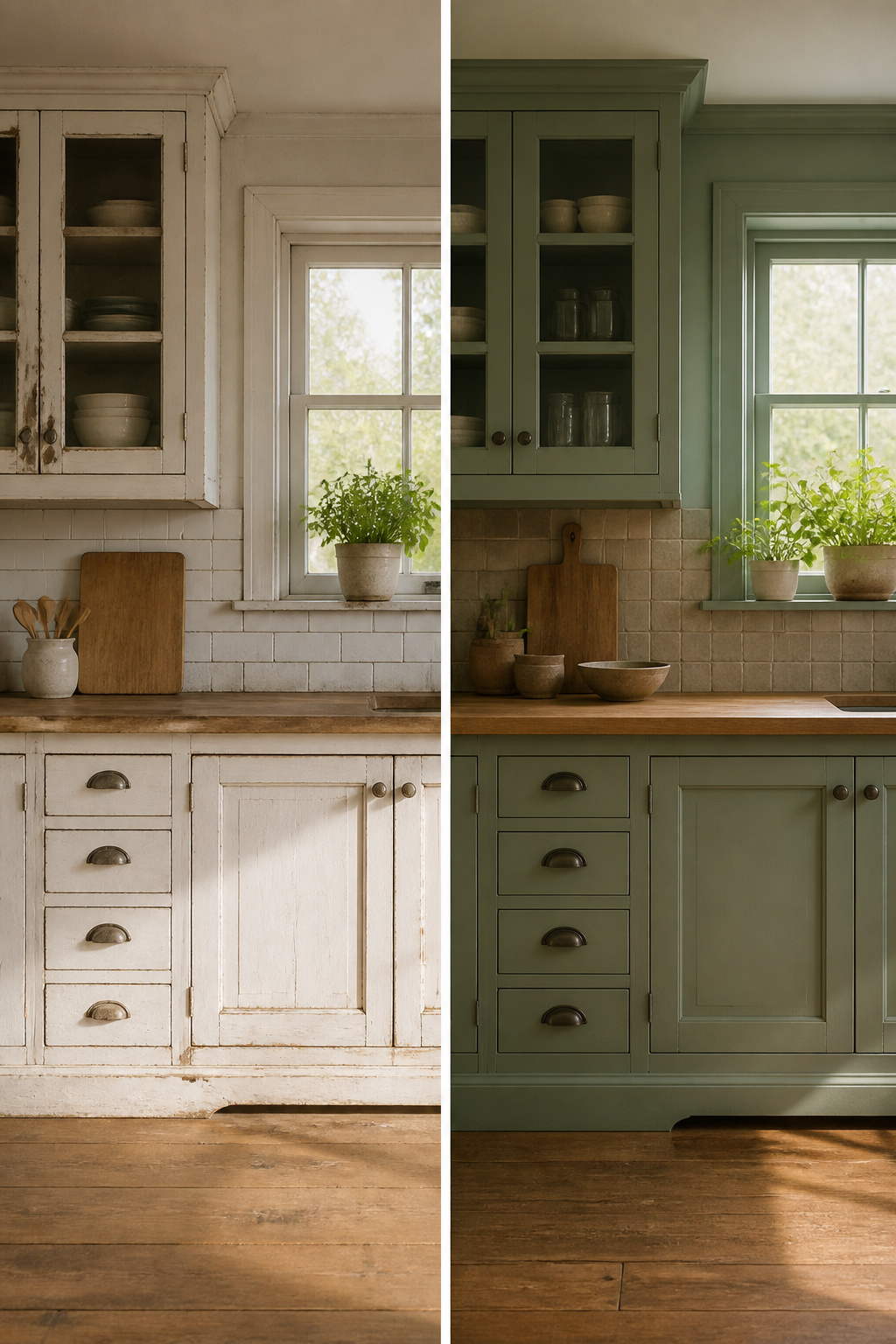
Painting cabinets to match your walls works best when the kitchen is small and enclosed, with no strong architectural features fighting for attention. In that situation, a single color across cabinets, trim, and walls dissolves the edges and lets the eye travel without stopping at every corner. Sam at Sustainable Kitchens used this to hide extra storage for a family of six in a tight cottage kitchen, painting wall cabinets in Chappell Green by Farrow & Ball so the cabinetry melted into the walls. The same green on doors, trim, and baseboards kept the ceiling height working for the room instead of breaking it up.
Castle Gray by Farrow & Ball and Stonington Gray by Benjamin Moore behave the same way: quiet colors that let natural wood and stone take the lead. Stonington Gray showed up in a Bronxville cottage with a wood island and exposed beams; the gray perimeter cabinets stayed calm enough that the beams could be the feature.
Where this falls flat is in kitchens with strong natural architecture. Exposed ceiling beams, original stone surrounds, or a prominent fireplace need contrast to read as intentional. Paint the cabinets to match the walls in a room like that and the whole space flattens into one note. You lose the cottage character you were trying to keep.
7. Moveable Kitchen Islands
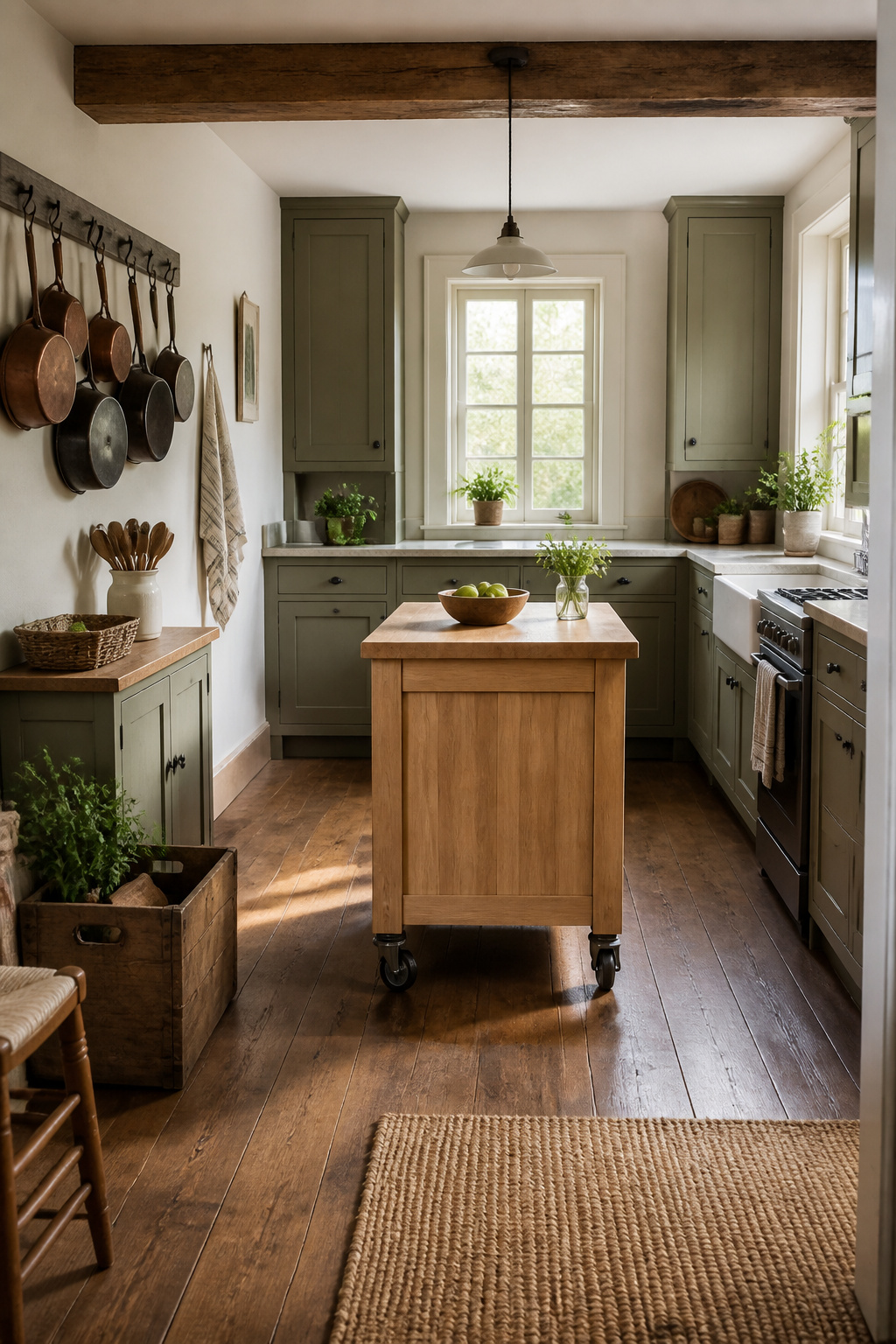
A moveable island buys you prep space you can roll away when you need the floor for something else. In a small cottage kitchen, that flexibility matters more than built-in bulk. Keep the footprint between 24 and 36 inches wide, and leave clearance on all sides so you can actually walk around it when it is parked in place.
Butcher block works especially well for the top. The chevron butcher block from Lowe’s adds pattern without looking fussy, and the surface holds up to real cutting if you are not precious about it. A vintage metal trolley on casters or an old wooden table does the same job with more patina. Roll it out for a dinner prep marathon, shove it against the wall when you need to lay down a drop cloth or let two people pass.
8. Wall Hooks for Tools and Pots
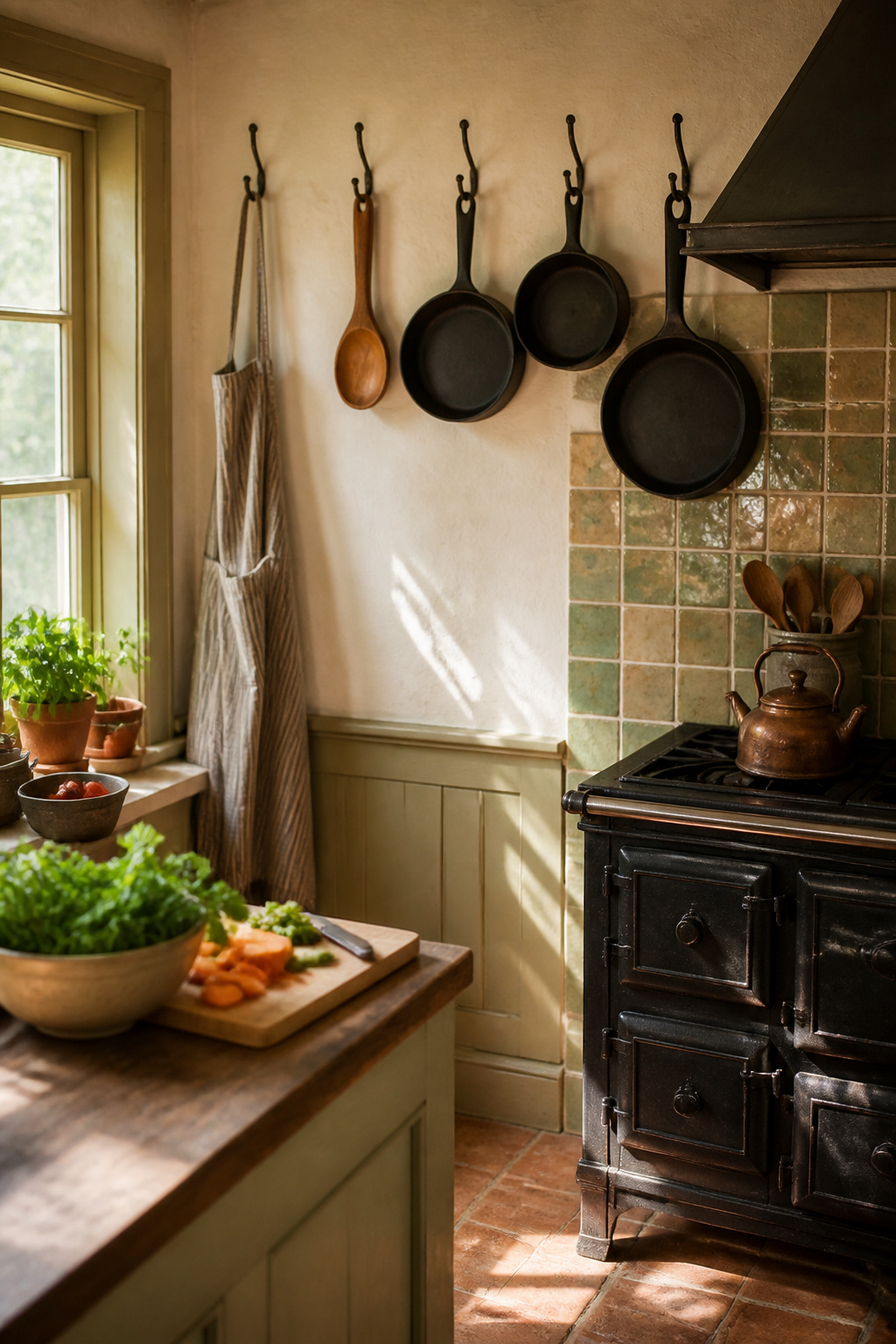
Wall hooks buy back the drawer and cabinet space a small cottage kitchen never had to begin with. A skillet on a hook clears an entire shelf; three hooks by the stove can hold your apron, a mesh basket of garlic, and the sauce pan you reach for twice a day. The trick is keeping them where they help rather than where they become obstacles. Mount hooks beside the stove or on the return wall of a narrow galley, never on the wall facing the stove where a swinging handle blocks your path. Hooks also fail with weight. A Dutch oven will pull most hardware out of plaster sooner or later, and anything with a rounded handle that can slide ends up on the floor. Stick to cast-iron skillets with helper handles, sheet pans if the hook is deep enough, and textiles. One mistake worth avoiding: drilling into tile without a masonry bit. Standard bits skate, crack the glaze, and leave you with a hole that will not hold anything. A ceramic or diamond bit costs a few dollars and keeps the wall intact.
9. Warm Neutral Color Palettes

Cream, putty, warm gray, sage, and pale ochre read as warm neutrals in a cottage kitchen because they carry undertones of yellow, green, or brown rather than blue. Cool whites can feel sterile against aged wood floors and vintage hardware, and in a small kitchen with limited windows, they bounce light harshly rather than absorbing it. Warm tones soften that bounce, so the room feels lit from within even on gray afternoons.
The risk is tipping from cozy into dim. A kitchen with one small window and low ceilings can go muddy fast if every surface reads warm. The balance is keeping at least one element crisp: white Carrara countertops, a pale backsplash, or tall wall cabinets in a cleaner shade. That contrast lets the warm walls or cabinetry do the welcoming without closing the walls in. If the room faces north or opens onto a narrow yard, lean lighter on the warm spectrum, toward cream or warm white rather than ochre or sage, and save the deeper tones for a single run of base cabinets or a pantry door.
10. Vintage Finds with Patina
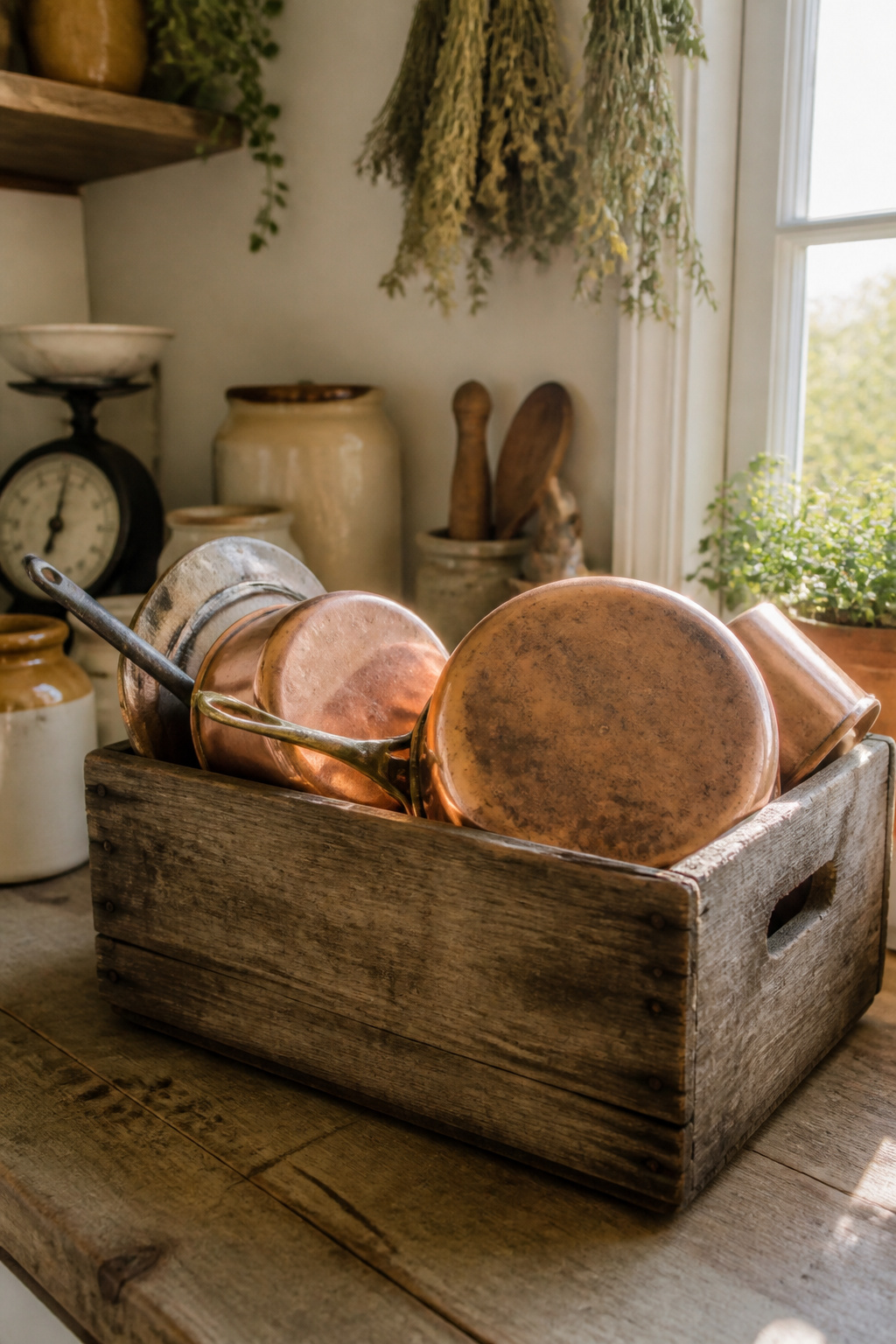
Reproduction enamel has a coating too perfect to fool anyone up close. Hunt instead for the real thing at estate sales, auctions, or your own family’s attic, where chipped rims and faded rims are the point. A crack in the enamel is fine; rust bleeding through from underneath is not. That rust means the metal core has failed, and no amount of scrubbing saves it.
Copper pots, wooden crates, and ceramic crocks all follow the same test. Hold them up to the light you actually cook under. A Vermont barn kitchen centers on a vintage pine wine-tasting table surrounded by Pennsylvania Windsor chairs, and the pieces earn their keep because they are used, not staged. In a 900-square-foot Cotswolds cottage, silver cutlery lives in vintage ceramic jam jars on the worktop because drawers were skipped entirely.
One common misread: the piece that looks right but functions wrong. A creamware set sourced abroad reads beautifully on open shelving until you try to stack it. The shapes do not nest, and the shelves fill twice as fast as planned. Judge condition by how the object lives in your space, not by how it photographs.
11. Kitchen Table as Social Anchor
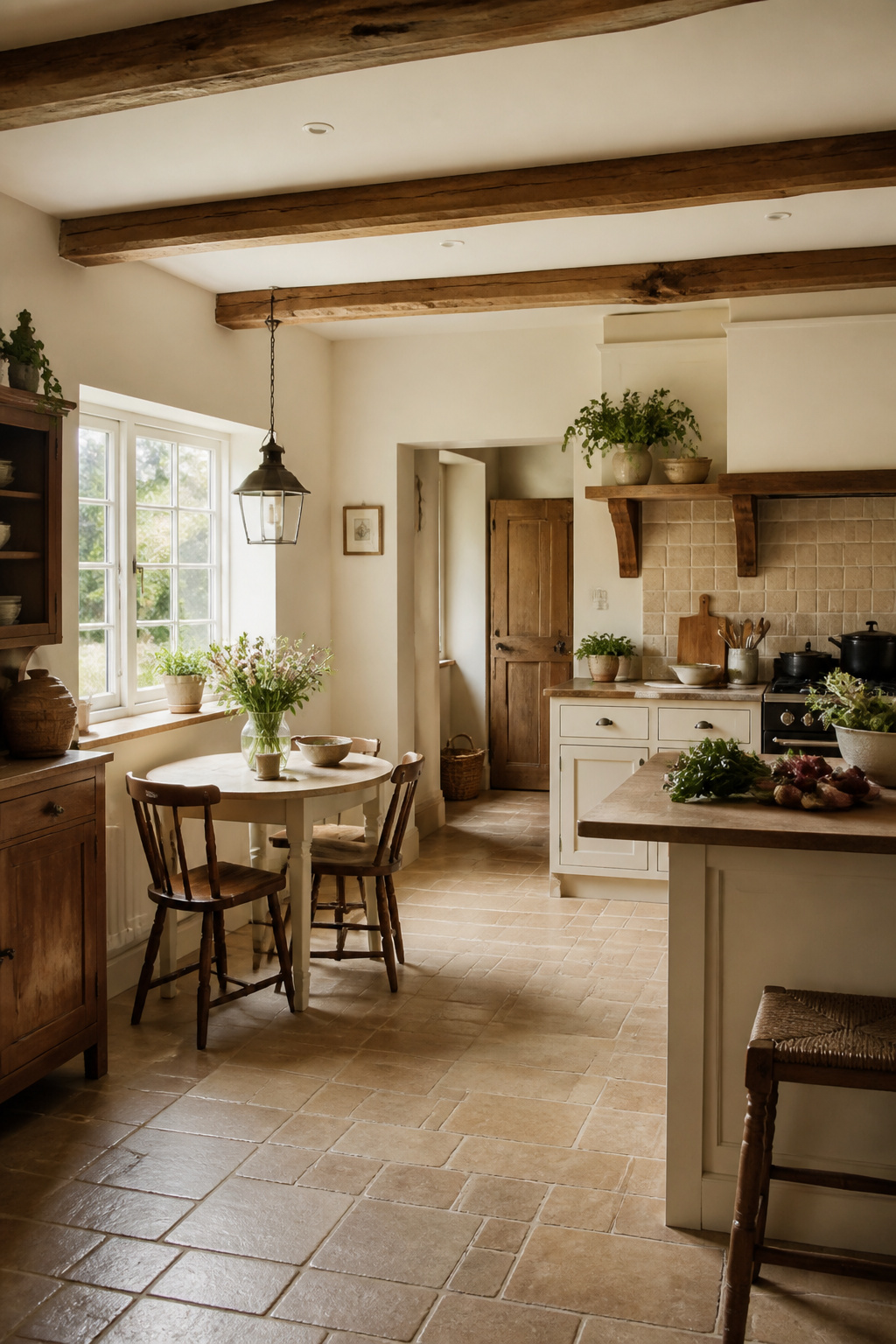
In a cottage kitchen, the table belongs in the room where the cooking happens, not tucked away behind a wall. One builder of a four-sleep cottage planned for a vintage table until the cabinets went in and erased that option entirely. The replacement was a Murphy table from Etsy, wall-mounted and folding flat like its bed cousin, which left floor space free for the work that happens between meals.
That trade raises a sizing question worth answering directly. A table 24 inches square handles two people for breakfast without crowding. Push to 30 inches and you seat four for dinner, though serving dishes will need counter space nearby. Anything under 36 inches across works only if guests are occasional and the menu is plate-in-hand simple.
Where even a Murphy table will not fit, a petite bistro table tucked against a wall or into a window recess gives you the same informal gathering point. It is not a dining room, and it is not the sofa with toast. It is the middle ground that makes a small kitchen feel like the center of the house rather than a passage through it.
12. Mixed Wood Finishes
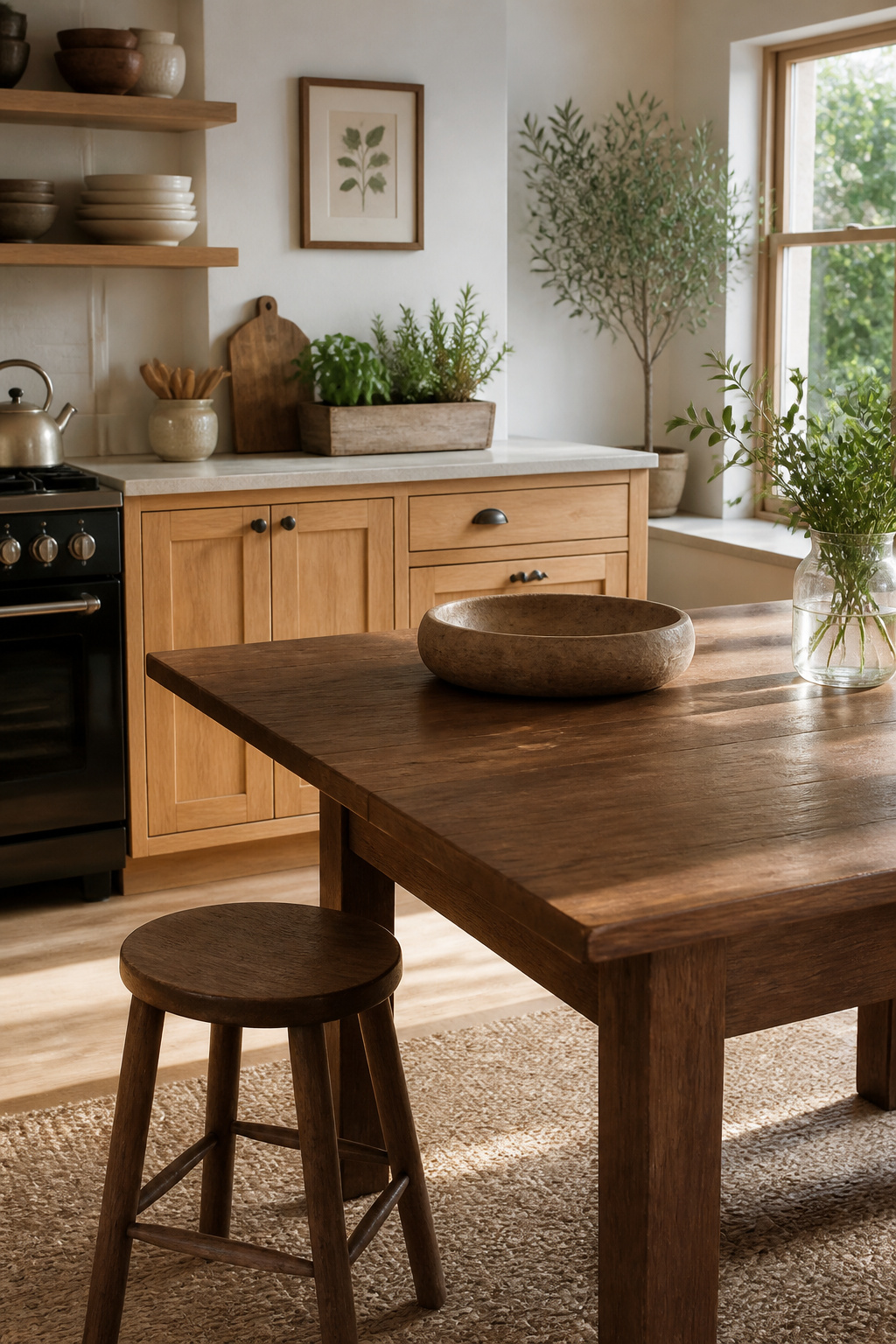
Mixed wood finishes work in a small cottage kitchen only when you decide which tone leads and which ones support it. Pick one dominant wood, usually the largest surface you are not painting, like the floor or the main cabinet run. Let everything else sit a step lighter or darker, never competing at the same visual weight.
The rule of three still applies: no more than three wood tones in any single sightline, with one clearly in charge. A pine shelf against oak cabinets and a walnut stool passes that test if the cabinets take up sixty percent of what your eye lands on. Add a fourth tone, even a small one, and the kitchen starts to look like you collected furniture from yard sales without a plan.
The fear that everything must match usually comes from showroom conditioning. In a real cottage kitchen, perfect matching reads flat and can feel institutional. The opposite risk is overcorrecting into chaos. Two mismatched wood tones look intentional; five look like you ran out of time. If you are unsure, paint one element, a base cabinet or the island, and let the wood tones breathe against it. Painted wood counts as a tone, but it quiets down faster than bare grain, which is why it helps in tight spaces where every surface is close enough to touch.
13. Vertical Storage Above Windows and Doors
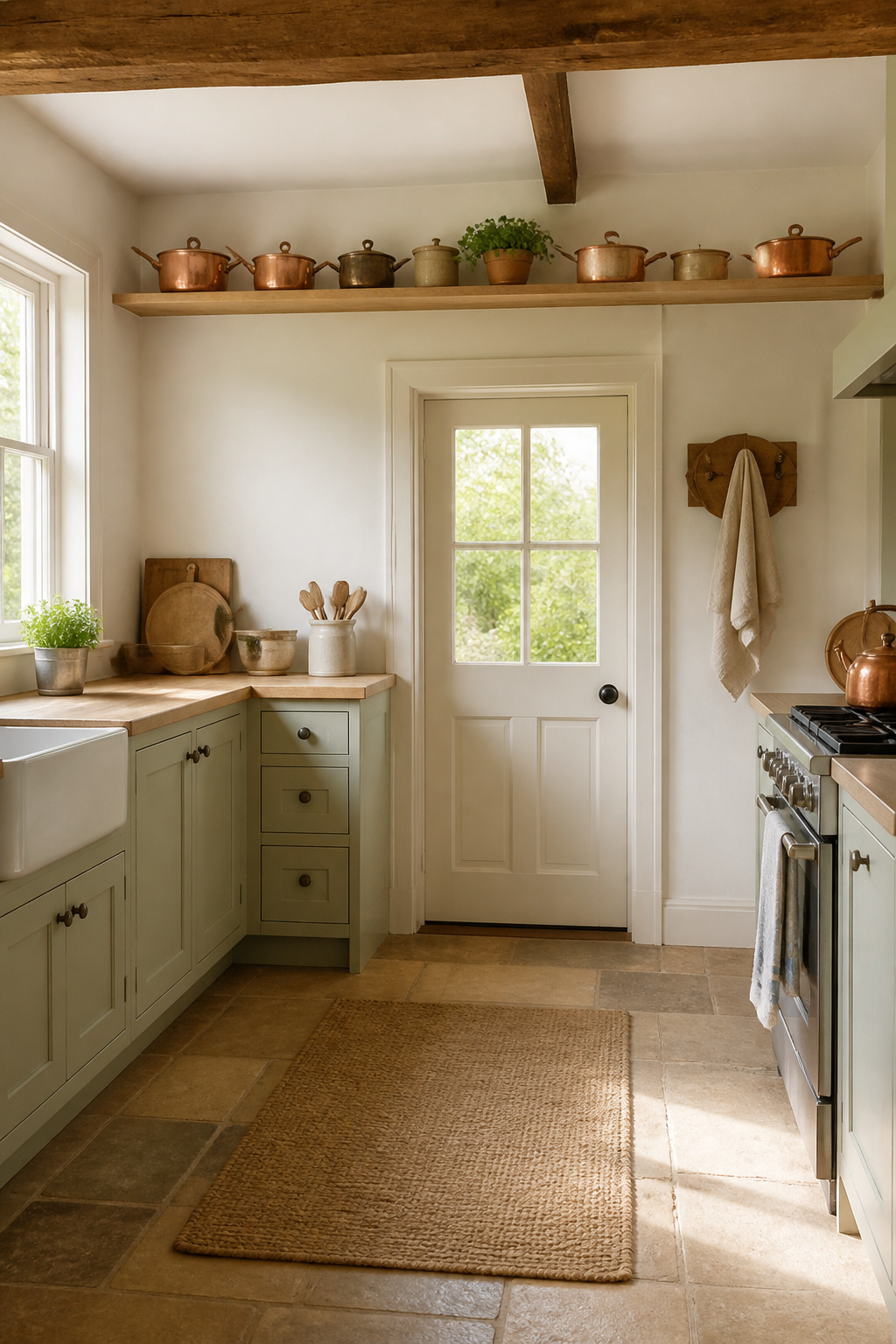
In a small cottage kitchen, the strip of wall between the top of a window or door and the ceiling is often the last place anyone thinks to look for storage, which is exactly why it works. A shelf mounted in that gap can hold pans you reach for daily without cluttering the counter below, or it can carry the decorative pieces that give a cottage kitchen its warmth without getting in the way of actual cooking.
The trick is keeping the depth shallow enough that you do not bonk your head on it when you stand at the sink or reach across the counter. Four to six inches is the usual workable range overhead, less than the standard twelve-inch kitchen shelf, because you are not storing dinner plates up there. Seasonal items, extra dishes pulled out twice a year, a bread machine you bought during one January and now use every November, these are the things that belong in that zone.
Reaching them safely means planning for it before you load the shelf. A folding step stool stored inside a cabinet toe-kick or hung on the back of a pantry door turns that high storage from theoretical to usable. Without the stool, you will either never use the shelf or you will climb on a chair one hurried morning and wish you had not.
What convinced me, reading through the designs that make this look effortless, is how often the vertical answer is already built into the architecture. You do not need to reframe the room; you need to see the six inches above the doorframe as real estate.
"No matter how small your kitchen is, there is always a way to utilise the benefits of a purpose-built pantry — you simply need to think vertically… By creating a narrow floor-to-ceiling larder and then adding generously spaced vertical shelves, you can maximise the storage space… without taking too much of your kitchen space either."
For the reader with a weekend and a few hundred dollars, this means a single board cut to length, three brackets, and a drill. The pantry the quote describes is the same principle compressed: use the height you already have, keep the footprint narrow, and leave the floor clear.
14. Pulley Dryers and Hanging Racks
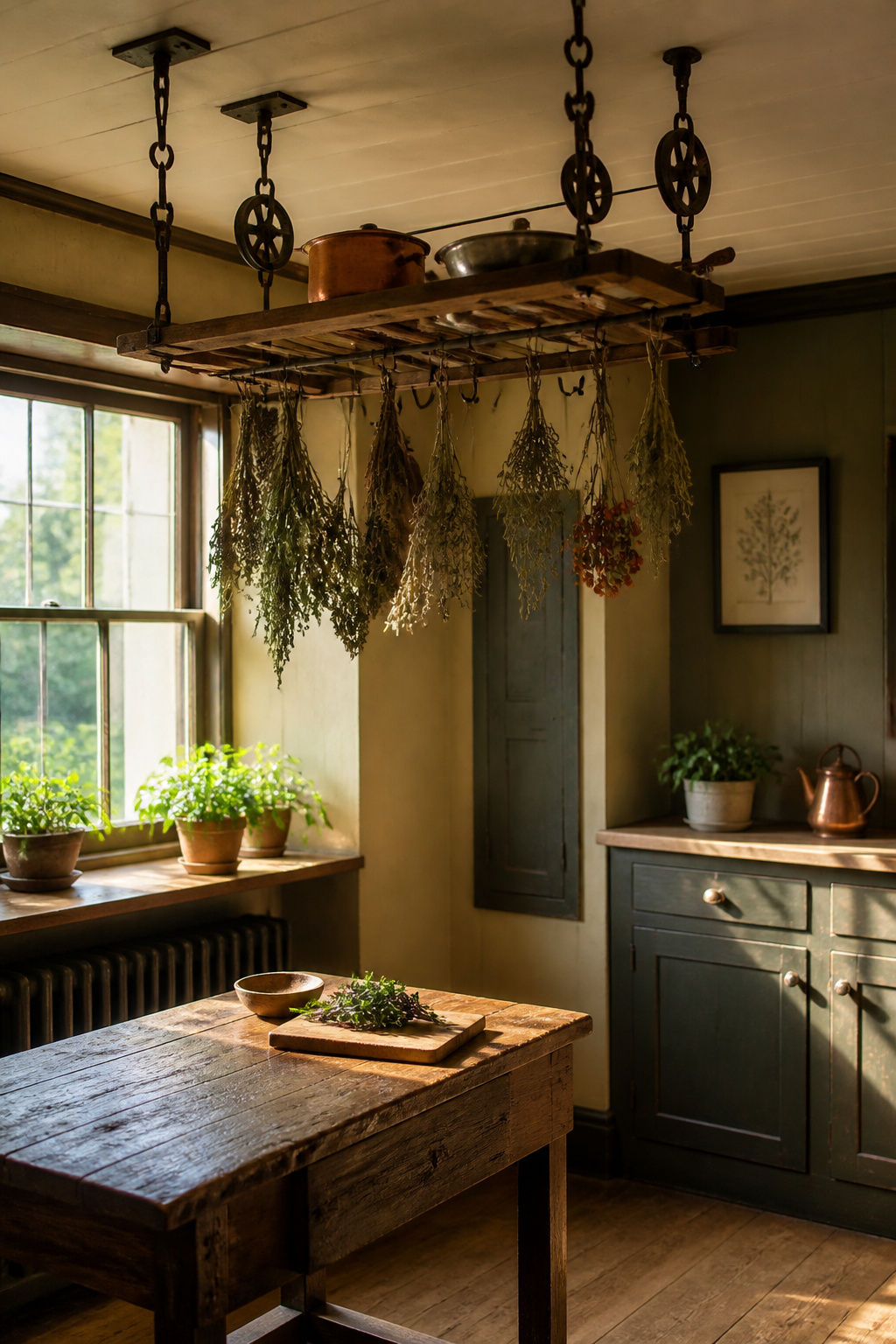
A ceiling-mounted pulley dryer, sometimes called a pulley maid, gives a small cottage kitchen its atmosphere while keeping the footprint clear. You raise and lower the rack on ropes to hang laundry, herbs, or pots, then hoist it back up toward the ceiling where it stays out of your way. The vintage hardware can be hard to source now, so a modern pulley clothes airer with the same rope-and-rack mechanics will get you the same look and function.
You need at least eight feet of ceiling height for the rack to hang at a useful level and still retract above head height, and you must anchor the pulleys directly into ceiling joists, not drywall, because a loaded rack carries real weight. Add S-hooks to the slats and the dryer doubles as storage for utensils, dried flowers, or copper pans you want displayed.
15. Mantel Shelves for Display
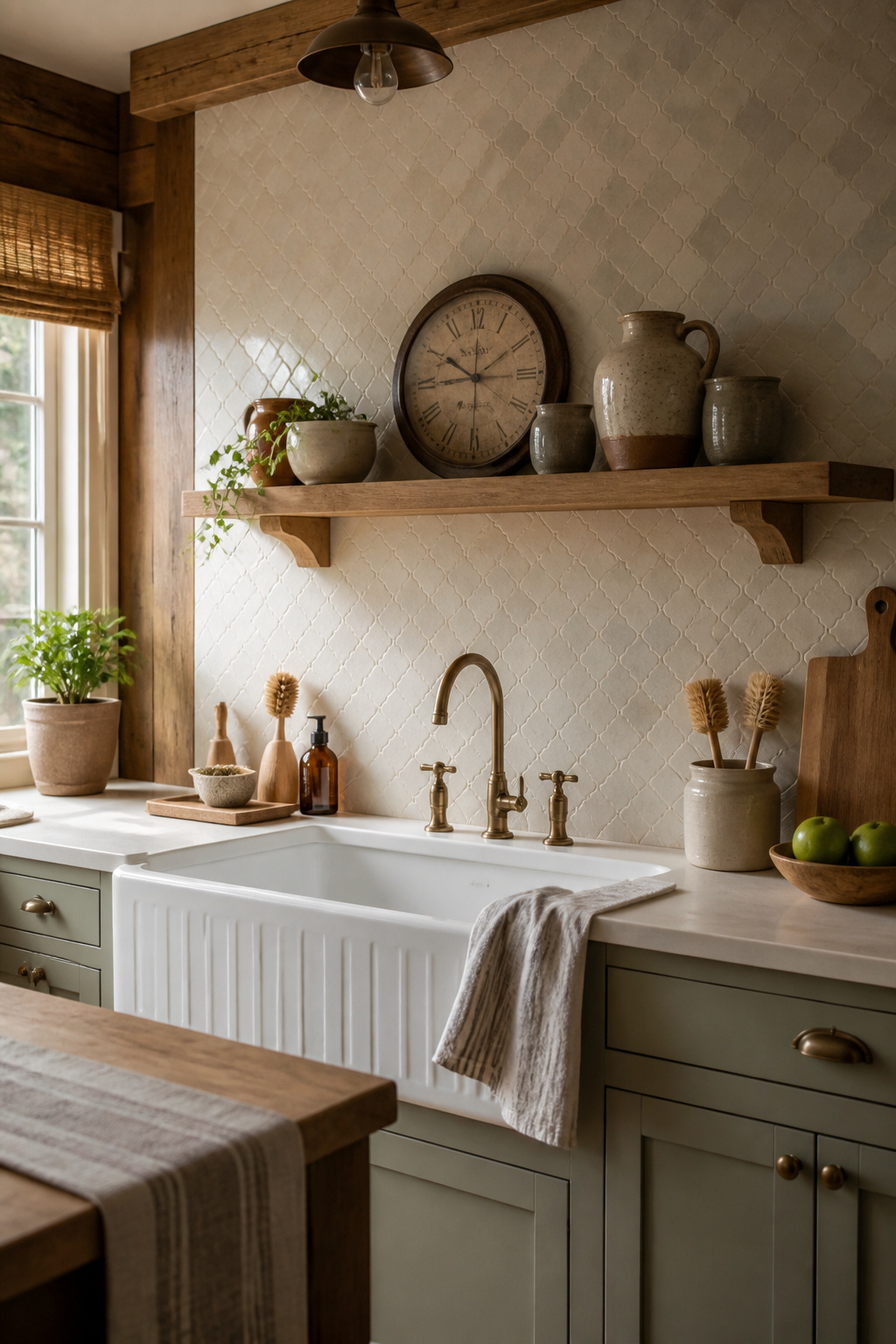
A shallow mantel shelf above the stove or sink gives a small cottage kitchen its focal point without the cost of a full surround. The trick is the depth: deep enough for a small clock or a plate rail display, shallow enough that you stop short of hitting your head when you lean over the cooktop. Four to six inches front to back is the usual workable range, with corbels or simple L-brackets carrying the weight.
What you put up there matters more than in the living room. A clock with a sealed face, a pottery jug, or a wooden sign survives the environment fine. Framed art, dried flowers, or anything porous collects grease and steam damage faster than you’d think. If the shelf sits above the sink rather than the range, you get more leeway, but splatter still travels. Group a few pieces with breathing room between them; a crowded mantel looks inherited, not arranged, and it complicates cleaning.
Budget Realities for Weekend Projects
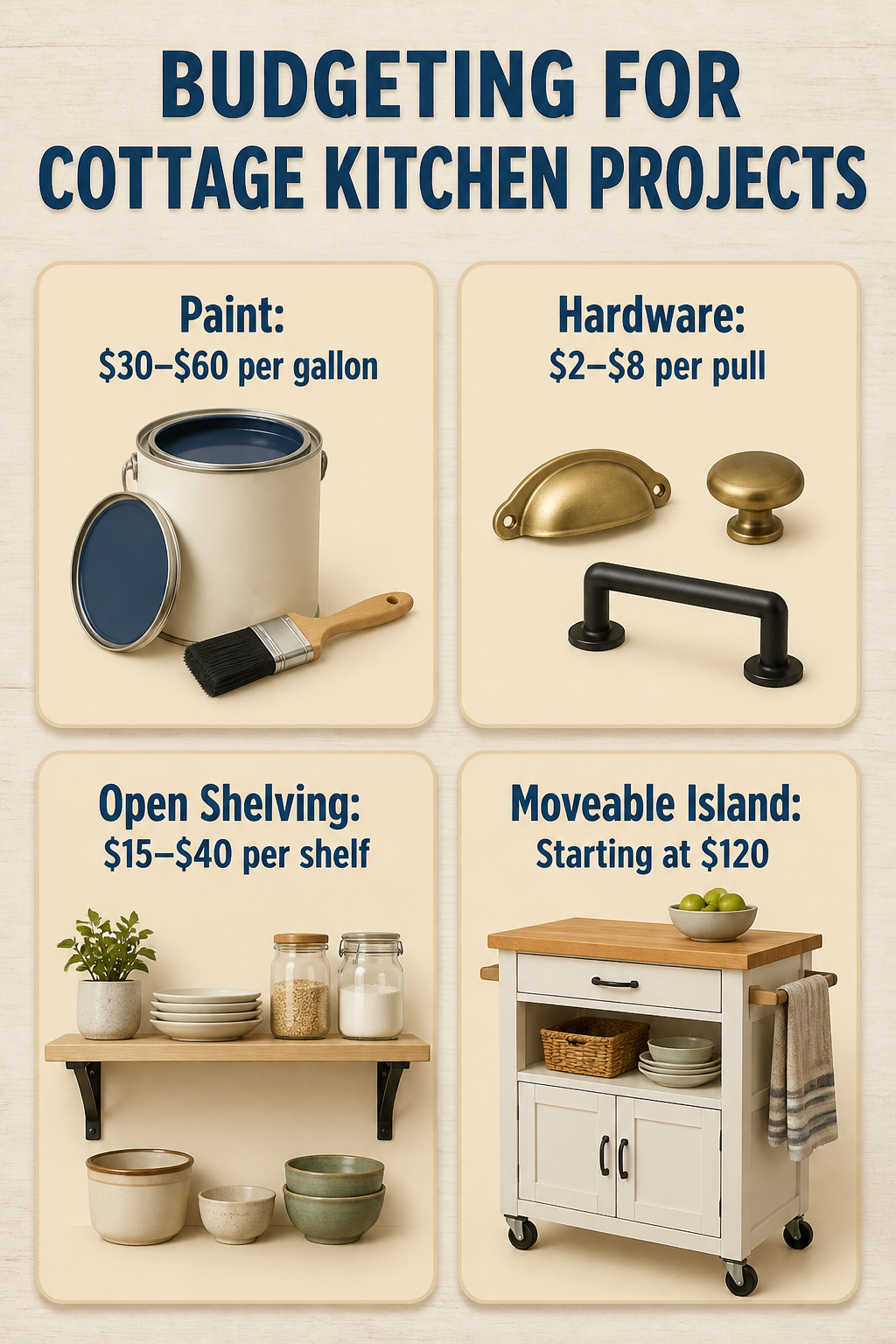
Most write-ups on small cottage kitchen ideas mention doing a project "on a budget" without telling you what that number actually gets you. A few hundred to a thousand dollars covers paint, hardware swaps, one open shelving run, and a rolling island if you choose carefully and do the labor yourself. Paint runs roughly $30–$60 per gallon for cabinet-grade enamel; a small kitchen needs two gallons if you are doing walls and cabinets in related colors. Hardware adds another $2–$8 per pull, and the difference between the low end and the high end is feel, not just look. The cheaper zinc pulls chip at the screw hole after two years of daily use. Brass or solid steel at $5–$8 each is where I would put the money.
Open shelving is where you save. Pine boards cut to length and basic brackets from a hardware store run $15–$40 per shelf, and you install them in an afternoon. Skip the reclaimed barn wood unless you genuinely have a source; the markup for "rustic" is steep and the boards are often too warped to hold a plate level.
A moveable island is the single biggest item. A basic rolling cart starts around $120; a butcher-block top version with storage runs closer to $400–$600. The cart works if you only need prep space and a place to park a mixer. The butcher block is worth it if you cook daily and need a surface you can actually cut on. Spend the extra here, or you will replace the cart in three years when the particleboard swells.
Functional Design for Tight Work Triangles
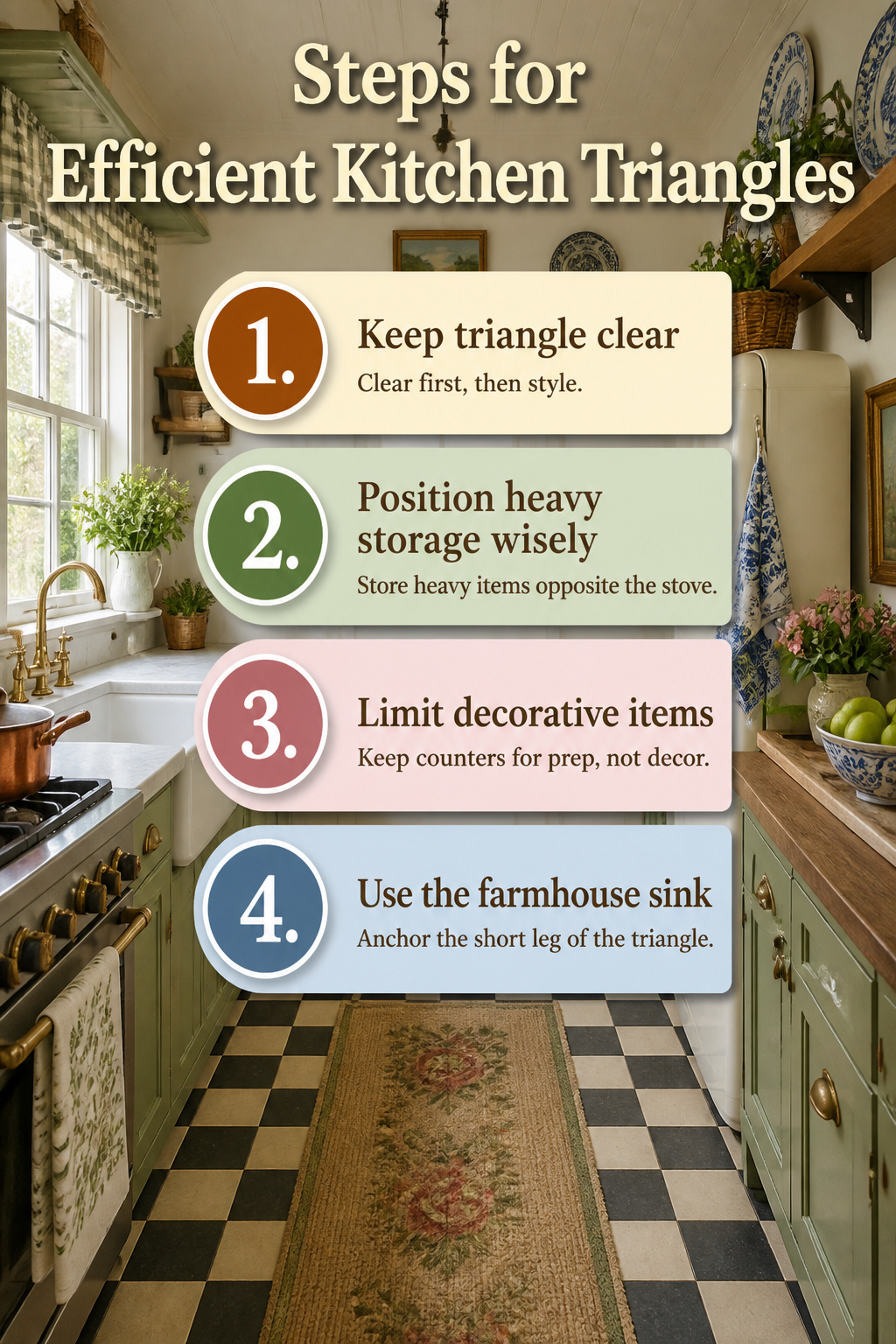
In a narrow cottage kitchen, the sink, stove, and refrigerator can sit close enough to touch in a single pass, which is the one advantage a cramped plan offers. The risk is that cottage styling crowds the triangle until it breaks. Open shelving above the stove looks collected until you need the eighth spice jar and knock the seventh into the soup. Decorative ceramics on the counter feel charming until they become the cutting board’s only competition for space.
Keep the triangle clear first, then add character at the edges. Run your heaviest storage on the wall opposite the stove, not above it, so the cooking zone stays open. If you want display shelving, put it beyond arm’s reach of the flame or shift it to the refrigerator wall, where a grabbed plate does not cross the burner path. The farmhouse sink can anchor the short leg of the triangle without penalty; the mistake is treating the counter between sink and stove as a stage for vignettes. That surface is prep territory. Store the pretty bowls where you will reach for them after cooking, not while you are in it.
Parallel cabinets along a galley wall make the triangle almost automatic in small cottages. The intimacy is the point. You gain efficiency without giving up the checkerboard floor or the copper you want on view; you just move the copper to the wall you face when you are not holding a hot pan.
Color Decisions That Expand Space
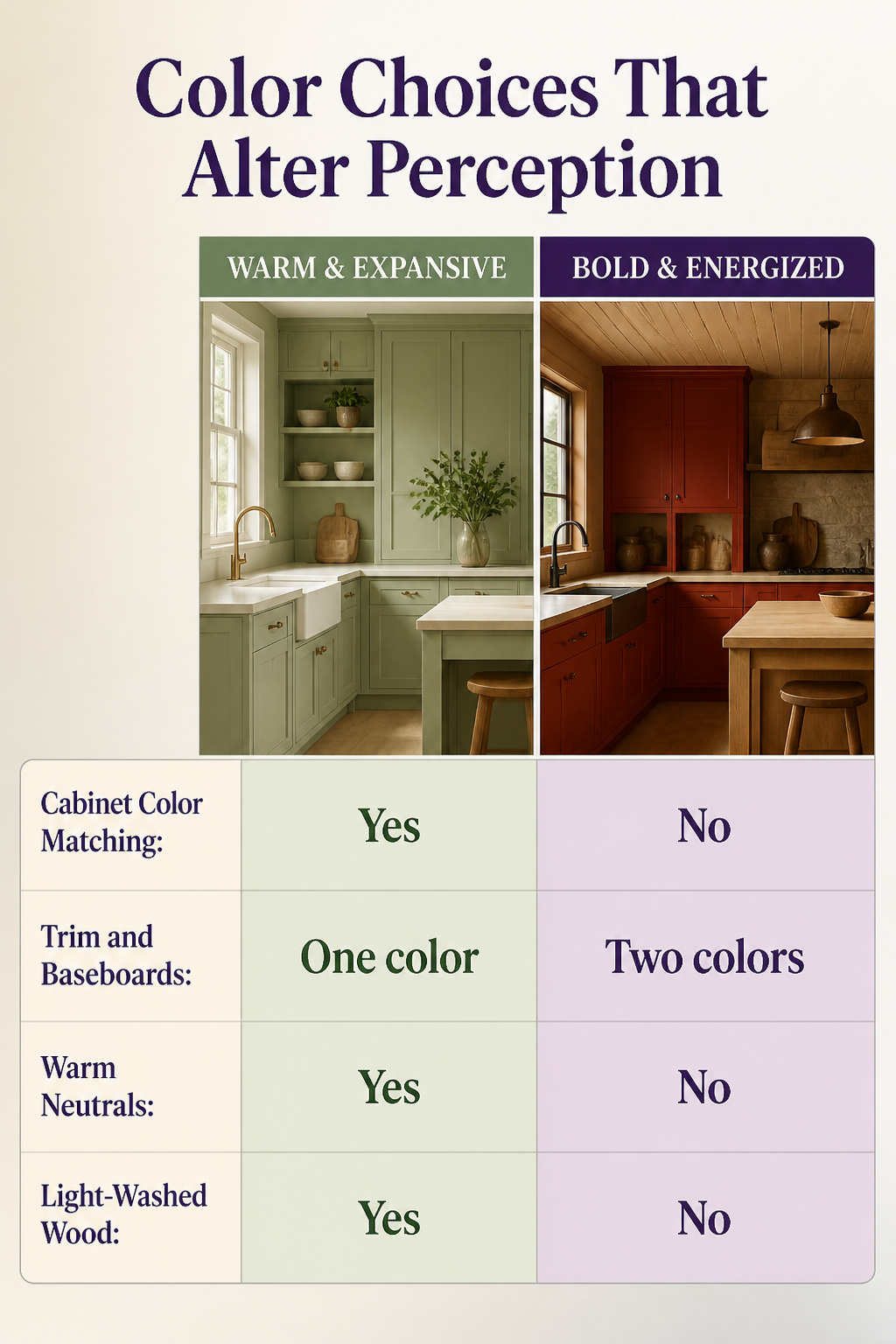
Painting cabinets to match the walls works because the eye stops reading boundaries. Where a white cabinet against a sage wall creates a hard edge that says "here the room ends," Chappell Green by Farrow & Ball running across both surfaces lets the wall keep going. You gain the storage without paying for the visual weight. The same logic holds for trim and baseboards: one color, one plane, more room.
Warm neutrals do something gray cannot in a small cottage kitchen. Linen, the creamy Devol shade, catches morning light and keeps reflecting it after noon. In a north-facing kitchen, where daylight stays cool and flat, that warmth becomes your light source. South-facing rooms already get gold; there, a warm neutral can tip into yellow by three o’clock, so you want something like Linen with enough restraint to handle the surplus.
The rule breaks when a room has no light to work with. A pokey north-facing kitchen with a single window will not expand under beige. Red cabinetry, paired with raw wood and stone, adds energy the sun won’t bring. It is not restful, but restful is not the only goal. The risk is garish; the payoff is a room that feels inhabited rather than merely efficient. Light-washed wood overhead, like a tongue-and-groove ceiling in pale oak, draws the eye up and adds texture without the darkness that would close a low space in.
Antiques That Earn Their Counter Space
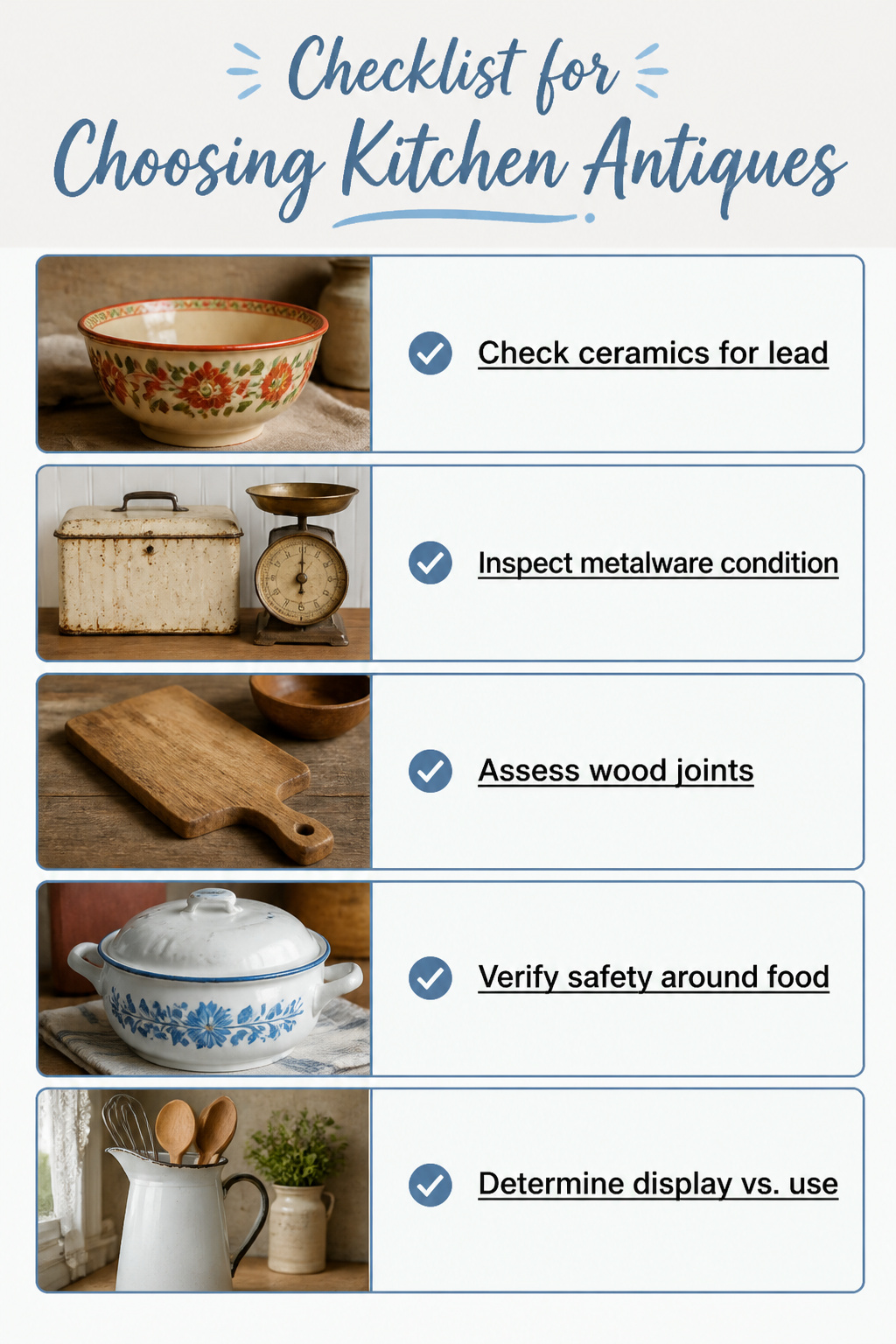
Every vintage piece that makes it onto your counter needs to pass two tests: will it survive daily use, and is it actually safe around food. Start with ceramics. Old pottery often carries lead in its glaze, especially pieces with bright reds, oranges, or yellows made before the 1970s. If you plan to serve from it, use a lead-testing kit from the hardware store; display-only pieces get a pass. Metalware is simpler to read. Surface rust on a bread bin or scale is cosmetic, but anything that holds food or water needs intact tin or stainless lining. Pitting inside an old pot means it stays on the shelf.
Wood demands a harder look. Wiggle every joint on a cutting board or bowl stand. A wobbly base will get worse with humidity shifts, and glued repairs near food contact can harbor bacteria in cracks that open later. The honest divide: a chipped enamel pitcher earns its spot holding utensils dry, but the same chip on a soup tureen makes it a windowsill piece. Give display items the stricter standard of beauty, and working pieces the standard of safety.
Frequently Asked Questions
What are some small cottage kitchen ideas?
Reclaimed barn wood for open shelving or range hood covers, glass-front cabinets that open the room visually, Shaker-style cabinets in muted colors like light sage, and vintage finds with real patina such as chipped enamel or copper pots. Moveable islands, wall hooks for tools, and pulley dryers hung from the ceiling also add cottage character without eating up floor space.
How can I make a small kitchen feel larger?
Paint cabinets to match the walls in a single color that dissolves the edges; Chappell Green, Castle Gray, or Stonington Gray all work well. Removing upper cabinets and replacing them with one open shelf earns back about a foot of visual depth. Glass-front cabinets and light warm neutrals like cream or putty bounce light softly rather than closing the walls in.
What are the best cabinet styles for a cottage kitchen?
Shaker-style cabinets are the standard choice: the flat center panel reads simpler than a raised panel, and the frame adds just enough detail without cluttering a tight room. Specify standard overlay rather than full overlay for a more cottage-appropriate look. Paint them or stain them; either finish works, and gold vintage-style pulls dress them up without fighting the plain door.